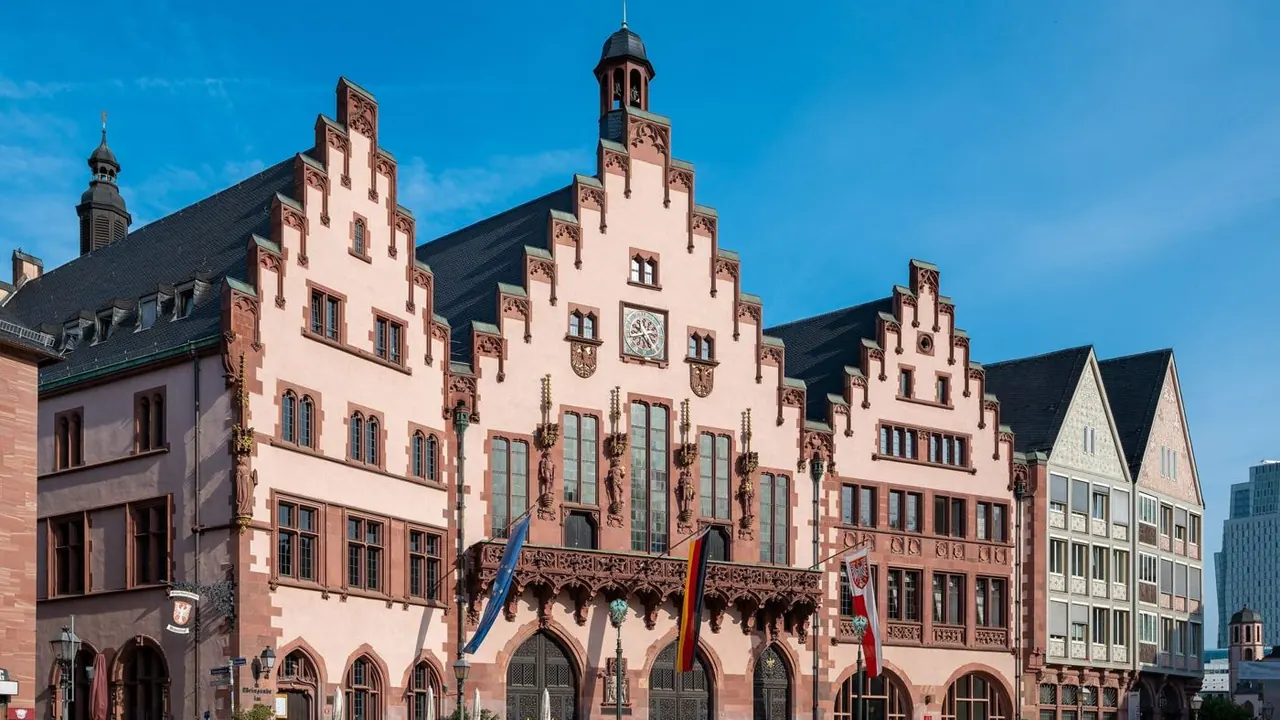
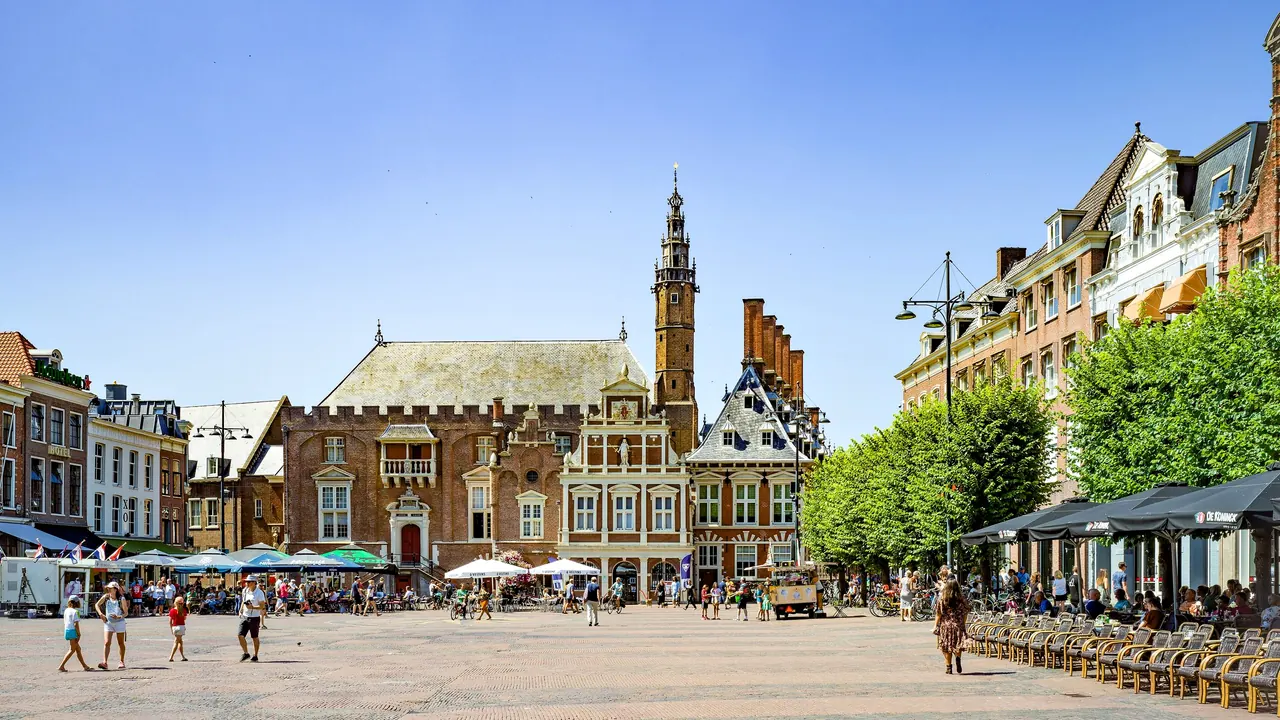
Photos: Frankfurt by Thomas Wolf, CC BY-SA 3.0 DE, cropped; Haarlem by Moroder, CC BY-SA 4.0, cropped.
Frankfurt or Haarlem?
Our verdict in twelve categories, each scored against the same fixed benchmark cities, and the climate month by month, so you can choose for your trip.
Choose Frankfurt for
- live music and the arts
- nightlife
- wellness
Frankfurt suits travellers who want a city with an evening programme. Its opera company, the Alte Oper and the drama and jazz stages give it far more performing arts than Haarlem. Its techno clubs and station-district bars outlast Haarlem's brown cafés, and the thermal baths in Wiesbaden and Bad Homburg give it a real spa side. Hotels can also be a little easier on the budget at weekends and away from the trade fairs.
Choose Haarlem for
- beaches
- nature and the outdoors
- shopping
Haarlem is the choice for a slower, more intimate stay. Its old centre survived the war intact, the dunes start at the edge of town and the North Sea sand is a short train ride away. Pick it if you want canals, almshouse courtyards and bike rides to the coast, with Amsterdam close by for a big night or a major museum.
Scoreboard
Twelve categories on one fixed scale from 0 to 100. The shaded stretch is the gap between the two.
Your match
Pick a travel style or drag the sliders, and both match scores follow your weighting.
Wins on live music and the arts and nightlife with your weighting.
Wins on beaches and nature and the outdoors with your weighting.
What matters to you?
Category by category
What the scores mean for a trip.
Beaches & swimming
Frankfurt has no coast at all. A summer swim means an outdoor pool or a gravel-pit lake such as the Langener Waldsee in the southern forest.
Haarlem is far better placed. Zandvoort's long beach and the dune-backed sand at Bloemendaal aan Zee are within a short train or bike ride. The North Sea stays cool and windy, though, so expect beach walks and quick dips rather than long swims.
Food & drink
Frankfurt has the deeper table. Its apple-wine taverns serve Grüne Soße and Handkäs at shared benches, and the Kleinmarkthalle is a proper market hall. Turkish, Italian and Asian kitchens add the range of an international city.
Haarlem eats well but simply, with terrace cafés, herring and kibbeling from the Saturday market, and strong craft beer. Its upper end of dining is thin.
Culture & sights
The two are evenly matched, but in different ways. Frankfurt is a museum city. The Städel and the long row of institutions on the Museumsufer are the draw, set around a rebuilt Römer and a skyline of towers.
Haarlem's strength is its intact historic fabric: canals, hidden hofjes, St Bavo and its famous organ. It also has two distinctive museums in the Frans Hals and the eighteenth-century Teylers.
Nightlife
Frankfurt clearly goes later and harder. It carries on the techno and house tradition it shares with Offenbach, the Bahnhofsviertel has rough-edged cocktail bars, and the riverbanks fill on summer nights. Its weekends are much busier than its weeknights.
Haarlem's evenings revolve around brown cafés and terraces on the Grote Markt and Botermarkt, sociable but finished well before dawn. For clubs, people take the train to Amsterdam.
Nature & outdoors
Frankfurt's outdoors is wooded hills. The Taunus begins past the northern suburbs, with beech forest, Roman frontier trails and the Großer Feldberg at about 880m, all under an hour away by S-Bahn and bus. The Stadtwald and the cycle paths along the Main are inside the city, and the Rheingau vineyards lie further out.\n\nHaarlem has dunes and sea instead. The pine woods, small lakes and grazing ponies of Zuid-Kennemerland begin at the western edge of town, the coast is good for long beach walks, and spring brings cycling through the bulb fields. There is nothing to climb, and the wind is often strong.
Day trips
Both are superb bases, with different scenery to reach. Frankfurt's high-speed rail brings Heidelberg, the castle-lined Rhine Gorge, Cologne and Würzburg within about an hour or so.
Haarlem's dense Dutch network puts Amsterdam, Leiden, The Hague and Delft close at hand, plus cheese markets, windmills and the Keukenhof in spring. The Dutch towns are closer to one another, while Frankfurt's trips reach further and take in more variety.
Good for families
Frankfurt has more that is built for children. The Senckenberg's dinosaur hall, a central zoo, the Palmengarten glasshouses and parks out in the Taunus fill several days.
Haarlem is easy and relaxed with children, with a car-free centre, bikes everywhere and the dunes to run in. But it has no zoo or theme park, so families often head to Amsterdam for those.
Getting around
Frankfurt runs on rails. U-Bahn, S-Bahn, trams and buses share one network that stretches to the Taunus, Wiesbaden and Mainz, and the airport is about a quarter of an hour from the centre by train. The zones take a day to learn, though the core from the Römer to the Museumsufer is easy to walk.\n\nIn Haarlem the bike does most of the work. The flat centre takes about twenty minutes to cross on foot, the station sits at its northern edge, and separate bike paths lead out into the dunes. For longer trips, one contactless card covers the trains.
Shopping & style
Frankfurt has the big names. The Zeil is lined with department stores and malls, and Goethestraße, just west of it, holds the luxury fashion and jewellery houses. For independent shops you head out to Berger Straße or Schweizer Straße.\n\nIn Haarlem it is the other way round, and the independents fill the centre. Gierstraat, Kleine Houtstraat and Schagchelstraat are full of boutiques, design shops and bookshops, and on market days the Grote Markt fills with flowers and cheese. It suits an afternoon of browsing better than a big shopping trip.
Affordability
Neither is cheap, but Frankfurt gives a little more room to manage costs. Its hotels are priced for business travellers and soar during trade fairs, yet they ease noticeably at weekends and in summer. Taverns and Turkish grills keep meals modest.
Haarlem has too few rooms for the visitors who want to stay there, especially in tulip season. Rooms run small for the price, and regular train trips add up.
Live music & performing arts
This is one of Frankfurt's clearest advantages. Its opera company is among Germany's most respected, the Alte Oper hosts symphony concerts, and drama, contemporary dance and cellar jazz round out a full season from autumn to early summer.
Haarlem offers a solid small-city programme at the Philharmonie and Stadsschouwburg. Its real speciality is organ music at St Bavo. For opera, visitors go to Amsterdam.
Wellness & relaxation
Frankfurt itself is busy, but the spa towns around it are not. Wiesbaden's hot-spring Kaiser-Friedrich-Therme, Bad Homburg's thermal complex and Bad Nauheim all carry on the old German tradition of taking the waters.
Haarlem has no springs or historic baths. It relaxes you through its quiet canals, terrace lingering and dune walks, with Dutch sauna complexes further out in the region.
When should you go?
Pick your month. The climate figures are measured averages, not a forecast.
Frankfurt in July
Haarlem in July
Daytime high, °C
Rainfall in the month, mm
Where the figures come from
Haarlem has no rain gauge within 25 km of the centre, so its rainfall comes from a gridded climate dataset read at the city rather than from a gauge further away.
Haarlem's sunshine is measured 49 km from the centre, at De Bilt.
Temperature and rainfall are climate normals, averaged over the years shown. Frankfurt: 1991-2020 normals, Frankfurt Westend (2 km from centre). Haarlem: 1991-2020 normals, Amsterdam Airport Schiphol (12.7 km from centre).
Frankfurt has the warmer summers. July and August reach about 26°C with long sunny days, which is fine for river terraces and the forest lakes. In May, June and September the streets are at their most comfortable for walking. Winter is cold and grey in both cities, and Frankfurt's December is especially dark.
Haarlem stays cooler, peaking around 22°C, and the North Sea only warms to about 19°C in August, so a swim is brisk at best. Its spring is dry, and April and May are good for the bulb fields and cycling. From late summer the rain builds steadily to about 109mm in October, so autumn suits Frankfurt better than the Dutch coast.
Which traveller are you?
For a beach and sun trip, Haarlem is the only real option of the two. Zandvoort's sand is a few minutes away by train and the dunes at Bloemendaal frame a quieter strand. Frankfurt has only forest lakes and outdoor pools.
On a food and nightlife trip, Frankfurt gives you more. You get apple-wine taverns in Sachsenhausen, cheap global eating in the Bahnhofsviertel and a serious weekend club scene. Haarlem's evenings are relaxed bar terraces that close early.
On a relaxing and wellness trip, Frankfurt wins on its spa towns. Wiesbaden's Art Nouveau thermal bath and Bad Homburg's spa park are easy outings. Haarlem offers a calm pace and sauna complexes in the region, but no hot springs.
Before you go
| Measure | Frankfurt | Haarlem |
|---|---|---|
| Official language | German | Dutch |
| Currency | Euro (EUR) | Euro (EUR) |
| Sockets | CF230 V, 50 Hz | CF230 V, 50 Hz |
| Driving side | Right | Right |
| Time zone | UTC+1, UTC+2 in summer | UTC+1, UTC+2 in summer |
| Emergency number | 112 | 112 |
| Elevation | 101 m | 2 m |
| Main airport | Frankfurt Main Airport (FRA)13 km from centre281 non-stop destinations | Amsterdam Airport Schiphol (AMS)12 km from centre287 non-stop destinations |
| Public holidays this year | 10 days | 11 days |
By the numbers
| Measure | Frankfurt | Haarlem |
|---|---|---|
| City population | 760,656 | 162,543 |
| People per km² | 3,063 | 5,064 |
| Museums within 10 km | 53 | 28 |
| UNESCO World Heritage sites within 50 km | 4 | 5 |
| Swim season, months above 21 °C | - | None |
Where else could you go?
Every comparison below shares a destination with this one, so you can follow Frankfurt or Haarlem somewhere new.
- Amsterdamvs Haarlem
- The Haguevs Haarlem
- Utrechtvs Haarlem
- Rotterdamvs Haarlem
- Heidelbergvs Frankfurt
- Antwerpvs Haarlem