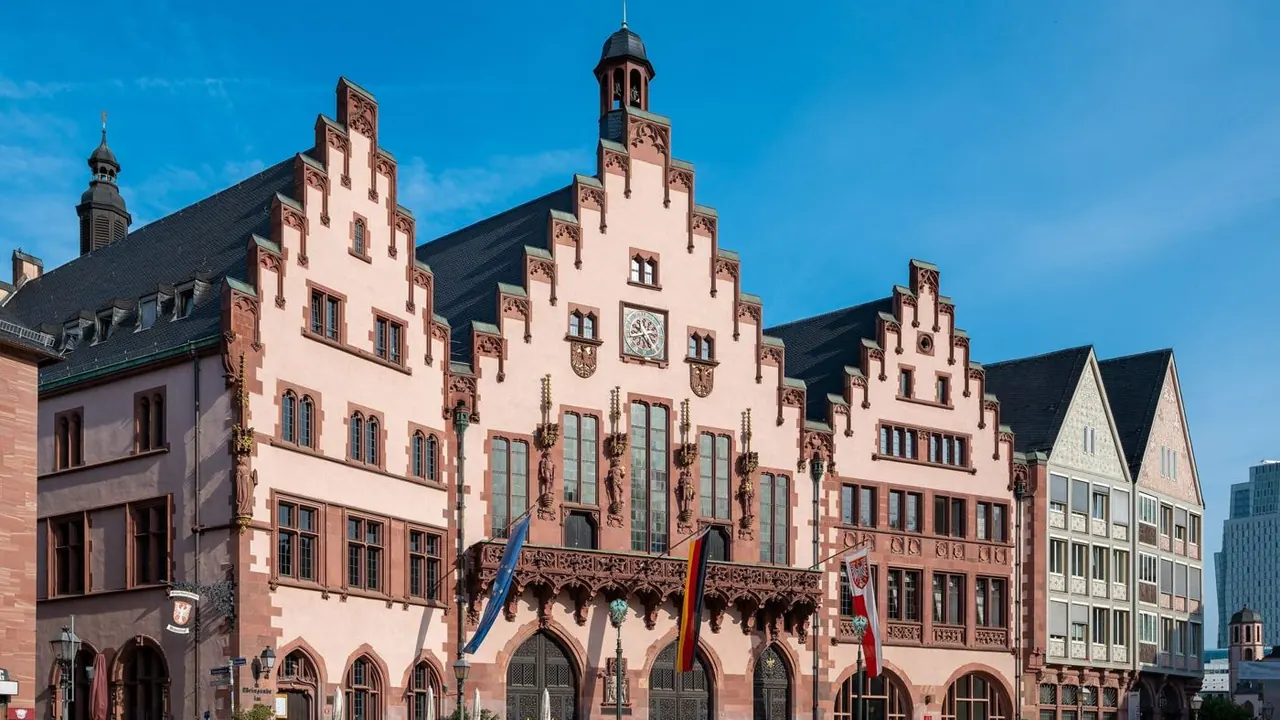
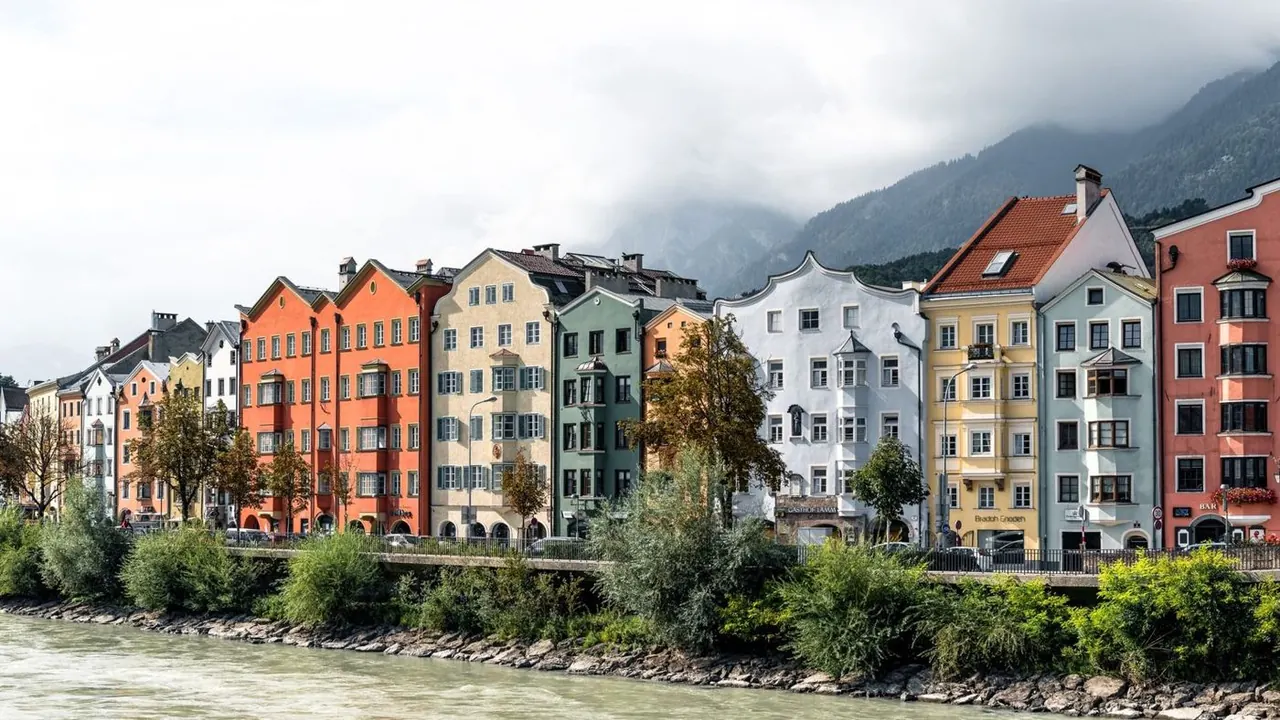
Photos: Frankfurt by Thomas Wolf, CC BY-SA 3.0 DE, cropped; Innsbruck by Wolfgang Weiser, Pexels License.
Frankfurt or Innsbruck?
Our verdict in twelve categories, each scored against the same fixed benchmark cities, and the climate month by month, so you can choose for your trip.
Choose Frankfurt for
- live music and the arts
- shopping
- nightlife
Frankfurt suits a traveller who wants a city with plenty going on indoors and a railway station that opens up half of Germany. The Museumsufer, a respected opera company, apple-wine taverns and a weekend club scene fill the days and evenings. Heidelberg, the Rhine Gorge and Cologne are all close enough for easy day trips.
Choose Innsbruck for
- nature and the outdoors
- beaches
If the mountains are the point of the trip, pick Innsbruck. A funicular from the edge of the old town takes you up to Alpine ridges in under half an hour, with skiing in winter and hut-to-hut hiking in summer. Between outings, the compact Habsburg quarter has the Golden Roof and the Hofkirche. Evenings are quieter and the food simpler, but few cities have this much landscape right on the doorstep.
Scoreboard
Twelve categories on one fixed scale from 0 to 100. The shaded stretch is the gap between the two.
Your match
Pick a travel style or drag the sliders, and both match scores follow your weighting.
Wins on live music and the arts and shopping with your weighting.
Wins on nature and the outdoors and beaches with your weighting.
What matters to you?
Category by category
What the scores mean for a trip.
Beaches & swimming
Neither city is a beach destination, but Innsbruck gives you the better afternoon swim. The Lanser See and the Natterer See on the plateaus above town warm to about 22°C in July and August, with peaks all around. The clear Achensee is lovely to look at, though too cool for most swimmers.
In Frankfurt you have outdoor pools and gravel-pit lakes such as the Langener Waldsee in the forest to the south. It has sandy shores and is fine on a hot day, but none of the Alpine scenery. The Main is for sitting beside, not swimming in.
Food & drink
Frankfurt is the better place to eat, mostly because it has more variety. You can eat the Hessian classics, Grüne Soße and Handkäs mit Musik, at the shared tables of Sachsenhausen's apple-wine taverns. Beyond those there is the Kleinmarkthalle for regional produce, cheap Turkish and Asian kitchens, and serious business-dinner restaurants.
Innsbruck's Tyrolean food, Gröstl, Kaspressknödel and Kaiserschmarrn, tastes best at a mountain hut after a walk, and the coffee houses serve good strudel. In town the choice is narrow, and there is no market hall like Frankfurt's.
Culture & sights
Both cities give you two or three good days of sightseeing, but of different kinds. Frankfurt is a museum city. The Städel leads more than a dozen institutions along the Museumsufer, and the rebuilt Römer and old-town lanes stand below a skyline of towers unlike any other in Germany.
Innsbruck's strength is its Habsburg old town: arcaded painted houses, the Golden Roof, the Hofburg and Maximilian's tomb in the Hofkirche, ringed by its bronze figures. Ambras Castle, with its cabinet of curiosities, is on the edge of town. Go to Frankfurt for paintings and to Innsbruck for palaces and townscape.
Nightlife
Frankfurt has more going on after dark. A small, serious techno and house scene carries on its electronic-music history, the Bahnhofsviertel has late cocktail bars, and in summer people drink outside on the banks of the Main. Even so, it only gets properly busy on Friday and Saturday.
In Innsbruck, students keep the bars in the brick arches under the railway viaduct busy at weekends, but there are few late venues. In winter a lot of the partying moves out to après-ski in the resorts.
Nature & outdoors
This is where Innsbruck is furthest ahead. From the old town, the funicular and cable cars reach a ridge at about 2,300m in under half an hour, with the Karwendel behind it. The Stubai Glacier has snow for most of the year. Skiing, hut-to-hut hiking, via ferratas, rafting and paragliding are all close by.
Frankfurt's countryside is pleasant but modest next to that. It has the Stadtwald, flat cycle paths along the Main, and the beech-wooded Taunus within an hour, rising to about 880m. It is good for gentle walking and cycling, not for days in the mountains.
Day trips
Both cities are on major rail lines, but Frankfurt sits at the centre of Germany's high-speed network, so more is within easy reach. Heidelberg, the castle-lined Rhine Gorge and Cologne's cathedral are each about an hour away. Mainz, Wiesbaden, Würzburg and the Rheingau vineyards are also close.
Innsbruck's day trips cross three countries, from medieval Hall in Tirol ten minutes away to Bolzano and Merano over the Brenner Pass. The bigger names, Munich, Salzburg and Neuschwanstein, are each closer to two hours away.
Good for families
Families do equally well in both, but in different ways. In Frankfurt most of the highlights are in town and many are indoors: the dinosaur hall at the Senckenberg, the central zoo, the Palmengarten glasshouses and boat trips past the skyline. That makes rainy days easy.
Innsbruck takes children outdoors. The Alpenzoo, with its ibex and lynx, is on the funicular line, and there are adventure trails and plateau lakes in summer and ski schools in winter. Bad weather takes more planning here.
Getting around
Both cities are easy to get around, with compact centres you can walk and no need for a car. Frankfurt's U-Bahn, S-Bahn and trams run as one network that reaches Wiesbaden, Mainz and the Taunus, and the airport is about a quarter of an hour from the centre by train. The zones take some getting used to.
Innsbruck is smaller and simpler. Its special feature is the funicular from the edge of the old town, which connects to the Nordkette cable cars. You only need a car for the remote valleys and lakes.
Shopping & style
Frankfurt's shopping is split across districts with quite different characters, which gives a trip more choice. The Zeil has the department stores and big malls, and the streets around Goethestraße have luxury fashion and jewellery. Berger Straße and Schweizer Straße have independent boutiques and delis.
In Innsbruck you buy regional goods rather than fashion. Maria-Theresien-Strasse and the old-town arcades fill an afternoon. The things worth taking home are loden jackets, dirndls, woodcarvings, Speck and mountain cheese, and the specialist outdoor and ski shops are excellent.
Affordability
Neither city is cheap, and in both it pays to choose your dates. Frankfurt's hotels are priced for business travellers and get very expensive during trade fairs, but weekends and summer are often cheaper. Its taverns and Turkish grills keep meals inexpensive.
Innsbruck costs most in the ski season and around the Christmas markets, and spring and autumn are clearly cheaper. Eating out is less of a bargain, and cable car tickets add up quickly unless a city card covers them.
Live music & performing arts
Frankfurt has more on stage. Its opera company is one of the most respected in Germany, and the Alte Oper is a grand concert hall. There is also serious drama at the Schauspiel, contemporary dance, and jazz cellars that go back to the post-war years. The season runs from autumn to early summer.
Innsbruck's Landestheater and symphony orchestra offer a respectable provincial programme. Its highlight is the summer Festival of Early Music, held in places like the Spanish Hall at Ambras Castle, at the time of year when Frankfurt's calendar goes quiet.
Wellness & relaxation
Frankfurt has the edge for a restful trip, though not because of the city itself, which keeps a business pace. Its advantage is the ring of historic spa towns around it, a bathing tradition Innsbruck simply does not have. Soaking in hot-spring water under the Art Nouveau tiles of Wiesbaden's Kaiser-Friedrich-Therme, or spending an afternoon in the spa park and saunas at Bad Homburg, is an easy outing on the regional network. Back in town, the Palmengarten is the place to slow down.
Innsbruck offers mountain air rather than mineral water. Relaxing there usually means a spa hotel in Igls or one of the plateau villages, with a sauna and a view of the peaks after a day on the trails. That suits active travellers winding down well, but anyone who wants a proper thermal bath has to head out to the valleys, while from Frankfurt there are several to choose from.
When should you go?
Pick your month. The climate figures are measured averages, not a forecast.
Frankfurt in July
Innsbruck in July
Daytime high, °C
Rainfall in the month, mm
Temperature and rainfall are climate normals, averaged over the years shown. Frankfurt: 1991-2020 normals, Frankfurt Westend (2 km from centre). Innsbruck: 1991-2020 normals, Innsbruck-Flughafen (3.3 km from centre).
The two cities have almost the same temperatures through the year. Both reach about 26°C in July and August and stay in single figures from November to February. High summer is the only time warm enough for lake swimming in either, and spring and early autumn are the most comfortable for walking the streets. The big difference is rain. Frankfurt's is spread fairly evenly across the year, while Innsbruck's summer is much wetter, with about 144mm in August.
In winter it is the other way round. Innsbruck gets about twice Frankfurt's sunshine from November to January, about 104 hours in January against 51, so cold days in the valley are often bright. Frankfurt's winter is grey and better spent in museums and concert halls.
Which traveller are you?
For an outdoors trip, Innsbruck is the clear choice. Cable cars from beside the old town reach the Nordkette, the Karwendel lies behind it, and the same slopes give skiing in winter and via ferratas and paragliding in summer. Frankfurt's Taunus is gentler walking country.
On a culture and arts trip, Frankfurt has more to fill both days and evenings. The Städel and a dozen other museums line the Main, and the opera company and the Alte Oper run a full season. Innsbruck's stages offer a smaller, provincial programme.
For a food and nightlife trip, Frankfurt has more to offer. There are apple-wine taverns in Sachsenhausen, the Kleinmarkthalle, cheap global eating in the Bahnhofsviertel and a serious techno tradition at weekends. Innsbruck's nights mostly happen along one strip of bars under the railway viaduct.
Before you go
| Measure | Frankfurt | Innsbruck |
|---|---|---|
| Official language | German | German, Austrian Sign Language |
| Currency | Euro (EUR) | Euro (EUR) |
| Sockets | CF230 V, 50 Hz | CF230 V, 50 Hz |
| Driving side | Right | Right |
| Time zone | UTC+1, UTC+2 in summer | UTC+1, UTC+2 in summer |
| Emergency number | 112 | 112 |
| Elevation | 101 m | 574 m |
| Main airport | Frankfurt Main Airport (FRA)13 km from centre281 non-stop destinations | Innsbruck Airport (INN)4 km from centre40 non-stop destinations |
| Public holidays this year | 10 days | 16 days |
By the numbers
| Measure | Frankfurt | Innsbruck |
|---|---|---|
| City population | 760,656 | 132,499 |
| People per km² | 3,063 | 1,263 |
| Museums within 10 km | 53 | 28 |
| UNESCO World Heritage sites within 50 km | 4 | 1 |
Where else could you go?
Every comparison below shares a destination with this one, so you can follow Frankfurt or Innsbruck somewhere new.