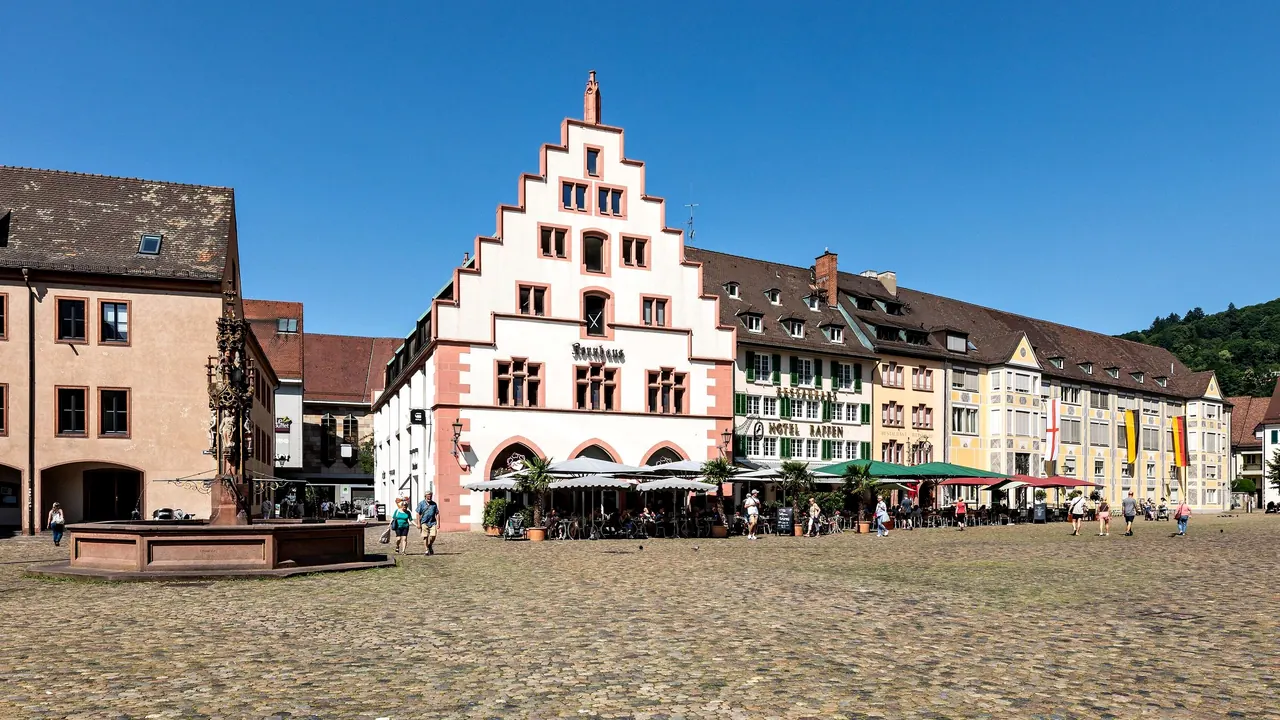
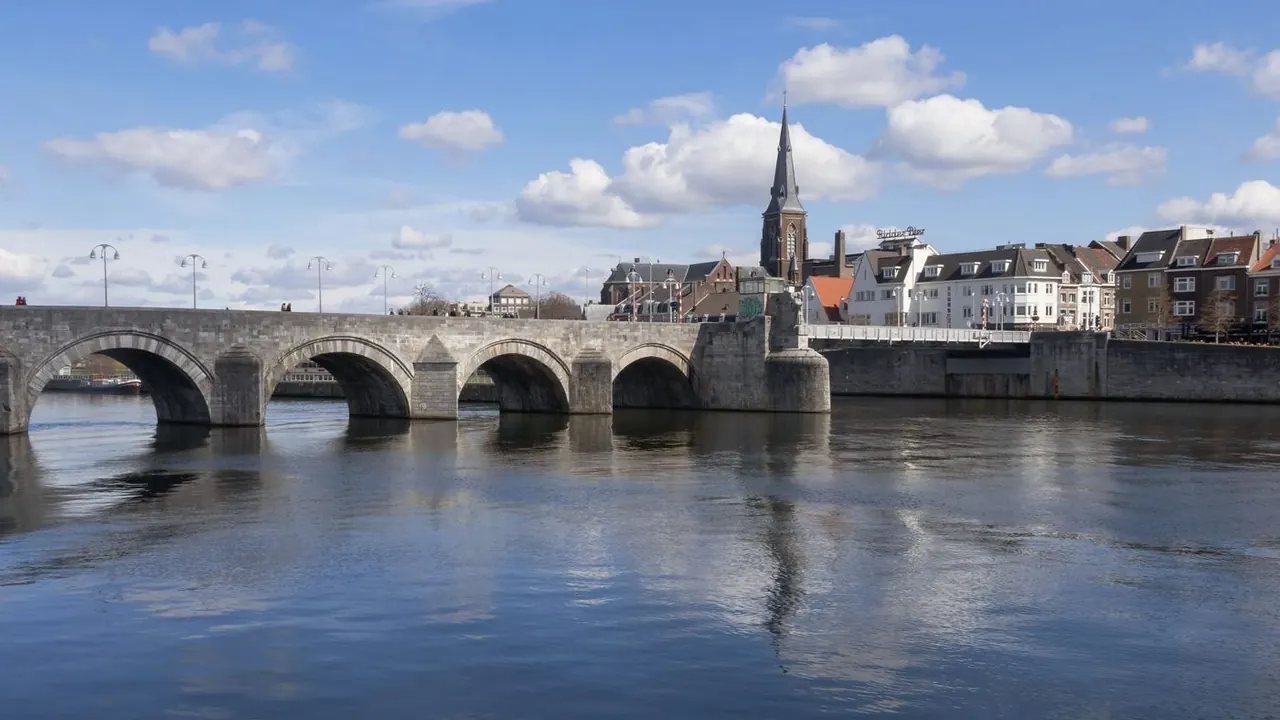
Photos: Freiburg by Dietmar Rabich, CC BY-SA 4.0, cropped; Maastricht by Michielverbeek, CC BY-SA 4.0, cropped.
Freiburg or Maastricht?
Our verdict in twelve categories, each scored against the same fixed benchmark cities, and the climate month by month, so you can choose for your trip.
Choose Freiburg for
- nature and the outdoors
- families
- wellness
Freiburg suits travellers who want the outdoors close at hand. The Black Forest begins at the edge of town, a cable car takes you up into the mountains, and families get Europa-Park, the Bächle channels and summer swimming lakes. Spa towns to the south add a restful side, and trams, trains and bike lanes make the whole region easy without a car.
Choose Maastricht for
- shopping
- culture and sights
- nightlife
Pick Maastricht for a weekend of browsing and eating in a genuinely old Dutch city. The Stokstraat boutiques, the terraces on the Vrijthof and the Romanesque basilicas reward slow strolling more than a busy itinerary, and Aachen and Liège are each about half an hour away. It suits couples and adults better than children, and its countryside is for gentle hill walks rather than mountains.
Scoreboard
Twelve categories on one fixed scale from 0 to 100. The shaded stretch is the gap between the two.
Your match
Pick a travel style or drag the sliders, and both match scores follow your weighting.
Wins on nature and the outdoors and families with your weighting.
Wins on shopping and culture and sights with your weighting.
What matters to you?
Category by category
What the scores mean for a trip.
Beaches & swimming
Neither city is a beach destination, but Freiburg gives swimmers a little more. The gravel-pit lakes on the Rhine plain get pleasantly warm in summer, the town's open-air pools fill up in July and August, and Titisee and Schluchsee in the Black Forest, about an hour away, make a scenic but cool swim.
In Maastricht the choice is the gravel-pit lakes along the Maas. Some have small sandy shores and lifeguards, which is fine for an afternoon but not much more. If a daily swim matters, book a hotel with a pool.
Food & drink
The two eat equally well, and both have the same weakness: very little international choice beyond the regional cooking. The difference is in what you eat and drink. Freiburg leans towards France and wine, with Flammkuchen, Schäufele, Black Forest trout and Kaiserstuhl Pinot. Its morning market around the Münster, with the long grilled sausage in a roll, is the high point of the day.
Maastricht leans towards Belgium and beer, with sweet-sour zuurvlees and fries, vlaai in every bakery and long hours on the terraces of the Vrijthof and the Markt. Its best restaurants are in the city itself, while Freiburg's finest tables are spread across the surrounding region.
Culture & sights
Both fill two rewarding days without a single headline sight, and the main difference is age. Maastricht is genuinely old. It has the Romanesque basilicas of Saint Servatius and Our Lady, the Helpoort gate, medieval walls along the Jeker and a bridge over the Maas that dates from the 13th century. The Bonnefanten museum and guided tours of the Sint-Pietersberg tunnels add to that.
Freiburg was largely rebuilt after wartime bombing, so it feels historic rather than truly old. It does have one great monument, the red sandstone Münster, whose tower you can climb, along with the Augustinermuseum's medieval sculpture and the Bächle channels running through the streets.
Nightlife
Both are student towns where evenings revolve around pubs rather than clubs, and both are livelier during term. In summer Freiburg's nights move outdoors, onto the squares, into beer gardens and along the Dreisam, with wine bars as well as student pubs around the Martinstor.
Maastricht's evenings centre on brown cafés and Belgian beer around the Markt and the Vrijthof. It also has something Freiburg cannot match: carnival, when the whole city dresses up and parties in the streets for several days before Lent.
Nature & outdoors
Freiburg is far ahead here. The Black Forest starts at the edge of town, and the Schauinsland cable car climbs to about 1,280m, with views to the Alps on clear days. The Feldberg, about an hour away, offers real hiking in summer and skiing in winter, and the Kaiserstuhl vineyards and the Rhine plain are good for gentle cycling.
Maastricht's countryside is pastoral rather than mountainous. It has the marl cliffs of the Sint-Pietersberg, the green Jeker valley, and the orchards and sunken lanes of the Heuvelland, whose short steep climbs road cyclists enjoy. For anything wilder you need a longer day out to the Ardennes.
Day trips
Both cities sit near a three-country border, and both have excellent day trips. From Freiburg the main draw is Alsace and Switzerland: Basel by train, Colmar and wine villages such as Riquewihr by car, and Strasbourg a little further. Staufen and Breisach are close by.
From Maastricht, Germany and Belgium are short train rides away. Aachen and Liège are each about half an hour, Tongeren and Valkenburg are nearer, and Cologne, Brussels and Leuven work for a longer day. Maastricht's trips are mostly to cities, while Freiburg's mix towns with wine country, where a car helps.
Good for families
Freiburg is the better choice with children. Europa-Park, Germany's largest theme park, is about 40 minutes away. In town there are the Bächle to dangle feet in, the free Mundenhof animal park and the cable car ride, with lakes and easy Black Forest walks in summer.
Maastricht is safe and flat for a buggy, and the Sint-Pietersberg tunnel tour is a good outing. Most of what children enjoy is out of town, though, in Valkenburg's caves and fairy-tale park or at the zoo in Kerkrade. The city's main pleasures, eating and strolling, suit adults better.
Getting around
Both centres are compact and easy to walk. In Maastricht almost everything is within fifteen minutes on either bank, and in Freiburg within twenty. Freiburg pulls ahead beyond the old town: trams serve the suburbs and the cable car, regional trains climb the Höllental into the Black Forest, and many hotels give guests a card for local buses and trains.
In Maastricht, bikes do most of the work and the riverside paths are easy even for occasional cyclists. The station has trains to Liège and Aachen, but the hill villages are much easier to explore with a car or bike.
Shopping & style
Maastricht is a real shopping destination. Weekend visitors come from three countries for the designer boutiques of the Stokstraat and the high-street brands of the Grote Staat, and Wyck has independent shops for interiors, vintage and food.
Freiburg's shopping is pleasant but modest. Kaiser-Joseph-Strasse has the chains, the Gerberau quarter has bookshops and organic stores, and cuckoo clocks are sold all over town. For serious shopping, locals go to Basel.
Affordability
Neither city is cheap, and in both the hotel costs more than the day itself. Hotel rooms in Freiburg are scarce on summer weekends and during trade fairs, so staying in a Black Forest village can help. Meals in the student quarter and free entry to the Münster keep daily costs down.
In Maastricht, weekend rooms are in demand, so staying from Sunday to Thursday makes the biggest difference, and since you can walk everywhere, transport costs almost nothing. Overall Freiburg is slightly kinder on the wallet, but a day across the border in Switzerland is not.
Live music & performing arts
Both have a solid provincial programme that makes for a good evening rather than a reason to visit. Freiburg's strength is the quality of its music. The Freiburger Barockorchester, a leading period-instrument ensemble, plays at the Konzerthaus, and every summer the Zelt-Musik-Festival fills a tent village with concerts.
In Maastricht, the theatre on the Vrijthof hosts the regional orchestra and opera, and the churches hold organ and choral concerts. In summer the square becomes an open-air arena for large concerts, and at carnival brass bands march through every street.
Wellness & relaxation
Freiburg is the better base for a spa break. It has a thermal bath on its own eastern edge, the large complex at Bad Krozingen is twenty minutes away, Badenweiler pairs a modern bath with Roman ruins, and Baden-Baden is an hour away by train.
Maastricht has no baths of its own, so for a soak you go to the thermal spa above Valkenburg, to Aachen, or to Spa in Belgium, all within an hour. Both cities move at an unhurried pace. In Maastricht that means long lunches on its squares, and in Freiburg riverside paths and wine villages nearby.
When should you go?
Pick your month. The climate figures are measured averages, not a forecast.
Freiburg in July
Maastricht in July
Daytime high, °C
Rainfall in the month, mm
Temperature and rainfall are climate normals, averaged over the years shown. Freiburg: 1991-2020 normals, Freiburg (0.6 km from centre). Maastricht: 1991-2020 normals, Maastricht Airport Zuid Limburg (10 km from centre).
Winters are much the same in both cities: cold, grey and short-days, with January highs around 6°C, so the colder months are best spent in museums and cafés. Spring comes slightly earlier in Freiburg, and its summer is warmer and sunnier, reaching 27°C in July against 24°C in Maastricht. That is warm enough for the lakes on the Rhine plain. The catch is rain, because Freiburg's wettest stretch runs from May to August, with 103mm in May.
Maastricht's rain is spread more evenly through the year, and April is its driest month. Its milder summers keep July and August comfortable for walking the streets. In both cities late spring and September are the best times to go, warm enough for terraces and hill walks without the full summer heat.
Which traveller are you?
On an outdoors trip, Freiburg is the clear choice. Trails start on the Schlossberg behind the old town, the cable car lifts you to the Schauinsland ridge, and the Feldberg adds summer hiking and winter snow. Maastricht's Heuvelland is lovely but much gentler.
On a family trip with children, Freiburg makes the week easier. Kids can race boats along the Bächle, visit the free Mundenhof animal park and spend a day at Europa-Park, about 40 minutes away. In Maastricht most of the children's attractions are out of town, around Valkenburg.
For a shopping trip, Maastricht wins comfortably. The restored houses of the Stokstraat are full of fashion and designer boutiques, Wyck adds independent shops for interiors and vintage, and the weekly market fills the Markt. Freiburg has chains, a few boutiques and cuckoo clocks.
Before you go
| Measure | Freiburg | Maastricht |
|---|---|---|
| Official language | German | Dutch |
| Currency | Euro (EUR) | Euro (EUR) |
| Sockets | CF230 V, 50 Hz | CF230 V, 50 Hz |
| Driving side | Right | Right |
| Time zone | UTC+1, UTC+2 in summer | UTC+1, UTC+2 in summer |
| Emergency number | 112 | 112 |
| Elevation | 278 m | 49 m |
| Main airport | EuroAirport Basel–Mulhouse–Freiburg (BSL)50 km from centre112 non-stop destinations | Maastricht Aachen Airport (MST)9 km from centre5 non-stop destinations |
| Public holidays this year | 12 days | 11 days |
By the numbers
| Measure | Freiburg | Maastricht |
|---|---|---|
| City population | 238,299 | 120,227 |
| People per km² | 1,558 | 2,000 |
| Museums within 10 km | 13 | 21 |
| UNESCO World Heritage sites within 50 km | 2 | 6 |
Where else could you go?
Every comparison below shares a destination with this one, so you can follow Freiburg or Maastricht somewhere new.
- Colmarvs Freiburg
- Baselvs Freiburg
- Strasbourgvs Freiburg
- Zurichvs Freiburg
- Dusseldorfvs Maastricht
- Colognevs Maastricht