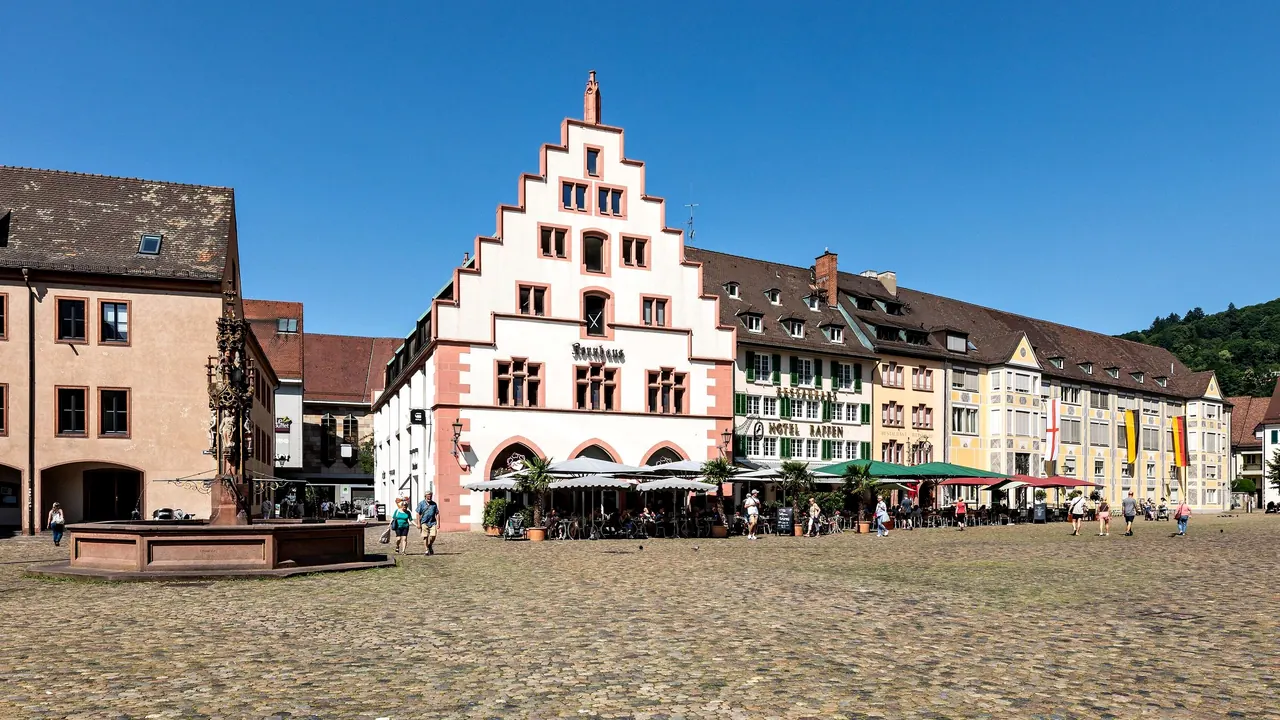
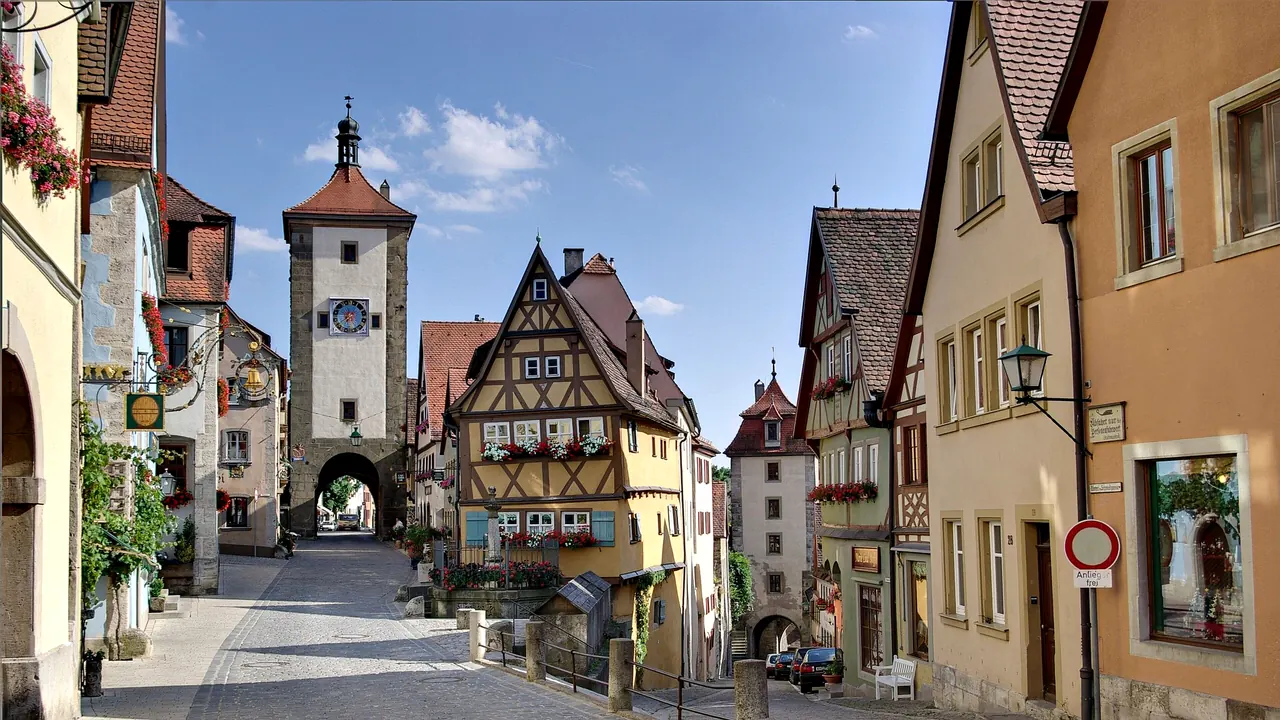
Photos: Freiburg by Dietmar Rabich, CC BY-SA 4.0, cropped; Rothenburg ob der Tauber by Berthold Werner, Public domain.
Freiburg or Rothenburg ob der Tauber?
Our verdict in twelve categories, each scored against the same fixed benchmark cities, and the climate month by month, so you can choose for your trip.
Choose Freiburg for
- nature and the outdoors
- families
- nightlife
Freiburg suits a longer stay with plenty of variety. The Black Forest starts at the edge of town, Basel is a short train ride away, the wine villages of Alsace lie just across the Rhine, and the evenings have the life a large student population brings. Families, walkers, cyclists and anyone who wants good regional food and wine as well as a cathedral will find more to do here. Trams, bikes and regional trains cover the city, the mountains and Basel, though the Alsace villages are easier to reach by car.
Choose Rothenburg ob der Tauber for
- culture and sights
- prices
For the medieval town itself, choose Rothenburg ob der Tauber. Almost nothing modern has been built inside its walls, so it feels more truly old than Freiburg's carefully rebuilt centre. It is best for a night or two on a Romantic Road drive, or for a winter visit around the Christmas market. Come for the wall walk at dusk and the quiet lanes once the coaches have left, and expect little going on after dinner.
Scoreboard
Twelve categories on one fixed scale from 0 to 100. The shaded stretch is the gap between the two.
Your match
Pick a travel style or drag the sliders, and both match scores follow your weighting.
Wins on nature and the outdoors and families with your weighting.
Wins on culture and sights and prices with your weighting.
What matters to you?
Category by category
What the scores mean for a trip.
Beaches & swimming
Neither town is a swimming destination, but Freiburg is better placed for a summer dip. Its flooded gravel pits on the Rhine plain warm up nicely, and the Black Forest lakes of Titisee and Schluchsee are about an hour away. In Rothenburg it is the town pool, or a drive of about an hour to the grassy shores of the Franconian lake district.
Food & drink
Freiburg eats better. Baden cooking has a lighter, French-leaning touch: Flammkuchen, mountain trout and spring asparagus, with Pinot from the Kaiserstuhl vineyards just outside town. The Münster market every morning but Sunday gives the day a centre, and the region around has some of Germany's best fine dining.
Rothenburg's food is heavier Franconian fare in timbered inns, like roast pork with dumplings and Silvaner served in the squat Bocksbeutel bottle. Many of the places around the Marktplatz cook for coach parties, so the better meals are in family-run guesthouses on the side lanes. Both serve Schäufele, but Freiburg's range is wider.
Culture & sights
Rothenburg has the stronger sense of place. It is a walled town that is still almost entirely medieval. You can walk the covered wall walk above the rooftops, see the Plönlein between its two gate towers, and visit St Jakob's for Riemenschneider's Holy Blood Altar. Even the town's main museum fits the setting, with its collection on medieval crime and punishment.
Freiburg has one great building in its red sandstone Münster, plus the Augustinermuseum's medieval sculpture and the water-filled Bächle running along its streets. Much of the centre, however, was rebuilt after wartime bombing and feels historic rather than truly old. In both places a day or two covers the main sights.
Nightlife
Freiburg's students make the difference. The lanes around the Martinstor fill with pubs, wine bars and beer gardens, people stay out late along the Dreisam in summer, and a few clubs play techno and indie, though it is quieter between semesters.
Rothenburg goes quiet once the day visitors leave. The evening out is the night watchman's tour and a glass of wine in an inn, and the lanes are mostly silent by eleven.
Nature & outdoors
Freiburg is much the better base for the outdoors. The Black Forest rises straight behind the old town, a cable car climbs to the Schauinsland at about 1,280m, and the Feldberg gives hiking in summer and skiing in winter. To the west, the Kaiserstuhl's volcanic terraces and the flat Rhine plain are good cycling country.
Rothenburg's countryside is gentle. Paths drop from the walls into the Tauber valley past mills and meadows, and the Tauber valley cycle path is an easy family ride. There are no mountains or wild country nearby, so it suits a gentle walk more than a demanding hike.
Day trips
Both are good bases, but Freiburg has more range, with three countries within easy reach. Basel's museums are about 45 minutes away by train, and Colmar, Riquewihr and Strasbourg are a short drive into Alsace. Baden-Baden is a fast train ride north.
Rothenburg's excursions follow one theme: more old towns along the Romantic Road. Dinkelsbühl and Nördlingen, with its walls set in a meteorite crater, are close by, and Würzburg's Residenz is about an hour away. The towns are lovely, but they are similar to one another and much easier to reach by car.
Good for families
Freiburg gives children a full week. They can float boats in the Bächle, see the animals at Mundenhof, ride the Schauinsland cable car, swim in the lakes in summer and spend a big day at Europa-Park about 40 minutes north. The flat, green centre is easy with a pushchair.
Rothenburg is a storybook stop rather than a family base. Children enjoy the ramparts, the Rathaus tower and following the night watchman's lantern, and older ones like the crime museum. Beyond that there is little for them, and the cobbles and steep valley paths are hard going.
Getting around
Both centres are easy to walk and largely car-free, Rothenburg's within its walls and Freiburg's in its compact old town. The difference shows once you leave. Freiburg has dense trams, cycle lanes everywhere and regional trains up the Höllental and along the Rhine, and many hotels give guests a card for local buses and trains.
Rothenburg sits at the end of a branch line, and most train journeys need a change at Steinach. Village buses are sparse, especially at weekends, so a car is close to essential for the surrounding area.
Shopping & style
Neither is a shopping destination, but Freiburg has the more everyday choice. Along with the chains on Kaiser-Joseph-Strasse, there are independent boutiques and bookshops in the Gerberau and Konviktstrasse quarters, and the Münster market sells local wine and ham. For serious retail, people take the train to Basel.
Rothenburg sells almost only souvenirs. Its year-round Christmas shops are full of baubles and nutcrackers, and its Christmas market is among the most atmospheric in Germany. Fashion and design are practically absent.
Affordability
Costs are much the same overall, and in both towns the room is the main expense. In Freiburg the problem is scarcity: hotels fill up on summer weekends and during trade fairs. Once you have a room, though, market snacks, student-quarter restaurants and the free Münster keep daily spending low.
Rothenburg adds a tourist premium to the guesthouses inside the walls and the restaurants on the Marktplatz, peaking in December. In both places, staying in a nearby village is the easy way to save.
Live music & performing arts
Freiburg has a proper season. The Theater Freiburg stages opera, drama and dance in repertory, and the Konzerthaus is home to the Freiburger Barockorchester, one of Europe's leading period-instrument ensembles. In summer the Zelt-Musik-Festival fills its tent village with concerts.
In Rothenburg, performance mostly means history. The costumed Meistertrunk play retells the town's rescue in the Thirty Years' War, and St Jakob's holds organ and choral concerts. On most evenings there is no show to go to.
Wellness & relaxation
Freiburg is in spa country. A thermal bath lies on the city's eastern edge, Bad Krozingen's warm outdoor pools are about twenty minutes away, Badenweiler has a modern spa beside its Roman ruins, and Baden-Baden is an easy train ride.
Rothenburg's calm is of a different kind: empty lanes at dawn and a quiet walk on the walls once the coaches have gone. For a proper soak you need to drive about an hour to the salt-water pool in Bad Windsheim or to Bad Mergentheim.
When should you go?
Pick your month. The climate figures are measured averages, not a forecast.
Freiburg in July
Rothenburg ob der Tauber in July
Daytime high, °C
Rainfall in the month, mm
Where the figures come from
Rothenburg ob der Tauber's sunshine is measured 27 km from the centre, at Feuchtwangen-heilbronn.
Temperature and rainfall are climate normals, averaged over the years shown. Freiburg: 1991-2020 normals, Freiburg (0.6 km from centre). Rothenburg ob der Tauber: 1991-2020 normals, Rothenburg ob der Tauber (0.9 km from centre).
Freiburg is the warmer of the two through the year, with summer highs around 27°C, and May to September is the time for its lakes and outdoor pools. That warmth comes with more rain. From May through the summer it gets close to 100mm a month, often in heavy showers, so spring and early autumn are the most comfortable months for hiking and long days in the old town. Its winters are mild in the city, while the higher Black Forest slopes get snow.
Rothenburg is a few degrees cooler in every month, and January highs of about 3°C make winter walks on the walls bitterly cold. Snow on the gables can be beautiful, though, and December is when the town looks its best. It has less rain than Freiburg, especially in spring and summer, and both towns get about the same long sunny days in July. Late spring, early summer and September are its best months for exploring the Tauber valley on foot or by bike.
Which traveller are you?
On an outdoors trip, choose Freiburg. A cable car runs up the Schauinsland, the Feldberg has summer trails and winter skiing, and there is mountain biking and vineyard cycling in the Kaiserstuhl. Rothenburg's gentle Tauber valley paths are pleasant, but they fill an afternoon rather than a week.
On a family trip with children, Freiburg wins clearly. Children can play in the Bächle, visit the free Mundenhof animal park and ride the cable car, and Europa-Park is only about 40 minutes away. Rothenburg's ramparts and the night watchman are memorable, but they keep children busy for a day or two at most.
For a culture and arts trip built around old buildings and medieval art, Rothenburg is the better pick. Its walls are intact, the old town has almost nothing modern in it, and St Jakob's holds Riemenschneider's carved altar. Freiburg has the better opera and concert stages but a more rebuilt centre.
Before you go
| Measure | Freiburg | Rothenburg ob der Tauber |
|---|---|---|
| Official language | German | German |
| Currency | Euro (EUR) | Euro (EUR) |
| Sockets | CF230 V, 50 Hz | CF230 V, 50 Hz |
| Driving side | Right | Right |
| Time zone | UTC+1, UTC+2 in summer | UTC+1, UTC+2 in summer |
| Emergency number | 112 | 112 |
| Elevation | 278 m | 430 m |
| Main airport | EuroAirport Basel–Mulhouse–Freiburg (BSL)50 km from centre112 non-stop destinations | Nuremberg Airport (NUE)66 km from centre56 non-stop destinations |
| Public holidays this year | 12 days | 12 days |
By the numbers
| Measure | Freiburg | Rothenburg ob der Tauber |
|---|---|---|
| City population | 238,299 | 11,331 |
| People per km² | 1,558 | 272 |
| Museums within 10 km | 13 | 6 |
| UNESCO World Heritage sites within 50 km | 2 | 2 |
Where else could you go?
Every comparison below shares a destination with this one, so you can follow Freiburg or Rothenburg ob der Tauber somewhere new.
- Colmarvs Freiburg
- Baselvs Freiburg
- Strasbourgvs Freiburg
- Nurembergvs Rothenburg ob der Tauber
- Bambergvs Rothenburg ob der Tauber
- Zurichvs Freiburg