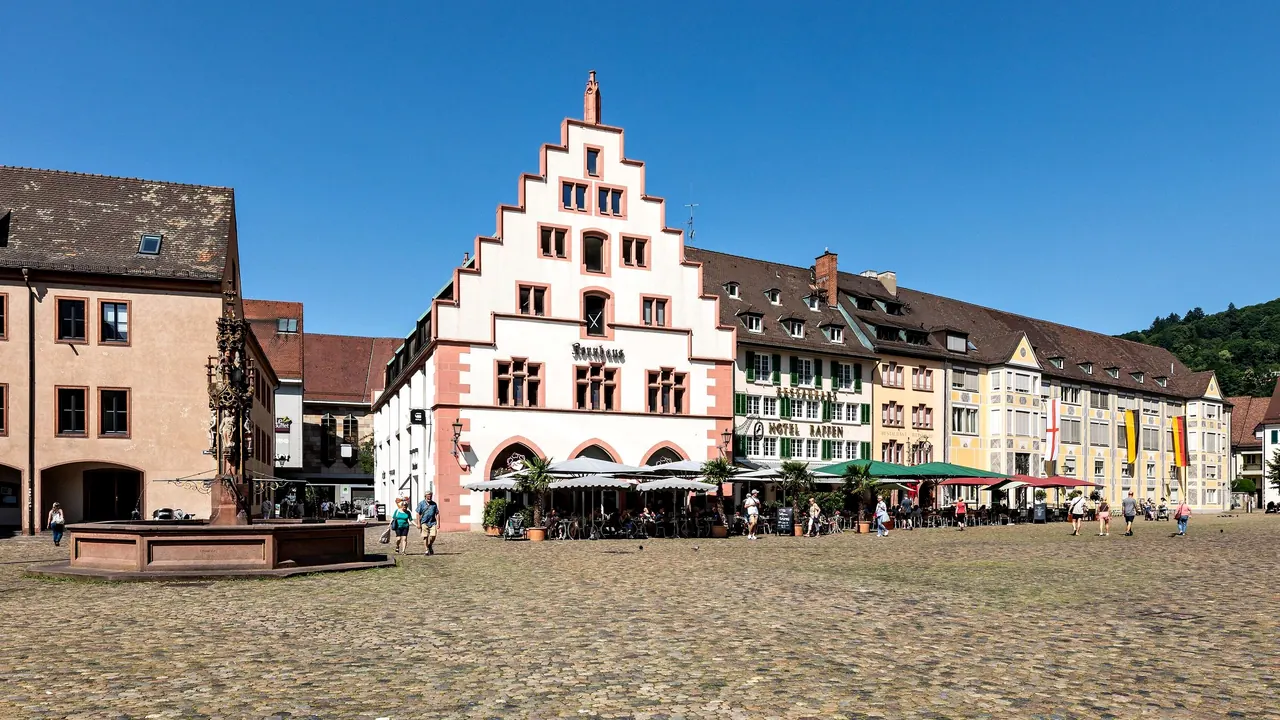
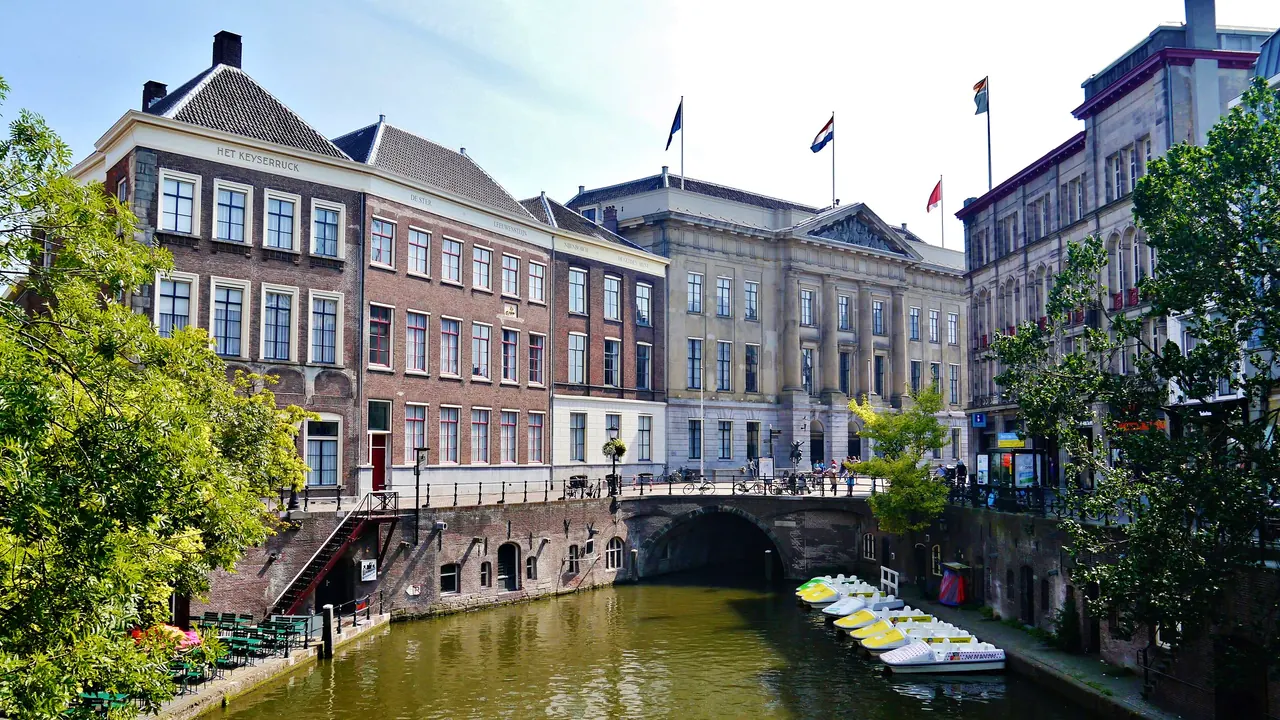
Photos: Freiburg by Dietmar Rabich, CC BY-SA 4.0, cropped; Utrecht by Zairon, CC BY-SA 4.0, cropped.
Freiburg or Utrecht?
Our verdict in twelve categories, each scored against the same fixed benchmark cities, and the climate month by month, so you can choose for your trip.
Choose Freiburg for
- nature and the outdoors
- wellness
- food and drink
Freiburg suits travellers who want the outdoors on the doorstep. The Black Forest begins at the edge of town, the thermal baths of southern Baden are close by, and Baden cooking with local Pinot Noir makes the better table of the two. Families do well here too, with Europa-Park within reach and a small, green centre. It is a base for walking, cycling, bathing and eating well rather than for a full city programme.
Choose Utrecht for
- shopping
- live music and the arts
- day trips
For a trip built around trains and towns, Utrecht is the stronger choice. It sits at the hub of the Dutch rail network, which puts Amsterdam, Rotterdam, Delft and Leiden within easy reach. At home it has better independent shopping, a fuller concert calendar centred on TivoliVredenburg and the unusual two-level wharves of the Oudegracht. Choose it when you want city life and variety more than mountains and spas.
Scoreboard
Twelve categories on one fixed scale from 0 to 100. The shaded stretch is the gap between the two.
Your match
Pick a travel style or drag the sliders, and both match scores follow your weighting.
Wins on nature and the outdoors and wellness with your weighting.
Wins on shopping and live music and the arts with your weighting.
What matters to you?
Category by category
What the scores mean for a trip.
Beaches & swimming
Neither city is a beach destination, and the swimming each offers is different. Freiburg has warm gravel pits on the Rhine plain with grassy shores, and the cooler Black Forest lakes of Titisee and Schluchsee are about an hour away for a scenic dip.
Utrecht has recreation lakes such as the Maarsseveense Plassen on the edge of town, and it can at least reach real sand. The North Sea at Zandvoort or Scheveningen is an hour or more by train, though the water there stays chilly.
Food & drink
Freiburg eats better. Its Baden cooking has a French lightness, with Schäufele, Flammkuchen, mountain trout and spring asparagus, and the wine comes from the Kaiserstuhl and Markgräflerland vineyards just outside town. The morning market around the Münster and the region's fine dining give food a real part in the trip.
Utrecht has no cuisine of its own, and much of the appeal is the setting: eating at water level on the Oudegracht wharves. In return it has more international variety, with Indonesian and Surinamese kitchens and casual bistros in Lombok, while in Freiburg the choice soon starts to repeat itself.
Culture & sights
These two are close, and the difference lies in character. Freiburg's sights centre on the red sandstone Münster, whose tower you can climb for views to the Black Forest, along with the medieval gates and the Bächle running through streets largely rebuilt after the war. Add the medieval sculpture and painting of the Augustinermuseum, and a day or two covers it.
Utrecht's medieval centre has survived in better shape, and its Dom Tower, standing apart from a nave lost to a storm, is the stranger sight. Its museums lean towards modern design, with the De Stijl holdings of the Centraal Museum and the Rietveld Schröder House, and together they fill two or three days.
Nightlife
Both cities run on student energy after dark, and neither is worth travelling for a night out. Freiburg's evenings mean wine bars, beer gardens and summer gatherings along the Dreisam, and they quieten down during the semester break.
Utrecht's centre fills on weeknights too, with brown cafés and canal-edge terraces around the Neude and the Oudegracht. When you want a bigger club night, Amsterdam is a short train ride away.
Nature & outdoors
This is where the two cities differ most. Freiburg has mountains at its back: the Schlossberg above the old town, the Schauinsland at about 1,280m by cable car, the Feldberg for hiking and skiing, and gorges such as the Ravenna valley. To the west, the volcanic Kaiserstuhl is good for cycling among the vineyards.
Utrecht's countryside is flat and gentle. It is best seen by bike, along the Vecht past windmills and country estates, or on the heath and low wooded ridges of the Utrechtse Heuvelrug. It is lovely for a relaxed ride but has none of the height or scale that lies on Freiburg's doorstep.
Day trips
Both make excellent bases, but Utrecht's trains give it the edge. From the hub of the Dutch network, Amsterdam, Rotterdam, The Hague, Delft, Leiden and Gouda are all short, direct rides, so you can see much of a country in a week without a hire car.
Freiburg's strength is three countries within a small radius: Basel by train, Colmar and the Alsace wine villages, Strasbourg and Baden-Baden. The Alsace villages are easier to reach by car, though, so its day trips take a little more planning.
Good for families
Freiburg has more to fill a family week. Europa-Park at Rust is about 40 minutes away, the free Mundenhof animal park and the Schauinsland cable car are close by, and children love the Bächle in the streets. Rainy days are its weak point.
Utrecht is calm and easy with children, and its Railway Museum and the Miffy museum for toddlers cover wet days well. Zoos and theme parks need a longer journey, though, and the steady stream of bikes calls for care with small children.
Getting around
Both cities are easy without a car. Freiburg has a compact, largely car-free old town, a dense tram network and regional trains up the Höllental and along the Rhine, and many hotels give guests a card for local buses and trains.
Utrecht's advantage is that its main station sits right at the edge of the old town, so you can step off the train and walk to the Dom. Bikes are the local way to travel in both, but in Utrecht the sheer number of cyclists is part of the experience.
Shopping & style
Utrecht is the better place to browse. Independent fashion, design and homeware shops line the Oudegracht wharves and streets such as the Twijnstraat, Hoog Catharijne takes care of the chains, and the flower market on the Janskerkhof adds colour.
Freiburg is more modest: chains on Kaiser-Joseph-Strasse, boutiques in the Gerberau, and the Münster market for wine, ham and schnapps. Its souvenirs run to cuckoo clocks and wood carvings, and serious shoppers go to Basel.
Affordability
Neither city is cheap, but Freiburg is a little gentler on the wallet. Its hotels are scarce and dear for a city of its size, but staying in a nearby Black Forest village is an easy alternative. Market snacks, wine taverns and a free Münster keep the days inexpensive.
Utrecht's centre has few hotels, and rooms cost what they would in any large Western European city. Sit-down meals with drinks add up quickly too. The compact streets and student lunch cafés help, but a bed costs more here.
Live music & performing arts
Utrecht has the fuller stage. TivoliVredenburg stacks several halls under one roof, with a programme running from the Radio Philharmonic to pop and experimental acts, and the Festival Oude Muziek is a major draw for lovers of early music. Theatre is mostly in Dutch, and there is no opera house.
Freiburg answers with opera at Theater Freiburg, the Freiburger Barockorchester, one of Europe's leading period-instrument ensembles, and the summer Zelt-Musik-Festival. It makes for a good evening out, but there is less to plan a trip around.
Wellness & relaxation
Freiburg sits in spa country. A mineral thermal bath lies on the city's eastern edge, Bad Krozingen and Badenweiler are a short ride south, and the bathhouses of Baden-Baden are an hour away by train.
Utrecht has no bathing tradition of its own, and wellness there means large sauna complexes in the green belt outside the city. For calm, it offers the Pandhof cloister garden beside the Dom and quiet evenings on the canal wharves.
When should you go?
Pick your month. The climate figures are measured averages, not a forecast.
Freiburg in July
Utrecht in July
Daytime high, °C
Rainfall in the month, mm
Temperature and rainfall are climate normals, averaged over the years shown. Freiburg: 1991-2020 normals, Freiburg (0.6 km from centre). Utrecht: 1991-2020 normals, De Bilt (4.3 km from centre).
Freiburg has the warmer, sunnier summer of the two, with July highs around 27°C against about 23°C in Utrecht. From June to August it is the better pick for swimming in the gravel-pit lakes and long evenings outdoors. Its rain peaks in late spring, with May the wettest month at about 103mm, so April and September are often the most pleasant months for walking in the hills. Winters are cold and grey in both cities, though Freiburg's higher slopes then turn to snow.
Utrecht's rainfall follows a different pattern. April is its driest month at about 42mm and a fine time for cycling, while the months from late summer through winter stay steadily damp. The North Sea, an hour or more away, reaches only about 19°C in August, so a beach day only makes sense in high summer. Its mild summers do mean the streets never get too hot for a full day on foot.
Which traveller are you?
For an outdoors trip, Freiburg is the clear choice. The Black Forest starts at the edge of town, the Schauinsland cable car lifts you to ridge trails and the Feldberg offers hiking and winter snow. Utrecht's flat polders are pleasant but tame.
On a relaxing and wellness trip, Freiburg wins again. Warm thermal pools at Bad Krozingen and Badenweiler are a short ride south, Baden-Baden is an hour by train and the city keeps an unhurried pace. Utrecht has only sauna complexes outside town.
For a culture and arts trip, Utrecht has the edge. The Dom Tower, the Oudegracht wharves and the Rietveld Schröder House give it a distinctive centre, and TivoliVredenburg and the Festival Oude Muziek fill more evenings than Freiburg's smaller stage.
Before you go
| Measure | Freiburg | Utrecht |
|---|---|---|
| Official language | German | Dutch |
| Currency | Euro (EUR) | Euro (EUR) |
| Sockets | CF230 V, 50 Hz | CF230 V, 50 Hz |
| Driving side | Right | Right |
| Time zone | UTC+1, UTC+2 in summer | UTC+1, UTC+2 in summer |
| Emergency number | 112 | 112 |
| Elevation | 278 m | 5 m |
| Main airport | EuroAirport Basel–Mulhouse–Freiburg (BSL)50 km from centre112 non-stop destinations | Amsterdam Airport Schiphol (AMS)34 km from centre287 non-stop destinations |
| Public holidays this year | 12 days | 11 days |
By the numbers
| Measure | Freiburg | Utrecht |
|---|---|---|
| City population | 238,299 | 359,370 |
| People per km² | 1,558 | 3,619 |
| Museums within 10 km | 13 | 28 |
| UNESCO World Heritage sites within 50 km | 2 | 5 |
| Swim season, months above 21 °C | - | None |
Where else could you go?
Every comparison below shares a destination with this one, so you can follow Freiburg or Utrecht somewhere new.
- Amsterdamvs Utrecht
- Colmarvs Freiburg
- Haarlemvs Utrecht
- Rotterdamvs Utrecht
- Baselvs Freiburg
- The Haguevs Utrecht