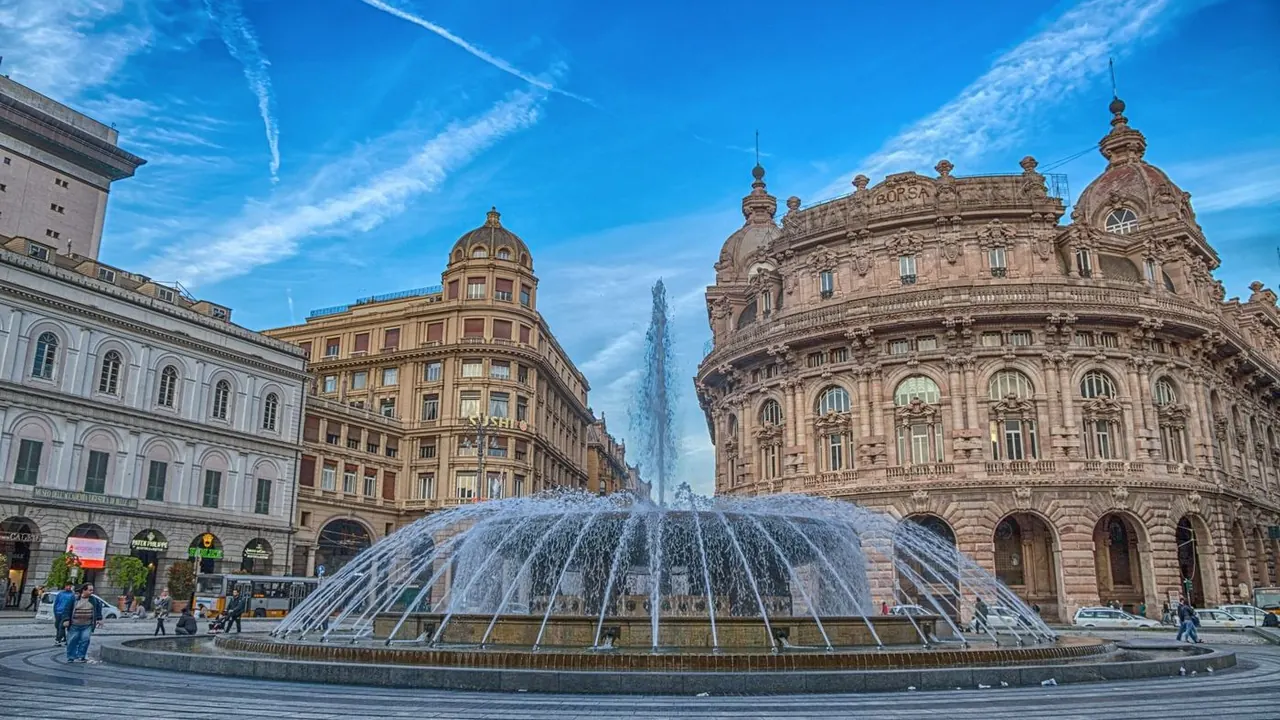
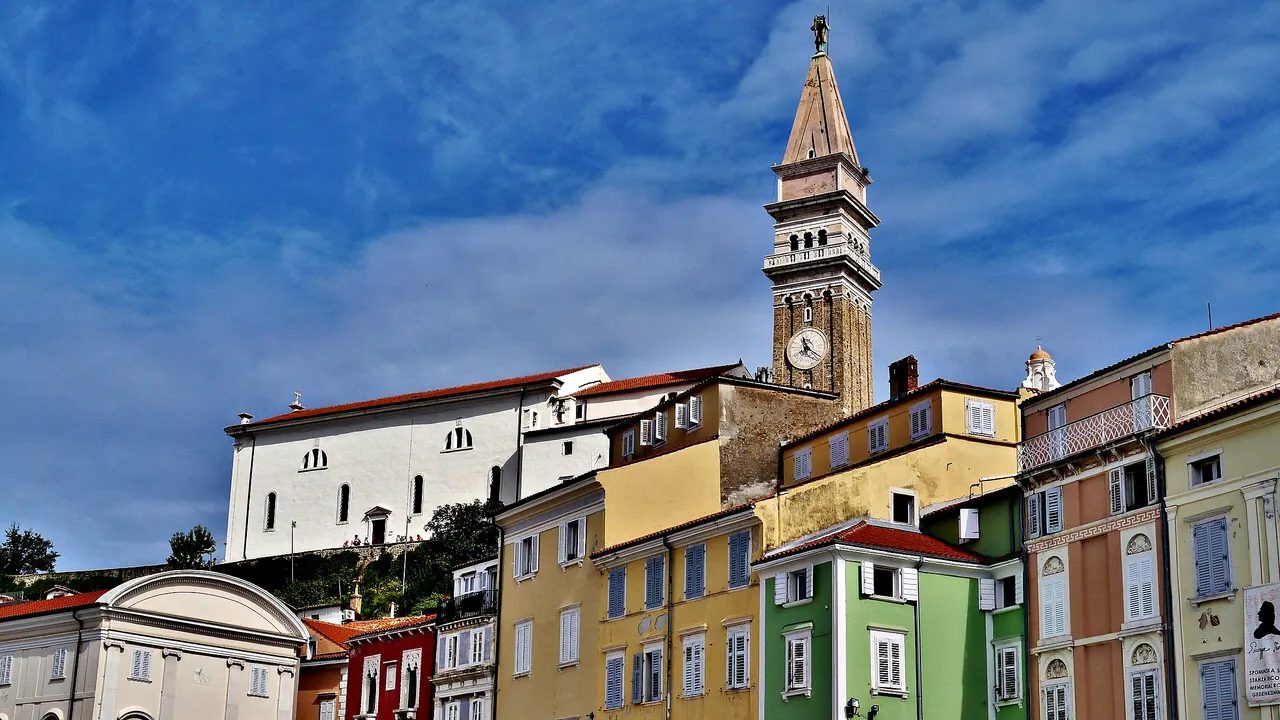
Photos: Genoa by Faber1893, CC BY-SA 4.0, cropped; Piran by Zairon, CC BY-SA 4.0, cropped.
Genoa or Piran?
Our verdict in twelve categories, each scored against the same fixed benchmark cities, and the climate month by month, so you can choose for your trip.
Choose Genoa for
- food and drink
- culture and sights
- live music and the arts
Genoa is the choice for a traveller who wants a real city with the sea attached. It has a vast medieval old town, palace museums, an opera house and some of Italy's most distinctive cooking. On top of that, the Riviera and the Cinque Terre are a train ride away. It is livelier, cheaper to eat in and easier to fill a week with. The trade-off is that the centre is busy and steep rather than restful.
Choose Piran for
- wellness
Piran rewards those who want to slow down. It is a small, car-free Venetian peninsula where the days are swimming off the rocks, sunset wine on Tartini Square and a salt-mud treatment at the spas of Portoroz and the salt pans. There is far less to see, eat and do in the evening than in Genoa. For a few quiet days, or as a base for driving round Istria, Trieste and the Karst, it suits better.
Scoreboard
Twelve categories on one fixed scale from 0 to 100. The shaded stretch is the gap between the two.
Your match
Pick a travel style or drag the sliders, and both match scores follow your weighting.
Wins on food and drink and culture and sights with your weighting.
Wins on wellness with your weighting.
What matters to you?
Category by category
What the scores mean for a trip.
Beaches & swimming
Neither is a sand-and-sunbed destination, and both are about swimming from rocks and pebbles. Genoa gives a bit more choice. Within the city there are the Boccadasse cove, the bathing establishments on Corso Italia and the platforms below Nervi's promenade, and the train reaches Camogli, Sestri Levante and Varazze's longer sandy beaches.
In Piran you climb down ladders from the concrete seafront or walk to the pebble cove at Fiesa. For sand you have to go to Portoroz's small artificial beach or the cliff-backed shore at Strunjan.
Food & drink
Genoa is a serious eating city. Pesto was born here, and you can start the day with focaccia dipped in cappuccino and snack on farinata and panissa from old-town friggitorie. Lunch might be pansoti in walnut sauce, and the Mercato Orientale shows off the region's produce.
Piran keeps to seafood by the water, such as scampi buzara and grilled squid in simple konobas. The Istrian hills supply olive oil, truffles and Malvazija. The harbour menus look alike, though, and anything more ambitious means driving inland.
Culture & sights
Genoa has far more to see. Its old town is one of Europe's largest medieval quarters. Above it, the Rolli palaces hold Van Dyck and Rubens under painted ceilings, and the cathedral, the Lanterna lighthouse and Staglieno cemetery add days of sightseeing.
Piran is a single lovely set piece: Venetian Gothic houses around oval Tartini Square, St George's campanile and the town walls looking over red roofs. Its maritime museum and monastery cloister are modest, and a day covers it.
Nightlife
Genoa has the livelier evenings, though it is reserved by Italian standards and weeknights are quiet. At weekends, students and locals fill the small bars of the old town and the lanes near the university, and drinks spill out into the medieval squares until late. In summer the evenings move out to the Foce waterfront, Corso Italia and the beach clubs along the coast.
Piran's evening is a glass of wine at sunset on the Punta or in Tartini Square, and the town falls quiet not long after. For anything louder you go a few minutes along the shore to Portoroz, which has beach bars, a casino and a few summer clubs.
Nature & outdoors
Genoa offers bigger and wilder landscapes. A funicular takes you up to the ring of hilltop forts above the port. The cliff paths of the Portofino promontory lead down to San Fruttuoso, and the Cinque Terre trails are a train ride away. Boats from the harbour go out to see whales in the Pelagos Sanctuary.
Piran's outdoors is gentler. There is the cliff path at Strunjan, birdlife in the Secovlje salt-pan lagoons, and cycling on the Parenzana through vineyards. The Skocjan caves on the Karst are about an hour away.
Day trips
Genoa is the stronger base. The coastal railway runs east to Camogli, Santa Margherita, Sestri Levante and the five villages of the Cinque Terre, and west to the walled town of Finale Ligure Borgo and little Noli. Portofino is off the line, but a short bus or boat ride from Santa Margherita gets you there. Inland, Milan and Turin are close enough for a day at the museums or the Last Supper, and none of it needs a car.
Piran's strength is having three countries within a day. From there you can reach Trieste with its coffee houses, Rovinj above the sea, hilltop Motovun among the vineyards and Predjama Castle set into its cliff, and in summer a boat crosses the gulf to Venice. With no railway, though, most of these trips mean hiring a car and more planning than Genoa's outings by train.
Good for families
Genoa has more to entertain children, almost all of it at the Porto Antico. There is the big aquarium with dolphins and penguins, the science centre, and the walk-through submarine at the Galata museum, with funiculars as a bonus. Away from the harbour, the steep stairs and dark lanes make hard going with a pushchair.
Piran is easier to manage day to day, with no traffic and a flat seafront. But apart from its small aquarium and Portoroz's shallow beach, there is little aimed at children.
Getting around
Both are easy to manage, but on very different scales. Genoa is a hilly city, where funiculars, a rack railway, public lifts and one metro line make up for slow buses, and the coastal railway reaches Nervi and the Riviera.
Piran is so small and car-free that you cross it on foot in a quarter of an hour. A shuttle runs to Portoroz. The problem starts beyond that: there is no railway, so exploring further usually means hiring a car.
Shopping & style
Genoa gives you a real shopping street. There is the arcaded Via XX Settembre and the Galleria Mazzini, and in the old town, old shops sell candied fruit and pesto and workshops make silver filigree and coral. Piran has a few galleries, harbour souvenirs and the true local buys of Secovlje salt flower, olive oil and coastal wine. For anything more you go to Trieste or Ljubljana.
Affordability
Genoa is the cheaper stay. Focaccia and farinata make very cheap meals, and central hotels cost less than in Italy's best-known cities, though the smart Riviera resorts charge more in summer.
Piran's old town is small and in demand. In July and August rooms are scarce and dear, and waterfront tables charge for the view. Staying in Portoroz or coming outside high summer brings costs back to a fair level.
Live music & performing arts
Each town is tied to a violinist, Paganini in Genoa and Tartini in Piran, but only Genoa has a year-round stage. The Teatro Carlo Felice on Piazza De Ferrari puts on opera, ballet and symphonic concerts, and small clubs keep the city's singer-songwriter tradition going. Piran's music is mostly summer concerts in churches, the Minorite cloister and on the main square, with little to attend the rest of the year.
Wellness & relaxation
Genoa is the harder place to switch off. A proper spa there means the facilities of a good hotel, and the nearest thermal water is at Acqui Terme, more than an hour inland in the Piedmont hills. The calm is at the city's eastern edge, on Nervi's promenade and in its villa gardens, or over a long lunch in a Riviera village, not in the port-side centre.
Piran is made for resting. Its treatments come from the sea and the salt pans close by, and some of them are taken in the open air beside the lagoons rather than in a hotel basement. The evening light over the bay does the rest, especially in the quieter weeks either side of high summer.
When should you go?
Pick your month. The climate figures are measured averages, not a forecast.
Genoa in July
Piran in July
Daytime high, °C
Rainfall in the month, mm
Where the figures come from
Genoa has no rain gauge within 25 km of the centre, so its rainfall comes from a gridded climate dataset read at the city rather than from a gauge further away.
Genoa's sunshine is measured 80 km from the centre, at Capo Mele.
Temperature and rainfall are climate normals, averaged over the years shown. Genoa: 1991-2020 normals, Genova / Sestri (6.7 km from centre). Piran: 2005-2020 (sunshine 1991-2020, rainfall 1991-2020) normals, Portoroz (1.2 km from centre).
Both towns have their swimming season from June to September, when the sea in each reaches about 25°C in August. Piran's summer is slightly hotter, with highs near 30°C in July, while Genoa stays a little cooler and is very dry in high summer, with only about 27mm of rain in July. Both see around 300 hours of sunshine in July. May and late September are the most comfortable months for walking the streets in either place.
The two part ways in autumn and winter. Genoa's rain arrives heavily in autumn, peaking at about 212mm in October, so September to November can bring days of downpours. In winter its sheltered coast stays milder than Piran's. Piran's rain is spread more evenly through the year. Its winters are colder and greyer, but it misses Genoa's autumn deluges.
Which traveller are you?
For a culture and arts trip, Genoa is far ahead. Its caruggi, the Rolli palaces on Via Garibaldi, Staglieno's marble cemetery and a full season at the Carlo Felice opera house can fill several days. Piran's old town and summer Tartini concerts take a day.
On a food and nightlife trip, Genoa wins. There is pesto, focaccia and farinata from the old friggitorie, and in the evening, aperitivo crowds around Piazza delle Erbe. Piran offers good grilled fish on repetitive menus and a town that goes quiet soon after dark.
For a relaxing and wellness trip, Piran is the better fit. The lanes are car-free and the pace is slow, and Portoroz, the Secovlje salt pans and Strunjan all offer brine, seawater and salt-mud treatments. Genoa's centre is noisy, and it has spas only in hotels.
Before you go
| Measure | Genoa | Piran |
|---|---|---|
| Official language | Italian | Slovene |
| Currency | Euro (EUR) | Euro (EUR) |
| Sockets | CFL230 V, 50 Hz | CF230 V, 50 Hz |
| Driving side | Right | Right |
| Time zone | UTC+1, UTC+2 in summer | UTC+1, UTC+2 in summer |
| Emergency number | 112 | 112 |
| Elevation | 20 m | 7 m |
| Main airport | Genoa Cristoforo Colombo Airport (GOA)7 km from centre25 non-stop destinations | Trieste Airport (TRS)34 km from centre32 non-stop destinations |
| Public holidays this year | 13 days | 21 days |
By the numbers
| Measure | Genoa | Piran |
|---|---|---|
| City population | 558,745 | 3,787 |
| People per km² | 2,325 | 85 |
| Museums within 10 km | 51 | 5 |
| UNESCO World Heritage sites within 50 km | 1 | 4 |
| Swim season, months above 21 °C | 4 months | 4 months |
Where else could you go?
Every comparison below shares a destination with this one, so you can follow Genoa or Piran somewhere new.