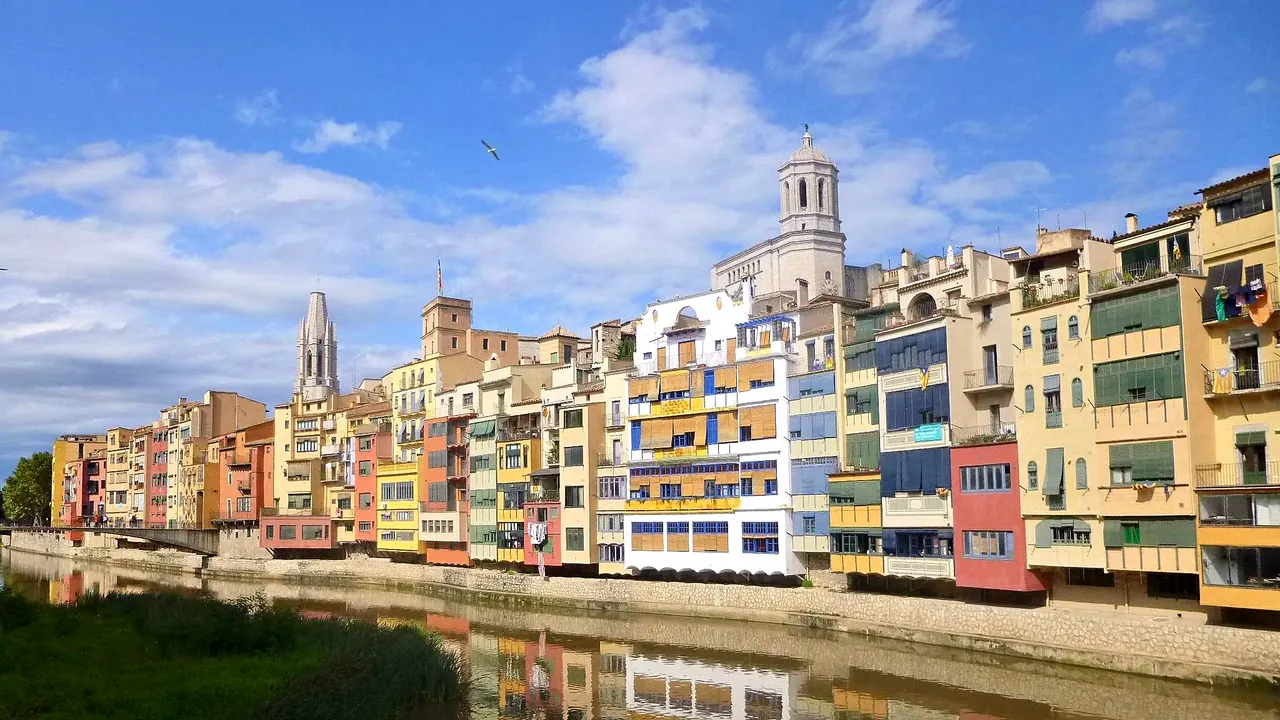
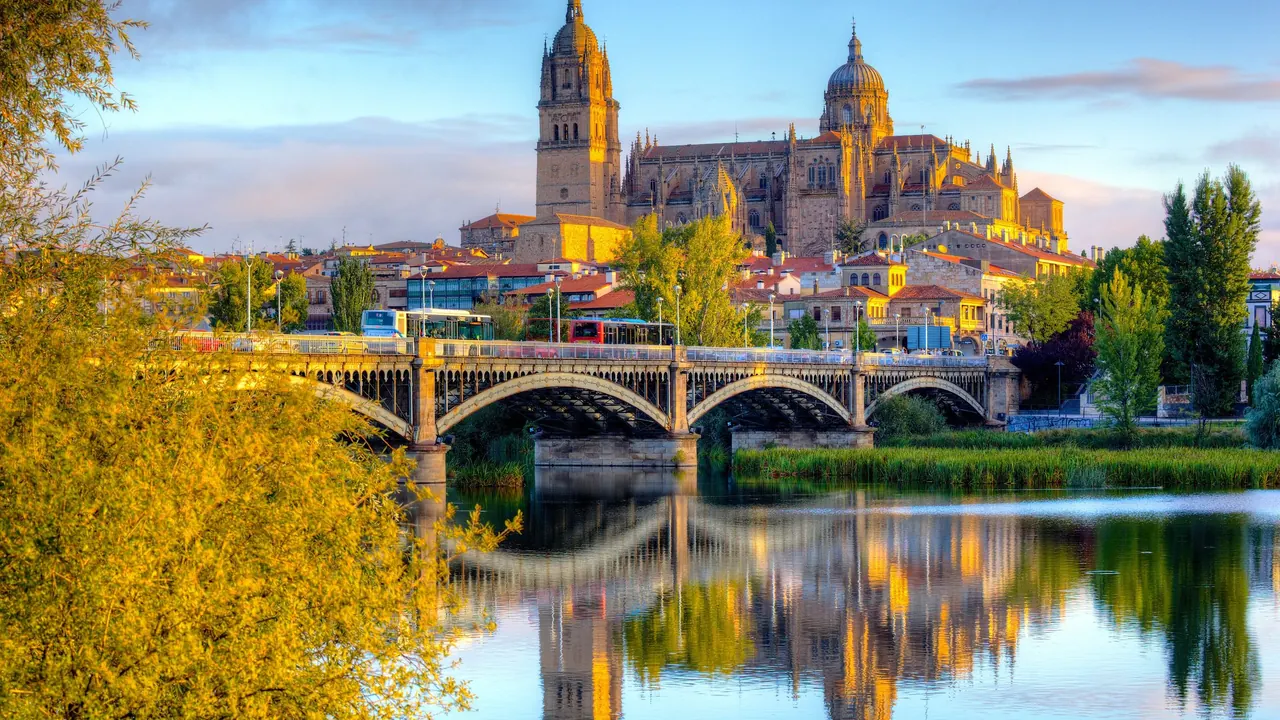
Photos: Girona by Zarateman, CC0; Salamanca by Jiuguang Wang, CC BY-SA 3.0 ES, cropped.
Girona or Salamanca?
Our verdict in twelve categories, each scored against the same fixed benchmark cities, and the climate month by month, so you can choose for your trip.
Choose Girona for
- beaches
- nature and the outdoors
- day trips
Girona suits travellers who want a small, walkable medieval city as a base for getting out of it. You can ride the cycling lanes and greenways, spend days in the coves of the Costa Brava, see Dalí's Figueres, or take the fast train to Barcelona for the day. It works best with an active plan and a hire car for part of the stay, and its evenings are for long dinners rather than late nights.
Choose Salamanca for
- nightlife
- getting around
- prices
Pick Salamanca if the city itself is the point. Its golden sandstone centre, with the Plaza Mayor, the old university and two cathedrals side by side, makes a fuller set of sights within a short walk. The student crowd keeps tapas cheap and the bars full until late. It is the better choice for a lively few days on a modest budget, but there is no sea, and the wilder country needs a car.
Scoreboard
Twelve categories on one fixed scale from 0 to 100. The shaded stretch is the gap between the two.
Your match
Pick a travel style or drag the sliders, and both match scores follow your weighting.
Too close to call, 2 points apart
Wins on beaches and nature and the outdoors with your weighting.
Wins on nightlife and getting around with your weighting.
What matters to you?
Category by category
What the scores mean for a trip.
Beaches & swimming
Neither city has a beach in town, but the gap between them is wide. From Girona the Costa Brava is about 40 minutes away, from the sandy bays of Platja d'Aro and Tossa de Mar to the clear coves around Begur. A beach day fits easily into a city stay, and it is simplest with a car.
Salamanca is a long day's drive from any coast. In summer the choice is a municipal pool or a river beach on the Tormes, which are fine for cooling off but no reason to go.
Food & drink
Both cities eat well, in different ways. Girona builds on Catalan cooking, with seafood and meat on one plate, rice dishes at weekends, Empordà wine, xuixos from the pastry shops and a serious tasting-menu scene alongside the taverns.
Salamanca is a city of the bar counter: Guijuelo ibérico ham, hornazo and roast suckling pig, eaten as you move between tapas bars off the Plaza Mayor and Calle Van Dyck. Girona gives you the better sit-down meal and some seafood, while Salamanca gives you the better evening of grazing.
Culture & sights
Both have medieval cores worth the journey, but Salamanca's is grander and fuller. Its UNESCO-listed centre fits the Plaza Mayor, the carved university façade, the Old and New Cathedrals, the Casa de las Conchas and the convent of San Esteban into a few streets of golden stone. The buildings are floodlit at night, and the city fills two or three days.
Girona's Barri Vell is smaller and steeper. Its highlights are the cathedral with its vast Gothic nave, the Jewish quarter of the Call, the Arab Baths and the walk along the walls. It is full of atmosphere, but a day or two covers it, and neither city has major museums.
Nightlife
This is where Salamanca pulls clearly ahead. From Thursday to Saturday in term time, students move from tapas to the bars around Calle Bordadores and Gran Vía and on to dance bars open well past 3am. It is cheap and sociable, though aimed mostly at a young crowd.
In Girona, evenings mean terraces and a long dinner. There are student bars near Plaça de la Independència and a few small late venues at weekends, but for a real night out people take the train to Barcelona.
Nature & outdoors
Girona has the stronger outdoors, and it starts at the edge of town. Road cyclists come for the climbs of Rocacorba and Els Àngels, and greenways on old railway lines run to Olot and the coast. Within about an hour are the beech woods and cinder cones of the Garrotxa and the cliff paths of the Costa Brava, where you can also kayak and snorkel.
Around Salamanca the plain is open and flat, with riverside paths along the Tormes. The good walking country of the Sierra de Francia, Las Batuecas and the Arribes del Duero canyon is about an hour's drive away. It is fine terrain, but less varied and far from the sea.
Day trips
Girona is the better base, with more variety within an hour. Barcelona is under 40 minutes by high-speed train, Figueres and the Dalí Theatre-Museum are about half an hour north, and Cadaqués and Portlligat lie beyond the Cap de Creus. Closer in are the fortified bridge at Besalú, the stone villages of Pals and Peratallada and the Greek and Roman ruins of Empúries, while Perpignan in France is under an hour by fast train.
Salamanca's circuit is Old Castile: walled Ávila and the Romanesque churches of Zamora, each about an hour away, the ramparts of Ciudad Rodrigo towards Portugal, and the mountain villages of La Alberca and Mogarraz. It is a fine run of historic towns, but there is no great city or coastline within reach to vary the days, and from either base the smaller villages need a car.
Good for families
Families will find both cities calm and safe, and both are short of anything built for children, with no zoo, aquarium or theme park. Girona works as a quiet base for beach days on the Costa Brava, though the stairs of the Barri Vell are hard work with a pushchair. Salamanca has a flatter, largely pedestrian centre, and children can hunt for the carved frog and astronaut, but there is no sea to escape the summer heat.
Getting around
Girona is walkable, with the old town, the river and the modern centre all close together, but the Barri Vell climbs in stairs and steep cobbled lanes. The fast trains to Barcelona and Figueres are a real asset, yet buses to the coast and Olot are infrequent, so many visitors hire a car for part of the stay.
Salamanca is the simpler city on foot. Its sights are grouped in one mostly traffic-free old town on gentle slopes, so getting from the Plaza Mayor down to the Roman bridge is an easy stroll rather than a climb. Buses matter only for reaching the stations. Trains run to Madrid and Valladolid, but the sierras and the Arribes del Duero are car country here too.
Shopping & style
Neither city is a shopping destination, and both send serious shoppers elsewhere. Girona's Rambla has independent fashion shops, bookshops and plenty of cycling kit, while Salamanca's pedestrian streets have high-street chains and a department store. The best things to take home also differ: Empordà cheese, olive oil and wine from the Mercat del Lleó, against ibérico ham and the silver filigree of charro jewellery.
Affordability
Salamanca is the cheaper stay. Students keep tapas and drinks prices low, a drink at the counter often comes with a free tapa, and the old town has plenty of simple guesthouses at moderate rates. Admission to the cathedrals, the university and the towers is the main extra cost.
Girona's prices sit in the middle range. Its weekday set lunches are good value, but it has few old-town rooms, and they get expensive in summer, during the flower festival and in the cycling season. A hire car for the region adds to the bill.
Live music & performing arts
The two are evenly matched and modest, with no opera season or resident orchestra in either. Girona's highlight is Temporada Alta, a long autumn festival of international theatre and dance, though many plays are in Catalan. Salamanca's music is more informal and part of everyday life, with caped student tunas playing under the arcades of the Plaza Mayor and university concerts in historic halls and churches.
Wellness & relaxation
Both are slow, unhurried cities with little bathing culture of their own, so a proper spa day means leaving town. From Girona, the thermal-spring town of Caldes de Malavella is about 20 minutes away. Salamanca has the old spa hotel at Ledesma and the Roman springs of Baños de Montemayor further south, and the quiet cloisters of Las Dueñas make a good place to sit in town.
When should you go?
Pick your month. The climate figures are measured averages, not a forecast.
Girona in July
Salamanca in July
Daytime high, °C
Rainfall in the month, mm
Temperature and rainfall are climate normals, averaged over the years shown. Girona: 1991-2020 normals, Gerona / Costa Brava (10.1 km from centre). Salamanca: 1991-2020 normals, Salamanca / Matacan (13.9 km from centre).
Girona has the gentler year. Winters stay mild enough for walking the old town, and spring is pleasant. July and August reach around 31°C inland, which is hot for the Barri Vell's stairs but right for the coast. The sea there peaks at about 24°C in August and is still good for swimming in September. Autumn is the wet season, with October the rainiest month at 86mm, so late May, June and September are the best balance of beach weather and comfortable streets.
Salamanca is drier, sunnier and more extreme. Midsummer is just as hot but almost rainless, with about 8mm in July, so afternoons on the open plain are hard going. Winter turns cold, with daytime highs of around 9°C in January. April to June and September into early October are the months for walking the city in comfort.
Which traveller are you?
On a beach and sun trip, Girona is the only real option of the two. The Costa Brava's sandy bays and clear coves are close enough for a swim day after day, while in summer Salamanca offers only municipal pools and river beaches.
For a food and nightlife trip, Salamanca is the stronger pick. Its huge student population keeps the tapas bars around the Plaza Mayor busy and cheap, and the night carries on into dance bars. In Girona, the evening usually ends after dinner unless you take the train to Barcelona.
On an outdoors trip, choose Girona. Cyclists ride straight out of town onto quiet lanes and old railway greenways, and the volcanic Garrotxa, the Costa Brava cliff paths and the Pyrenees are all close. From Salamanca, the sierras and the canyon of the Arribes are an hour's drive away.
Before you go
| Measure | Girona | Salamanca |
|---|---|---|
| Official language | Spanish | Spanish |
| Currency | Euro (EUR) | Euro (EUR) |
| Sockets | CF230 V, 50 Hz | CF230 V, 50 Hz |
| Driving side | Right | Right |
| Time zone | UTC+1, UTC+2 in summer | UTC+1, UTC+2 in summer |
| Emergency number | 112 | 112 |
| Elevation | 70 m | 798 m |
| Main airport | Girona-Costa Brava Airport (GRO)10 km from centre18 non-stop destinations | Adolfo Suárez Madrid–Barajas Airport (MAD)184 km from centre241 non-stop destinations |
| Public holidays this year | 14 days | 12 days |
By the numbers
| Measure | Girona | Salamanca |
|---|---|---|
| City population | 108,666 | 146,110 |
| People per km² | 2,779 | 3,690 |
| Museums within 10 km | 9 | 13 |
| UNESCO World Heritage sites within 50 km | 0 | 1 |
| Swim season, months above 21 °C | 3 months | - |
Where else could you go?
Every comparison below shares a destination with this one, so you can follow Girona or Salamanca somewhere new.
- Barcelonavs Girona
- Segoviavs Salamanca
- Carcassonnevs Girona
- Madridvs Salamanca
- Toledovs Salamanca
- Montpelliervs Girona