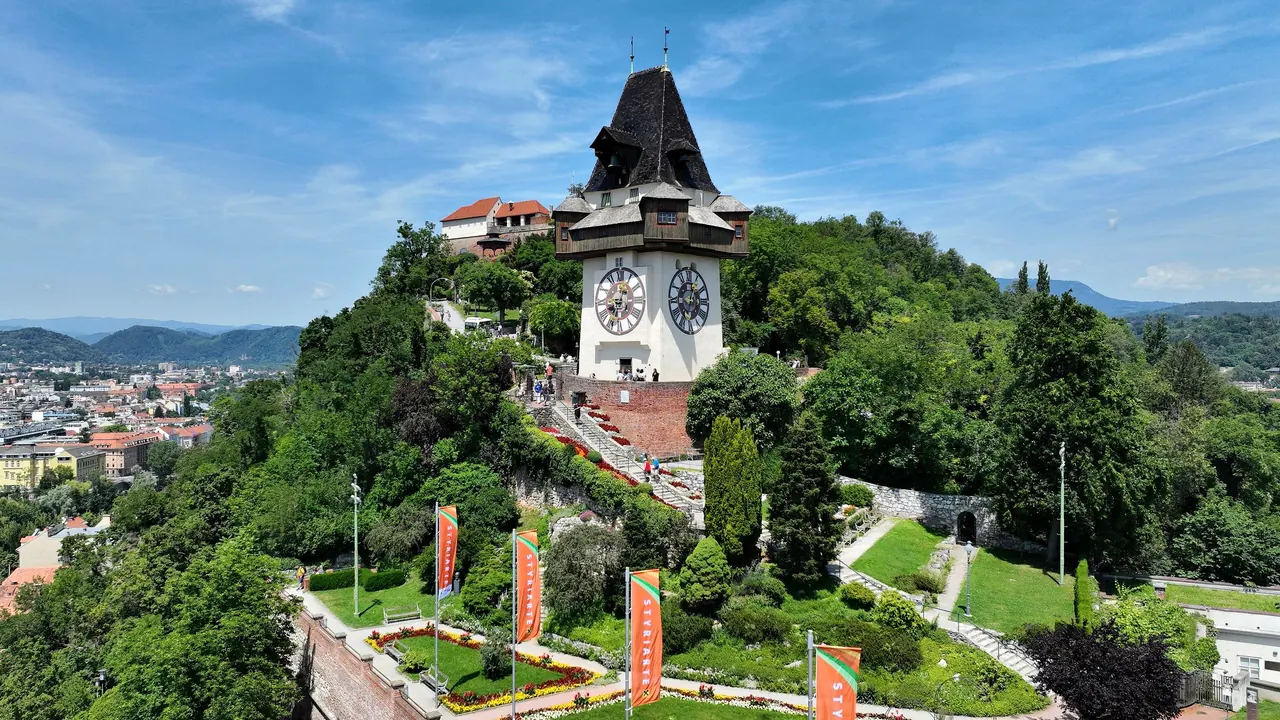
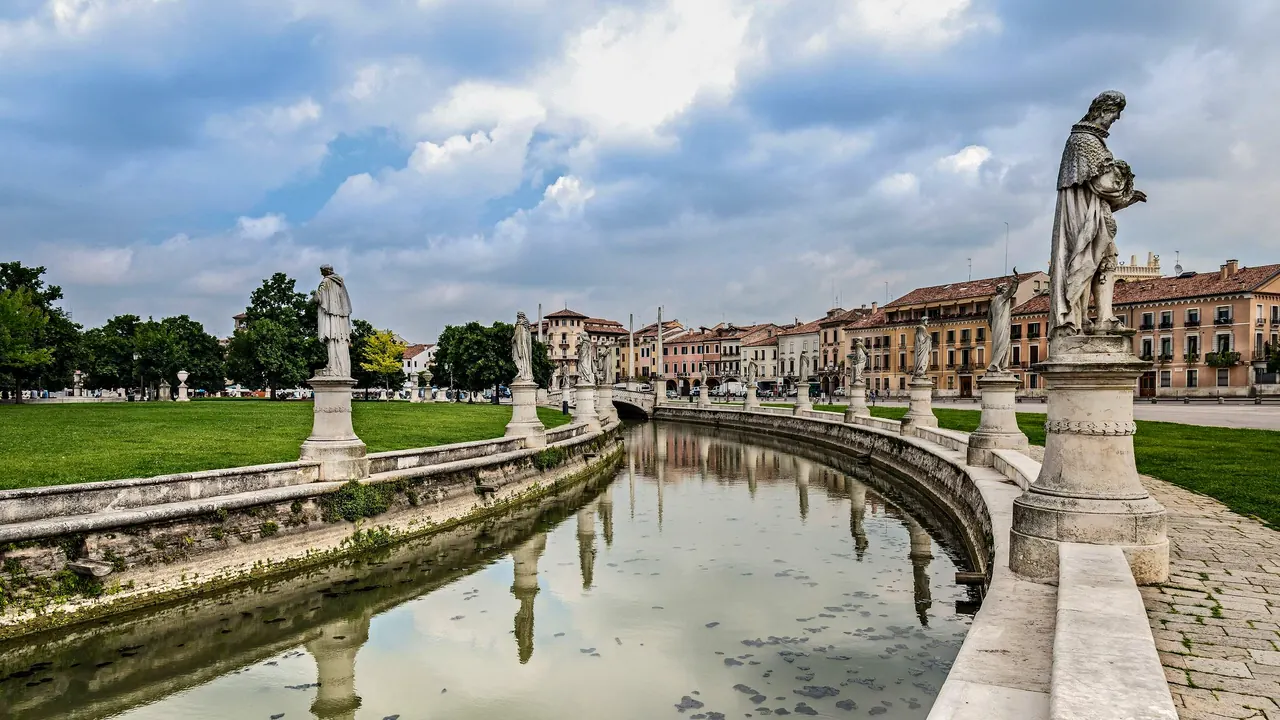
Photos: Graz by C.Stadler/Bwag, CC BY-SA 4.0, cropped; Padua by Didier Descouens, CC BY-SA 4.0, cropped.
Graz or Padua?
Our verdict in twelve categories, each scored against the same fixed benchmark cities, and the climate month by month, so you can choose for your trip.
Choose Graz for
- live music and the arts
- families
- nature and the outdoors
Graz suits travellers who want one compact, easy base with mountains on the doorstep and a serious evening programme of opera, festivals and jazz. The Schöckl, the Mur cycle path and alpine hiking within reach give it the stronger outdoors. The underground slide down the Schlossberg and a dedicated children's museum also make it the better pick for families who would rather stay put than spend their days on trains.
Choose Padua for
- day trips
- beaches
- wellness
Choose Padua if the trip is really about the region around it. Venice, Vicenza, Verona and Bologna are all short train rides away. Giotto's frescoes in the Scrovegni Chapel give the city a world-class sight of its own, and the thermal pools of Abano are only a bus ride out. It is also somewhat kinder on the budget, which counts when you are paying for a bed in one place and spending most days somewhere else.
Scoreboard
Twelve categories on one fixed scale from 0 to 100. The shaded stretch is the gap between the two.
Your match
Pick a travel style or drag the sliders, and both match scores follow your weighting.
Wins on live music and the arts and families with your weighting.
Wins on day trips and beaches with your weighting.
What matters to you?
Category by category
What the scores mean for a trip.
Beaches & swimming
Neither city is a place to plan a beach vacation around, but Padua at least has the sea within reach. Sottomarina and the Lido of Venice are about an hour away, with calm, shallow Adriatic water that suits small children, even if the long rows of umbrellas are practical rather than pretty.
Graz has no coast at all. Swimming there means the former gravel-pit lakes south of town, Schwarzlsee above all, with grassy banks and jetties. They are a fine escape on a hot afternoon, but they are not a day at the seaside.
Food & drink
Both cities build their food around regional cooking and morning markets, so they differ in flavour rather than quality. Graz is all about Styrian produce: pumpkin seed oil on almost everything, cold fried chicken in salad, and crisp white wines drunk at rustic Buschenschank taverns in the vineyards to the south.
Padua cooks Venetian home food, such as bigoli with duck sauce and baccalà, and the evening often starts with a spritz taken standing in Piazza delle Erbe. Eating here is more social and spills into the squares, while Graz leans towards inns, coffee houses and outings to wine country.
Culture & sights
Padua has the deeper heritage. Giotto's frescoes in the Scrovegni Chapel are a turning point in European painting, and other fourteenth-century fresco cycles nearby make up a UNESCO-listed group. Add the pilgrimage Basilica of Saint Anthony with Donatello's bronzes, and a university that keeps the oldest permanent anatomical theatre and botanical garden of their kind.
Graz has a beautifully kept old town of arcaded courtyards and red roofs. It also has the extraordinary armoury of the Landeszeughaus, Baroque Schloss Eggenberg and the blue Kunsthaus for modern contrast. That fills two satisfying days, but nothing in Graz carries the weight of the Scrovegni Chapel.
Nightlife
Both are student towns that go out in a relaxed way and go noticeably quiet in the summer break, so neither is a clubbing destination. Padua's evening is the aperitivo, with crowds standing over spritz glasses in the squares around the Palazzo della Ragione until late. Graz is more of a bar crawl through the lanes of the Bermuda Triangle and the artier bars of Lend, with a handful of clubs staying open late at weekends.
Nature & outdoors
Graz has the better outdoors because it sits where the Alps meet the hills. The Schöckl has a cable car, trails and paragliders. The Bärenschützklamm gorge climbs past waterfalls on ladders, and the limestone peaks of the Gesäuse and Hochschwab give proper alpine hiking within about two hours.
Padua lies on a flat plain, so its countryside is gentler. The volcanic Euganean Hills, about 15km away, have vineyards, chestnut woods and roads popular with cyclists, and towpaths along the Brenta make easy rides. For real mountains you need a car and an hour and a half to reach Monte Grappa or the Asiago plateau.
Day trips
This is where the two cities differ most. From Padua, Venice is under half an hour by train, so you can visit it several times and sleep somewhere calmer. Vicenza's Palladian buildings, Verona, Treviso, Bologna and Ferrara are all within about an hour, and the villas of the Brenta and the walled towns around the Euganean Hills are closer still.
Graz's outings are rural and slower: the South Styrian Wine Road, Riegersburg castle on its crag, the vast library at Admont Abbey, and Maribor across the Slovenian border. These are lovely trips, but most need a car and none compares with having Venice on your doorstep.
Good for families
Graz does much more for children. Families ride the glass lift up the Schlossberg and come down by a long underground slide, and the Märchenbahn train runs through fairytale scenes inside the rock. FRida & freD, a children's museum in the Augarten, adds hands-on exhibitions, and the Schöckl has summer toboggan runs.
Padua is safe, flat and welcoming to children in its trattorias, and Prato della Valle is a good place to run about. Beyond that the city offers little made for children, so families end up driving to Gardaland or the Adriatic to fill the days.
Getting around
The real difference lies outside the city. From Graz, the vineyards, castles and mountains are much easier with a car. Padua's main-line station puts Venice, Vicenza, Verona and Bologna within quick reach by train.
Inside town the two are much alike, with flat centres that are largely closed to traffic and easy to walk or cycle. Graz has trams on one simple ticket, a lift and a funicular up the Schlossberg, and level cycling along the Mur. In Padua, arcades keep off the rain and the summer sun, a tram links the station with Prato della Valle, and nearly every sight is within a 20-minute walk.
Shopping & style
Neither city is worth the trip for its shops, and overall they come out about level. The difference is in what you go home with. In Graz the best buys are regional: oil, wine and fruit brandies from the Styrian countryside, and traditional dress for anyone who wants a piece of Austrian costume. Lend, across the river, is the place to browse for something one-off from a small studio.
Padua suits the shopper who wants clothes and shoes. Its arcades make it easy to drift from one Italian shop to the next whatever the weather, and the morning market stalls in the old squares double as the place to pick up food to take home. Neither city has much in the way of luxury labels, so in both, shopping fits between sights rather than filling a day.
Affordability
Padua is the somewhat cheaper stay. Its hotels are reasonably priced as a base for the whole region, and a standing spritz with market food or a trattoria meal costs little, so a week of day trips from here is good value.
Graz is fair rather than cheap. Student lunch menus and bakeries keep daytime eating affordable, but sit-down dinners and wine cost what they usually do in Austria.
Live music & performing arts
Graz takes performance far more seriously. Its Opera is the second largest house in Austria and runs a full season of opera, ballet and operetta. Styriarte brings early and classical music in early summer, steirischer herbst brings avant-garde work in autumn, and the music university feeds a strong jazz scene.
Padua's programme is modest: theatre and some opera at the horseshoe-shaped Teatro Verdi, and chamber concerts in the Sala dei Giganti and the basilica. For major opera, visitors take the train to the Fenice in Venice or to the summer Arena in Verona.
Wellness & relaxation
Padua has one of Europe's largest thermal districts almost on its edge. At Abano Terme and Montegrotto Terme, about 12km away, hot mineral water and mud have been used since Roman times, and many spa hotels take day visitors. That makes a soak after a morning of frescoes easy to arrange.
Graz has no bathing tradition of its own. It is still a gateway to Styria's spa villages, such as Hundertwasser's Bad Blumau and Loipersdorf, but these are about an hour away and work better as a separate day out.
When should you go?
Pick your month. The climate figures are measured averages, not a forecast.
Graz in July
Padua in July
Daytime high, °C
Rainfall in the month, mm
Where the figures come from
Padua's temperatures are measured 35 km from the centre, at Treviso / Istrana.
Padua has no rain gauge within 25 km of the centre, so its rainfall comes from a gridded climate dataset read at the city rather than from a gauge further away.
Padua's sunshine is measured 36 km from the centre, at Treviso / S. Angelo.
Temperature and rainfall are climate normals, averaged over the years shown. Graz: 1991-2020 normals, Graz Airport (7.9 km from centre). Padua: 1991-2020 normals, Treviso / Istrana (35.4 km from centre).
Graz has the sharper seasons. Winters are cold, around 3°C by day in January, and summers are warm rather than hot, at about 27°C in July. June to August is also the wettest stretch, with roughly 125mm a month, so a sunny morning can turn to rain later. May, June and September are the best months for the old town and the hills, and the bathing lakes are warmest in July and August.
Padua is milder in winter and hotter in summer. It reaches about 31°C in July and August, which is sticky for sightseeing but right for a day on the Adriatic. The sea is pleasant from June to September and reaches about 26°C in August. Its rain is spread more evenly through the year and is heaviest in autumn, with November the wettest month. Spring and early autumn are the comfortable seasons for walking its streets. July is the sunniest month in both cities, and in Padua it is markedly so.
Which traveller are you?
On a family trip with young children, Graz is the easier choice. The underground slide down the Schlossberg, the fairytale train in the rock and a dedicated children's museum make real days out, while Padua's frescoes and churches hold far less for children.
For a relaxing and wellness trip, Padua has the edge. The thermal pools and mud treatments of Abano and Montegrotto are a short ride from town and welcome day visitors. Graz's spa villages are about an hour away in the hills to the east.
On an outdoors trip, Graz is clearly better. The Schöckl rises just outside town with trails and paragliding, the Mur cycle path runs through the centre, and alpine hiking in the Gesäuse is within two hours. Padua's Euganean Hills are gentler and smaller.
Before you go
| Measure | Graz | Padua |
|---|---|---|
| Official language | German, Austrian Sign Language | Italian |
| Currency | Euro (EUR) | Euro (EUR) |
| Sockets | CF230 V, 50 Hz | CFL230 V, 50 Hz |
| Driving side | Right | Right |
| Time zone | UTC+1, UTC+2 in summer | UTC+1, UTC+2 in summer |
| Emergency number | 112 | 112 |
| Elevation | 353 m | 12 m |
| Main airport | Graz Airport (GRZ)9 km from centre26 non-stop destinations | Venice Marco Polo Airport (VCE)39 km from centre103 non-stop destinations |
| Public holidays this year | 16 days | 13 days |
By the numbers
| Measure | Graz | Padua |
|---|---|---|
| City population | 306,971 | 206,496 |
| People per km² | 2,406 | 2,220 |
| Museums within 10 km | 29 | 29 |
| UNESCO World Heritage sites within 50 km | 1 | 5 |
| Swim season, months above 21 °C | - | 4 months |
Where else could you go?
Every comparison below shares a destination with this one, so you can follow Graz or Padua somewhere new.