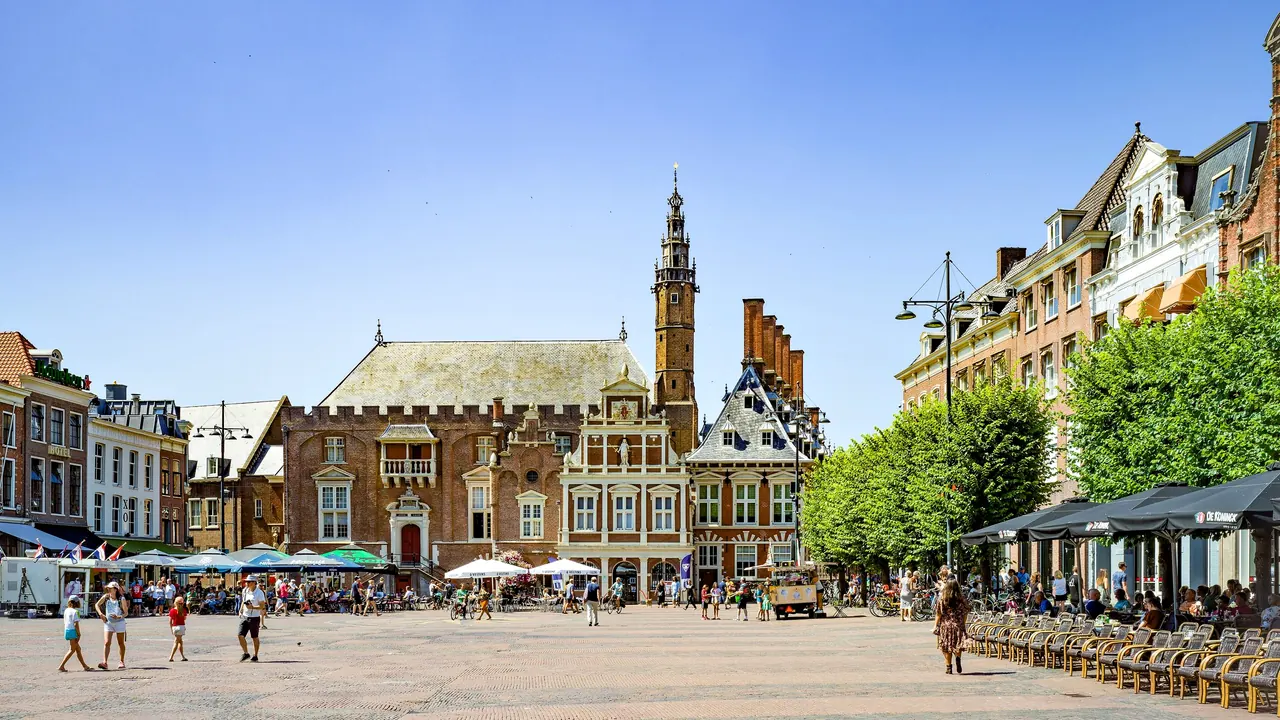
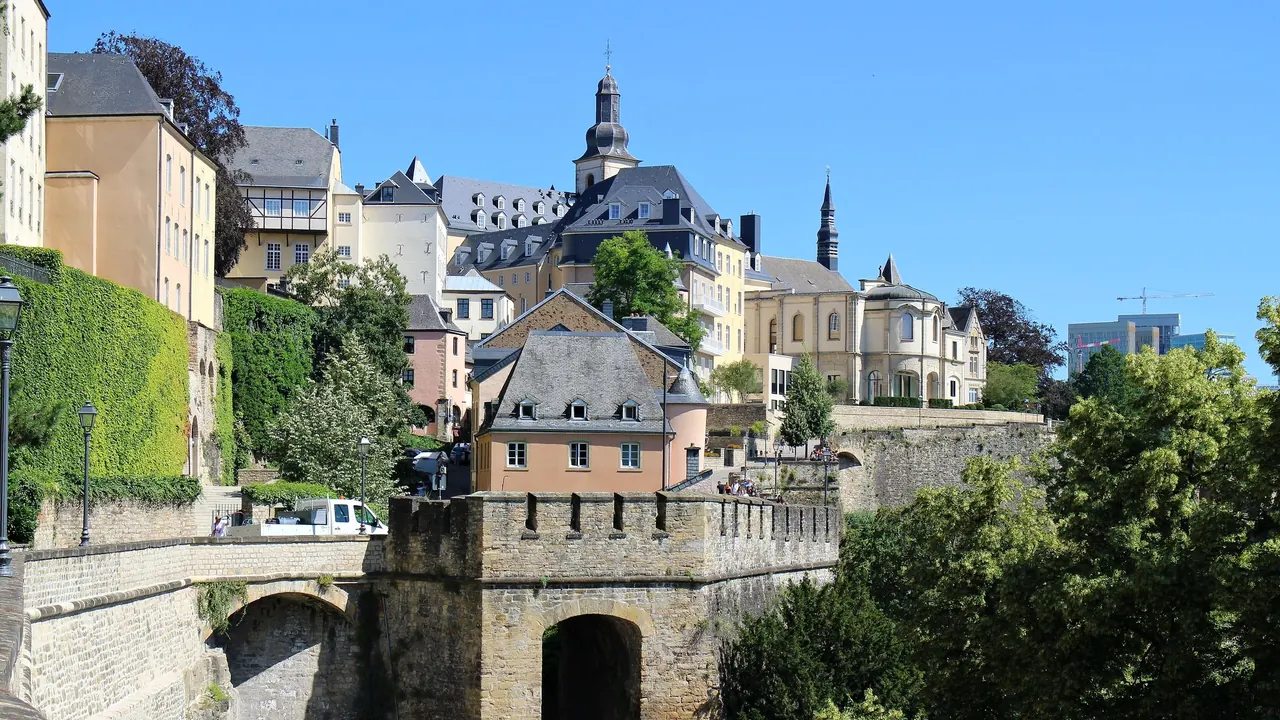
Photos: Haarlem by Moroder, CC BY-SA 4.0, cropped; Luxembourg by Suicasmo, CC BY-SA 4.0, cropped.
Haarlem or Luxembourg?
Our verdict in twelve categories, each scored against the same fixed benchmark cities, and the climate month by month, so you can choose for your trip.
Choose Haarlem for
- beaches
- prices
- shopping
Haarlem suits travellers who want a small, handsome Dutch town as a base for exploring a whole region. Amsterdam, Leiden, The Hague and Delft are all a short train ride away, the North Sea beach is close enough for an afternoon, and the lanes off the Grote Markt are good for browsing independent shops. It is also the slightly less punishing of the two on the wallet, and it is best for anyone who likes to get about by bike.
Choose Luxembourg for
- wellness
- live music and the arts
- food and drink
Luxembourg is the better pick for a slower, more polished stay built around concerts, good wine and green gorges. Its fortress setting above the Alzette is dramatic, and it has a proper concert and opera programme. A thermal spa is half an hour away and the Müllerthal trails are close by. Free public transport makes it easy to get around, but hotels and restaurants cost a great deal, so it works best as a short trip.
Scoreboard
Twelve categories on one fixed scale from 0 to 100. The shaded stretch is the gap between the two.
Your match
Pick a travel style or drag the sliders, and both match scores follow your weighting.
Wins on beaches and prices with your weighting.
Wins on wellness and live music and the arts with your weighting.
What matters to you?
Category by category
What the scores mean for a trip.
Beaches & swimming
Haarlem at least has a coast. Zandvoort's long sandy beach is ten minutes away by train, and the quieter strand at Bloemendaal aan Zee is a bike ride through the dunes. The North Sea stays cool and windy, though, so most beach afternoons are spent walking or sheltering behind a windbreak rather than swimming.
Luxembourg is landlocked, so a swim means a lake: the Upper Sûre reservoir an hour north, or the flooded gravel pits at Remerschen. These lakes warm a little more in high summer than the sea at Zandvoort, but they make a hot-day outing rather than a seaside day.
Food & drink
The two eat quite differently. Haarlem's food is Dutch comfort food, served in brown cafés and terrace bistros, plus herring and fried kibbeling from the Saturday market and a strong local craft-beer culture.
Luxembourg leans French in its better restaurants and has a more serious top tier of fine dining for a well-paid professional crowd. Its real draw is Moselle Riesling and crémant by the glass, while Portuguese and Italian neighbourhood places fill in the everyday eating.
Culture & sights
The two are about level, and each takes two unhurried days, but the pleasures differ. Haarlem's strength is art and intimate interiors: Frans Hals portraits, Teylers' oval room of fossils and instruments, St Bavo's great organ and the quiet hofje courtyards behind plain doors.
Luxembourg's strength is its site. The UNESCO-listed fortress wraps around a sandstone plateau, you can walk through the Bock casemates cut into the rock, and the Corniche looks down on the Grund. MUDAM adds contemporary art across the river on Kirchberg.
Nightlife
Neither is a place for big nights out, and they are quiet in similar measure. In Haarlem an evening means beer in the brown cafés around the Grote Markt and the Botermarkt, and anyone wanting a club takes the short train to Amsterdam. Luxembourg at least has a couple of clubs at the Rives de Clausen and some later venues in Hollerich. Its international crowd goes out mainly on Thursday and Friday, and many residents leave town at the weekend.
Nature & outdoors
Both have good countryside on the doorstep, but the ground could hardly be more different. Around Haarlem it is flat and open: the dunes, pine woods and grazing ponies of Zuid-Kennemerland, the beach beyond them, and the spring bulb fields, all best seen by bike.
Luxembourg has relief. Wooded gorges cut through the city itself, and the Müllerthal's mossy rock passages are half an hour away. The Ardennes hills lie further north. This is walking country, at its best in autumn.
Day trips
Both are excellent bases, but Haarlem has more within easy reach. Amsterdam is fifteen minutes away and Leiden twenty, with The Hague, Delft, Utrecht and Rotterdam close behind on a dense rail network. In spring, Keukenhof and the windmill villages are easy extras.
Luxembourg's appeal is crossing borders. Roman Trier and Metz, with its Gothic cathedral, are each under an hour away, and Vianden's castle and the Moselle wine villages are closer still. It is a fine set of outings, just more spread out.
Good for families
For children, Haarlem's attraction is the open air. The centre is flat and mostly free of cars, local children ride along in cargo bikes and child seats, and the dunes of Zuid-Kennemerland have play areas and visitor centres before the beach opens out beyond them. Teylers' fossils suit curious minds, and on a wet day Amsterdam's zoo and science museum are an easy train ride away.
In Luxembourg the fortress is the main attraction for children. They can explore the casemate tunnels cut into the rock and walk the ramparts above the drop to the Grund, and the natural history museum by the river is aimed at younger visitors. Parc Merveilleux at Bettembourg is the one place built for families. Neither town has a zoo, aquarium or theme park of its own.
Getting around
Haarlem is a bike town and Luxembourg a free-transport one, and that shapes the day. Haarlem is flat, the station sits at the northern edge of a centre you can cross on foot in about twenty minutes, and separate paths lead straight out to the dunes and the sea. Trains to Zandvoort and Leiden take a single contactless card.
In Luxembourg the trams, buses and second-class trains cost nothing, with no ticket to buy, and they reach Vianden, Clervaux and the Moselle as well as Kirchberg. The city is built on several levels, so walking means some climbing, though public lifts and a funicular save your legs.
Shopping & style
Haarlem is the better place for an afternoon of shopping. The narrow streets south and west of the Grote Markt are full of independent fashion, interiors, bookshops and delis, and the chains are kept to the Grote Houtstraat.
Luxembourg's Grand-Rue mostly sells international luxury labels to wealthy residents. The more personal finds are Villeroy & Boch porcelain from its long-standing factory outlet and bottles of Moselle crémant to take home.
Affordability
Neither is a bargain, but Luxembourg is the harder on the wallet. Its hotels are priced for business travellers and EU officials, and eating out costs well above what the Netherlands charges. Free transport, free museums and good-value lunch menus help, and many visitors sleep in Trier or Metz instead.
Haarlem is expensive too, with small rooms that book up early in tulip season. Even so, market stalls, bakeries and cheap bike hire keep a day's spending more manageable.
Live music & performing arts
Both cities have a concert hall called the Philharmonie, but Luxembourg's has a resident orchestra and draws touring orchestras and soloists. The Grand Théâtre adds visiting opera and dance, often performed in French, German or English. That gives Luxembourg the fuller programme for a visitor.
Haarlem's theatre is mostly in Dutch, and for opera you go to Amsterdam. What it has that Luxembourg lacks is a tradition of its own: organ concerts on St Bavo's great instrument and a long-running international organ festival.
Wellness & relaxation
Luxembourg has the more restorative offer, thanks to Mondorf-les-Bains near the French border. Its warm mineral spring feeds a thermal spa in landscaped grounds, and it is an easy day out from the city.
Haarlem has no thermal waters and no bathhouse tradition. It relies on the Dutch sauna culture of larger spa complexes in the wider region, and on its own slow pace: quiet canals after dark and long cycles through the dunes.
When should you go?
Pick your month. The climate figures are measured averages, not a forecast.
Haarlem in July
Luxembourg in July
Daytime high, °C
Rainfall in the month, mm
Where the figures come from
Haarlem has no rain gauge within 25 km of the centre, so its rainfall comes from a gridded climate dataset read at the city rather than from a gauge further away.
Haarlem's sunshine is measured 49 km from the centre, at De Bilt.
Temperature and rainfall are climate normals, averaged over the years shown. Haarlem: 1991-2020 normals, Amsterdam Airport Schiphol (12.7 km from centre). Luxembourg: 1991-2020 normals, Luxembourg / Luxembourg (6.3 km from centre).
Haarlem has mild, cloudy summers. July and August peak at about 22°C, and by August the North Sea has warmed to around 19°C, which is enough for a bracing dip but rarely more. Late spring is the sunniest stretch and the driest, which is good news for bulb-season cycling. The rain builds through autumn and peaks in October at about 109mm. Winters are grey and damp, though seldom freezing.
Luxembourg has more of an inland climate. Summers are warmer and sunnier, reaching about 24°C in July and August, which makes June to August the easiest months for long walks in the gorges and evenings on a terrace. Winters are colder, with January highs around 4°C. The rain is spread fairly evenly through the year rather than piling up in autumn, so September and October stay pleasant for walking among the turning forests and the vineyard harvest.
Which traveller are you?
On a shopping trip, Haarlem is the clear choice. Gierstraat, Kleine Houtstraat and Schagchelstraat are full of independent boutiques, design shops and delicatessens. Luxembourg's Grand-Rue is mostly international luxury labels, with little independent or local design.
For a relaxing and wellness trip, Luxembourg has the edge. The mineral spring at Mondorf-les-Bains, half an hour away, has fed a thermal spa since the nineteenth century, and the city is quiet in the evenings. Haarlem has saunas, but no thermal waters at all.
On a tight budget, Haarlem is the easier of the two, though neither is cheap. Luxembourg's hotels are priced for business travellers and its restaurants sit well above the Western European norm. Free transport there helps, but less than Haarlem's lower overall costs.
Before you go
| Measure | Haarlem | Luxembourg |
|---|---|---|
| Official language | Dutch | French, German, Luxembourgish |
| Currency | Euro (EUR) | Euro (EUR) |
| Sockets | CF230 V, 50 Hz | CF230 V, 50 Hz |
| Driving side | Right | Right |
| Time zone | UTC+1, UTC+2 in summer | UTC+1, UTC+2 in summer |
| Emergency number | 112 | 112 |
| Elevation | 2 m | 300 m |
| Main airport | Amsterdam Airport Schiphol (AMS)12 km from centre287 non-stop destinations | Luxembourg-Findel International Airport (LUX)6 km from centre115 non-stop destinations |
| Public holidays this year | 11 days | 12 days |
By the numbers
| Measure | Haarlem | Luxembourg |
|---|---|---|
| City population | 162,543 | 137,678 |
| People per km² | 5,064 | 2,663 |
| Museums within 10 km | 28 | 19 |
| UNESCO World Heritage sites within 50 km | 5 | 4 |
| Swim season, months above 21 °C | None | - |
Where else could you go?
Every comparison below shares a destination with this one, so you can follow Haarlem or Luxembourg somewhere new.
- Amsterdamvs Haarlem
- The Haguevs Haarlem
- Utrechtvs Haarlem
- Rotterdamvs Haarlem
- Antwerpvs Haarlem
- Maastrichtvs Luxembourg