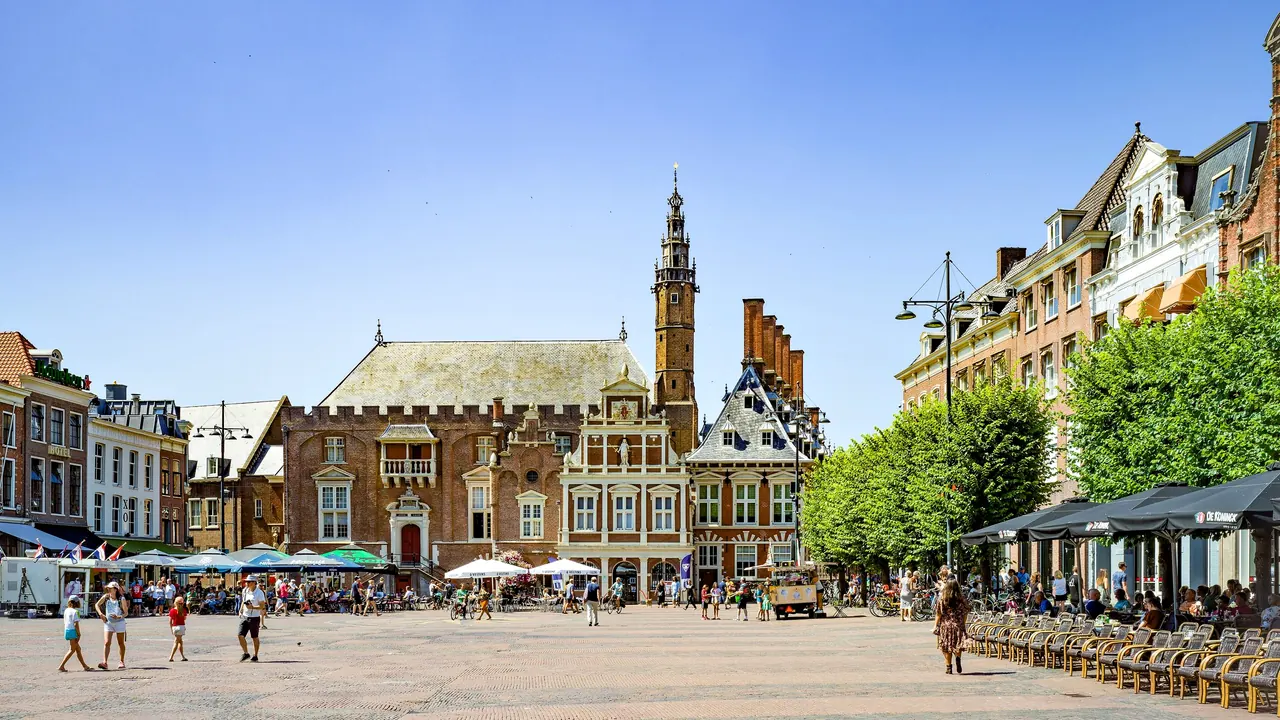

Photos: Haarlem by Moroder, CC BY-SA 4.0, cropped; York by PAUL FARMER, CC BY-SA 2.0, cropped.
Haarlem or York?
Our verdict in twelve categories, each scored against the same fixed benchmark cities, and the climate month by month, so you can choose for your trip.
Choose Haarlem for
- beaches
- shopping
- wellness
Haarlem suits travellers who want a calm, good-looking small city that also works as a base. The dunes and the beach are a bike ride away, the side streets are full of independent shops, and the dense Dutch rail network puts Amsterdam, Leiden, The Hague and Delft within easy reach without a car. Choose it for a relaxed mix of cycling, browsing, organ music and day trips, with quiet canals to come back to in the evening.
Choose York for
- culture and sights
- prices
- families
York is the better pick for someone whose vacation is about history. The Minster, the walkable medieval walls and the Roman, Viking and medieval layers give it more to see inside the city, and the National Railway Museum and Jorvik make it a strong choice for families. It costs a little less to visit, and it is the gateway to the moors, the Dales and the great abbeys, though many of those are best reached by car.
Scoreboard
Twelve categories on one fixed scale from 0 to 100. The shaded stretch is the gap between the two.
Your match
Pick a travel style or drag the sliders, and both match scores follow your weighting.
Wins on beaches and shopping with your weighting.
Wins on culture and sights and prices with your weighting.
What matters to you?
Category by category
What the scores mean for a trip.
Beaches & swimming
Haarlem sits right at the edge of the coast. You can take a short train ride to the long sands of Zandvoort, or cycle through the dunes to the quieter beach at Bloemendaal aan Zee, and both have beach pavilions in summer. The sea is cool and the swimming season is short, but a beach afternoon fits easily into any day.
From York, the beach is a day out rather than an afternoon. Scarborough's two bays, Filey and Whitby are an hour or more away, and the sea there is a little colder still. Those seaside towns have their own traditional charm, but you go to see them, not to swim.
Food & drink
Neither city is a destination for food. Both serve good, comfortable meals rather than memorable ones, and the difference is in the national cooking. In Haarlem that means raw herring and freshly fried kibbeling at the Saturday market, café terraces around the Grote Markt and a craft beer culture with deep roots.
York is built on English tradition: afternoon tea and fat rascals in old tearooms, Sunday roasts with Yorkshire pudding, and Yorkshire real ale in pubs that are centuries old. Close to the Minster and the Shambles, expect more tourist fare than you will find on Haarlem's side streets.
Culture & sights
Haarlem has a fine Golden Age centre that you can see in two unhurried days. The Frans Hals Museum and Teylers Museum, with its 18th-century oval room, are the highlights. Add the great organ in St Bavo, the quiet hofjes behind their doors and the Corrie ten Boom House.
York goes further back and has more to see. The Minster is one of the great Gothic cathedrals of northern Europe, and you can walk the medieval walls around the centre. Jorvik is built on an excavated Viking street, the Yorkshire Museum stands among abbey ruins, and the National Railway Museum adds a whole different era. Here you will want three days rather than two.
Nightlife
Both cities spend their evenings in old drinking rooms rather than clubs. In Haarlem that means brown cafés and terraces around the Grote Markt and the Botermarkt, which is sociable and settled, and Amsterdam is a quarter of an hour away for anything bigger.
York's version is the ale-house crawl through centuries-old inns on Stonegate, Micklegate and the riverside. Its weekends are louder, with stag and hen parties and race-day crowds. On weeknights it goes quiet early, and the real clubs are in Leeds.
Nature & outdoors
Both are flat cities with fine country nearby, but the distances are very different. Haarlem's countryside starts at the edge of town: you can cycle straight into the dunes, pine woods and lakes of Zuid-Kennemerland, with its ponies and fallow deer, and the bulb fields in spring. All of it is gentle and easy to reach by bike.
York's own green space is mostly riverside paths, the Strays and the Museum Gardens. Its bigger landscapes are further out: heather moorland and sea cliffs on the North York Moors, and limestone scars and waterfalls in the Dales. These offer more variety and real hill walking, but they work best with a car.
Day trips
Both are first-rate bases, but Haarlem's outings are easier because nearly all of them are a quick train ride. Amsterdam, Leiden, The Hague, Delft, Utrecht and Rotterdam are all close by rail, so you can decide in the morning and go.
York has excellent trips to Harrogate, Leeds, Durham and Beverley by train. Many of its best sights, though, such as Castle Howard, Fountains Abbey, Rievaulx and the moorland railway from Pickering, are much easier by car or on a coach tour.
Good for families
For families, the real difference is open space against attractions. Haarlem gives children room rather than things to queue for. The centre is mostly free of cars, families everywhere ride cargo bikes, and the dunes and the beach are close by for running about. Apart from the fossils at Teylers, though, the zoo and the science museum are in Amsterdam.
York packs its children's highlights into the walled centre. The National Railway Museum lets them walk around real locomotives, and with Jorvik, the Victorian street in the Castle Museum and a walk along the walls, a short stay fills itself without much planning.
Getting around
A bike takes you much further from Haarlem than from York. In Haarlem, separate paths run from the small, flat centre into the dunes and down to the beach, and trains and regional buses cover the coast and the bulb fields, so you never need a car.
York's walled centre is just as easy on foot, and the station, which is a major rail hub, is about fifteen minutes' walk from the Minster. Beyond the city it is another matter. Buses to the moors and the country houses are sparse, so many visitors hire a car or join a tour.
Shopping & style
Haarlem gives you more to browse. Its shops spread through a web of narrow side streets south and west of the Grote Markt, where small owner-run boutiques, interior shops and delicatessens fill most of the shopfronts and the chains stay on the Grote Houtstraat. It suits an unplanned afternoon of wandering from one doorway to the next, and on market days the square adds flowers and fabric stalls.
In York, the timber-framed lanes inside the walls are half the reason to shop. Independent shops sit next to high-street names and shops aimed at visitors, so shopping fits around sightseeing between the Minster and the Shambles more than it fills a day of its own. Neither city has a luxury street, but York's late-autumn and December markets make the run-up to Christmas its best season for shopping.
Affordability
Neither is cheap, but York is a little easier on the budget. The National Railway Museum, the walls and the Museum Gardens cost nothing, and staying midweek or just outside the walls brings room rates down noticeably.
In Haarlem, hotels are few for the demand and the rooms are small. Market stalls and bakeries help keep the cost of eating down, but regular train outings and museum entry add up over a stay.
Live music & performing arts
Haarlem has the stronger concert life. The 19th-century Philharmonie hosts classical and chamber music, and the great organ of St Bavo is played in regular concerts and at a long-running international organ festival. Most of the theatre at the Stadsschouwburg is in Dutch, though.
York's strengths are in English and closely tied to the city. The Theatre Royal is one of the oldest theatres in England, early-music concerts are held in a medieval church, choral evensong at the Minster is free, and the Mystery Plays are now and then performed on wagons in the streets.
Wellness & relaxation
Haarlem offers more ways to unwind. The Dutch sauna habit means large day-spa complexes with gardens and outdoor pools in the region, as well as smaller saunas in town. The canals are quiet after dark, and the dunes are close for a calming walk or ride.
York has only hotel spas and a few day spas, and its centre is crowded on busy weekends. Its best answer is half an hour away: the Victorian Turkish bath in Harrogate's Royal Baths, a real historic bathhouse of a kind Haarlem does not have.
When should you go?
Pick your month. The climate figures are measured averages, not a forecast.
Haarlem in July
York in July
Daytime high, °C
Rainfall in the month, mm
Where the figures come from
Haarlem has no rain gauge within 25 km of the centre, so its rainfall comes from a gridded climate dataset read at the city rather than from a gauge further away.
Haarlem's sunshine is measured 49 km from the centre, at De Bilt.
York has no rain gauge within 25 km of the centre, so its rainfall comes from a gridded climate dataset read at the city rather than from a gauge further away.
York's sunshine is measured 48 km from the centre, at Leeming.
Temperature and rainfall are climate normals, averaged over the years shown. Haarlem: 1991-2020 normals, Amsterdam Airport Schiphol (12.7 km from centre). York: 1991-2020 normals, Linton-On-Ouse (14.9 km from centre).
The two cities have much the same temperatures all year: cool, changeable and never hot. Both are at their warmest in July and August, when afternoons reach about 22°C in Haarlem and a degree or so less in York. That is pleasant walking weather but only just warm enough for the beach. Haarlem's North Sea is warmest in August, at about 19°C, so a swim there is short. Late spring is the sunniest time in Haarlem, with long bright days in May and June, and it is also when the bulb fields are in bloom. York gets less sunshine through the year.
Rainfall separates them most. Haarlem gets wetter from midsummer on and peaks at about 109mm in October, so the autumn is grey and damp. York is drier through the year and never gets much above 60mm in a month, which makes it the better bet for September and October. Winters in both are cold and dark, around 7°C, and suit museums and pubs rather than long walks.
Which traveller are you?
On a culture and arts trip, York has more to fill the days. The Minster's medieval glass, the walkable walls, Jorvik on its excavated Viking street and the abbey ruins in the Museum Gardens span two thousand years within a short walk.
For a shopping trip, Haarlem is the stronger choice. Its side streets are given over to independent fashion and design shops. In York, independent jewellers, bookshops and antiques dealers share the centre with familiar chains and a souvenir-heavy Shambles.
For a beach and sun trip, neither is a true seaside destination, but Haarlem has the coast on its doorstep. Zandvoort's sand is ten minutes away by train, while from York the nearest beach is about an hour's journey.
Before you go
| Measure | Haarlem | York |
|---|---|---|
| Official language | Dutch | English |
| Currency | Euro (EUR) | Pound Sterling (GBP) |
| Sockets | CF230 V, 50 Hz | G230 V, 50 Hz |
| Driving side | Right | Left |
| Time zone | UTC+1, UTC+2 in summer | UTC, UTC+1 in summer |
| Emergency number | 112 | 112 or 999 |
| Elevation | 2 m | 25 m |
| Main airport | Amsterdam Airport Schiphol (AMS)12 km from centre287 non-stop destinations | Leeds Bradford Airport (LBA)39 km from centre69 non-stop destinations |
| Public holidays this year | 11 days | 8 days |
By the numbers
| Measure | Haarlem | York |
|---|---|---|
| City population | 162,543 | 208,400 |
| People per km² | 5,064 | 766 |
| Museums within 10 km | 28 | 24 |
| UNESCO World Heritage sites within 50 km | 5 | 2 |
| Swim season, months above 21 °C | None | - |
Where else could you go?
Every comparison below shares a destination with this one, so you can follow Haarlem or York somewhere new.
- Amsterdamvs Haarlem
- The Haguevs Haarlem
- Utrechtvs Haarlem
- Rotterdamvs Haarlem
- Manchestervs York
- Antwerpvs Haarlem