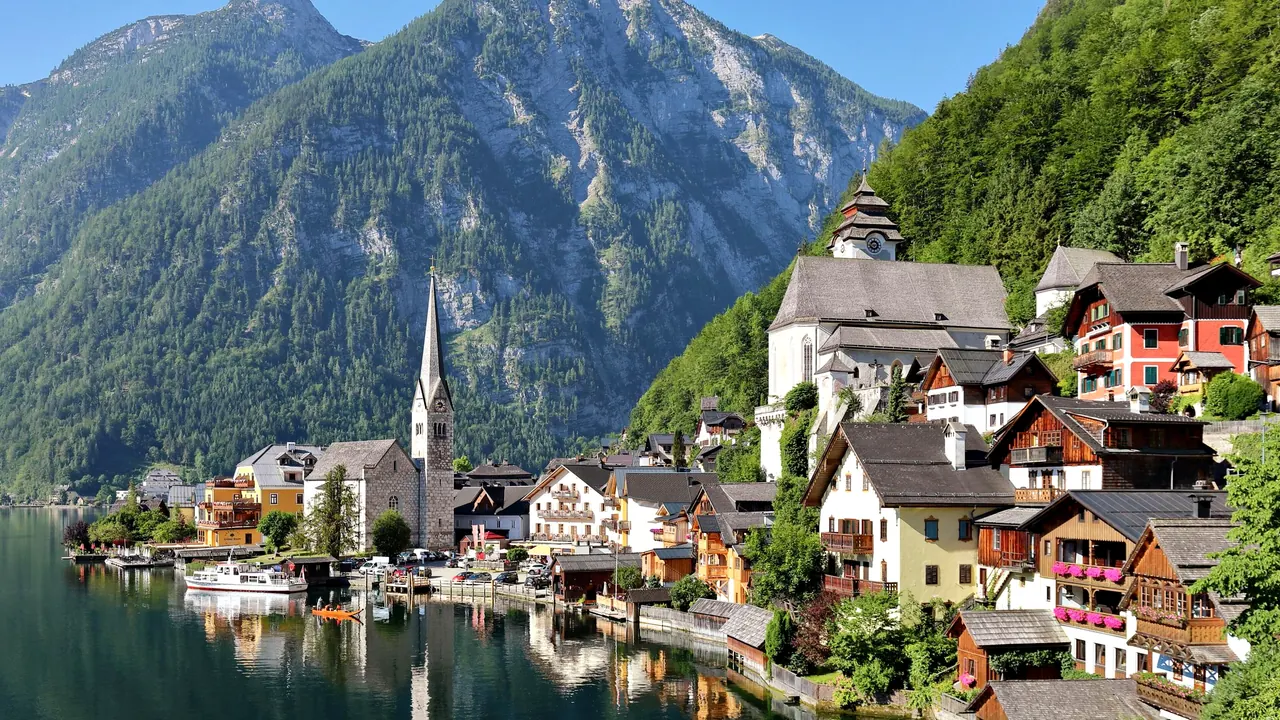
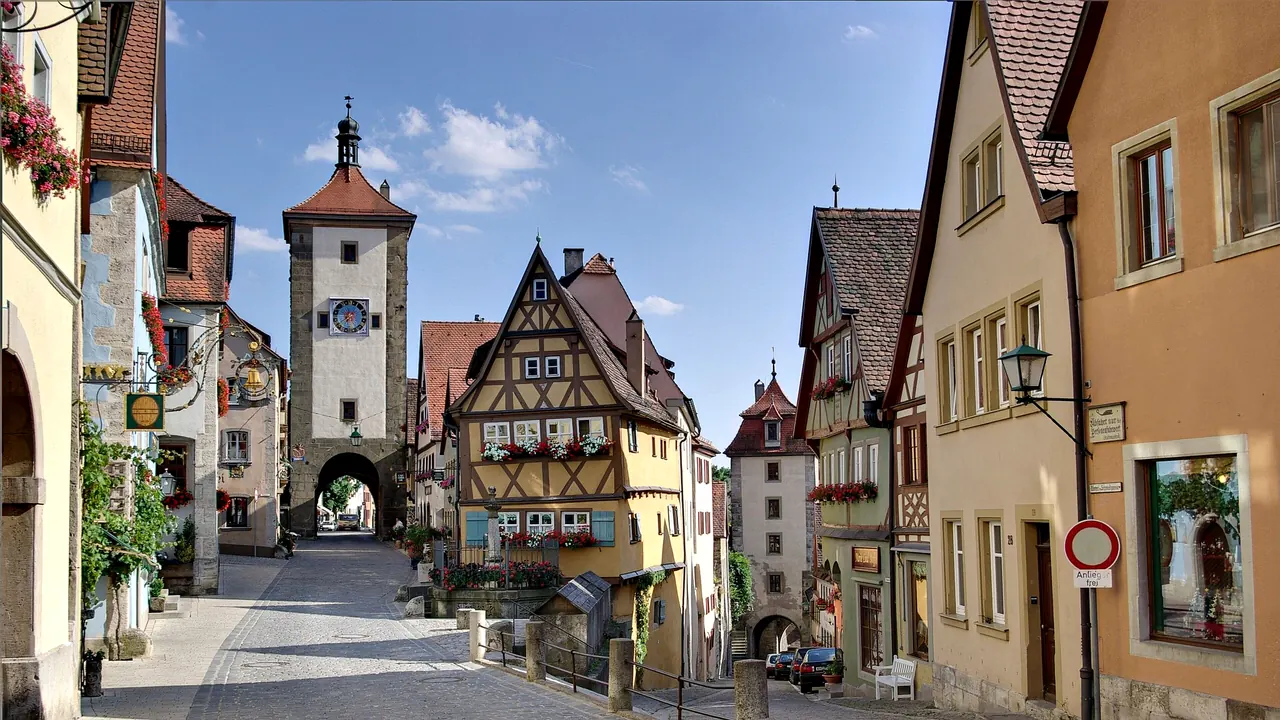
Photos: Hallstatt by C.Stadler/Bwag, CC BY-SA 4.0, cropped; Rothenburg ob der Tauber by Berthold Werner, Public domain.
Hallstatt or Rothenburg ob der Tauber?
Our verdict in twelve categories, each scored against the same fixed benchmark cities, and the climate month by month, so you can choose for your trip.
Choose Hallstatt for
- nature and the outdoors
- beaches
- wellness
Hallstatt is for travellers who want mountains. The village fills half a day on its own, but the reason to stay is the Dachstein country around it: the Krippenstein cable car, the ice caves, the walk to the Gosausee and still mornings on the lake once the day visitors have gone. Expect to pay well for a room, eat simply and pack for rain.
Choose Rothenburg ob der Tauber for
- culture and sights
- prices
- shopping
If the medieval town itself is what draws you, Rothenburg has more to look at. It has an intact ring of walls you can walk, Riemenschneider's altar in St Jakob's, and the Romantic Road towns of Dinkelsbühl and Nördlingen within an easy drive. It is the cheaper base of the two and eats a little better. It suits a slow few days of old towns and wine villages, not a hiking trip.
Scoreboard
Twelve categories on one fixed scale from 0 to 100. The shaded stretch is the gap between the two.
Your match
Pick a travel style or drag the sliders, and both match scores follow your weighting.
Too close to call, 1 point apart
Wins on nature and the outdoors and beaches with your weighting.
Wins on culture and sights and prices with your weighting.
What matters to you?
Category by category
What the scores mean for a trip.
Beaches & swimming
Neither is a swimming destination, but Hallstatt at least has water at its feet. There is a bathing lawn and jetty at the north end of the village and a lido at Obertraun, on a deep, cold lake that suits a brisk dip after a hike.
Rothenburg is landlocked on its hilltop. Swimming there means the town's outdoor pool or an hour's drive to the Altmühlsee and the other artificial lakes of the Franconian lake district.
Food & drink
Rothenburg eats better, though not by a wide margin. Its timbered inns serve Schäufele, bratwurst and roast pork, and dry Franconian Silvaner and the Tauber valley's own wines make an evening more interesting, especially in family-run guesthouses away from the Marktplatz.
Hallstatt has a few guesthouse dining rooms and terraces serving Austrian standards. The lake char and whitefish, smoked or pan-fried, are the meal to have there, and kitchens close early. For anything more, people go to Bad Ischl's old patisseries.
Culture & sights
For sightseeing, Rothenburg fills more of your time. It has the covered walk along the walls, the Plönlein, the view from the Rathaus tower, Riemenschneider's Holy Blood Altar and the Medieval Crime Museum, all in a town with almost nothing modern inside its walls.
Hallstatt's history goes back much further: seven thousand years of salt mining and the Iron Age culture that bears its name. But you see it in fewer places: the salt mine, the small village museum and the painted skulls of the Beinhaus. It makes a rich half day, where Rothenburg rewards a full day of wandering.
Nightlife
Neither has a night out in any real sense. Rothenburg's evenings at least have a regular outing, the night watchman's tour, plus wine taverns, and for bars Würzburg or Nuremberg are within reach. In Hallstatt an evening means a lakeside dinner and a walk by the dark water, and that stillness is the whole point.
Nature & outdoors
This is the widest gap between the two. Hallstatt sits under the Dachstein, with the Krippenstein cable car and its Five Fingers platform, the Giant Ice Cave, the Echerntal waterfalls and the walk to the Gosausee. Add via ferratas in summer and freeride and ski touring in winter.
Rothenburg's countryside is gentle by comparison: paths dropping from the walls into the Tauber valley, the riverside cycle path through the vineyards, and orchards in blossom or autumn colour. It is lovely for an easy afternoon, but there is no high ground or wild country.
Day trips
Both make good bases if you have a car, and Rothenburg has the edge for range. Dinkelsbühl and Nördlingen, the town in a meteorite crater, are on the Romantic Road, Schwäbisch Hall and Weikersheim are about an hour away, and so are Würzburg and Nuremberg.
Hallstatt's outings are lake towns and imperial history: the Kaiservilla at Bad Ischl, St Wolfgang's altarpiece, Gmunden on the Traunsee, and Salzburg as a longer day. In both regions public transport works but makes every trip slower.
Good for families
Both suit families for a short stay rather than a long one, in different ways. Hallstatt's draws are physical: the miners' slides and underground lake in the salt mine, the cable car and ice caves for older children, and boats on the lake. Its steep, crowded lane is hard going with a pushchair.
Rothenburg works more like a storybook, with ramparts to walk, a tower to climb, the night watchman with his lantern and, for older children, the Crime Museum. Its walled centre is small and mostly free of traffic, though the cobbles are hard on pushchairs here too.
Getting around
On foot the two are much alike. Both have compact centres with little traffic and some steep walking: steps up to the church in Hallstatt, cobbles and a climb back up from the Tauber valley in Rothenburg.
The difference is in how you arrive. Hallstatt's station is across the lake and a small boat takes you over to the village, which is charming but slow. Rothenburg sits at the end of a branch line, usually with a change at Steinach. In both areas buses are sparse and a car makes the wider region far easier.
Shopping & style
Rothenburg has a reason to shop that Hallstatt lacks. Its shops sell Christmas decorations all year, from glass baubles and nutcrackers to Erzgebirge carvings, and in Advent the Marktplatz holds one of Germany's most atmospheric Christmas markets. Hallstatt's lane of souvenir shops is worth half an hour for salt from the mine above the village, and that is about it. Neither is a place for fashion.
Affordability
Rothenburg is easier on the wallet. Its prices are those of small-town Germany with a tourist premium, entry fees are modest, beer and wine in the inns are fairly priced, and rooms just outside the walls cost less.
Hallstatt has few rooms and visitors from all over the world, so rooms and meals cost well above the Austrian average, and the salt mine, funicular and cable car add up. The usual way round it is to sleep in Obertraun or Bad Ischl.
Live music & performing arts
Rothenburg has a little more to plan an evening around. There is the costumed Meistertrunk play, re-enacting the town's Thirty Years' War legend, summer productions in a small open-air theatre, and organ and choral concerts in St Jakob's. In Hallstatt it comes down to a brass band and folk music on feast days and the odd church concert. For a real programme you would go to Salzburg or to Bad Ischl's summer operetta.
Wellness & relaxation
Both are calmest early and late in the day, once the tour groups leave, and neither has a spa tradition of its own. Hallstatt's quiet is mist on the lake under the mountains, and the old brine spas of Bad Ischl, Bad Aussee and Bad Goisern are close by.
In Rothenburg the restful hours mean an early walk on the walls or down into the Tauber valley. Thermal bathing is about an hour's drive away, at Bad Windsheim's salt-water pool or in Bad Mergentheim.
When should you go?
Pick your month. The climate figures are measured averages, not a forecast.
Hallstatt in July
Rothenburg ob der Tauber in July
Daytime high, °C
Rainfall in the month, mm
Where the figures come from
Hallstatt's temperatures are measured 56 km from the centre, at Salzburg.
Hallstatt has no rain gauge within 25 km of the centre, so its rainfall comes from a gridded climate dataset read at the city rather than from a gauge further away.
Rothenburg ob der Tauber's sunshine is measured 27 km from the centre, at Feuchtwangen-heilbronn.
Temperature and rainfall are climate normals, averaged over the years shown. Hallstatt: 1991-2020 normals, Salzburg (55.5 km from centre). Rothenburg ob der Tauber: 1991-2020 normals, Rothenburg ob der Tauber (0.9 km from centre).
Through the year the two have almost the same temperatures. Both reach highs of about 25°C in July and August and drop to around 3°C in January, so the warm months for walking and swimming are June to September in both places. The big difference is rain. Hallstatt sits against the Alps and is wet all year, wettest in summer: July brings about 178mm, against 66mm in Rothenburg. The lake is only warm enough for a bracing swim in July and August, and September is often the best balance of mild walking weather and a little less rain.
Rothenburg is the drier and sunnier of the two from May to September, which suits walking the walls and cycling in the valley, and October adds autumn colour. In winter the order flips. Rothenburg's December and January are grey and short of sun, while Hallstatt gets noticeably more winter sunshine between the wet spells.
Which traveller are you?
On an outdoors trip, Hallstatt is the clear pick. The Dachstein starts at the edge of the village, with a cable car, ice caves, hut-to-hut hiking and the walk to the Gosausee. Rothenburg offers gentle valley paths and a riverside cycle route.
For a culture and arts trip, Rothenburg gives more. You can walk an intact walled town from end to end, see Riemenschneider's altar and the Crime Museum, and reach Dinkelsbühl, Nördlingen and Würzburg's Residenz easily. Hallstatt's prehistory is fascinating but fills a single day.
On a tight budget, Rothenburg makes your money go further, with modest entry fees, fair prices in the inns and cheaper rooms outside the walls. Hallstatt has few beds for a lot of visitors, so budget travellers end up sleeping in neighbouring villages anyway.
Before you go
| Measure | Hallstatt | Rothenburg ob der Tauber |
|---|---|---|
| Official language | German, Austrian Sign Language | German |
| Currency | Euro (EUR) | Euro (EUR) |
| Sockets | CF230 V, 50 Hz | CF230 V, 50 Hz |
| Driving side | Right | Right |
| Time zone | UTC+1, UTC+2 in summer | UTC+1, UTC+2 in summer |
| Emergency number | 112 | 112 |
| Elevation | 511 m | 430 m |
| Main airport | Salzburg Airport (SZG)55 km from centre64 non-stop destinations | Nuremberg Airport (NUE)66 km from centre56 non-stop destinations |
| Public holidays this year | 16 days | 12 days |
By the numbers
| Measure | Hallstatt | Rothenburg ob der Tauber |
|---|---|---|
| City population | 741 | 11,331 |
| People per km² | 12 | 272 |
| Museums within 10 km | 3 | 6 |
| UNESCO World Heritage sites within 50 km | 2 | 2 |
Where else could you go?
Every comparison below shares a destination with this one, so you can follow Hallstatt or Rothenburg ob der Tauber somewhere new.
- Salzburgvs Hallstatt
- Nurembergvs Rothenburg ob der Tauber
- Bambergvs Rothenburg ob der Tauber
- Stuttgartvs Rothenburg ob der Tauber
- Heidelbergvs Rothenburg ob der Tauber
- Frankfurtvs Rothenburg ob der Tauber