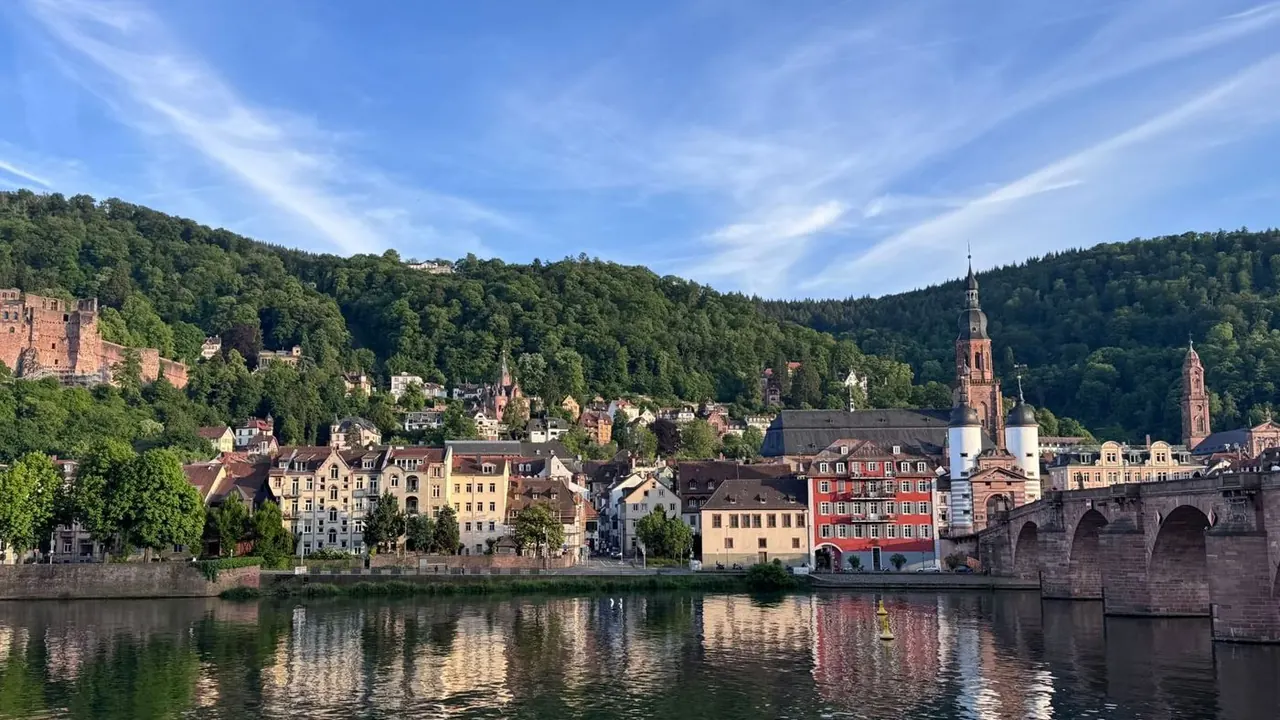
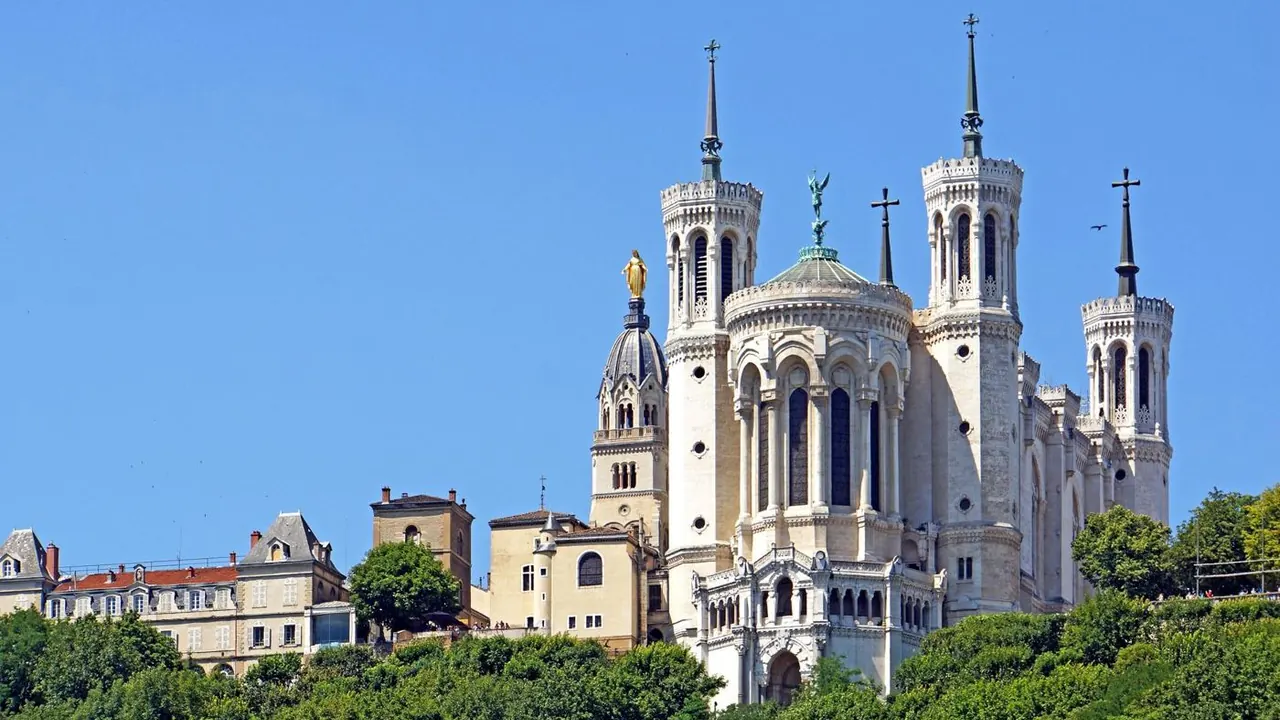
Photos: Heidelberg by Kuanling Chen, Pexels License; Lyon by Dennis G. Jarvis, CC BY-SA 2.0, cropped.
Heidelberg or Lyon?
Our verdict in twelve categories, each scored against the same fixed benchmark cities, and the climate month by month, so you can choose for your trip.
Choose Heidelberg for
- wellness
- day trips
Heidelberg suits a slower, smaller trip: a castle ruin above a well-preserved old town, forest paths starting at the edge of the streets, and a wine tavern to end the day. It is easy to take in over a long weekend. With the Rhine-Neckar trains on your doorstep it also works well as a base for cathedral towns, monasteries and Neckar castles, especially if you want thermal baths within easy reach.
Choose Lyon for
- food and drink
- nightlife
- live music and the arts
Lyon is the stronger choice if you travel to eat, see and go out. Its bouchons, markets and fine-dining tradition are in another league, and Roman Fourvière, Renaissance Vieux Lyon and a major art museum need several full days. Add opera, a serious dance scene and bars on barges along the Rhône, and it rewards a longer stay with fuller evenings.
Scoreboard
Twelve categories on one fixed scale from 0 to 100. The shaded stretch is the gap between the two.
Your match
Pick a travel style or drag the sliders, and both match scores follow your weighting.
Wins on wellness and day trips with your weighting.
Wins on food and drink and nightlife with your weighting.
What matters to you?
Category by category
What the scores mean for a trip.
Beaches & swimming
Neither city is anywhere near the sea, so swimming in either means a lake or a pool. Lyon has slightly better options. Its park at Miribel-Jonage has a supervised bathing lake on the edge of the city, and the clear Alpine water of Lake Annecy is a day out away. In Heidelberg, swimmers use outdoor pools or the gravel-pit lakes on the Rhine plain about half an hour out.
Food & drink
This is where the two differ most. Heidelberg eats the hearty way of Baden and the Kurpfalz: Maultaschen, Schäufele, Flammkuchen and white asparagus in spring. Its real strength is the Bergstrasse and Palatinate wine. The best meals are in Neuenheim and the village wine taverns, not the tourist strip below the castle.
Lyon is one of the great food cities of France. The bouchon is a dining tradition of its own, and the fine-dining heritage goes back to the Mères lyonnaises. Les Halles Paul Bocuse and the Sunday markets along the Saône are destinations in themselves, with Beaujolais and northern Rhône wine on hand. A food lover will find far more to explore here.
Culture & sights
Heidelberg gives you one beautiful, concentrated scene. The red sandstone castle ruin looks down on the baroque Altstadt and the Old Bridge, and the university, founded in 1386, adds the Old University and the graffiti-covered Student Prison. Most visitors have seen it in a day or two.
Lyon spans two thousand years and needs several days. The Roman theatres and Gallo-Roman museum sit on Fourvière, and below them is Renaissance Vieux Lyon with its traboules. The Musée des Beaux-Arts is one of the finest in France, and there are the silk-weavers' buildings of Croix-Rousse and the Institut Lumière, where cinema began. It has no single famous landmark like Heidelberg's castle, but there is much more to see.
Nightlife
Heidelberg's evenings centre on the Untere Strasse: small pubs, old student taverns with carved tables, and a few late bars, all busiest in term time. Outside term the town goes quiet early, and anyone after a big club night takes the train to Mannheim or Frankfurt.
Lyon offers more choice. You can start in cocktail and wine bars on the Presqu'île, carry on in the barges moored along the Rhône, and end in warehouse clubs towards Gerland, a scene that also hosts the Nuits Sonores festival each spring. It too gets quieter outside weekends, but there is far more on.
Nature & outdoors
The two are fairly level here, but the outdoors works differently in each. In Heidelberg the forest starts at the edge of the old town. The Philosophers' Walk, the trails on the Königstuhl and the Celtic ramparts on the Heiligenberg can all be reached on foot or by funicular. Lyon's green life is more urban, with long car-free quays along the Rhône and the big Parc de la Tête d'Or. With a car, though, Lyon can reach the limestone massifs of Chartreuse and Vercors and the high Alps, which is steeper and wilder country than the Odenwald or the Palatinate Forest.
Day trips
Both are excellent bases, and the difference is in the themes. From Heidelberg you can reach the great Romanesque cathedrals of Speyer and Worms, the abbeys at Lorsch and Maulbronn, the castles along the Neckar and the half-timbered villages of the Palatinate Wine Route, most of them easily by train on one regional fare.
Lyon looks towards Roman Vienne, the hill village of Pérouges, the Beaujolais and the Burgundy towns around Beaune. In the other direction it reaches Annecy's lake and the Alps, so you get mountain scenery that Heidelberg's outings don't offer.
Good for families
Both are easy with children, with different highlights. In Heidelberg the funicular ride itself is the treat, with a small fairy-tale park at the top, and the Technik Museum Speyer lets children climb into aircraft and a submarine. Lyon puts its best outings in town: a free zoo, pedalos and pony rides in the Parc de la Tête d'Or, dinosaur skeletons at the Musée des Confluences and Guignol puppet shows. In both cities the hilly old lanes are hard work with a pushchair.
Getting around
Getting around is easy in both cities, with a slight edge to Lyon. Heidelberg is basically one long walk along the pedestrian Hauptstrasse. The only rides you'll need are a tram in from the distant station and the funicular up the castle hill.
Lyon is larger, but its metro, trams, funiculars and bike-share all run on one ticket, and the airport has its own tram link. The Presqu'île is flat and easy to walk. The hills mean the odd climb or change, but you'll rarely be far from a stop.
Shopping & style
Heidelberg's shopping is essentially one street. High-street chains line the western end of the Hauptstrasse, and cuckoo clocks, beer steins and Studentenkuss chocolates fill the eastern end. Serious fashion shoppers head to Frankfurt.
Lyon offers much more. There are luxury labels around Place des Jacobins, a huge mall at Part-Dieu, silk scarves from its weaving heritage, designer workshops on Croix-Rousse and antique dealers on the rue Auguste Comte. Each city's best souvenir is something to eat or drink: Bergstrasse wine from Heidelberg, pralines and charcuterie from Lyon.
Affordability
Overall costs are much the same, but the pressure points differ. In Heidelberg the problem is rooms: there aren't many, and congresses and summer weekends fill them, so many visitors stay in Mannheim and come in by train. Lyon has plenty of hotels for most of the year but gets tight during trade fairs and the Fête des Lumières. In both, eating is where you save, through student cafés and taverns in Heidelberg and generous bouchon set lunches in Lyon.
Live music & performing arts
Heidelberg does well for a small town. The municipal theatre stages opera and drama, the Heidelberger Frühling festival brings chamber music in spring, and in summer plays and concerts are staged in the castle courtyard against the ruins.
Lyon has a bigger and stronger stage scene. There's the Opéra under its glass vault, the Orchestre National, the grand Célestins playhouse and, above all, dance, with the Maison de la Danse and the Biennale. Its summer equivalent of Heidelberg's castle stage is the Nuits de Fourvière, held in the Roman theatres above the city.
Wellness & relaxation
Neither city has baths of its own, but Heidelberg has the edge for proper thermal bathing. The Kraichgau's saline pools and saunas are about half an hour away and Baden-Baden about an hour, while Lyon's nearest equivalent, Aix-les-Bains, is a longer outing. The way to relax differs too: in Heidelberg it is evenings on the Neckar meadows and quiet forest paths, in Lyon long lunches, a hammam and Sunday mornings by the Saône.
When should you go?
Pick your month. The climate figures are measured averages, not a forecast.
Heidelberg in July
Lyon in July
Daytime high, °C
Rainfall in the month, mm
Temperature and rainfall are climate normals, averaged over the years shown. Heidelberg: 1991-2020 normals, Heidelberg (4.5 km from centre). Lyon: 1991-2020 normals, Lyon / Bron (10.6 km from centre).
Heidelberg is at its best from May to September. Highs reach about 26°C in July and August, which is warm enough for long evenings on the Neckar meadows but not too hot for the climb to the castle. Summer is also its wettest season, with around 80mm in July, so expect some showery days among the sunny ones. April and September are mild and good for walking the Altstadt and the forest trails. Winters are grey and cold, with highs near 5°C in January and very little sun.
Lyon is a couple of degrees warmer, reaching about 28°C in July and August, and it gets clearly more sunshine in June and July. Midsummer afternoons on the Presqu'île can feel hot for sightseeing. That makes June the most comfortable month, with long sunny days and warmth that hasn't yet turned heavy. May and September have pleasant temperatures but are often showery, and the rain builds through autumn to about 101mm in October, the wettest month of the year. Heidelberg gets most of its rain in high summer, but Lyon's driest months are in late winter, and July is drier than the months either side of it.
Which traveller are you?
For a food and nightlife trip, Lyon is the clear pick. Bouchon dinners, Les Halles Paul Bocuse and Beaujolais within reach can lead on to wine bars on the Presqu'île, barge bars on the Rhône and proper electronic club nights. Heidelberg's student pubs can't match that.
On a culture and arts trip, Lyon again has more to offer: Roman theatres, one of Europe's largest Renaissance quarters, a major fine-arts museum, and opera and dance at a level Heidelberg's municipal theatre and spring festival don't reach.
For a short city break, Heidelberg works better. The castle, Old Bridge, university and Student Prison fit into a day or two along one walkable street, and a funicular ride takes you up into the forest. Lyon needs more time to do it justice.
Before you go
| Measure | Heidelberg | Lyon |
|---|---|---|
| Official language | German | French |
| Currency | Euro (EUR) | Euro (EUR) |
| Sockets | CF230 V, 50 Hz | CE230 V, 50 Hz |
| Driving side | Right | Right |
| Time zone | UTC+1, UTC+2 in summer | UTC+1, UTC+2 in summer |
| Emergency number | 112 | 112 |
| Elevation | 114 m | 160 m |
| Main airport | Frankfurt Main Airport (FRA)69 km from centre281 non-stop destinations | Lyon Saint-Exupéry Airport (LYS)20 km from centre141 non-stop destinations |
| Public holidays this year | 12 days | 11 days |
By the numbers
| Measure | Heidelberg | Lyon |
|---|---|---|
| City population | 156,092 | 519,127 |
| People per km² | 1,433 | 10,838 |
| Museums within 10 km | 17 | 43 |
| UNESCO World Heritage sites within 50 km | 4 | 2 |
Where else could you go?
Every comparison below shares a destination with this one, so you can follow Heidelberg or Lyon somewhere new.