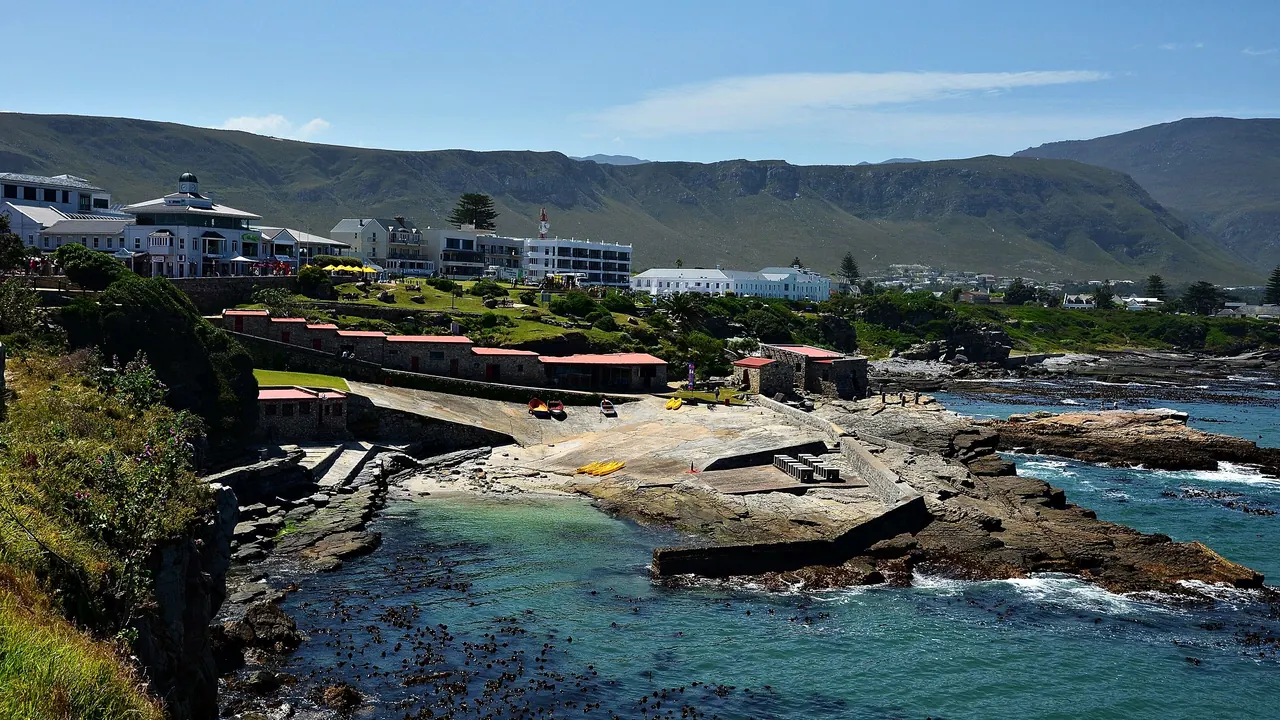
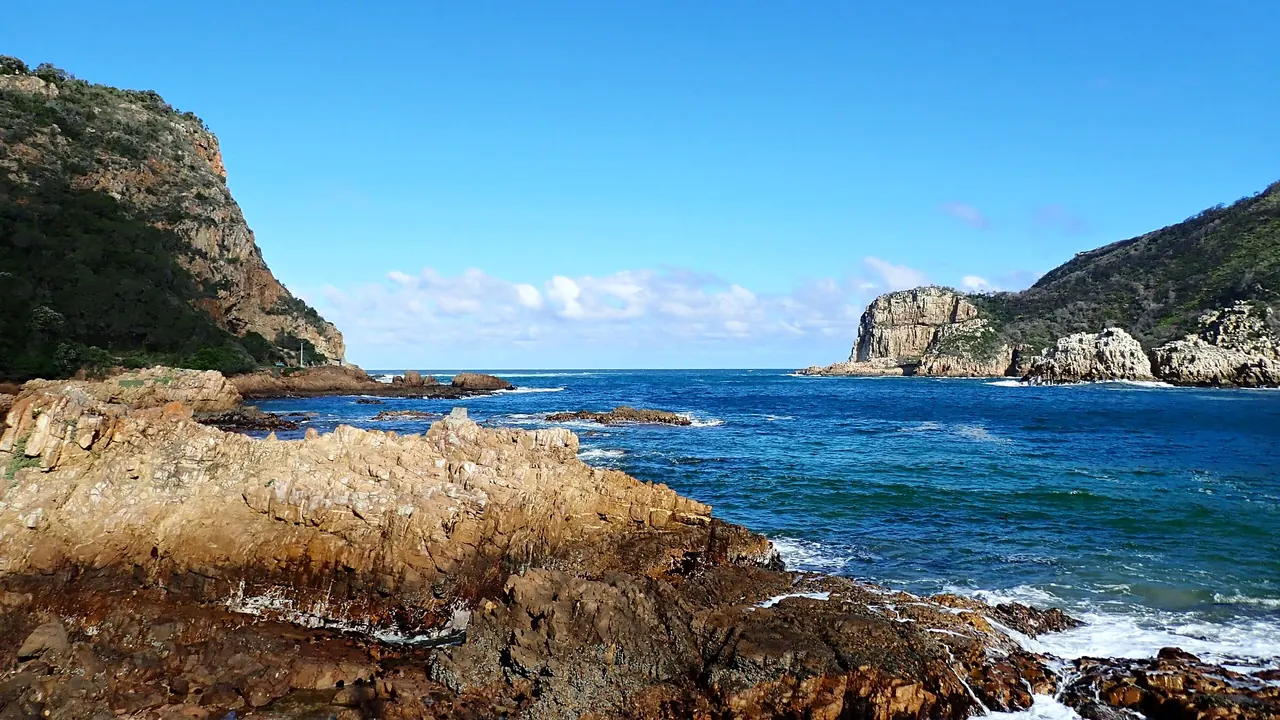
Photos: Hermanus by Pavel Špindler, CC BY 3.0, cropped; Knysna by Andrawaag, CC BY-SA 4.0, cropped.
Hermanus or Knysna?
Our verdict in twelve categories, each scored against the same fixed benchmark cities, and the climate month by month, so you can choose for your trip.
Choose Hermanus for
- day trips
- getting around
- food and drink
Hermanus is the pick if the southern right whales are the main reason for the trip. From the cliff path you can watch them in the bay from land, and the Hemel-en-Aarde wine estates are just behind the town. It also suits travellers who want to fit in Cape Town, Stellenbosch or Cape Agulhas, because all of them make a comfortable day's drive. Summers here are drier and sunnier, but the sea stays cold.
Choose Knysna for
- beaches
- families
- shopping
Knysna suits a slower stay built around forest and lagoon. You can walk under old yellowwoods in the morning and paddle on the lagoon in the afternoon. The sea is warmer, Plettenberg Bay's sheltered beaches are close by, and the elephant sanctuaries and animal parks give children more to do. The trade-off is distance: the places within reach are smaller coastal and Karoo towns, not Cape Town or the Winelands.
Scoreboard
Twelve categories on one fixed scale from 0 to 100. The shaded stretch is the gap between the two.
Your match
Pick a travel style or drag the sliders, and both match scores follow your weighting.
Too close to call, level with your weighting
Wins on day trips and getting around with your weighting.
Wins on beaches and families with your weighting.
What matters to you?
Category by category
What the scores mean for a trip.
Beaches & swimming
Hermanus has sand right in town. Grotto Beach runs for kilometres towards De Kelders, and Voëlklip and Kammabaai are good for surfers. The problem is Walker Bay's cold water, which makes most swims short and bracing. The Klein River lagoon and the tidal pools are where people swim calmly.
Knysna's open-sea beaches mean a short drive, but the swimming is better once you get there. The water is a couple of degrees warmer, Plettenberg Bay has the most sheltered beaches on the coast, and the lagoon sandbanks at Leisure Isle give children calm, shallow water. Rip currents mean you should stay near the lifeguards.
Food & drink
The two eat about equally well, and both are mostly about seafood. The difference is what comes with it. In Hermanus that is wine: the Hemel-en-Aarde estates serve lunch among the vines, and farmed abalone appears on menus around the Old Harbour. Knysna's speciality is oysters farmed in its own lagoon, celebrated at the winter Oyster Festival, along with a local brewing tradition and long meals on Thesen Island's waterfront.
Culture & sights
Neither town is a sightseeing destination, and each takes about an afternoon. Hermanus's heritage is maritime, with fishing boats and stone slipways at the Old Harbour and the Whale House Museum. Knysna's is about forest and gold: the 1850s stone church at Belvidere, the ruins of the Millwood gold-rush settlement, and museums on the timber trade.
Nightlife
Evenings are quiet in both and centre on sundowners. In Hermanus that means wine bars and terraces in the village centre, and the town is mostly asleep by eleven. Anyone after a late night has to drive back to Cape Town.
Knysna has a little more going on, with a few pubs open after dinner on the waterfront and real peaks during the Oyster Festival and the Pink Loerie Mardi Gras. There are still no clubs worth planning around.
Nature & outdoors
Both are outstanding, but in different ways. Hermanus is about the sea and the open slopes. From June to November southern right whales calve close to the cliff path. Fernkloof's fynbos climbs the mountains behind the town, and the coast road leads to the penguins at Stony Point.
Knysna is about forest and lagoon. Trails run under yellowwood and stinkwood at Diepwalle and Harkerville, there is mountain biking in the plantations, and the lagoon suits kayaking and sailing. Robberg's walk past its seal colony and the Tsitsikamma gorge are close enough for a day out each. Whales also come into Knysna's waters, but Hermanus's cliff path is the stronger draw for watching them.
Day trips
Hermanus has much better places within reach. Cape Town is about an hour and a half away along a dramatic coastal road, the Cape Dutch estates of Stellenbosch and Franschhoek are under two hours inland, and Cape Agulhas, the southern tip of Africa, is a long but rewarding drive east. Stanford, Greyton and Elim add quieter villages.
From Knysna the outings are pleasant but smaller. Plettenberg Bay, Wilderness and Mossel Bay are coastal towns. The best day crosses the Outeniqua passes into the Little Karoo for Oudtshoorn's ostrich-boom mansions and the Cango Caves.
Good for families
Knysna has more to keep children busy. You can walk with rescued elephants, and a primate park, a free-flight aviary and the wildlife sanctuaries near Plettenberg Bay fill whole days. Boat trips through the Heads are an easy outing, and the lagoon flats suit small children.
Hermanus is gentler and has less to fill the days. Whale spotting from the cliffs, the rock pools and short Fernkloof trails are good fun, but the cold sea limits beach time and there are no animal parks to fall back on.
Getting around
Both need a car, and both have only a small walkable core. In Hermanus that core is the village centre and the cliff path, which links several coves. In Knysna it is the town centre, the waterfront and Thesen Island. The arrival also differs: Hermanus is usually a drive of about 120km from Cape Town, while Knysna visitors tend to fly into George, an hour away, and hire a car there.
Shopping & style
Shopping is modest in both, and Knysna has a little more to browse. Its Thesen Island boutiques and galleries are joined by furniture makers and woodturners working local yellowwood and stinkwood. In Hermanus the galleries and craft stalls near the Old Harbour are small, and the best thing to take home is wine bought at the Hemel-en-Aarde estates.
Affordability
Both are good value for visitors from Europe or North America. Meals and wine are cheap, and self-catering cottages are roomy. Car hire and the December and January school vacation push costs up in both places. Hermanus also gets pricier in peak whale season, when boat trips add to the bill. In Knysna most forest and lagoon activities cost little.
Live music & performing arts
There is little formal performance in either town. Hermanus has a yearly arts festival with chamber music, and Cape Town's concert halls and theatres are an evening's drive away. Knysna leans more towards pub bands at weekends and street performance at its festivals, and it is too far from any major city for a night at the theatre.
Wellness & relaxation
Both are places to slow down rather than to take a cure, and neither has thermal baths. Hermanus's version is outdoors: walks along the cliff path, long lunches at the wine farms and a cold morning dip in the tidal pools. Knysna offers more quiet retreat, with spas at forest lodges, yoga retreats in the hills and slow mornings on a lagoon deck.
When should you go?
Pick your month. The climate figures are measured averages, not a forecast.
Hermanus in July
Knysna in July
Daytime high, °C
Rainfall in the month, mm
Where the figures come from
Hermanus's temperatures are measured 77 km from the centre, at Cape Town Airport.
Hermanus has no rain gauge within 25 km of the centre, so its rainfall comes from a gridded climate dataset read at the city rather than from a gauge further away.
Knysna's temperatures are measured 62 km from the centre, at George, George Airport.
Knysna's station stands 184 m above the city centre, so the centre is likely a little warmer than the figures say.
Knysna has no rain gauge within 25 km of the centre, so its rainfall comes from a gridded climate dataset read at the city rather than from a gauge further away.
Temperature and rainfall are climate normals, averaged over the years shown. Hermanus: 1991-2020 normals, Cape Town Airport (76.8 km from centre). Knysna: 1991-2020 normals, George, George Airport (61.5 km from centre).
Hermanus has two clear seasons. From December to March it is dry, very sunny and warm, with highs reaching 28°C. That is the time for the beach, although Walker Bay stays cool even then, at about 19°C. From June to August the rain sets in heavily, with close to 100mm a month, and the days turn cool enough that you will want a jacket on the cliff path. Those are also the whale months, so the wet season is still worth it if you dress for it.
Knysna is milder all year. It is never really hot and rarely cold, so the streets and forest trails are good for walking in every season. Rain is spread across the year rather than falling in one season, and the wettest spell is October and November. Summers get noticeably less sunshine than in Hermanus. The sea is warmer, though, reaching about 21°C from January to March, which makes late summer the best time to swim.
Which traveller are you?
For wine lovers, Hermanus is the obvious base. Some of South Africa's finest cool-climate Pinot Noir and Chardonnay grows in the valley just behind town, and the Winelands are a day's drive away. Knysna serves good Cape wines, but its own tradition is oysters and beer.
On a beach and sun trip, Hermanus has sand in town and the sunnier summer, but its sea is for brave swimmers. If you want to spend hours in the water, Knysna is the better choice: its sea is warmer and it has more beaches within easy reach.
On a family trip with children, Hermanus suits a quiet week by the coast, though livelier children may run out of things to do. Knysna gives active children much more to do, with whole days spent among animals, out on boats and in the forest.
Before you go
| Measure | Hermanus | Knysna |
|---|---|---|
| Official language | English, Zulu, Xhosa, Afrikaans, Venda, Northern Sotho, Swazi, Tswana, Tsonga, Sesotho, Southern Ndebele, South African Sign Language | English, Zulu, Xhosa, Afrikaans, Venda, Northern Sotho, Swazi, Tswana, Tsonga, Sesotho, Southern Ndebele, South African Sign Language |
| Currency | Rand (ZAR) | Rand (ZAR) |
| Sockets | CMN230 V, 50 Hz | CMN230 V, 50 Hz |
| Driving side | Left | Left |
| Time zone | UTC+2 | UTC+2 |
| Emergency number | 112 | 112 |
| Elevation | 27 m | 9 m |
| Main airport | Cape Town International Airport (CPT)77 km from centre45 non-stop destinations | George Airport (GRJ)62 km from centre4 non-stop destinations |
| Public holidays this year | 13 days | 13 days |
By the numbers
| Measure | Hermanus | Knysna |
|---|---|---|
| City population | - | 51,078 |
| People per km² | - | 469 |
| Museums within 10 km | 0 | 0 |
| UNESCO World Heritage sites within 50 km | 0 | 0 |
| Swim season, months above 21 °C | None | 1 month |
Where else could you go?
Every comparison below shares a destination with this one, so you can follow Hermanus or Knysna somewhere new.
- Stellenboschvs Hermanus
- Cape Townvs Hermanus
- Stellenboschvs Knysna
- Cape Townvs Knysna
- Durbanvs Knysna
- Johannesburgvs Knysna