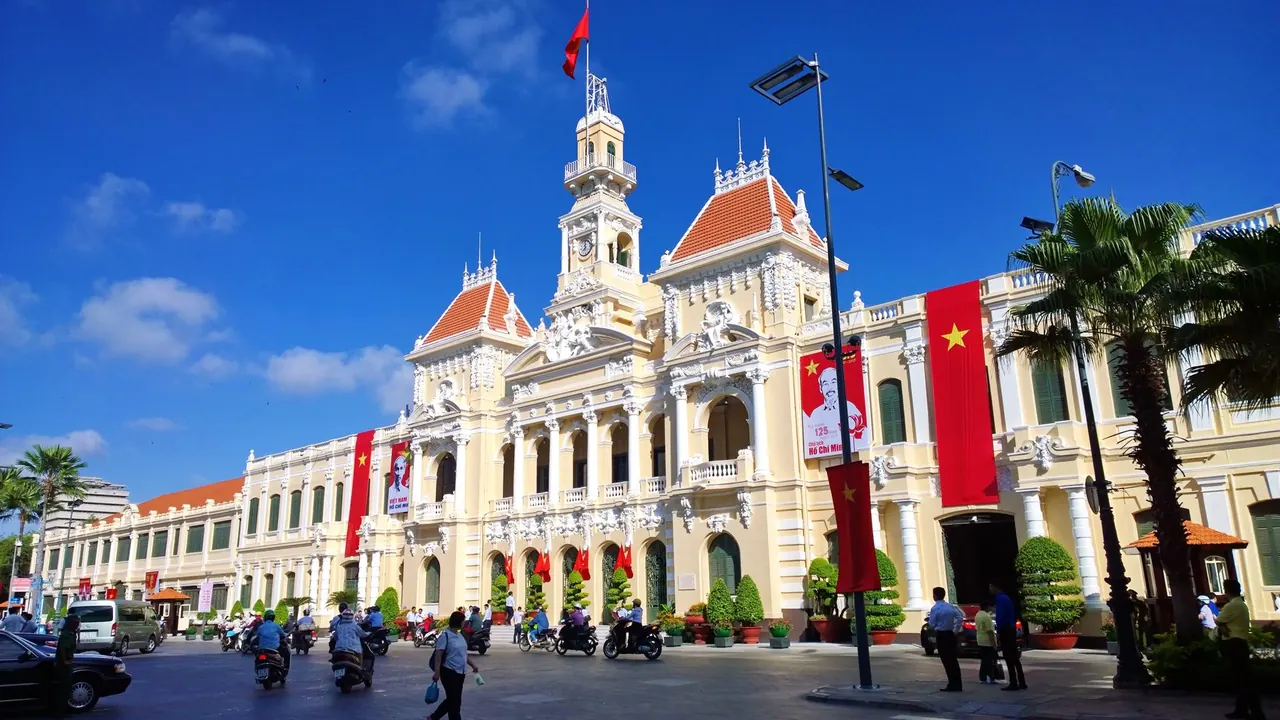
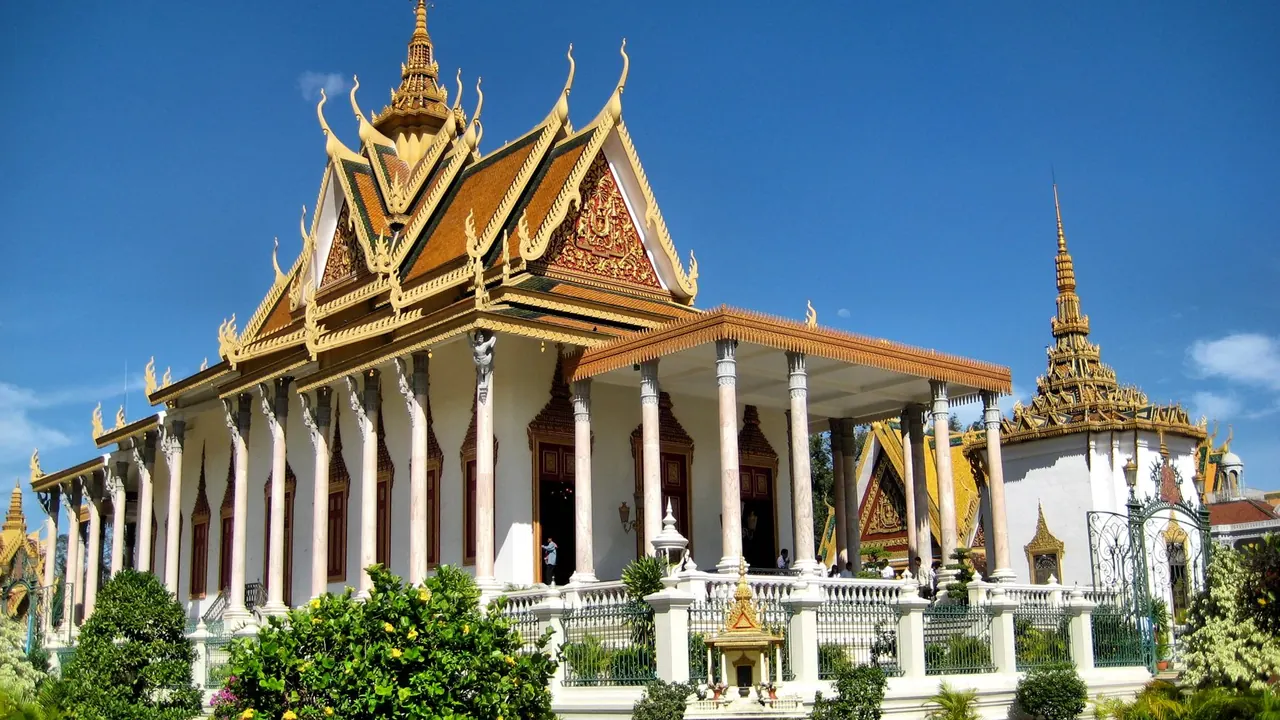
Photos: Ho Chi Minh City by trungydang, CC BY 3.0, cropped; Phnom Penh by Francisco Anzola, CC BY 2.0, cropped.
Ho Chi Minh City or Phnom Penh?
Our verdict in twelve categories, each scored against the same fixed benchmark cities, and the climate month by month, so you can choose for your trip.
Choose Ho Chi Minh City for
- food and drink
- day trips
- beaches
Ho Chi Minh City suits travellers who want to eat their way through a city and stay out late. Its street food runs from the Chinese-Vietnamese kitchens of Cholon to the shellfish stalls that fill after dark, and its evenings go from Bui Vien's neon to rooftop cocktails. The Cu Chi tunnels, the Mekong Delta and Vung Tau make for more varied days out, and cheap massages and long shampoo rituals make a longer stay in the heat easy to bear.
Choose Phnom Penh for
- culture and sights
Phnom Penh is the better choice for a trip built around history. The Royal Palace, the Silver Pagoda and the Angkorian sculpture of the National Museum stand within a short walk of each other on the riverfront, while Tuol Sleng and Choeung Ek tell the Khmer Rouge story without softening it. The city is smaller and slower than Saigon, with a compact late-night scene. It works best as one stop on a wider Cambodia route that also takes in Angkor and the coast.
Scoreboard
Twelve categories on one fixed scale from 0 to 100. The shaded stretch is the gap between the two.
Your match
Pick a travel style or drag the sliders, and both match scores follow your weighting.
Wins on food and drink and day trips with your weighting.
Wins on culture and sights with your weighting.
What matters to you?
Category by category
What the scores mean for a trip.
Beaches & swimming
Neither city is a place to swim, and both leave you relying on a hotel or rooftop pool. Ho Chi Minh City has the easier escape. Vung Tau is about two hours away by road or by fast boat down the Saigon River, though its water is often cloudy and its sand is crowded at weekends.
From Phnom Penh the coast at Kep and Kampot is about three hours by road, and the island beaches need an overnight stay. That makes the sea a separate stop on the route, not an outing.
Food & drink
Food is where Ho Chi Minh City pulls furthest ahead. Southern cooking at the pavement stools is sweet and full of herbs, Cholon has a Chinese-Vietnamese cuisine of its own, and the coffee goes from drip over condensed milk to coconut and egg versions. Above street level there are modern Vietnamese kitchens, French bistros and the international spread of Thao Dien.
Phnom Penh's Khmer cooking is gentler and well worth exploring, from fish amok and lok lak to morning bai sach chrouk at the Russian Market counters. NGO training restaurants add interest, but the higher tier and the international range are much narrower.
Culture & sights
Both cities' sights carry the weight of the twentieth century's wars. Phnom Penh adds a royal and Angkorian layer that Saigon lacks. The gilded Royal Palace, the silver-floored pagoda and the National Museum's sculpture stand together on the riverfront, and Tuol Sleng and Choeung Ek are harder still than anything in Saigon.
Ho Chi Minh City's strengths are the War Remnants Museum, the Reunification Palace frozen in 1975 and the French landmarks around Dong Khoi, along with the incense-filled assembly halls of Cholon. Beyond that core it is mostly modern.
Nightlife
Ho Chi Minh City has the wider night out. You can choose between the loud walking street of Bui Vien, rooftop bars above Nguyen Hue, cocktail rooms hidden in old apartment blocks and clubs full of young locals, with a calmer expat scene across the river in Thao Dien.
Phnom Penh's scene is smaller and looser, packed into a few blocks around Bassac Lane, the riverside and Street 51. Some of its late bars keep going into the early morning, longer than most in Saigon, but part of the riverside strip is rough.
Nature & outdoors
Both are flat, hot river cities with little green space, so the difference lies in what is nearby. Ho Chi Minh City has the Can Gio mangroves with their boardwalks and macaques, and the canals of the Mekong Delta two hours south. Phnom Penh offers easy cycling on Koh Dach island, the Phnom Tamao wildlife rescue centre and, unlike Saigon, real hills and pine forest at Kirirom within a long day's reach.
Day trips
Saigon's day trips have more pull. The Cu Chi tunnels pair well with the pastel Cao Dai Holy See at Tay Ninh, My Tho and Ben Tre offer boat rides through the Delta's canals, and Vung Tau adds a seaside town with a lighthouse.
Phnom Penh's outings are quieter. There are the stupa-covered ridge at Oudong, the old temples at Tonle Bati and Phnom Chisor, and the pottery town of Kampong Chhnang. They make pleasant days, but Cambodia's headline places, Angkor and Kampot, are too far for a return trip in a day.
Good for families
Children get a warm welcome in both cities, and in both the traffic and heat make walking hard work. Ho Chi Minh City has more to do on purpose for them: the Dam Sen rides and water park, the eccentric Suoi Tien park and the zoo in the centre.
In Phnom Penh the main sights, Tuol Sleng and the killing fields, are unsuitable for children. Days lean on Phnom Tamao, river cruises and mall ice rinks, so it suits families already used to Southeast Asia.
Getting around
Getting around is about equally awkward in both, and in both ride-hailing apps do most of the work. Ho Chi Minh City has a single metro line east from Ben Thanh and a river bus, which Phnom Penh lacks. There, tuk-tuks take the place of cars, and the broken pavements make even the short walk between riverfront sights slow. Keep your phone and bag away from the kerb in either city.
Shopping & style
Ho Chi Minh City gives you more to buy. You can haggle at Ben Thanh, browse the wholesale floors of Binh Tay, have a suit or ao dai made by a tailor within days, and find lacquerware and Song Be ceramics as well as luxury labels in the Dong Khoi malls.
Phnom Penh has no luxury street, but the Russian Market's silks and silver, the art deco Central Market and the fair-trade shops around Street 240 are good for textiles, crafts and Kampot pepper.
Affordability
Both are very cheap if you eat where locals eat, and Ho Chi Minh City comes out slightly cheaper. Its pavement meals, draught beer and motorbike taxis cost next to nothing. In both cities anything imported, from wine to international hotels, costs close to Western prices. In Phnom Penh the gap between a market-and-tuk-tuk trip and a hotel-and-cocktails trip shows up most sharply in the final bill.
Live music & performing arts
Neither city is worth a trip for its stage, but Saigon has more evenings to fill. The French Opera House hosts the ballet, the symphony orchestra and acrobatic shows about village life, water puppetry plays in the centre and cai luong opera survives in a few theatres.
Phnom Penh's draw is classical Khmer dance, the apsara repertoire rebuilt after the Khmer Rouge years. It is staged near the National Museum and at the Chaktomuk Theatre. There is no opera or orchestra.
Wellness & relaxation
Ho Chi Minh City is easier for being looked after. Foot and body massage parlours run late, the long reclining shampoo with herbal water and warm towels is a daily ritual for locals, and day spas add hot stones and steam.
Phnom Penh has Khmer massage on most streets and blind-masseur centres, and its leafy villa hotels can feel quieter than anywhere in Saigon. Its overall menu of treatments is smaller, though.
When should you go?
Pick your month. The climate figures are measured averages, not a forecast.
Ho Chi Minh City in July
Phnom Penh in July
Daytime high, °C
Rainfall in the month, mm
Where the figures come from
Ho Chi Minh City has no rain gauge within 25 km of the centre, so its rainfall comes from a gridded climate dataset read at the city rather than from a gauge further away.
Temperature and rainfall are climate normals, averaged over the years shown. Ho Chi Minh City: 1991-2020 normals, Ho Chi Minh (6 km from centre). Phnom Penh: 1991-2020 normals, Phnom-Penh / Pochentong (8 km from centre).
Both cities are hot all year, with daytime highs that barely drop below 31°C, so the real choice is about rain. In Ho Chi Minh City the dry season runs from December to April, and February and March are almost rainless. April is the hardest month for walking the streets, at around 35°C. The wet season arrives suddenly in May and stays heavy until October at roughly 280mm a month. For a beach detour to Vung Tau, the sea is warm at any time of year, between 26°C and 30°C.
Phnom Penh follows the same pattern with a gentler start. Rain builds slowly through April and the early summer, then peaks in September and October rather than staying heavy from May. April is its hottest month too, and a little fiercer than in Saigon. December to February is the most comfortable window in both cities, and the best time for a trip that combines them.
Which traveller are you?
On a food and nightlife trip, choose Ho Chi Minh City. Eating is the point of the place, pavement meals and fresh draught beer cost very little, and evenings range from Bui Vien's neon to rooftop cocktails. Phnom Penh eats well on a smaller scale.
For a culture and arts trip, Phnom Penh gives you more to think about. Saigon's sights are mostly twentieth-century, though its Opera House fills more evenings. Phnom Penh adds the Royal Palace, Angkorian sculpture and the Khmer Rouge memorials, all close together.
On a relaxing and wellness trip, Ho Chi Minh City does more for you. Cheap massage and the long reclining shampoo are part of daily life, easy to repeat after every hot afternoon. Phnom Penh is a gentler city to rest in, with fewer treatments.
Before you go
| Measure | Ho Chi Minh City | Phnom Penh |
|---|---|---|
| Official language | Vietnamese | Khmer |
| Currency | Dong (VND) | Riel (KHR) |
| Sockets | ACFG220 V, 50 Hz | ACG230 V, 50 Hz |
| Driving side | Right | Right |
| Time zone | UTC+7 | UTC+7 |
| Emergency number | Police 113, ambulance 115, fire 114 | Police 117, ambulance 119, fire 118 |
| Elevation | 13 m | 11 m |
| Main airport | Tan Son Nhat International Airport (SGN)7 km from centre90 non-stop destinations | Techo International Airport (KTI)23 km from centre41 non-stop destinations |
| Public holidays this year | - | 21 days |
By the numbers
| Measure | Ho Chi Minh City | Phnom Penh |
|---|---|---|
| City population | 14,002,598 | 2,129,371 |
| People per km² | 2,068 | 3,138 |
| Museums within 10 km | 9 | 3 |
| UNESCO World Heritage sites within 50 km | 0 | 1 |
| Swim season, months above 21 °C | 12 months | - |
Where else could you go?
Every comparison below shares a destination with this one, so you can follow Ho Chi Minh City or Phnom Penh somewhere new.