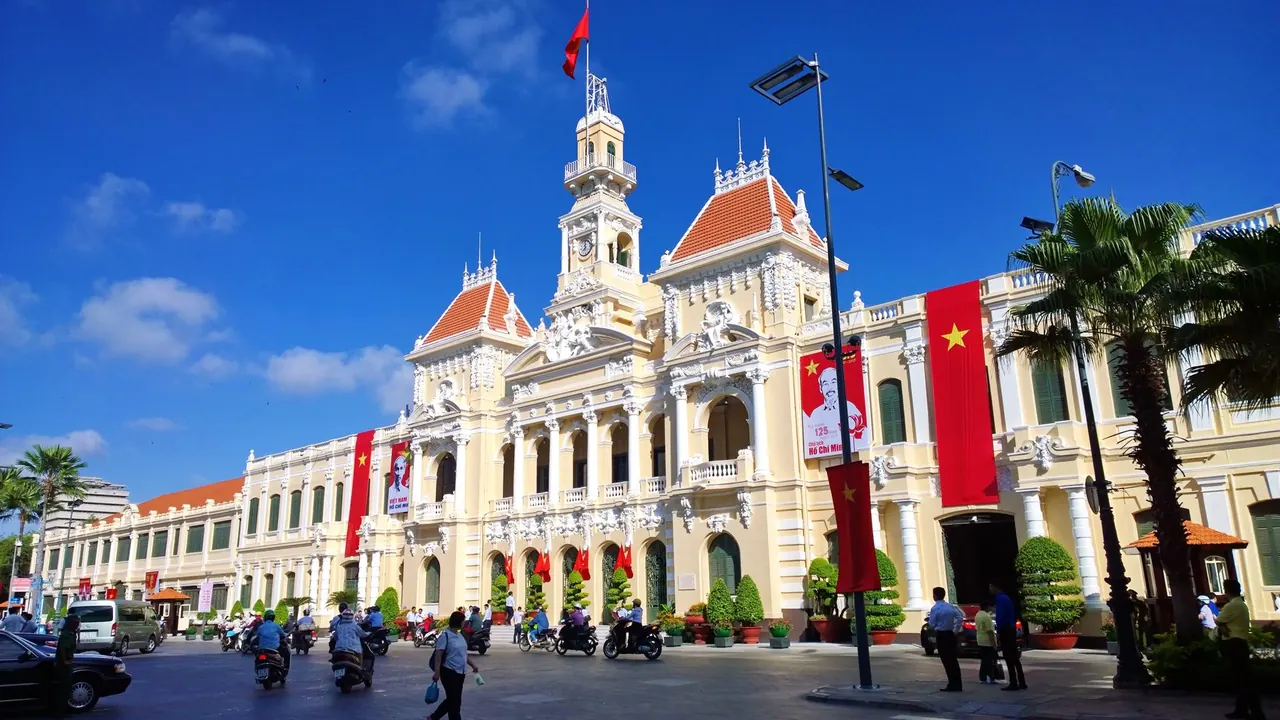
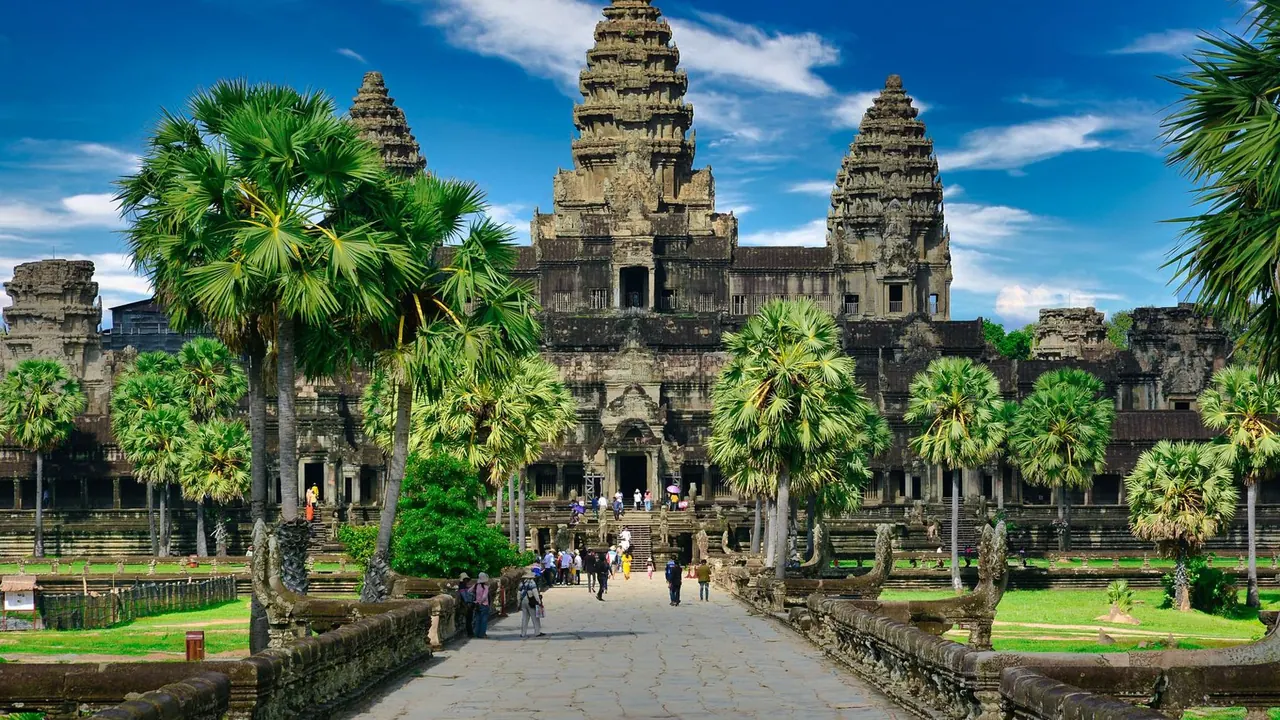
Photos: Ho Chi Minh City by trungydang, CC BY 3.0, cropped; Siem Reap by allPhoto Bangkok, Pexels License.
Ho Chi Minh City or Siem Reap?
Our verdict in twelve categories, each scored against the same fixed benchmark cities, and the climate month by month, so you can choose for your trip.
Choose Ho Chi Minh City for
- food and drink
- nightlife
- shopping
Ho Chi Minh City suits travellers who want a big Asian city to eat and drink their way through. Pavement stalls, Cholon's Chinese-Vietnamese kitchens, a coffee culture of its own and late rooftop bars give it a depth of food and evenings that Siem Reap cannot match. The colonial landmarks and war museums fill two or three days around the meals, and the tailors, markets and Dong Khoi malls make it the better shopping stop.
Choose Siem Reap for
- culture and sights
- nature and the outdoors
Choose Siem Reap if the trip is built around one of the world's great monuments. The Angkor temples, from the Bayon's stone faces to Ta Prohm's tree roots, outweigh every sight Saigon has. The pattern of temples at dawn and afternoons by a garden pool makes for a slower, quieter stay, and the paddies, cycling lanes and the Tonle Sap are close to town.
Scoreboard
Twelve categories on one fixed scale from 0 to 100. The shaded stretch is the gap between the two.
Your match
Pick a travel style or drag the sliders, and both match scores follow your weighting.
Wins on food and drink and nightlife with your weighting.
Wins on culture and sights and nature and the outdoors with your weighting.
What matters to you?
Category by category
What the scores mean for a trip.
Beaches & swimming
Neither city is a beach destination, and in both of them swimming means a hotel pool. Ho Chi Minh City at least has the sea within reach: Vung Tau is about two hours away by road or fast boat, with warm but often cloudy water and weekend crowds.
Siem Reap has nothing like it. The Tonle Sap is a muddy lake that nobody swims in, and the coast is most of a day's drive away, so the pool after a morning at the temples is all the swimming you will get.
Food & drink
The gap here is wide. Ho Chi Minh City is one of Southeast Asia's great eating cities, with broken-rice plates, banh xeo, snail stalls after dark and the Chinese-Vietnamese cooking of Cholon. Alongside these sit a coffee culture of its own, modern Vietnamese restaurants and the international scene in Thao Dien.
Siem Reap eats well if you go looking: fish amok, num banh chok at the morning stalls and a few tasting-menu kitchens working with Khmer ingredients. The centre around Pub Street, though, is mostly backpacker menus, and the range is a fraction of Saigon's.
Culture & sights
Here the order flips sharply. Ho Chi Minh City's sights are about recent history: the War Remnants Museum, the Reunification Palace, the French landmarks around Dong Khoi and the incense-filled assembly halls of Cholon. They are worth seeing, but they fill two or three days rather than justifying the journey.
Angkor is in a different league. Angkor Wat, the stone faces of the Bayon in Angkor Thom and the root-split galleries of Ta Prohm take three days without exhausting the park, and the Angkor National Museum in town adds useful context.
Nightlife
Each city has a loud, neon-lit backpacker strip, Bui Vien in Saigon and Pub Street in Siem Reap. The difference is what lies beyond it. Ho Chi Minh City adds rooftop bars above the skyline, cocktail bars up apartment stairwells, clubs with a young local crowd and the calmer expatriate bars of Thao Dien.
Siem Reap has a few quieter bars along the river and in the side alleys but no club culture, and the dawn starts at Angkor keep most nights short anyway.
Nature & outdoors
Neither city has mountains, but Siem Reap's countryside is easier to get into. Lanes through rice paddies and sugar palms make for gentle cycling, boats cross the Tonle Sap to the stork and pelican colonies at Prek Toal, and Phnom Kulen and Kbal Spean add a waterfall and jungle trails.
Ho Chi Minh City is densely built, and its green space is a few parks such as Tao Dan. The Can Gio mangroves and the Mekong Delta canals are its real nature, and both are a drive away.
Day trips
The two are evenly matched, but the outings differ in theme. From Ho Chi Minh City the days out mix war history and river life: the Cu Chi tunnels, the Cao Dai Holy See at Tay Ninh, boat trips through the Mekong from My Tho and Ben Tre, and the seaside at Vung Tau.
From Siem Reap nearly every trip is another temple, whether the fine pink carving of Banteay Srei, the collapsed and overgrown Beng Mealea or remote Koh Ker. The stilt villages of the Tonle Sap are the alternative. In both, the choice thins out quickly beyond these.
Good for families
Both cities are warm towards children and short on attractions built for them, and in both the heat and traffic make the hotel pool part of every day. Ho Chi Minh City has more to fill an afternoon, with the old zoo and botanical garden, Dam Sen's rides and water park, and the eccentric Suoi Tien.
Siem Reap suits older children better. They will love scrambling through Ta Prohm and taking boats to the stilt villages, but the steep temple steps soon wear out younger ones.
Getting around
Ho Chi Minh City gives you more ways to get about: a walkable colonial core, a metro line running east from Ben Thanh, a river bus, and cheap ride-hailing cars and motorbike taxis everywhere. Its traffic is far heavier, though, and bag snatching from passing bikes means keeping your phone away from the kerb.
Siem Reap has no public transport, so you are driven almost everywhere: by tuk-tuk in town, and by a hired driver or car for the temples. Cycling the flat Angkor circuits is the pleasant exception.
Shopping & style
Ho Chi Minh City gives shoppers far more scope. It has the haggling stalls of Ben Thanh and the wholesale bustle of Binh Tay, tailors who make suits and ao dai within days, and lacquerware and Song Be ceramics, with malls of international labels and the Thao Dien boutiques on top.
Siem Reap is limited to markets and crafts, with no fashion or department stores. Its social-enterprise workshops for silk, stone carving and lacquer do sell pieces of a higher standard than the tourist stalls in either city.
Affordability
Both are very cheap, and anyone eating at stalls will spend little in either. The extra costs fall in different places. In Ho Chi Minh City they come from its business-capital layer of international hotels, rooftop bars and imported wine. In Siem Reap the one big outlay is the Angkor pass, which takes a real bite out of a short stay.
Live music & performing arts
Ho Chi Minh City's French-built Opera House gives it something Siem Reap lacks entirely: a formal stage with its own ballet and symphony orchestra, plus acrobatic shows drawn from southern village life. Water puppetry, the sentimental songs of cai luong in a few surviving theatres and small jazz rooms can fill another evening or two, though it is still a modest scene.
Siem Reap has no theatre or concert hall, so its evenings come down to two things. Apsara dance, the court tradition carved on the temple walls, is best seen at the smaller, more serious performances rather than the buffet halls. The widely admired Cambodian circus under its big top, where young performers tell Khmer stories through acrobatics and live music, is the other.
Wellness & relaxation
Massage is cheap and everywhere in both cities, so the difference is in the setting. Ho Chi Minh City's speciality is the long reclining shampoo with scalp and face massage. Outside the treatment room, though, calm has to be found in the parks at dawn, in temple courtyards or in Thao Dien.
Siem Reap is easier to unwind in. It has garden hotels with pools, Khmer massage, yoga classes and small retreats, and quiet lanes across the river, as long as you stay away from Pub Street.
When should you go?
Pick your month. The climate figures are measured averages, not a forecast.
Ho Chi Minh City in July
Siem Reap in July
Daytime high, °C
Rainfall in the month, mm
Where the figures come from
Ho Chi Minh City has no rain gauge within 25 km of the centre, so its rainfall comes from a gridded climate dataset read at the city rather than from a gauge further away.
Siem Reap has no weather station within reach, so its figures come from a gridded climate model rather than a measured record, and read a broad area rather than the city itself.
Temperature and rainfall are climate normals, averaged over the years shown. Ho Chi Minh City: 1991-2020 normals, Ho Chi Minh (6 km from centre). Siem Reap: 2001-2020 normals, NASA POWER reanalysis grid, no weather station within 90 km.
Both cities are hot all year, so the choice comes down to rain. Ho Chi Minh City is dry from December to April, and February and March are almost rainless. The heat peaks at 35°C in April and May, just before the wet season starts. From May to October it is very wet, at around 280mm a month. The sea at Vung Tau stays warm enough to swim in every month.
Siem Reap's dry season runs from November to April, but February to April is hard going at the temples, with highs of 36°C. The wet season is lighter than Saigon's and peaks in September, and daytime highs ease to about 30°C, which is when the Tonle Sap villages are at their best. For a trip to both cities, December and January are the most comfortable months: dry, and a little less fierce for walking.
Which traveller are you?
On a culture and arts trip, Siem Reap is the clear choice. Angkor's temples need three days or more and reward every hour of them. Ho Chi Minh City's colonial landmarks and war museums are absorbing, but they are done in two or three days.
For a food and nightlife trip, Ho Chi Minh City wins easily. Its southern street cooking, Cholon's markets, serious coffee and evenings that run from Bui Vien to rooftop cocktail bars outclass Siem Reap's Pub Street and its smaller restaurant scene.
On an outdoors trip, Siem Reap has more to offer. Cycling lanes through the paddies, boat trips to the Prek Toal bird sanctuary and forest walks on Phnom Kulen are all close by. Saigon's green escapes are mainly the Can Gio mangroves and the Mekong canals.
Before you go
| Measure | Ho Chi Minh City | Siem Reap |
|---|---|---|
| Official language | Vietnamese | Khmer |
| Currency | Dong (VND) | Riel (KHR) |
| Sockets | ACFG220 V, 50 Hz | ACG230 V, 50 Hz |
| Driving side | Right | Right |
| Time zone | UTC+7 | UTC+7 |
| Emergency number | Police 113, ambulance 115, fire 114 | Police 117, ambulance 119, fire 118 |
| Elevation | 13 m | 18 m |
| Main airport | Tan Son Nhat International Airport (SGN)7 km from centre90 non-stop destinations | Siem Reap-Angkor International Airport (SAI)39 km from centre14 non-stop destinations |
| Public holidays this year | - | 21 days |
By the numbers
| Measure | Ho Chi Minh City | Siem Reap |
|---|---|---|
| City population | 14,002,598 | 147,866 |
| People per km² | 2,068 | - |
| Museums within 10 km | 9 | 6 |
| UNESCO World Heritage sites within 50 km | 0 | 1 |
| Swim season, months above 21 °C | 12 months | - |
Where else could you go?
Every comparison below shares a destination with this one, so you can follow Ho Chi Minh City or Siem Reap somewhere new.