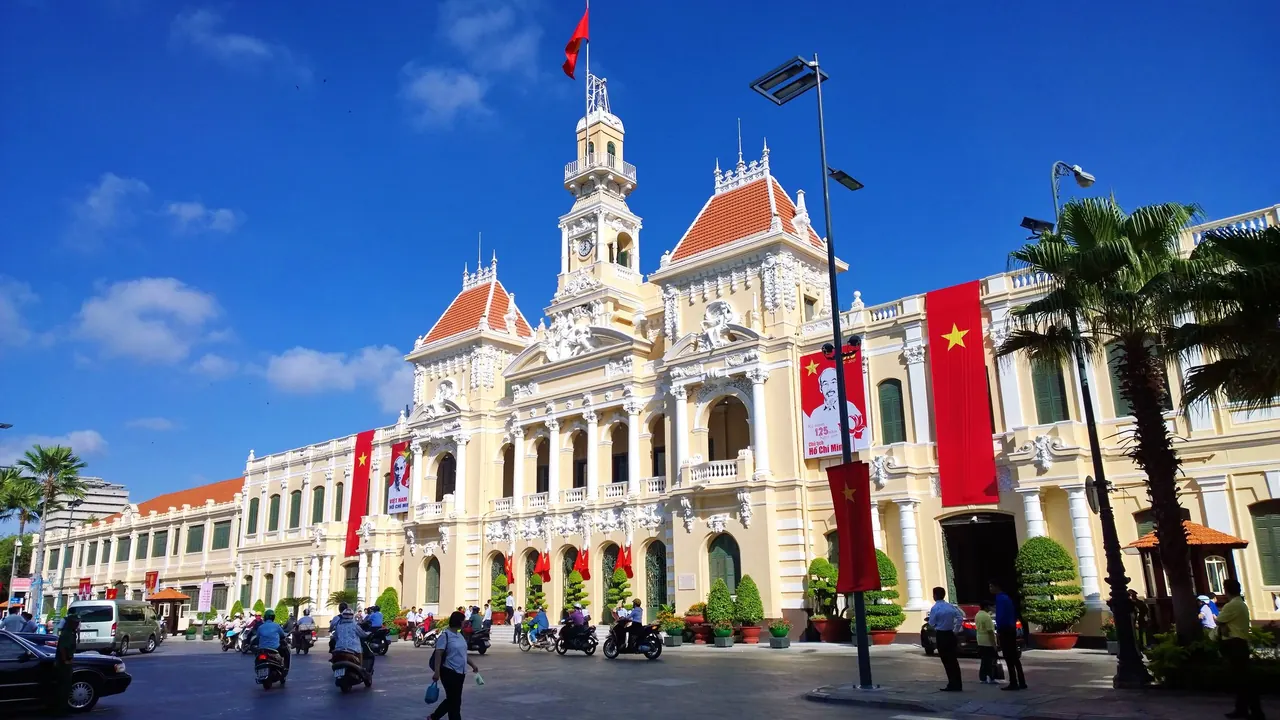
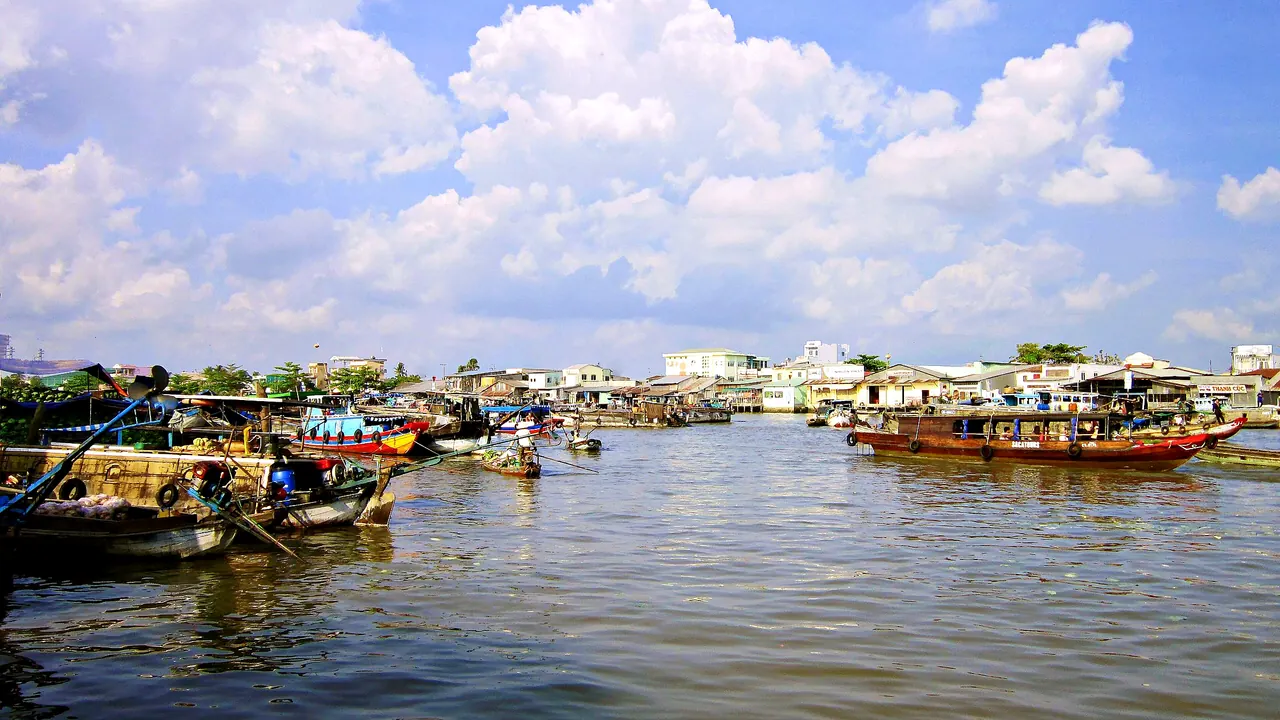
Photos: Ho Chi Minh City by trungydang, CC BY 3.0, cropped; Mekong Delta by Bùi Thụy Đào Nguyên, CC BY-SA 4.0, cropped.
Ho Chi Minh City or Mekong Delta?
Our verdict in twelve categories, each scored against the same fixed benchmark cities, and the climate month by month, so you can choose for your trip.
Choose Ho Chi Minh City for
- nightlife
- shopping
- food and drink
Ho Chi Minh City suits a traveller who wants a city to eat, drink and stay up late in, with the war museums, the French colonial core and the temples of Cholon a short ride apart. The streets are tiring, but massage parlours, rooftop bars, tailors and malls are always close, and a few days give you a full picture.
Choose Mekong Delta for
- nature and the outdoors
- beaches
- prices
For a slower journey through a working landscape of canals, orchards and floating markets, the Mekong Delta is the better pick. You move from Can Tho to Chau Doc and on to the coast at Ha Tien on the Gulf of Thailand. Evenings end early and comforts are simple, but the boats, Khmer pagodas and orchard homestays show a side of Vietnam the city cannot, and the trip costs even less.
Scoreboard
Twelve categories on one fixed scale from 0 to 100. The shaded stretch is the gap between the two.
Your match
Pick a travel style or drag the sliders, and both match scores follow your weighting.
Wins on nightlife and shopping with your weighting.
Wins on nature and the outdoors and beaches with your weighting.
What matters to you?
Category by category
What the scores mean for a trip.
Beaches & swimming
Neither is a beach destination, but the delta at least ends at one. From Ho Chi Minh City, the nearest swimming is at Vung Tau, two hours away, where the water is cloudy and the sand fills with weekend crowds from the city. In town, it means a hotel pool.
Where the delta's rivers meet the sea there is only mud and mangrove too. The far western side is different: around Ha Tien there are small sandy bays with clear water, the quiet islands of Hon Son and Nam Du lie offshore, and the ferry leaves for Phu Quoc. It makes a good beach finish to a delta route, best from November to April.
Food & drink
Ho Chi Minh City has the wider and deeper table. You can eat broken-rice plates and snails on the pavement, try the Chinese-Vietnamese cooking of Cholon, drink strong coffee and climb to a tier of modern Vietnamese and French restaurants above street level. Choice runs from a plastic stool to fine dining.
The delta eats closer to the source. There is river fish grilled in clay, turmeric-yellow banh xeo, Khmer-influenced fermented fish hotpot around Chau Doc and fruit picked straight from the tree in Vinh Long. It is fresh and honest, but outside Can Tho menus are short and the cooking rarely goes beyond home style.
Culture & sights
Ho Chi Minh City gives the more concentrated sightseeing. The War Remnants Museum and the Reunification Palace cover the twentieth century, the cathedral and the iron-vaulted post office stand in the colonial core, and Cholon has its incense-filled assembly halls. All of it fits into two or three days.
The delta has no comparable museums, and its heritage is spread across long drives. What it offers is different in kind: Khmer pagodas at Soc Trang and Tra Vinh, the pilgrimage temples of Sam Mountain, Cham villages near Chau Doc and daily life on the water at the Cai Rang floating market.
Nightlife
This is one of the widest gaps between the two. Ho Chi Minh City has a night out for most moods: the neon din of Bui Vien, cocktails up the stairwells and on the rooftops around Nguyen Hue, young local clubs and the quieter bars of Thao Dien, with plenty open into the small hours.
In the delta, the riverfront at Ninh Kieu in Can Tho is as lively as it gets, with a night market and open-air beer restaurants. Elsewhere the evening ends with rice wine at the homestay, and the dawn floating markets make an early night sensible anyway.
Nature & outdoors
The delta is the landscape the city only hints at. You can take small boats through the backwaters, cycle the dyke paths between orchards, cross the flooded Tra Su melaleuca forest by sampan and watch wetland birds at Tram Chim. That is enough for several days outdoors, even though the only climbs are the granite hills near Chau Doc.
From Ho Chi Minh City, nature means a dawn walk in Tao Dan park, the boardwalks and macaques of the Can Gio mangroves, or a two-hour ride into the delta itself. In both places the heat makes early morning the time to be out.
Day trips
Both offer a similar number of outings, but of different sorts. From Ho Chi Minh City the trips are varied: the Cu Chi tunnels, the Cao Dai Holy See at Tay Ninh, a first taste of the delta at My Tho, and the hilltop lighthouse and seafront of Vung Tau.
From Can Tho, the trips to Soc Trang, Vinh Long and Sa Dec tend to look alike, with river towns, markets and pagodas each time. Chau Doc and Ha Tien are too far to see in a day, so the delta suits a journey in stages rather than one fixed base.
Good for families
Children get more that is made for them in Ho Chi Minh City: the old zoo and botanical garden, the rides and water park at Dam Sen, the eccentric Suoi Tien, and a hotel pool for the hot afternoons. The downside is the traffic and the crowded pavements, which make every walk with small children hard work.
The delta works for school-age children who love boats, coconut candy workshops and orchard homestays. But nothing there is built for them, and the road days are long and hot. Jetties and small boats often have no railings, so toddlers are harder to manage.
Getting around
Neither is easy, but the problems differ. In Ho Chi Minh City the walkable colonial core is small and the metro covers only one corridor. Most journeys are by ride-hailing car or motorbike taxi through dense traffic, and bag snatching at the kerb is a known risk.
In the delta the problem is distance. Coaches link Can Tho, Chau Doc and Rach Gia over bridged highways, but there are no trains, the side roads and ferry crossings are slow, and the canals and orchards need a hired boat or bicycle. Many visitors hire a driver.
Shopping & style
Ho Chi Minh City is clearly the place to shop. You can haggle at Ben Thanh, browse the wholesale stalls of Binh Tay, have a suit or ao dai made to measure in a few days, and pick up lacquerware and Song Be ceramics. The malls around Dong Khoi carry international labels.
The delta's markets mostly sell food. Cham silk and krama scarves from near Chau Doc, coconut goods from Ben Tre and sedge mats are worth carrying home, but there is no fashion or boutique shopping to speak of.
Affordability
Both are among the cheapest trips you can take, so the difference lies in where money slips away. As the business capital, Ho Chi Minh City has an upper layer of international hotels, rooftop bars and imported wine at close to Western prices, and it is easy to drift into it.
In the delta that layer barely exists. Homestays, coaches, market meals and free temples keep spending low, and only private boat charters, guided tours and a few riverside resorts cost more.
Live music & performing arts
The French-built Opera House gives Ho Chi Minh City a stage the delta lacks, with ballet, the symphony orchestra and acrobatic shows about southern village life. Around it, the centre adds water puppetry, cai luong theatres and small jazz rooms, enough for an evening or two.
The delta is the home of don ca tai tu chamber music and cai luong opera, but visitors mostly hear them as short sets in orchard gardens on boat tours. The exception is Khmer dance at the Soc Trang and Tra Vinh pagodas, which happens only during festivals.
Wellness & relaxation
For being looked after, the city wins. Foot and body massage parlours line the central streets and stay open late, and the long reclining shampoo with scalp and face massage soon becomes a daily habit. Quiet is harder to find, though you get it in the parks at dawn, in temple courtyards and along the riverside streets of Thao Dien.
The delta is the other way round. Its massage is basic, but a few nights in an orchard homestay on the water, with hammocks, boat rides at dusk and early nights, give a calm the city rarely does.
When should you go?
Pick your month. The climate figures are measured averages, not a forecast.
Ho Chi Minh City in July
Mekong Delta in July
Daytime high, °C
Rainfall in the month, mm
Where the figures come from
Mekong Delta has no weather station within reach, so its figures come from a gridded climate model rather than a measured record, and read a broad area rather than one spot.
Temperature and rainfall are climate normals, averaged over the years shown. Ho Chi Minh City: 1991-2020 normals, Ho Chi Minh (6 km from centre). Mekong Delta: 2001-2020 normals, NASA POWER reanalysis grid, no weather station within 90 km.
Both share one rhythm: a dry season from December to April, heavy rain from May to October, and heat that never really lets up. In Ho Chi Minh City highs stay between 32°C and 35°C all year, so the streets are never cool. The rain builds to a peak of about 306mm in October before easing in November. December and January are the easiest months for walking, with little rain and highs at the bottom of the range. The sea at Vung Tau stays warm enough to swim in all year.
Around the main delta towns, January to March is the driest stretch. March and April are the hottest months, with highs of 36°C, so boat trips and cycling along the dykes are best done in the early morning. The rains arrive in May and last through October, and from September to November floods spread across the fields. December and January are a little cooler and suit both destinations best. They also fall in the calm season on the delta's western coast.
Which traveller are you?
For a food and nightlife trip, Ho Chi Minh City is the clear choice. Street stalls, the Chinese-Vietnamese kitchens of Cholon and a serious coffee culture fill the days. Bui Vien, the rooftop bars and the late clubs fill the nights, while the delta goes to bed after dinner.
On an outdoors trip, the Mekong Delta wins. You get boat rides through the backwaters of Cai Be and Ben Tre, cycling along the orchard dykes, the flooded Tra Su forest and the storks of Tram Chim. A flat, built-up city with a few parks has nothing like it.
For a beach and sun trip, choose the delta, but only its western end. Ha Tien's sandy bays, the quiet islands of Hon Son and Nam Du and the ferry to Phu Quoc make a real beach finish. From Ho Chi Minh City, the nearest beach is crowded, cloudy Vung Tau.
Before you go
| Measure | Ho Chi Minh City | Mekong Delta |
|---|---|---|
| Official language | Vietnamese | Vietnamese |
| Currency | Dong (VND) | Dong (VND) |
| Sockets | ACFG220 V, 50 Hz | ACFG220 V, 50 Hz |
| Driving side | Right | Right |
| Time zone | UTC+7 | UTC+7 |
| Emergency number | Police 113, ambulance 115, fire 114 | Police 113, ambulance 115, fire 114 |
| Elevation | 13 m | - |
| Main airport | Tan Son Nhat International Airport (SGN)7 km from centre92 non-stop destinations | Can Tho International Airport (VCA)7 non-stop destinations |
By the numbers
| Measure | Ho Chi Minh City | Mekong Delta |
|---|---|---|
| Population | 14,002,598 | 24,490,000 |
| People per km² | 2,068 | - |
| Museums within 10 km | 9 | - |
| UNESCO World Heritage sites within 50 km | 0 | - |
| Swim season, months above 21 °C | 12 months | - |
Where else could you go?
Every comparison below shares a destination with this one, so you can follow Ho Chi Minh City or Mekong Delta somewhere new.
- Phu Quocvs Mekong Delta
- Phnom Penhvs Ho Chi Minh City
- Da Latvs Ho Chi Minh City
- Koh Rongvs Mekong Delta
- Nha Trangvs Ho Chi Minh City
- Koh Koodvs Mekong Delta