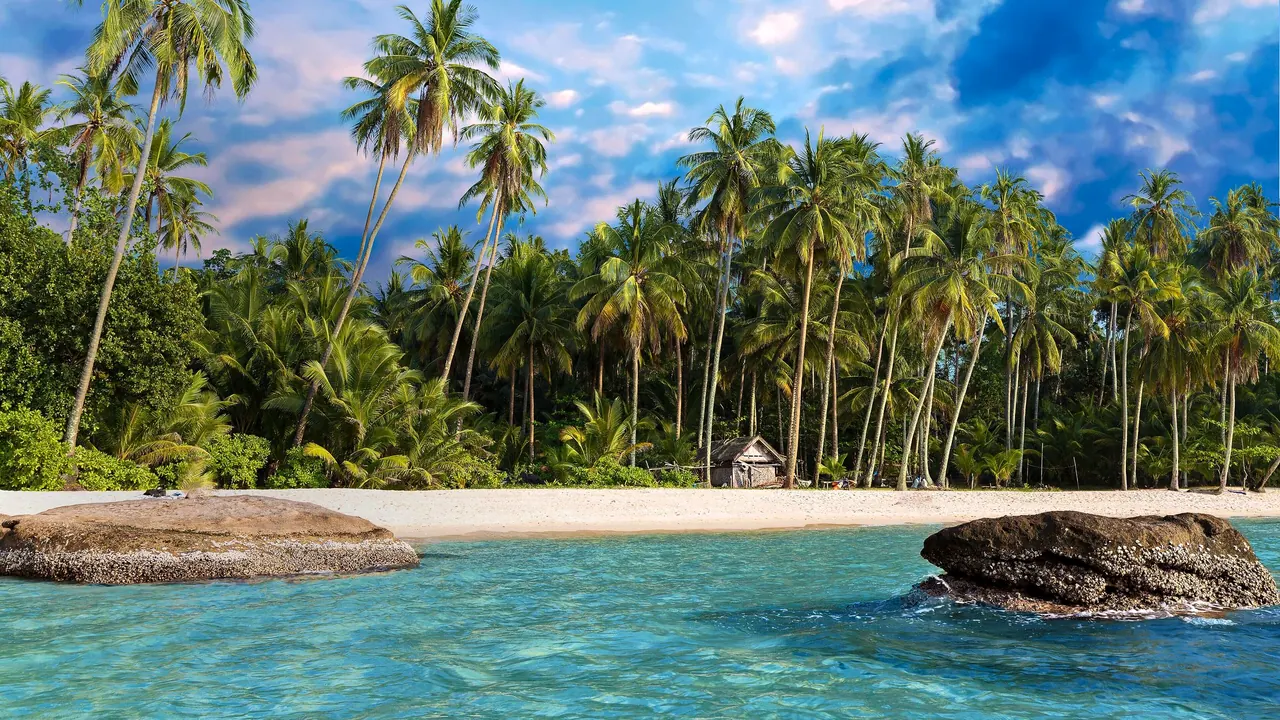
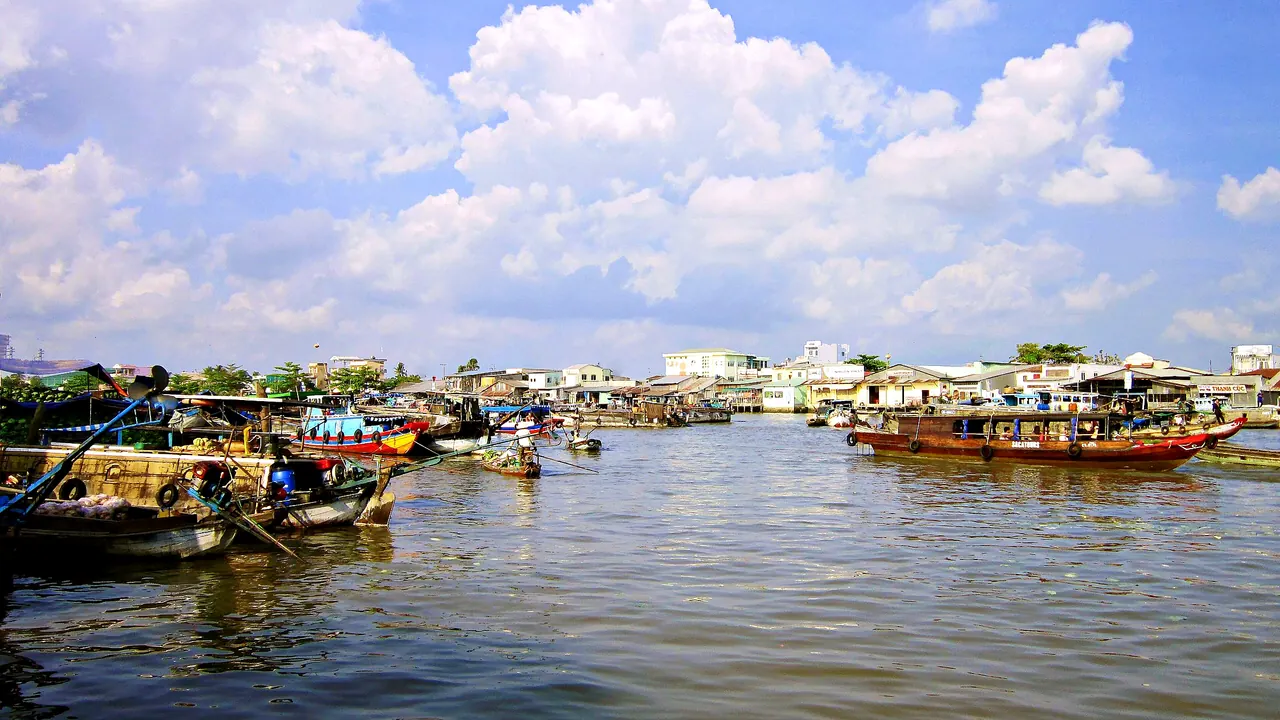
Photos: Koh Kood by Stéphane Bidouze, CC BY-SA 4.0, cropped; Mekong Delta by Bùi Thụy Đào Nguyên, CC BY-SA 4.0, cropped.
Koh Kood or Mekong Delta?
Our verdict in twelve categories, each scored against the same fixed benchmark cities, and the climate month by month, so you can choose for your trip.
Choose Koh Kood for
- beaches
- wellness
- families
Koh Kood is for a beach vacation in the full sense: a week or two on a quiet west-coast bay with clear, warm water, jungle behind and little to do but swim, kayak and go to bed early. It suits couples and families who want rest more than variety, and who will accept a long journey and resort-priced meals in return for that calm.
Choose Mekong Delta for
- prices
- day trips
- culture and sights
Travellers who want to keep moving and looking will do better in the Mekong Delta. Canal boat trips, Khmer pagodas, floating markets at dawn and some of Vietnam's best regional cooking make it a journey taken in stages rather than a stay in one place, and it costs very little. Beaches come only at the far western end, as a last stop.
Scoreboard
Twelve categories on one fixed scale from 0 to 100. The shaded stretch is the gap between the two.
Your match
Pick a travel style or drag the sliders, and both match scores follow your weighting.
Wins on beaches and wellness with your weighting.
Wins on prices and day trips with your weighting.
What matters to you?
Category by category
What the scores mean for a trip.
Beaches & swimming
Koh Kood is a true beach island. Klong Chao, Ao Tapao, Bang Bao and the other west-coast bays have pale sand, jungle behind and clear, warm water, with plenty of space even in busy months. A few bays go very shallow at low tide, so it pays to choose one with deeper water.
In the delta, the sea mostly means brown water over silt and mangrove. Swimming only starts on the western Gulf coast, at small bays like Mui Nai near Ha Tien and on the islands of Hon Son and Nam Du. Most travellers treat it as the end of the trip or take the ferry on to Phu Quoc.
Food & drink
The delta is the better place to eat. Huge turmeric banh xeo, snakehead grilled in clay, mam hotpot around Chau Doc, Can Tho's night-market grills by the water and fruit eaten straight from the trees of Vinh Long make food a reason to travel.
Koh Kood cooks Thai food properly, and the fish, crab and squid in the stilt villages of Ao Salad and Ao Yai come fresh off the boats. Even so, the bays are far apart after dark, so most meals end up being eaten at the resort.
Culture & sights
Neither is a heritage destination, but the delta has far more to see. Khmer pagodas around Soc Trang and Tra Vinh, the Ba Chua Xu temple on Sam Mountain, Cham mosques, the ancient Funan port at Oc Eo and the floating market at Cai Rang add up to a real itinerary, even if it is spread out.
On Koh Kood the interest ends with the wooden houses and piers of Ao Yai and Ao Salad and a few small temples. That fills a pleasant afternoon and little more.
Nightlife
Both are places for early nights. The delta at least has Can Tho, where the Ninh Kieu riverfront, a night market and loud open-air beer restaurants keep the evening going for a while. Elsewhere in the delta the night ends with rice wine at the homestay, and on Koh Kood, which has no bar strip or clubs at all, with a drink at a resort bar on the sand.
Nature & outdoors
A forested island with reefs offshore and a flat country of rivers and flooded forest offer two very different outdoor days, though neither has long trails or real climbs. On Koh Kood you walk through jungle to the pools under Klong Chao and Huang Nam Kheo falls, visit the giant old trees inland, paddle a kayak up the mangrove river and take a boat out to snorkel or dive the marine park reefs.
The Mekong Delta is all water and level ground. Sampans thread the palm-shaded canals near Cai Be and Ben Tre, bicycles follow the dyke paths between orchards, and near Chau Doc a boat glides under duckweed through the Tra Su melaleuca forest. Birdwatchers have the storks of Tram Chim, and Sam Mountain gives the only view from above.
Day trips
From Koh Kood the only real outing is a dry-season boat to Koh Mak and a few snorkelling islets, and most people simply stay on their own bay.
The delta offers far more. From Can Tho, Soc Trang's pagodas, Vinh Long's orchards and the flower villages of Sa Dec are within an hour or two, and Ho Chi Minh City is an easy day out from My Tho. The trade-off is that the river towns start to look alike after a while.
Good for families
Koh Kood is slightly better for families with younger children. Calm, warm bays, kayaks, waterfall pools and resorts with pools make an easy week, as long as you pick a beach with deeper water. The journey there is long, though, and anything serious needs a boat to the hospital in Trat.
The delta suits school-age children who enjoy boats, coconut candy workshops and fruit picked from the tree. Long road days in constant heat and jetties without railings make it harder going with toddlers.
Getting around
Getting about the delta is slow, but on Koh Kood the journey itself is the hard part. Reaching the island takes a road trip or flight to Trat and then a boat. Once there, with no public transport, you depend on resort pick-ups or a scooter on the steep, sandy turns down to the bays, and many guests barely leave their own beach.
The delta at least has a working network. Coaches run on bridged highways from Ho Chi Minh City to Can Tho, Chau Doc and Rach Gia, and in the towns there are taxis and ride-hailing motorbikes. Off the main routes, narrow roads and small river ferries slow things down, so many visitors hire a driver to link the towns.
Shopping & style
Neither is a place to go shopping, but only the delta gives you anything worth carrying home. On Koh Kood, buying stops at what the beach requires: sun cream and snacks from a minimart on the main road, or beachwear from the resort boutique. Nothing is made on the island for visitors to look for, and there is no market to wander round.
The delta's advantage is that you buy close to where things are made. A scarf from the weaving villages near Chau Doc, or coconut candy from a Ben Tre workshop where you have just watched it being made, carries a memory of the trip. The dawn markets are also worth seeing for themselves, even if all you buy is fruit. The gap ends there, though: anyone hoping for clothes, design or an afternoon of browsing will find the delta nearly as bare as the island.
Affordability
On Koh Kood, a mid-range budget buys a comfortable bungalow on a quiet bay, and Thai massage and the simple places on the main road stay cheap. The costs build up elsewhere: snorkelling trips to the marine park, transfers between bays and a few very expensive luxury retreats can make a week cost far more than you planned.
In the delta, the same money goes much further. Temples, pagodas and markets are mostly free to visit, and even the dearer choices, a private boat for the day or a night at a riverside resort, cost little by any standard. Spending freely here would still cost less than an ordinary stay on Koh Kood.
Live music & performing arts
Koh Kood has nothing here beyond the odd acoustic evening at a resort bar. The delta has music of its own: don ca tai tu for zither, moon lute and voice, and cai luong opera. Visitors usually hear them as short sets in orchard gardens on boat tours, and the Soc Trang pagodas hold Khmer dance during Ok Om Bok. The scene is small, but it is genuinely local.
Wellness & relaxation
Koh Kood is the better place to unwind. Resorts sit in the jungle or on a bay of their own, with no traffic or nightlife nearby. Massage pavilions stand near most beaches, and the upmarket places have spas and some yoga.
The delta can be restful too, in a hammock at an orchard homestay or on a slow boat at dusk. But the towns are loud with motorbikes and treatments rarely go beyond basic massage, so you have to seek out the calm.
When should you go?
Pick your month. The climate figures are measured averages, not a forecast.
Koh Kood in July
Mekong Delta in July
Daytime high, °C
Rainfall in the month, mm
Where the figures come from
Koh Kood's temperatures are measured 39 km from the centre, at Khlong Yai.
Koh Kood has no rain gauge within 25 km of the centre, so its rainfall comes from a gridded climate dataset read at the destination rather than from a gauge further away.
Mekong Delta has no weather station within reach, so its figures come from a gridded climate model rather than a measured record, and read a broad area rather than one spot.
Temperature and rainfall are climate normals, averaged over the years shown. Koh Kood: 1971-2000 (rainfall 1991-2020) normals, Khlong Yai (38.5 km from centre). Mekong Delta: 2001-2020 normals, NASA POWER reanalysis grid, no weather station within 90 km.
Koh Kood is at its best from December to February. Rain is light then, around 19mm in December, and the sea is near 28°C, so you can swim all day. March and April bring more showers but are still a good time to go. From May the monsoon arrives in earnest: July to September each bring well over 600mm, the west coast takes heavy swell and many resorts close. Daytime heat stays in the low 30s all year, so the season is set by rain, not temperature.
The delta's dry season falls at much the same time, December to April, and February is almost rainless. March and April are its hottest months at 36°C, though, which is hard going for midday cycling or walking round markets. The wet season from May to October is far gentler than on Koh Kood, at about 200mm a month, so the delta is still worth travelling then. From September to November the floods turn the flat land into water.
Which traveller are you?
On a beach and sun trip, Koh Kood is the obvious choice. Its west-coast bays have soft, pale sand, calm water and only a few resorts behind each one. Most of the delta's coast is mud and mangrove, and swimming only starts around Ha Tien.
For a culture and arts trip, the Mekong Delta wins easily. Khmer pagodas at Soc Trang, the pilgrimage temples of Sam Mountain, Cham villages and don ca tai tu music give it real substance. Koh Kood offers little beyond its stilt fishing villages.
On a trip on a tight budget, money goes much further in the delta. Homestays, noodle stalls, coaches and motorbike taxis cost very little. On Koh Kood, the boat crossing, isolated resorts and resort-priced meals push up spending even if you sleep in a fan bungalow.
Before you go
| Measure | Koh Kood | Mekong Delta |
|---|---|---|
| Official language | Thai | Vietnamese |
| Currency | Baht (THB) | Dong (VND) |
| Sockets | ABCF220 V, 50 Hz | ACFG220 V, 50 Hz |
| Driving side | Left | Right |
| Time zone | UTC+7 | UTC+7 |
| Emergency number | Police 191, ambulance 1669, fire 199 | Police 113, ambulance 115, fire 114 |
| Main airport | Trat Airport (TDX)1 non-stop destination | Can Tho International Airport (VCA)7 non-stop destinations |
By the numbers
| Measure | Koh Kood | Mekong Delta |
|---|---|---|
| Population | 2,000 | 24,490,000 |
| People per km² | 18 | - |
| Swim season, months above 21 °C | 12 months | - |
Where else could you go?
Every comparison below shares a destination with this one, so you can follow Koh Kood or Mekong Delta somewhere new.
- Koh Changvs Koh Kood
- Ho Chi Minh Cityvs Mekong Delta
- Koh Rongvs Koh Kood
- Koh Sametvs Koh Kood
- Phu Quocvs Mekong Delta
- Phu Quocvs Koh Kood