Vietnam
Mekong Delta
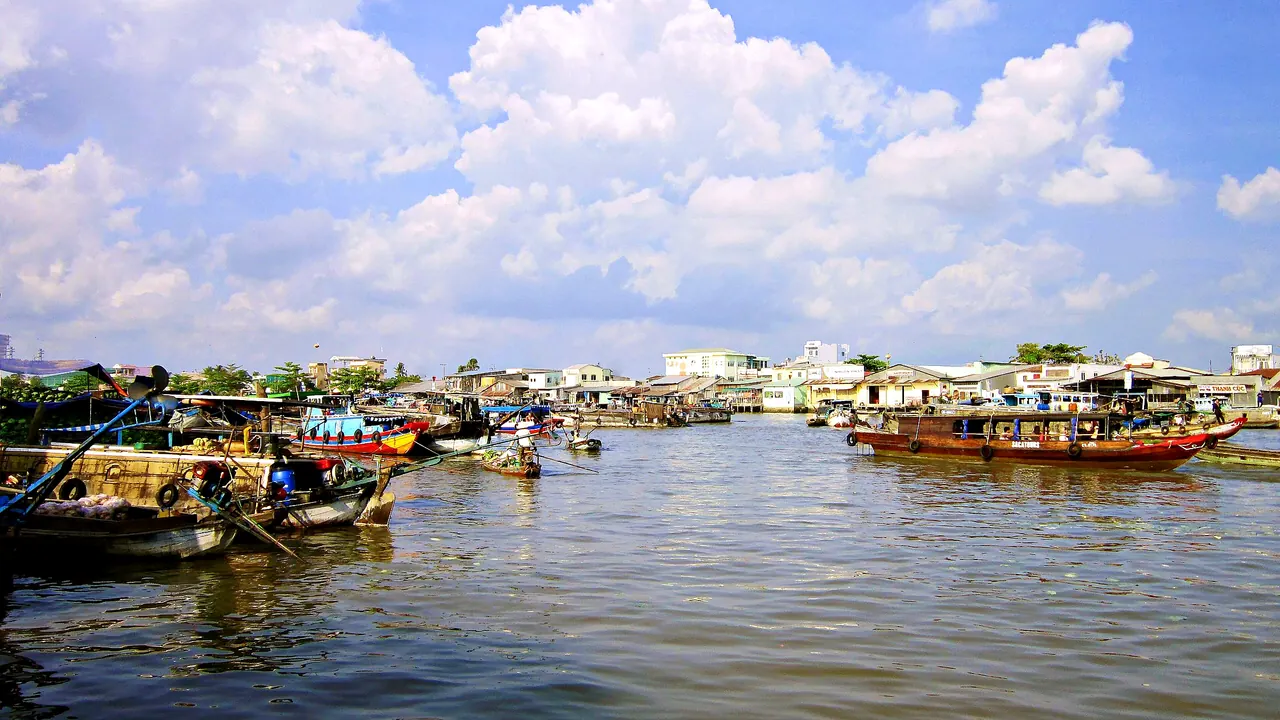
The Cai Rang floating market on the Mekong
- Affordability96
- Food & drink64
- Nature & outdoors55
Photo: Bùi Thụy Đào Nguyên, CC BY-SA 4.0, cropped
Match
43
Every category weighted equally
- Beach & sun47
- Culture & arts42
- Food & nightlife41
- Family trip48
- Outdoors50
- Relax & unwind46
- Shopping & style40
- On a budget49
Mekong Delta in twelve categories
Our verdict on each, scored 0 to 100 against the same fixed benchmark cities, so a score means the same thing on every page.
Beaches & swimming. Scores 42 out of 100.
Food & drink. Scores 64 out of 100.
Culture & sights. Scores 40 out of 100.
Nightlife. Scores 18 out of 100.
Nature & outdoors. Scores 55 out of 100.
Day trips. Scores 55 out of 100.
Good for families. Scores 33 out of 100.
Getting around. Scores 35 out of 100.
Shopping & style. Scores 22 out of 100.
Affordability. Scores 96 out of 100.
Live music & performing arts. Scores 20 out of 100.
Wellness & relaxation. Scores 38 out of 100.
Mekong Delta category by category
Beaches & swimming
42Most of the delta has no beaches. Where the river meets the sea in the south and east, the coast is silt, mud flats and mangrove, and the water is brown. Swimming starts on the far western side, on the Gulf of Thailand. Around Ha Tien there are small sandy bays such as Mui Nai, and offshore lie the quiet fishing islands of Hon Son and Nam Du. The water there is clear and about 29°C.
Ha Tien is also the ferry port for Phu Quoc, a large beach island that many travellers add as the last stop of a delta trip. Beaches here are something you finish with, not the point of the journey. The western coast is calmest from November to April.
Food & drink
64This is Vietnam's rice bowl and fruit garden, and you eat close to where things grow. Breakfast is hu tieu noodle soup at a riverside stall. Banh xeo here is huge and crisp, with turmeric in the batter. The river and canals supply snakehead and elephant-ear fish, often grilled in clay or rolled in rice paper with herbs from the garden. Around Chau Doc, fermented fish pastes and mam hotpot show the Khmer and Cham influence, and Ben Tre sells coconut candy and coconut-based dishes everywhere.
Can Tho has the widest choice, from night-market grills along the waterfront to simple seafood places. In the orchard country of Vinh Long and Cai Be you can eat rambutan, mangosteen and durian in season straight from the tree. Fine dining and international cooking hardly exist, and outside the main towns menus are short and home-style.
Culture & sights
40The delta's heritage is spread out and modest in scale, but it is unusual. The Khmer community has left ornate pagodas around Soc Trang and Tra Vinh, with tiered roofs, naga balustrades and monks in saffron robes. Around Chau Doc, Sam Mountain is a major pilgrimage centre with the Ba Chua Xu temple, and Cham villages with mosques stand on the opposite bank. Oc Eo, an ancient Funan port, is now an archaeological site in the rice fields.
There are also French-era merchant houses such as Binh Thuy in Can Tho, and the Vinh Trang pagoda at My Tho. Much of the delta's culture is the way people live on the water: floating wholesale markets at Cai Rang and Phong Dien, stilt houses and boat-building yards. There are no great museums, so come for the life rather than the monuments.
Nightlife
18Evenings in the delta are short. Can Tho has the only real night: the riverfront promenade at Ninh Kieu, a night market and loud open-air beer restaurants where locals drink over grilled food. A few bars face the river. In smaller towns and homestays, the night ends after dinner and a beer or two of rice wine with your hosts, and the floating markets mean waking before dawn anyway. Nobody comes here to go out.
Nature & outdoors
55The delta is a flat world of water: wide brown river channels, narrow canals shaded by water coconut palms, rice paddies, orchards and stilt villages. The best way into it is by small boat through the backwaters near Cai Be, Ben Tre and Can Tho, or by bicycle along the dyke paths between orchards. Near Chau Doc, the Tra Su melaleuca forest is a flooded forest crossed by sampan under duckweed. The granite hills of Sam and Cam mountains give the only climbs.
For wildlife, Tram Chim in the Plain of Reeds has storks and wetland birds, the U Minh peat forests lie further south, and Ca Mau cape ends in mangroves. From September to November the floods transform the landscape. It is hot and humid all year, so plan outdoor time for early morning.
Day trips
55Can Tho is the natural centre. Within an hour or two you can reach Soc Trang's Khmer pagodas, the orchard islands and craft villages of Vinh Long, Sa Dec with its flower villages and old riverside houses, and the market town of Long Xuyen. From My Tho or Ben Tre on the eastern edge, Ho Chi Minh City is about two hours by road, so a day in the big city is easy.
The outings are similar to each other, though: river towns, markets and pagodas. Chau Doc and Ha Tien are worth visiting but are too far for a day, so it is better to stay there. Most visitors move through the delta in stages rather than staying in one base.
Good for families
33Children who like boats, animals and eating fruit straight from the tree will enjoy themselves. Rowing through canals, visiting coconut candy and rice paper workshops, and staying in orchard homestays all keep their interest, and Vietnamese hosts are warm with children. But there are no zoos, theme parks or attractions made for children, and days involve long road trips in steady heat. Riverbanks, jetties and small boats often have no railings and life jackets are not always provided, so it works best for school-age children rather than toddlers.
Getting around
35There are no trains. You cross the delta by road. Comfortable long-distance coaches run from Ho Chi Minh City to Can Tho and on to Chau Doc, Rach Gia and Ca Mau, using bridged highways that link the main towns across the river's branches. Off those trunk routes, roads are narrow and crowded with motorbikes, and small river crossings are still made by local ferry, so journeys take longer than the map suggests.
In the towns you get around by taxi, ride-hailing motorbike or on foot, though pavements are poor. The best parts, the canals and orchards, are reached by hired boat or bicycle. Many visitors hire a driver or join a tour to link the towns. Boats run from Chau Doc towards the Cambodian border and from Rach Gia and Ha Tien out to the islands.
Shopping & style
22Markets are the main attraction, but they sell food: fruit sold from boats at dawn, and town markets full of dried fish and fish sauce. For things to take home, look for Cham silk and checked krama scarves woven near Chau Doc, coconut candy and coconut-shell goods from Ben Tre, sedge mats and rice paper. Can Tho has a few modern malls. There is no fashion, design or boutique shopping to speak of.
Affordability
96The delta is one of the cheapest places to travel in Southeast Asia. Family homestays, small town hotels, noodle stalls, market meals, coaches and motorbike taxis all cost very little, and many temples and markets are free. Costs go up for private boat charters, guided tours from Ho Chi Minh City and a handful of riverside resorts. Even those are modest compared with most destinations.
Live music & performing arts
20The delta is home to don ca tai tu, a southern chamber music for zither, moon lute and voice, and to cai luong, the region's reformed opera. Visitors mostly hear them as short performances in orchard gardens on boat tours, sometimes beautiful and sometimes routine. Khmer pagodas in Soc Trang and Tra Vinh hold dance and music during festivals such as Ok Om Bok and the Khmer new year. Beyond that, there are no theatres or concert venues you can plan a trip around.
Wellness & relaxation
38There is no bathing tradition here, and spas are limited to cheap, basic massage in the towns and a few riverside resorts with treatment rooms. What the delta offers is its pace. A few nights in an orchard homestay, with hammocks under fruit trees, slow boat rides at dusk and early nights, can be truly restful. The towns are noisy with motorbikes and the heat is constant, so choose a place on the water outside the towns to unwind.
Where to stay in Mekong Delta
Most visitors cross the delta in stages, so plan on two or three bases rather than one. Can Tho is the natural first stop. It has the widest choice of food, the only real evening life along the Ninh Kieu riverfront, coach links to Ho Chi Minh City, and the Cai Rang floating market and Soc Trang's Khmer pagodas within easy reach. It suits a first visit and anyone who wants a town around them.
For a quiet stay, sleep in an orchard homestay on the river islands around Vinh Long, Cai Be or Ben Tre. Nights end early, hammocks hang under fruit trees, and boats and bicycles take you into the canals. This is the best choice for families with school-age children and for anyone who wants to slow down. On the eastern edge, it is also the closest base to Ho Chi Minh City, about two hours by road.
On a second visit, or a longer first one, head west. Chau Doc, near the Cambodian border, suits travellers drawn to Sam Mountain's pilgrim temples, the Cham villages and the flooded Tra Su forest. Ha Tien, on the Gulf of Thailand, is the place for small sandy bays and calm water from November to April. It is also the ferry port for Phu Quoc if you want to finish with a few beach days.
When should you go?
Pick a month to see what it is like. The climate figures are measured averages, not a forecast.
Mekong Delta in July
Daytime high, °C
Rainfall in the month, mm
The whole year
Shaded against this destination’s own year: the deepest cell is its best month for that figure and the palest its weakest.
Where the figures come from
Mekong Delta has no weather station within reach, so its figures come from a gridded climate model rather than a measured record, and read a broad area rather than one spot.
Temperature and rainfall are climate normals, averaged over the years shown. Mekong Delta: 2001-2020 normals, NASA POWER reanalysis grid, no weather station within 90 km.
Before you go
| Measure | Mekong Delta |
|---|---|
| Official language | Vietnamese |
| Currency | Dong (VND) |
| Sockets | ACFG220 V, 50 Hz |
| Driving side | Right |
| Time zone | UTC+7 |
| Emergency number | Police 113, ambulance 115, fire 114 |
| Main airport | Can Tho International Airport (VCA)7 non-stop destinations |
By the numbers
| Measure | Mekong Delta |
|---|---|
| Population | 24,490,000 |
Compare Mekong Delta with
Every comparison with a written verdict behind it.