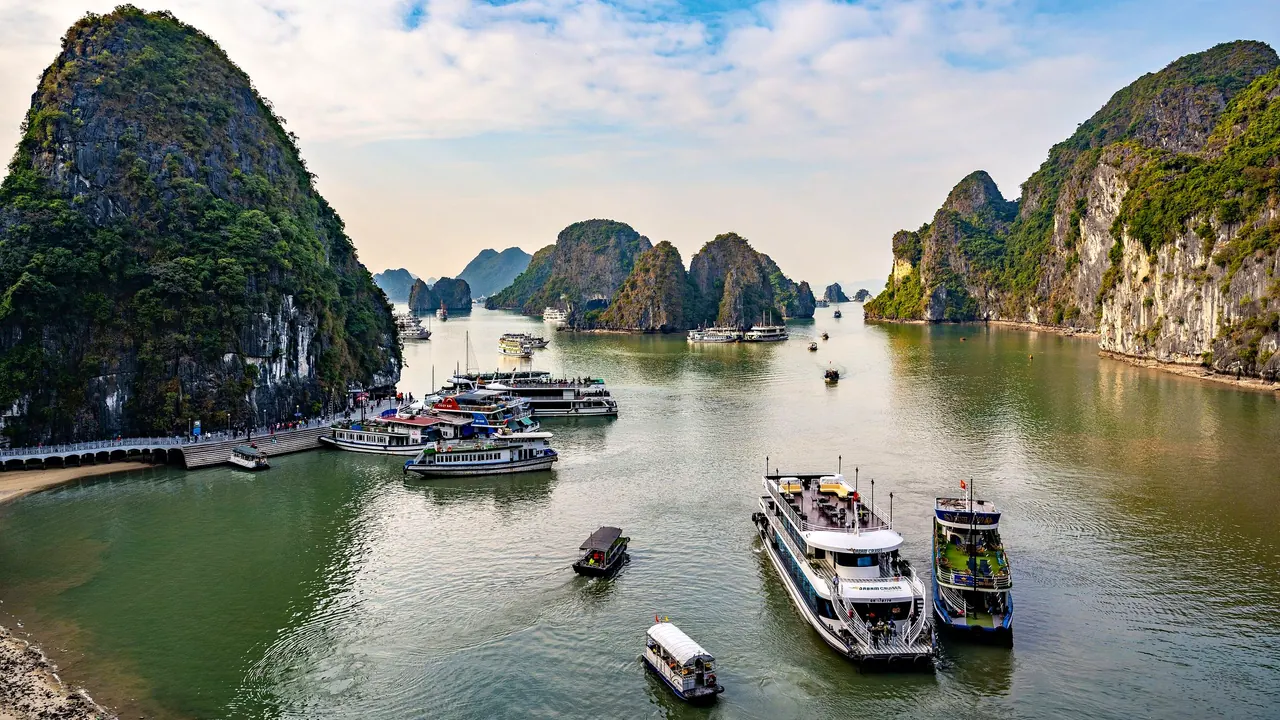
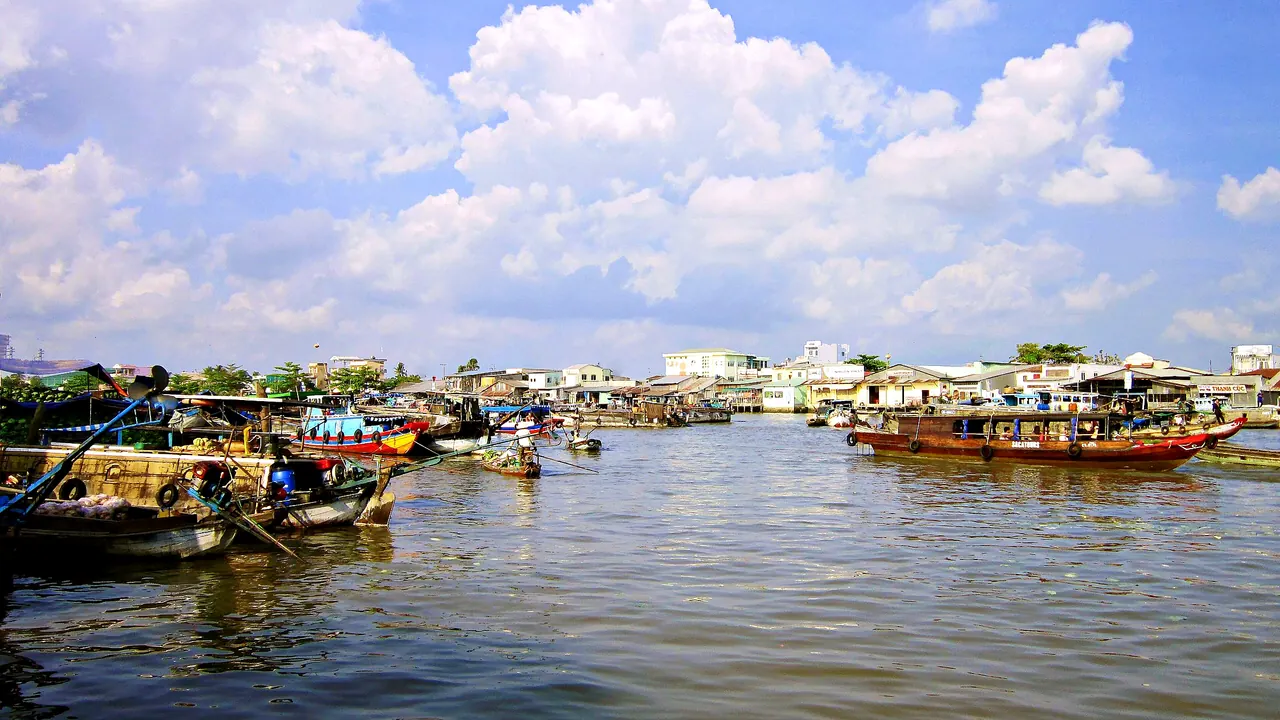
Photos: Ha Long by Takeshi Aida from Hong Kong, Hong Kong, CC BY-SA 2.0, cropped; Mekong Delta by Bùi Thụy Đào Nguyên, CC BY-SA 4.0, cropped.
Ha Long or Mekong Delta?
Our verdict in twelve categories, each scored against the same fixed benchmark cities, and the climate month by month, so you can choose for your trip.
Choose Ha Long for
- nature and the outdoors
- families
- wellness
Ha Long is the choice if you want scenery first. Its whole trip runs on the bay: a night or two on a boat among the limestone towers, kayaking into hidden lagoons, swimming off the deck and walking through caves. It suits couples and families who want one spectacular landscape, a comfortable base in Bai Chay, a spa on board or a soak at the Quang Hanh hot springs, and attractions children enjoy. Don't expect much from the town itself, which offers little in culture or food beyond seafood.
Choose Mekong Delta for
- food and drink
- culture and sights
- day trips
The Mekong Delta suits travellers who want to watch daily life rather than look at a view. It is a slow, cheap journey through river towns, floating markets, Khmer pagodas and orchard homestays. The food is richer and more varied, the culture is more unusual, and the money goes further. The cost is a lot of road travel in steady heat, and a flat landscape that charms you gradually rather than amazing you at first sight.
Scoreboard
Twelve categories on one fixed scale from 0 to 100. The shaded stretch is the gap between the two.
Your match
Pick a travel style or drag the sliders, and both match scores follow your weighting.
Too close to call, level with your weighting
Wins on nature and the outdoors and families with your weighting.
Wins on food and drink and culture and sights with your weighting.
What matters to you?
Category by category
What the scores mean for a trip.
Beaches & swimming
Neither destination is a beach trip, and they fall short in different ways. In Ha Long the town sand at Bai Chay is imported and the water is cloudy. The swimming that's worth doing is from a cruise boat in a quiet cove or on small island beaches like Ti Top, from late spring to autumn. Cleaner sand on Quan Lan means staying overnight.
Most of the Mekong Delta's coast is mud and mangrove, with brown water. Clear sea only begins on the Gulf of Thailand around Ha Tien, at bays such as Mui Nai and the islands of Hon Son and Nam Du. Ha Tien is also the ferry port for Phu Quoc, so beach days come at the end of a delta journey, between November and April.
Food & drink
The delta eats better and with more variety. Ha Long has one strong card: the seafood. You choose crab, mantis shrimp and sea snails from the tanks in Hon Gai and Bai Chay, and the springy cha muc squid cakes are worth eating. Beyond that you get set menus on the boats and large, impersonal tourist restaurants.
In the Mekong Delta the food changes as you travel. There is crisp turmeric banh xeo, snakehead grilled in clay, Khmer-influenced mam hotpot around Chau Doc, coconut sweets in Ben Tre, and mangosteen picked straight from the tree in the Vinh Long orchards. Can Tho's waterfront grills give the widest choice.
Culture & sights
Ha Long's great sight is a landscape, not a monument. In town there are the Quang Ninh Museum in its black glass building, Long Tien pagoda and the climb up Bai Tho mountain, enough for about a day. Out on the bay, a boat visit to the old floating village of Cua Van shows how fishing families lived on the water.
The Mekong Delta has no big museums either, but its heritage is more unusual and covers far more ground. There are ornate Khmer pagodas around Soc Trang and Tra Vinh, the Ba Chua Xu temple on Sam Mountain, Cham mosques near Chau Doc, the ancient Funan site at Oc Eo and the Binh Thuy merchant house. The floating markets at Cai Rang add a living culture that Ha Long can't match.
Nightlife
Both places go to bed early, so choose on the kind of evening you want. In Ha Long, Bai Chay has beer halls, karaoke rooms and a few bars for foreign visitors near the night market. On a cruise, the evening is a drink on the sundeck and squid fishing off the stern.
In the delta, only Can Tho has any night at all: the Ninh Kieu riverfront and its loud open-air beer restaurants. Elsewhere you share rice wine with your homestay hosts and turn in before a dawn market.
Nature & outdoors
Ha Long is the more dramatic natural destination by a wide margin. Close to two thousand forested limestone towers rise from the bay, with caves, enclosed lagoons reached by kayak, the quieter Lan Ha and Bai Tu Long bays, and Cat Ba's national park and climbing routes.
The delta's nature is quieter and flatter, mostly worked land. It means canals under water coconut palms, cycling along dyke paths through orchards, a sampan through the Tra Su flooded forest, and storks at Tram Chim. It is gentle and absorbing, but nothing in it matches the bay.
Day trips
Ha Long has a few strong outings but not many of them. The holy mountain of Yen Tu with its forest pagodas is the highlight, and Hai Phong's colonial streets and the Bach Dang battlefield are each about an hour away. Hanoi is too far for a comfortable day.
From Can Tho, the delta offers more places within easy reach: Soc Trang's Khmer pagodas, Vinh Long's orchard islands, Sa Dec's flower villages and Long Xuyen. From My Tho, Ho Chi Minh City makes an easy day out. The catch is that these outings feel alike, all river towns and markets, and the far west needs overnight stays.
Good for families
Ha Long is the easier choice with children. A bay cruise with caves, kayaks and swimming off the deck feels like an adventure, and back on land Sun World has a cable car over the water, a Ferris wheel and a water park. Watch out for summer heat, heavy traffic and overnight boats with toddlers.
In the delta, children who like boats and fruit trees will enjoy the canals, the coconut candy workshops and the welcome at orchard homestays. However, there is nothing built for children, the drives are long and hot, and jetties often have no railings. It suits school-age children better.
Getting around
Ha Long is one town to get around, while the Mekong Delta is a whole region to cross. Ha Long comes in two halves, Bai Chay and Hon Gai, linked by a long bridge. Cheap taxis and ride-hailing cover the distances, and cruise transfers to Tuan Chau are usually included. The main effort is the shuttle from Hanoi.
In the delta, the travelling is a large part of the trip. Coaches run along the bridged highways from Ho Chi Minh City to Can Tho and Chau Doc, but side roads are slow and crowded with motorbikes, and some river crossings are still made by ferry. The best parts are reached by hired boat or bicycle, so many visitors hire a driver.
Shopping & style
From Ha Long you take home food, and from the delta handicrafts, and neither has a street where browsing fills an afternoon. Ha Long adds pearl showrooms and the souvenir stalls of the Bai Chay night market, but the best finds are the dried squid and fish sauce at the market in Hon Gai. In the delta you can buy Cham silk and checked krama scarves woven near Chau Doc, coconut-shell goods and candy from Ben Tre, and sedge mats.
Affordability
Both are very cheap on land, but the delta goes further. In Ha Long, hotels, taxis and street food cost little. The overnight cruise is the big expense, and waterfront seafood needs its weight and price agreed before it is cooked.
The delta has no big fixed cost of that kind. Homestays, coaches, noodle stalls and motorbike taxis are all cheap, and many temples and markets are free. Only private boat charters and tours from Ho Chi Minh City push the budget up.
Live music & performing arts
Neither will fill your evenings, but the delta has its own traditions. You might hear don ca tai tu chamber music and cai luong opera in orchard gardens, and see dance at Khmer pagodas during Ok Om Bok. Ha Long only has staged shows at the entertainment complex in Bai Chay and some folk singing on cruise boats.
Wellness & relaxation
Ha Long gives more ways to unwind. There is tai chi on the sundeck and a night anchored in a sheltered cove, and many better boats have small spas. Bai Chay has cheap reflexology, and the onsen-style mineral hot springs at Quang Hanh are about forty minutes away.
The delta has no bathing tradition and only basic massage. Its calm comes from slowing down: hammocks under fruit trees at an orchard homestay, boat rides at dusk and early nights. You need to stay outside the noisy towns to find it.
When should you go?
Pick your month. The climate figures are measured averages, not a forecast.
Ha Long in July
Mekong Delta in July
Daytime high, °C
Rainfall in the month, mm
Where the figures come from
Ha Long's temperatures are measured 50 km from the centre, at Phu Lien.
Ha Long has no rain gauge within 25 km of the centre, so its rainfall comes from a gridded climate dataset read at the destination rather than from a gauge further away.
Mekong Delta has no weather station within reach, so its figures come from a gridded climate model rather than a measured record, and read a broad area rather than one spot.
Temperature and rainfall are climate normals, averaged over the years shown. Ha Long: 1991-2020 normals, Phu Lien (49.9 km from centre). Mekong Delta: 2001-2020 normals, NASA POWER reanalysis grid, no weather station within 90 km.
Ha Long has a real winter. From December to March the days stay cool, around 19°C in January, and the sky is often grey with little sunshine. The sea is too cool for most swimmers, though the weather is fine for walking and the mist softens the karsts. April warms up and stays fairly dry, but it is still dull. From May the rain sets in hard and peaks at 553mm in July. In the hot summer the sea is warm enough to swim, but storms come with it. October and November are the best balance: warm, dry and much sunnier, and in October the sea is still warm enough for a swim.
The Mekong Delta is hot all year and never cool. December and January are the most comfortable months, dry and around 30°C. February stays dry but climbs to 34°C, and March and April reach 36°C, so anything after mid-morning is hard work. Heavy rain arrives in May and lasts into November. From September to November the floods spread across the fields, which changes the landscape but slows travel. If you are combining the two, Ha Long is at its best in autumn and the delta in midwinter.
Which traveller are you?
For an outdoors trip, choose Ha Long if you want active days with a paddle, a climb or a hiking trail. Choose the Mekong Delta only if your idea of the outdoors is gentle, flat country seen slowly by bicycle or small boat.
On a family trip with young children, Ha Long is the safer bet. You get one comfortable base, short transfers and plenty to fill the days between boat trips. In the delta you keep moving from town to town by road in steady heat, which tests small children's patience.
For a culture and arts trip, the Mekong Delta gives curious travellers far more. Its heritage comes from Khmer, Cham and Vietnamese communities living side by side, and you meet it as you travel. Ha Long's town sights are used up in a day.
Before you go
| Measure | Ha Long | Mekong Delta |
|---|---|---|
| Official language | Vietnamese | Vietnamese |
| Currency | Dong (VND) | Dong (VND) |
| Sockets | ACFG220 V, 50 Hz | ACFG220 V, 50 Hz |
| Driving side | Right | Right |
| Time zone | UTC+7 | UTC+7 |
| Emergency number | Police 113, ambulance 115, fire 114 | Police 113, ambulance 115, fire 114 |
| Elevation | 8 m | - |
| Main airport | Noi Bai International Airport (HAN)136 km from centre91 non-stop destinations | Can Tho International Airport (VCA)7 non-stop destinations |
By the numbers
| Measure | Ha Long | Mekong Delta |
|---|---|---|
| Population | - | 24,490,000 |
| Museums within 10 km | 1 | - |
| UNESCO World Heritage sites within 50 km | 2 | - |
| Swim season, months above 21 °C | 9 months | - |
Where else could you go?
Every comparison below shares a destination with this one, so you can follow Ha Long or Mekong Delta somewhere new.
- Hanoivs Ha Long
- Ho Chi Minh Cityvs Mekong Delta
- Phu Quocvs Mekong Delta
- Koh Rongvs Mekong Delta
- Sapavs Ha Long
- Koh Koodvs Mekong Delta