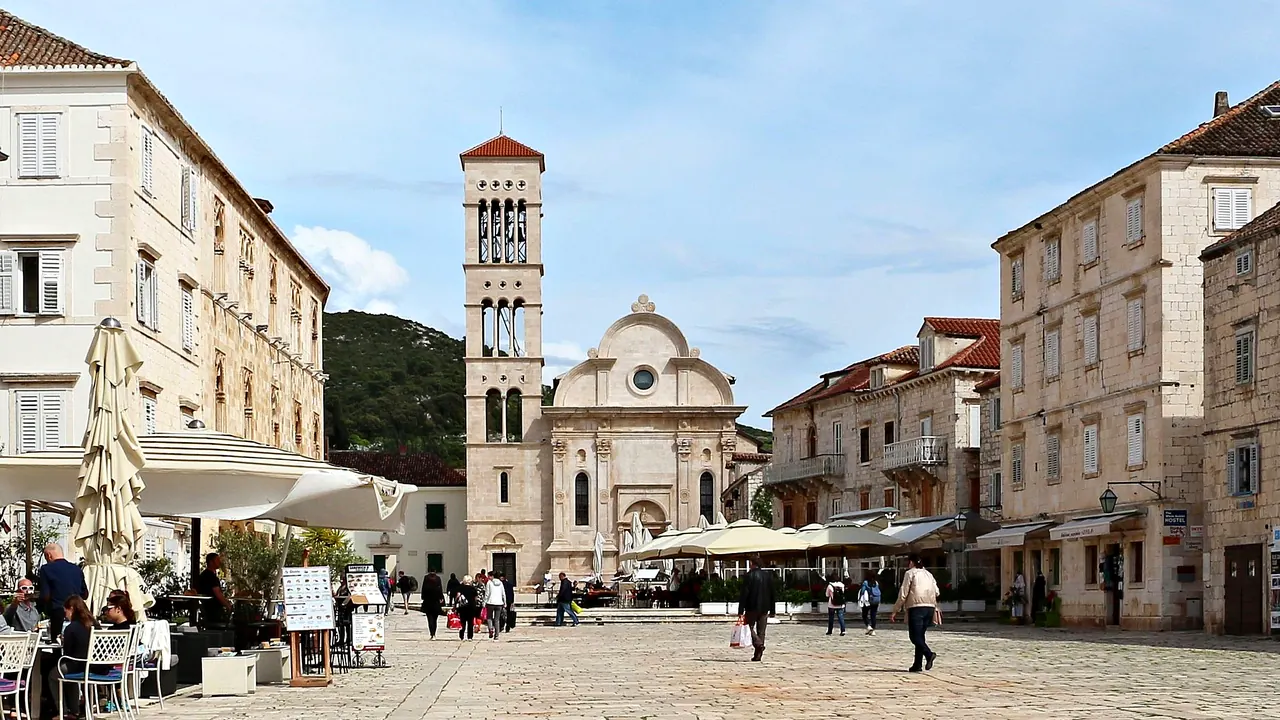
Photos: Hvar by Bernard Gagnon, CC BY-SA 4.0, cropped.
Hvar or Umbria?
Our verdict in twelve categories, each scored against the same fixed benchmark cities, and the climate month by month, so you can choose for your trip.
Choose Hvar for
- beaches
- nightlife
Hvar is the pick for a summer by the sea. Choose it if your days revolve around clear water, boat rides to the Pakleni Islands and long lunches with island wine, and especially if you want Hvar Town's party evenings in July and August. Couples and families after something quieter can still find calm on the north side around Jelsa and Stari Grad. Just know that the sights are few and the season is short.
Choose Umbria for
- culture and sights
- day trips
- live music and the arts
Travellers drawn to art, food and landscape will get more from Umbria. A week based near Perugia or Spoleto brings Giotto in Assisi, Orvieto's cathedral, truffles and Sagrantino, and a different hill town or Tuscan outing each day, at gentler prices. What it gives up is the sea and any real nightlife, so it suits a slow, curious trip rather than a beach one.
Scoreboard
Twelve categories on one fixed scale from 0 to 100. The shaded stretch is the gap between the two.
Your match
Pick a travel style or drag the sliders, and both match scores follow your weighting.
Wins on beaches and nightlife with your weighting.
Wins on culture and sights and day trips with your weighting.
What matters to you?
Category by category
What the scores mean for a trip.
Beaches & swimming
Hvar is the clear choice for swimming. The water is clear and warm through summer. The shore is pebble and rock rather than sand, but there are pine-backed bays on the Pakleni Islands, wild coves on the south coast and shallower water on the north side around Jelsa and Vrboska.
Umbria has no coast at all. Lake Trasimeno's lidos have warm, shallow water for paddling, but it is often cloudy and soft-bottomed, and most visitors end up swimming in a farmhouse pool. The sea is a drive of two hours or more.
Food & drink
Both are country kitchens built on local produce, but Umbria's goes further. Black truffle over handmade strangozzi, Norcia's pork butchery, Castelluccio lentils and the Sagrantino of Montefalco give it a depth that lasts through a week of meals, and Perugia has the widest choice of restaurants.
Hvar's strength is the sea: grilled fish, gregada and octopus or lamb under the peka, with Plavac Mali poured in family cellars and the best meals served in inland konobas. Its range is narrower, and much of it shuts outside summer, though it fills the one real gap in Umbria's cooking, which is seafood.
Culture & sights
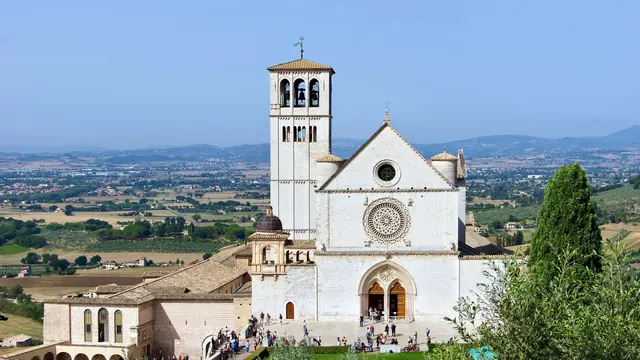
This is where Umbria pulls far ahead. Its hill towns hold art of the first rank: Giotto's frescoes in the Basilica of St Francis at Assisi, Signorelli's Last Judgement in Orvieto's cathedral and Perugino in Perugia's Galleria Nazionale, with a different set-piece town for each day of a long stay.
Hvar has a pleasing but compact set of sights. There is Hvar Town's white-stone square and cathedral, the 1612 Arsenal theatre and the Fortica, then Stari Grad with its Greek origins and its UNESCO-listed plain. Two or three easy days cover the island, while Umbria can fill two weeks.
Nightlife
Hvar Town in July and August is a proper party destination. Evenings start with sundowners on the waterfront and move to packed cocktail bars up the stepped lanes and to beach clubs on the Pakleni Islands, reached by taxi boat late into the night. It is crowded and expensive, and it winds down in early September.
In Umbria, the evening is a long dinner and a stroll. Only Perugia, where students gather on the cathedral steps and in the wine bars of the old lanes, keeps going late, and there are no clubs.
Nature & outdoors
Umbria has the more varied outdoors. The Monti Sibillini rise above 2,000m, the Castelluccio plain flowers in early summer and the Valnerina offers rafting and canyoning. The Marmore Falls, Monte Subasio and the old Spoleto to Norcia railway path give walkers and cyclists plenty of choice.
On land, Hvar is gentler: a limestone ridge of pine, stone terraces and lavender, topped by Sveti Nikola at 626m. Its sea gives it something Umbria lacks, though, with kayaking, sailing and snorkelling around the Pakleni Islands. In both places, summer heat pushes serious walking into spring and autumn.
Day trips
Umbria is built for day trips. From a base near Perugia or Spoleto, Gubbio, Todi, Spello, Norcia and the Montefalco wine hills are all a short drive away. Tuscan towns such as Cortona and Montepulciano are close, and Rome is a little over an hour by train from Orvieto.
Hvar's outings run on catamaran timetables. Split's Diocletian's Palace and the harbours of Vis are about an hour away, and Korčula's walled town lies to the south. Stari Grad, Jelsa and Vrboska also make easy outings from one another. These trips are rewarding but need planning, and there are fewer of them outside summer.
Good for families
Neither has much built for children, so both suit a slow family vacation rather than a run of attractions. The difference is the setting. On Hvar, days are spent in the calm, shallow bays of Jelsa, Stari Grad and Vrboska, with boat trips to coves for excitement, and steep, noisy Hvar Town is best avoided.
In Umbria, the base is a farmhouse with a pool and animals. Lake Trasimeno is good for paddling, and the Marmore Falls and the amusement park near Perugia make good outings, but the steep medieval towns are hard going with a pushchair.
Getting around
Both regions are easiest with a car, but Umbria makes driving simpler. Roads are good, distances are short and traffic is light, and you reach the hill towns from car parks below the walls by escalator, lift or funicular. Without a car, trains link Perugia, Assisi, Spoleto and Orvieto.
Hvar starts with a boat, either the car ferry to Stari Grad or a catamaran to Hvar Town or Jelsa. Once there, buses are infrequent, the roads to the south coast are narrow and winding, and taxi boats do the work of buses for the Pakleni Islands.
Shopping & style
Crafts and local food, not fashion, are what fill the bags in both places, and Umbria's workshops offer far more than Hvar's harbour stalls. On Hvar the list is short: lavender oil from the waterfront, olive oil, honey and wine from family cellars, lace made by the Benedictine nuns in Hvar Town, and resort boutiques selling linen and swimwear to the yacht crowd.
In Umbria, whole towns live by a craft. Deruta's roadside workshops sell painted majolica, Montefalco and Bevagna weave hand-loomed linen, outlets around Perugia sell cashmere, and Norcia's shops are hung with hams and stocked with truffles. Perugia's Corso Vannucci adds ordinary high-street shopping, but you won't find a luxury street in either place.
Affordability
Umbria is the easier place to keep costs down. Farmhouse stays and small hotels cost less than across the Tuscan border, village set lunches and local wine are good value, and most sights are churches that cost little or nothing. The main extra cost is a hire car.
In July and August, Hvar is among the most expensive places on the Croatian coast, especially Hvar Town. Staying in Jelsa or Stari Grad and eating in village konobas helps, and June and September are much cheaper.
Live music & performing arts
Umbria has a real stage calendar, mostly in early summer. In July, Umbria Jazz fills Perugia's arena and streets, and from late June Spoleto's Festival dei Due Mondi brings opera, theatre and dance to its Roman theatre and opera house. Perugia's Teatro Morlacchi and Spoleto's opera house keep seasons, and Orvieto hosts a winter jazz edition around the New Year.
Hvar's historic Arsenal theatre has no regular programme. Its live music is limited to summer concerts in Hvar Town's churches and cloister and klapa singing at village feasts.
Wellness & relaxation
On Hvar, how restful your stay is depends on where and when you go. A room in Vrboska, Stari Grad or one of the hill villages gives you slow lunches, an evening stroll by the harbour and the smell of pine in the warm air. Hvar Town in July or August is the opposite, loud until late. Massage and yoga come from the bigger hotels in Hvar Town and Jelsa, and only in season, with no spa tradition behind them.
Umbria's calm is more reliable, and there is more to it. Many farmhouses have a pool and offer massage or yoga, so the place you stay can be your retreat. Assisi and the hermitages on Monte Subasio have long been places of quiet retreat, and Assisi is peaceful once the day visitors leave. The small mineral-water spas at San Gemini, Nocera Umbra and Fontecchio are modest, but they still offer the bathing Hvar lacks.
When should you go?
Pick your month. The climate figures are measured averages, not a forecast.
Hvar in July
Umbria in July
Daytime high, °C
Rainfall in the month, mm
Where the figures come from
Hvar's temperatures are measured 38 km from the centre, at Split / Marjan.
Hvar has no rain gauge within 25 km of the centre, so its rainfall comes from a gridded climate dataset read at the destination rather than from a gauge further away.
Hvar's sunshine is measured 38 km from the centre, at Split / Marjan.
Umbria's temperatures are measured 53 km from the centre, at Frontone.
Umbria has no rain gauge within 25 km of the centre, so its rainfall comes from a gridded climate dataset read at the destination rather than from a gauge further away.
Temperature and rainfall are climate normals, averaged over the years shown. Hvar: 1991-2020 (sunshine 1971-2000) normals, Split / Marjan (38.2 km from centre). Umbria: 1991-2020 normals, Frontone (52.9 km from centre).
Hvar is at its best from June to September, when the sea is warm enough for long swims, reaching 25°C in August. July and August bring 31°C days, long sunshine and almost no rain. That is fine on the water but too hot for walking at midday, so June and September are the easier months. Rain sets in from late September, November is the wettest month at 116mm, and winters are cool.
Umbria is inland, so its winters are colder, with highs around 7°C in January. The best months for touring the hill towns on foot are April, May, September and early October. July and August are almost as hot in the valleys as on Hvar, which makes the cobbled climbs hard work in the afternoon, and autumn turns wet, with rain peaking at 97mm in November. Both are hot in midsummer, but Hvar's summer is the drier one and suits the beach, while Umbria's spring and autumn are better for walking.
Which traveller are you?
On a beach and sun trip, Hvar wins easily. Clear, warm sea, the Pakleni Island bays reached by taxi boat and quiet coves along the south coast mean swimming every day, while Umbria has no coast and offers only lake lidos and pools.
For a culture and arts trip, choose Umbria. Giotto in Assisi, Orvieto's cathedral and a hill town for every day give far more to see, and the summer festivals in Perugia and Spoleto add music that Hvar's few summer concerts cannot match.
On a trip on a tight budget, Umbria stretches money further. Farmhouse rooms, village set lunches and cheap local wine keep costs low, whereas Hvar in high summer is priced for the yacht crowd, even if June and September soften the bill.
Before you go
| Measure | Hvar | Umbria |
|---|---|---|
| Official language | Croatian | Italian |
| Currency | Euro (EUR) | Euro (EUR) |
| Sockets | CF230 V, 50 Hz | CFL230 V, 50 Hz |
| Driving side | Right | Right |
| Time zone | UTC+1, UTC+2 in summer | UTC+1, UTC+2 in summer |
| Emergency number | 112 | 112 |
| Main airport | Split Saint Jerome Airport (SPU)69 non-stop destinations | Perugia San Francesco d'Assisi – Umbria International Airport (PEG)17 non-stop destinations |
| Public holidays this year | 14 days | 13 days |
By the numbers
| Measure | Hvar | Umbria |
|---|---|---|
| Population | - | 852,085 |
| People per km² | - | 101 |
| Swim season, months above 21 °C | 4 months | - |
Where else could you go?
Every comparison below shares a destination with this one, so you can follow Hvar or Umbria somewhere new.