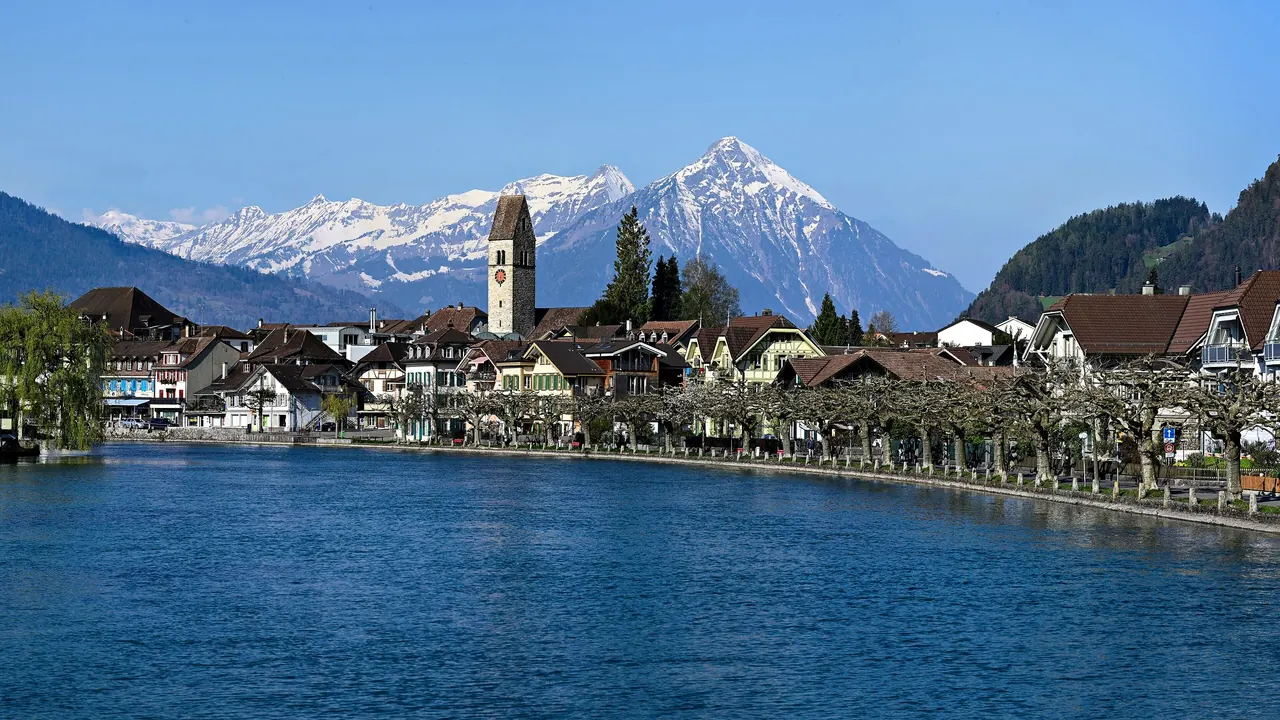
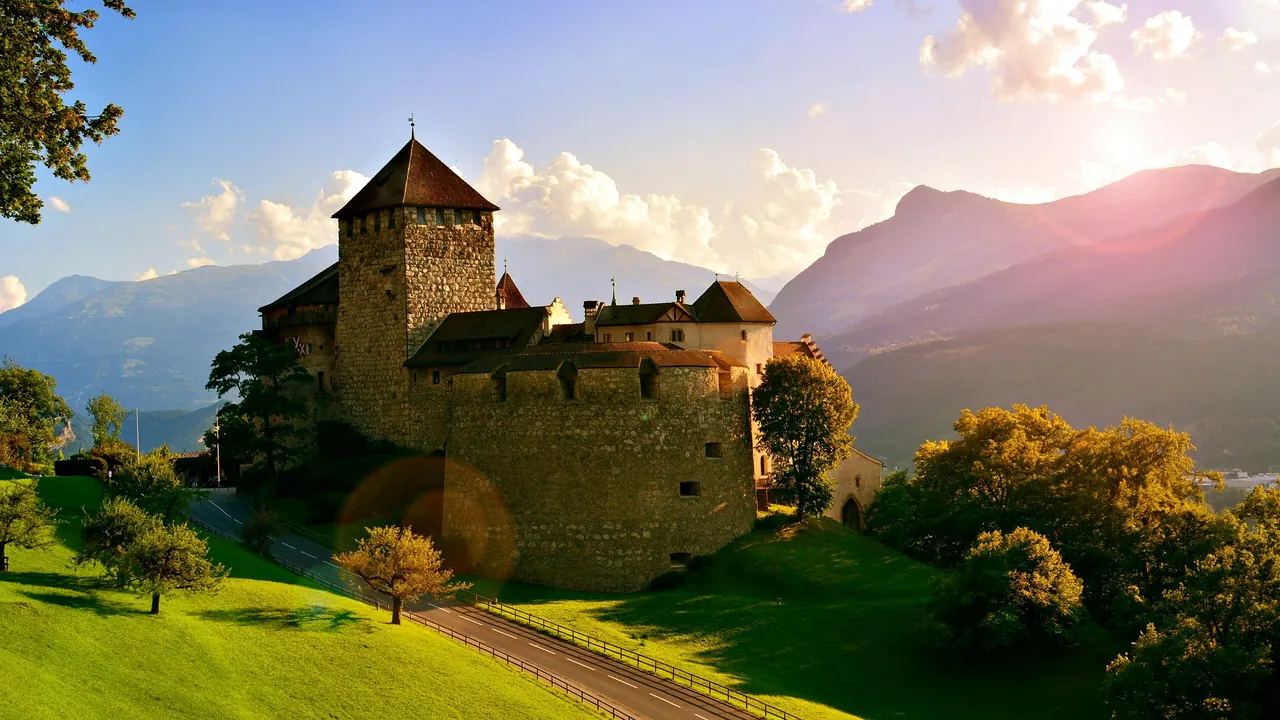
Photos: Interlaken by Roy Egloff, CC BY-SA 4.0, cropped; Vaduz by Justin LaBerge, CC BY 2.0, cropped.
Interlaken or Vaduz?
Our verdict in twelve categories, each scored against the same fixed benchmark cities, and the climate month by month, so you can choose for your trip.
Choose Interlaken for
- families
- getting around
- beaches
Interlaken is the stronger choice for anyone who wants the high Alps to fill the whole trip. Trains, cog railways and cable cars put the Eiger, the Lauterbrunnen valley and the Jungfraujoch within easy reach without a car. Paragliding, canyoning and lake paddling all start from town, and families get playgrounds and toboggan runs at the summit stations. The town itself has little to look at, so treat it as a base rather than a destination.
Choose Vaduz for
- culture and sights
- live music and the arts
- wellness
Vaduz suits a quieter, smaller trip. Here a morning in the Kunstmuseum and a glass of the prince's Pinot Noir count for as much as the hike above Triesenberg. Its mountains are gentler and less famous, but they start at the edge of town, and Bad Ragaz's thermal bath and old towns such as Feldkirch and St Gallen are close by. Travellers who don't mind driving, or changing buses, will get the most from it.
Scoreboard
Twelve categories on one fixed scale from 0 to 100. The shaded stretch is the gap between the two.
Your match
Pick a travel style or drag the sliders, and both match scores follow your weighting.
Wins on families and getting around with your weighting.
Wins on culture and sights and live music and the arts with your weighting.
What matters to you?
Category by category
What the scores mean for a trip.
Beaches & swimming
Neither town is a swimming destination, but Interlaken at least has water on its doorstep. Lake Thun warms enough in July and August for a dip from the lidos and shingle beaches at Neuhaus or towards Spiez, and Bönigen offers a bracing swim in turquoise Lake Brienz.
Vaduz has no lake, and the Rhine is not for swimming. You have the municipal open-air pools, or a half-hour drive to the steep-walled Walensee. That makes a swim an outing to plan rather than something to fit in after a hike.
Food & drink
The two are about level, and neither is worth travelling for the food. Interlaken's restaurants serve fondue, raclette and rösti to visitors alongside a good number of Indian and Asian kitchens. Its best meals are up at the hut terraces above Grindelwald or Mürren.
Vaduz has fewer restaurants and less variety, but it has a stronger local identity. Käsknöpfle and autumn game are on the menus of village inns, and the vineyards below the castle mean a local Pinot Noir comes with dinner.
Culture & sights
Vaduz has more to see, even if it only fills a day. The black cube of the Kunstmuseum and the Hilti Art Foundation beside it hold modern art of real quality. The National Museum and the Postage Stamp Museum explain the principality, and the walk up towards the castle ties it all together.
In Interlaken itself there is very little: the grand hotels and the Kursaal on the Höheweg, and a few timber houses in Unterseen. Its culture is a train ride away, in Bern or at Ballenberg.
Nightlife
Interlaken has a bit more going on after dark, thanks to its backpacker crowd. There are pubs, sports bars and a couple of basement clubs near the hostels, plus the casino in the Kursaal, and things liven up in summer and the ski season.
Vaduz has a few wine bars and hotel lounges on the Städtle, then nothing at all. Locals who want a late night cross to Feldkirch or go on to Zurich.
Nature & outdoors
Both towns sit in real mountains, but Interlaken's are on a different scale. Within an hour by rail you can be under the waterfalls of the Lauterbrunnen valley or out on the high trails at First, along the Schynige Platte ridge or below the Schilthorn. A longer day takes you up the cog railway to the Jungfraujoch at 3,454m, looking out over the Aletsch glacier. On top of that, the town is one of the great centres for paragliding, canyoning and rafting.
Vaduz's outdoors is quieter and closer to hand. You can walk from the centre up through vineyards and beech forest, or drive to Malbun for the Rätikon ridges and the exposed Fürstensteig path. Cycling on the flat Rhine dam path is excellent, and the small ski area suits beginners.
Day trips
Interlaken has the edge, largely because the Swiss railways make every outing simple. Bern's arcaded old town is under an hour away, and Thun, Spiez and Oberhofen are reached by lake steamer. Lucerne is a scenic ride over the Brünig Pass.
Vaduz sits on a border, so its outings cross two countries: medieval Feldkirch in Austria, St Gallen's baroque abbey library, Appenzell's painted houses and Lindau on Lake Constance. The range is wide, but without a station a car makes it much easier.
Good for families
Interlaken works far better with children because the mountain transport is the entertainment. Gondolas and steamers are fun in themselves, the summit stations have playgrounds and toboggan runs, and the St Beatus caves and Ballenberg make easy wins. Wet days and high altitudes are its weak points.
Vaduz is safe and calm, and its flat centre is easy with a pushchair. Beyond the pools, gentle walks and Malbun's beginner slopes, though, there is almost nothing for children, and its museums of modern art and stamps will bore most of them.
Getting around
Both centres are small and walkable. The difference is what lies beyond them. From Interlaken, mainline trains, narrow-gauge railways, cog railways, gondolas and steamers all link up, so the whole Jungfrau region can be done without a car, though the busiest summer trains get crowded.
Vaduz has a tidy bus network that reaches every village and runs up to Malbun. With no station of its own, though, going further means changing at Buchs, Sargans or Feldkirch, and many visitors end up hiring a car.
Shopping & style
Interlaken has more shops, though nearly all are aimed at tour groups. The Höheweg has big watch and jewellery stores, army knives, cuckoo clocks, chocolate and outdoor gear, and Brienz woodcarving is the one craft worth seeking out.
Vaduz's Städtle has only a handful of shops. Its best souvenirs are Liechtenstein stamps and a bottle of local wine, and serious shoppers head to Zurich.
Affordability
Both are very expensive, with prices at Swiss levels for rooms and meals. The costs fall in different places, though. In Interlaken the big expense is the mountain railways and cable cars, the Jungfraujoch above all, and hostels and transport passes help only so much.
In Vaduz the problem is a small choice of hotels and expensive meals. Buses and museums cost little, and some visitors save by sleeping across the border in Austria.
Live music & performing arts
The two are much alike: small and seasonal. Interlaken's highlight is the outdoor amateur staging of Schiller's William Tell in the woods each summer, a tradition going back to the early twentieth century, along with folklore evenings of yodelling and alphorns.
Liechtenstein offers more conventional fare. There is drama and dance at the national theatre stage in Schaan, a short orchestra season and a summer classical festival in Vaduz, so a week's stay usually turns up a concert.
Wellness & relaxation
For relaxation it comes down to the hotel spas on Interlaken's Höheweg against the centuries-old thermal springs at Bad Ragaz, twenty-five minutes from Vaduz. Interlaken has the bigger spas and calm steamer crossings, but its centre is busy with coach groups, so people who want rest tend to stay out in Wengen, Mürren or the lakeside villages.
Vaduz is the calmer town to come back to, with quiet streets and early nights. Its advantage is the large public bath at Bad Ragaz, fed by warm water from the Tamina gorge, which goes well with a few gentle days of walking in the hills.
When should you go?
Pick your month. The climate figures are measured averages, not a forecast.
Interlaken in July
Vaduz in July
Daytime high, °C
Rainfall in the month, mm
Where the figures come from
Interlaken has no rain gauge within 25 km of the centre, so its rainfall comes from a gridded climate dataset read at the destination rather than from a gauge further away.
Interlaken's sunshine is measured 66 km from the centre, at Sion.
Vaduz's temperatures are measured 51 km from the centre, at Sigmarszell-Zeisertsweiler.
Vaduz has no rain gauge within 25 km of the centre, so its rainfall comes from a gridded climate dataset read at the destination rather than from a gauge further away.
Temperature and rainfall are climate normals, averaged over the years shown. Interlaken: 2005-2020 (sunshine 1961-1990, rainfall 1991-2020) normals, Meiringen / Unterbach (19.3 km from centre). Vaduz: 1991-2020 normals, Sigmarszell-Zeisertsweiler (51.3 km from centre).
The two towns share almost the same climate. Both are cold from December to February, with highs around 4°C, which suits skiing but is raw for strolling the streets. Both warm up through May and peak in July and August at about 24°C, when the lakes near each town are warm enough for a swim. Summer is also the wettest season in both places, with showers and storms at their heaviest from June to August, so plan mountain days with some flexibility.
The difference is in the light. Interlaken gets noticeably more sunshine through summer and early autumn, about 270 hours in July, which matters when you are riding up to a viewpoint. Vaduz is a touch warmer in May but duller from September on. September is a good month in both, still mild and drier than midsummer.
Which traveller are you?
On a family trip with children, Interlaken is the easier pick. Rack railways, lake steamers, summit playgrounds, summer toboggan runs, the St Beatus caves and Ballenberg's farm animals keep children busy. Vaduz has open-air pools and gentle walks but little laid on for them.
For an outdoors trip, Interlaken wins clearly. The Jungfrau peaks, the Lauterbrunnen waterfalls and the high trails at First and Schynige Platte are all reached by rail, and paragliding, canyoning and rafting run from town. Vaduz offers quieter Rätikon ridges and a small ski area.
On a culture and arts trip, Vaduz gives more. The Kunstmuseum and Hilti Art Foundation hold serious modern art, there are national and stamp museums, and St Gallen's abbey library is an hour away. Interlaken has little beyond hotel façades and Unterseen's old houses.
Before you go
| Measure | Interlaken | Vaduz |
|---|---|---|
| Official language | French, German, Italian, Romansh | German |
| Currency | Swiss Franc (CHF) | Swiss Franc (CHF) |
| Sockets | CJ230 V, 50 Hz | CJ230 V, 50 Hz |
| Driving side | Right | Right |
| Time zone | UTC+1, UTC+2 in summer | UTC+1, UTC+2 in summer |
| Emergency number | 112 | 112 |
| Elevation | 571 m | 455 m |
| Main airport | Zürich Airport (ZRH)100 km from centre226 non-stop destinations | Zürich Airport (ZRH)81 km from centre226 non-stop destinations |
| Public holidays this year | 10 days | 21 days |
By the numbers
| Measure | Interlaken | Vaduz |
|---|---|---|
| Population | 6,123 | 5,668 |
| People per km² | 1,424 | 328 |
| Museums within 10 km | 3 | 7 |
| UNESCO World Heritage sites within 50 km | 2 | 3 |
Where else could you go?
Every comparison below shares a destination with this one, so you can follow Interlaken or Vaduz somewhere new.
- Grindelwaldvs Interlaken
- Bernvs Interlaken
- Engelbergvs Interlaken
- Lucernevs Interlaken
- Zermattvs Interlaken
- Zurichvs Vaduz