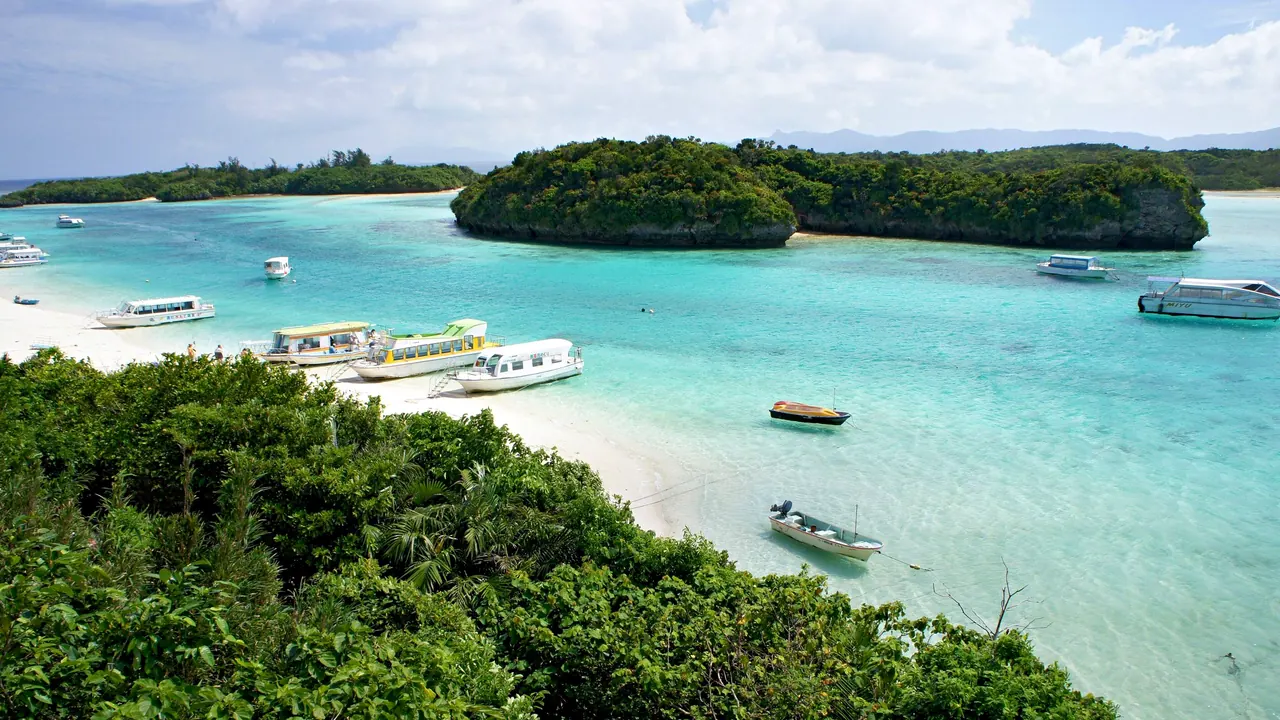
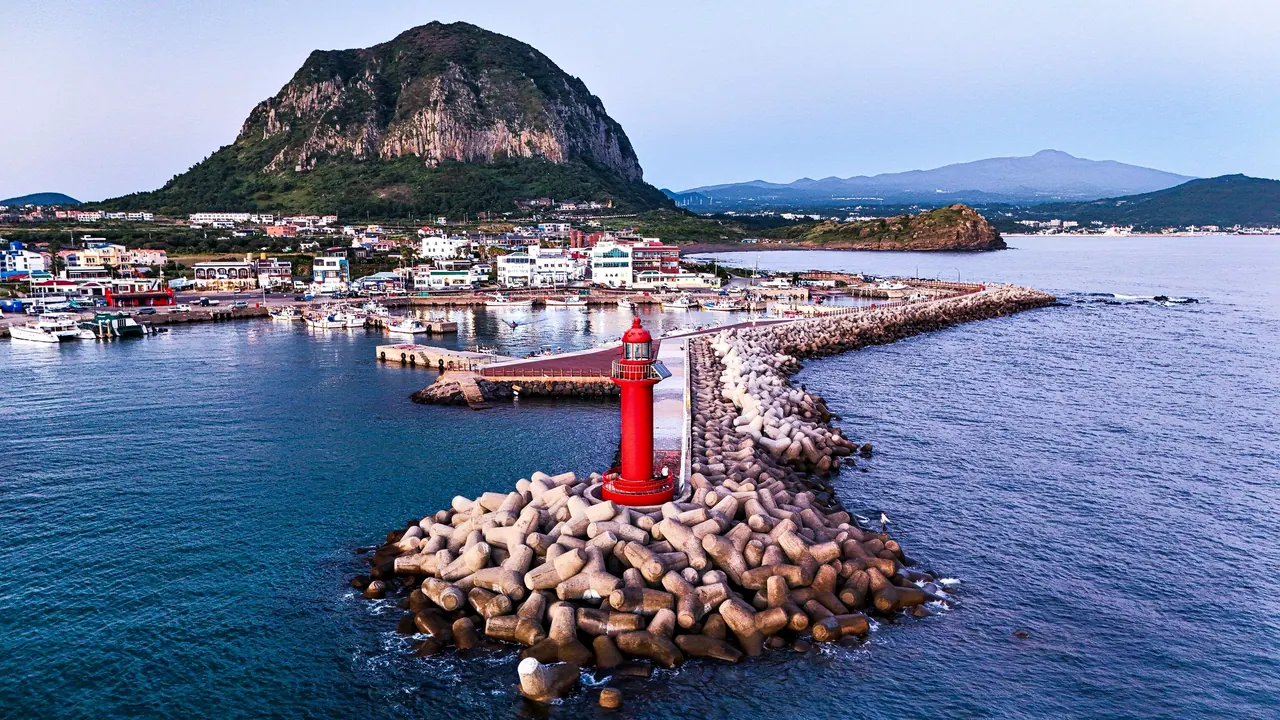
Photos: Ishigaki by 663highland, CC BY 2.5, cropped; Jeju by Nuhyil Ahammed, Pexels License.
Ishigaki or Jeju?
Our verdict in twelve categories, each scored against the same fixed benchmark cities, and the climate month by month, so you can choose for your trip.
Choose Ishigaki for
- beaches
- live music and the arts
- day trips
Ishigaki is the pick for a trip built around the water. Coral reef starts right off its shore, the sea stays warm enough to swim for most of the year, and the ferry terminal in town puts Taketomi's white sand, Iriomote's jungle rivers and the manta sites within easy reach. It suits snorkellers, divers and couples who are happy with small coral beaches, long izakaya dinners and evenings of sanshin songs, and who don't mind that the sights run out after a day or two.
Choose Jeju for
- food and drink
- families
- shopping
Choose Jeju if you would rather walk than swim, or if you are bringing children. Hallasan, the oreum cones and the Olle coastal trails make it an island for hiking, and its family attractions, from tangerine picking to the aquarium near Seongsan, go well beyond anything Ishigaki has. Its cooking has more range too, with charcoal-grilled black pork and seafood from the haenyeo divers. You give up warm sea for most of the year, though.
Scoreboard
Twelve categories on one fixed scale from 0 to 100. The shaded stretch is the gap between the two.
Your match
Pick a travel style or drag the sliders, and both match scores follow your weighting.
Too close to call, 1 point apart
Wins on beaches and live music and the arts with your weighting.
Wins on food and drink and families with your weighting.
What matters to you?
Category by category
What the scores mean for a trip.
Beaches & swimming
Ishigaki wins on the water itself. The sea is warm enough for about eight months of the year, reef sits just off the shore at Yonehara, and short ferry rides lead to Kondoi on Taketomi and Nishihama on Hateruma, the islands' best sand. The beaches are small coral coves, though, and in summer box jellyfish mean it's wise to swim at the netted beaches at Fusaki and Sukuji.
Jeju's beaches are broader and striking in their own way, with white sand and turquoise shallows at Hyeopjae and Geumneung set against black lava rock. But the sea is only warm from July to September. For the rest of the year the beaches are for walking, and in August they fill with Korean families.
Food & drink
Jeju gives a food lover more to explore. You get black pork grilled at the table, abalone porridge and sea urchin soup from the haenyeo catch, gogi-guksu for lunch and the evening stalls at Dongmun Market, a distinct island cuisine with real depth. The cafés in old stone farmhouses fill the gaps between meals.
Ishigaki's table is narrower: Yaeyama soba, goya champuru, sea grapes and Ishigaki beef, with awamori in the izakaya of Misaki-cho. That makes for very good eating over a few days, but there is little fine dining, kitchens close early and the outer islands have only a handful of places to eat.
Culture & sights
Neither island is a culture trip, but Jeju has more to fill a day off the beach. Seongeup Folk Village, the Haenyeo Museum and the 4.3 Peace Park, a memorial to the massacres of 1948, tell the story of an island that kept its own ways, and the National Museum and Stone Park explain the dol hareubang statues.
Ishigaki's heritage is smaller and gentler: the red-tiled village on Taketomi, the Ryukyu-era residence and stone garden at Miyara Donchi, the old temple and shrine at Torin-ji and the Yaeyama Museum. You can see all of it in a day or two.
Nightlife
Both islands go quiet early, and neither is a place to go out. The difference is in kind. Ishigaki's evenings gather in one walkable quarter, Misaki-cho behind the port, where dinner at an izakaya slides into awamori, karaoke and small counter bars.
Jeju City spreads its Korean pubs and soju-and-barbecue places across Nohyeong and Sinjeju and has a few clubs, which Ishigaki lacks. Outside the city, the rest of Jeju turns in after dinner.
Nature & outdoors
Both are excellent for the outdoors, but in different elements. Ishigaki's strength is underwater and in the jungle: snorkelling over some of Japan's richest coral, manta rays off Kabira and in the Yonara channel, and kayaking up Iriomote's mangrove rivers to waterfalls such as Pinaisara.
Jeju is the island for walking. You can climb Hallasan to its crater lake in a long day, take the short climbs up the oreum cones, follow the Olle trails past the basalt columns at Jusangjeolli, watch sunrise from Seongsan Ilchulbong and walk down into the Manjanggul lava tube. There is diving off Seogwipo, but for reef life Ishigaki is the place.
Day trips
On both islands a day trip means a ferry to a smaller island, and in both cases the list is short. Ishigaki's is a little longer and easier to work through, because frequent boats leave from the town waterfront for Taketomi, Kohama, Kuroshima and Iriomote, each a different village landscape, from Kuroshima's cattle pastures to the buffalo cart across to Yubu.
From Jeju you can cycle round Udo past its peanut farms or visit the barley fields of Gapado, Marado at Korea's southern tip or the fishing villages of the Chuja islands. A day in the other main town, Jeju City or Seogwipo, rounds it off.
Good for families
Jeju is the easier choice with children. Korean families have long taken their vacations here, and it shows. There is sheltered shallow water at Hamdeok and Gimnyeong, plus horse riding, tangerine picking in winter, a large aquarium near Seongsan, a theme park in the southwest and a lava tube that older children can walk into.
Ishigaki works for a family trip centred on the beach, with netted beaches at Fusaki and Sukuji and glass-bottom boats at Kabira Bay. Beyond that there is nothing built for children, and the fierce midday sun from June to September limits what small ones can do.
Getting around
On both islands a hire car is the practical answer, and on both the buses thin out once you leave town. What differs is the shape of the trip. Ishigaki town is compact, and every island ferry leaves from one waterfront terminal, so much of a stay runs on quick boat hops, which rough seas can cancel.
Jeju is a larger island to cross by road, about an hour from coast to coast. Its two towns sprawl beyond their walkable centres, and foreign drivers need an international driving permit.
Shopping & style
Jeju has the edge, largely because of its big duty-free stores in Jeju City and at the airport, strong on cosmetics and luxury goods. It also has dried fish and tangerine sweets at Dongmun and the Olle Market, and small coastal studios selling basalt pieces, natural-dye textiles and ceramics.
On Ishigaki, shopping means island produce in the covered arcades of the town centre: minsa cloth, salt, chilli oil, brown sugar and awamori. Neither island is a place for fashion.
Affordability
The two cost about the same, and on both the bill depends on where you stay and when you go. Ishigaki is most reasonable from a base in town, with business hotels and set lunches at normal Japanese levels. The west and north coast resorts, outer-island lodgings and boat tours push costs up.
Jeju stays affordable with pensions, market food and its free coastal trails, but black pork and haenyeo seafood are priced as the delicacies they are. Both are dearest in July and August and in the weeks when their home country travels: Golden Week and Obon for Ishigaki, Lunar New Year and Chuseok for Jeju.
Live music & performing arts
Ishigaki has the stronger living tradition. In its minyo bars, sanshin players perform Yaeyama folk songs on ordinary evenings, often with the audience singing along by the end. Summer brings Eisa and Angama dancing around Obon, and Taketomi holds its Tanadui festival in autumn.
On Jeju, live performance is occasional: concerts at the arts centres, haenyeo work songs and shaman rituals at folk festivals, and dinner shows for tourists. Neither island has a theatre or concert scene.
Wellness & relaxation
Jeju is the better place to unwind if you want facilities as well as quiet. Alongside the cedar forests and slow café stops, it has large hotel spas at Jungmun, jjimjilbang in both towns for long soaks, and a rare carbonated hot spring near Sanbangsan.
Ishigaki's calm comes from its pace rather than its facilities: empty roads in the north, sunsets, dark skies, and Taketomi or Kohama once the day boats have gone. Beyond the resort spas there is little, and no bathing culture to speak of.
When should you go?
Pick your month. The climate figures are measured averages, not a forecast.
Ishigaki in July
Jeju in July
Daytime high, °C
Rainfall in the month, mm
Temperature and rainfall are climate normals, averaged over the years shown. Ishigaki: 1991-2020 normals, Ishigakijima (1.3 km from centre). Jeju: 1991-2020 normals, Cheju (1.9 km from centre).
Ishigaki is subtropical and never really cold. January highs are around 21°C, so it works as a winter escape, though the sea is refreshing rather than warm then. Swimming is comfortable from about April to November. From June to September the days are very hot for walking about. Rain is heavy in May and June and again from August to October, peaking at around 256mm in September. July is the sunniest month, but typhoons can strike from July to October.
Jeju has proper seasons. Winters are cool, about 9°C in January, and the beaches are only worth it from July to September, when the sea reaches around 27°C in August. Summer is also its wettest time, with about 281mm in August. For hiking and the coastal trails, Jeju is at its best in April, May and October, which are mild, sunny and much drier. In short, Ishigaki is better from late autumn to early spring, and Jeju in spring and autumn.
Which traveller are you?
On a beach and sun trip, Ishigaki is the clear choice. Its sea stays warm for most of the year, and you can reach coral from the shore at Yonehara. The finer sand of Taketomi and Hateruma is a short ferry ride away. On Jeju, swimming is limited to high summer.
On a family trip with children, Jeju does more. Sheltered beaches at Hamdeok, horse-riding farms, tangerine picking, an aquarium and a theme park keep children busy. Ishigaki has gentle beaches and boat rides, but nothing actually built for children, and the midday summer heat is fierce.
On a food and nightlife trip, lean towards Jeju. Black pork grilled over charcoal, haenyeo seafood and the evening stalls at Dongmun Market give it more range than Ishigaki's soba and beef. Afterwards, Jeju City has rows of pubs and a few clubs.
Before you go
| Measure | Ishigaki | Jeju |
|---|---|---|
| Official language | Japanese | Korean, Korean Sign Language |
| Currency | Yen (JPY) | Won (KRW) |
| Sockets | AB100 V, 50 and 60 Hz depending on the region | CF220 V, 60 Hz |
| Driving side | Left | Right |
| Time zone | UTC+9 | UTC+9 |
| Emergency number | Police 110, fire 119 | Police 112, ambulance 119, fire 119 |
| Main airport | New Ishigaki Airport (ISG)11 non-stop destinations | Jeju International Airport (CJU)38 non-stop destinations |
| Public holidays this year | 16 days | 18 days |
By the numbers
| Measure | Ishigaki | Jeju |
|---|---|---|
| Population | 47,666 | 583,284 |
| People per km² | 214 | 316 |
| Swim season, months above 21 °C | 12 months | 4 months |
Where else could you go?
Every comparison below shares a destination with this one, so you can follow Ishigaki or Jeju somewhere new.