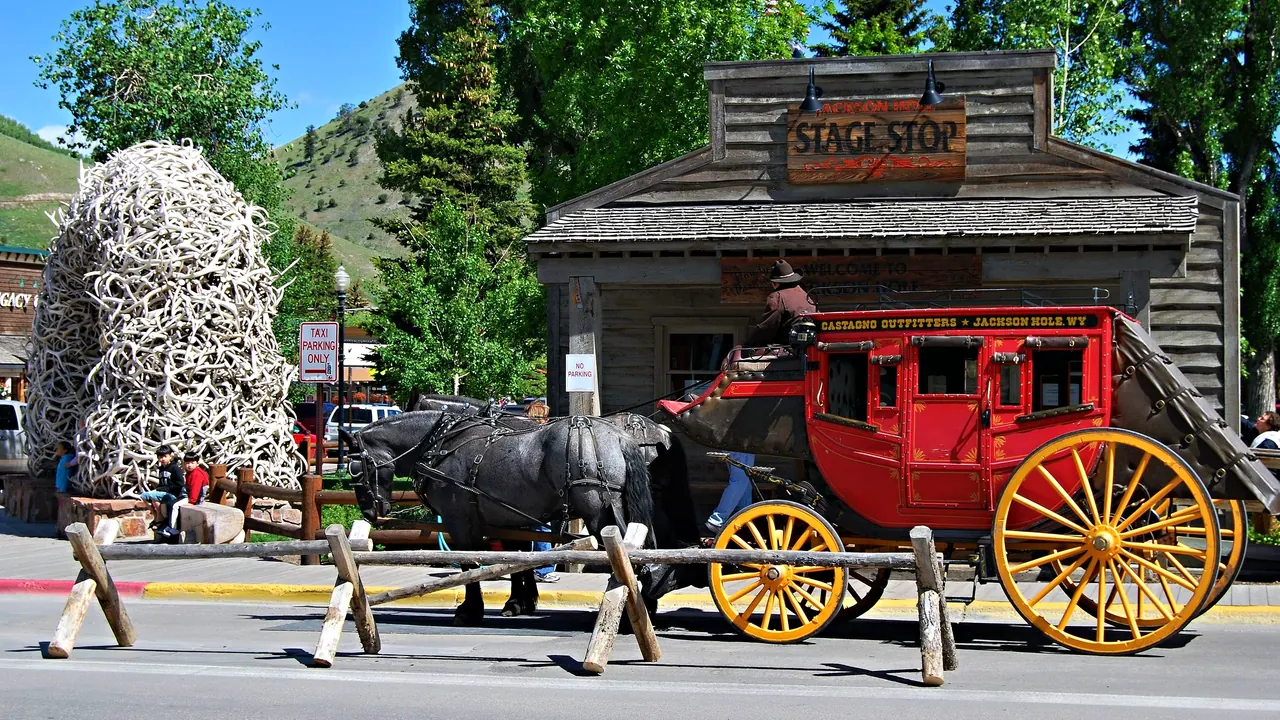
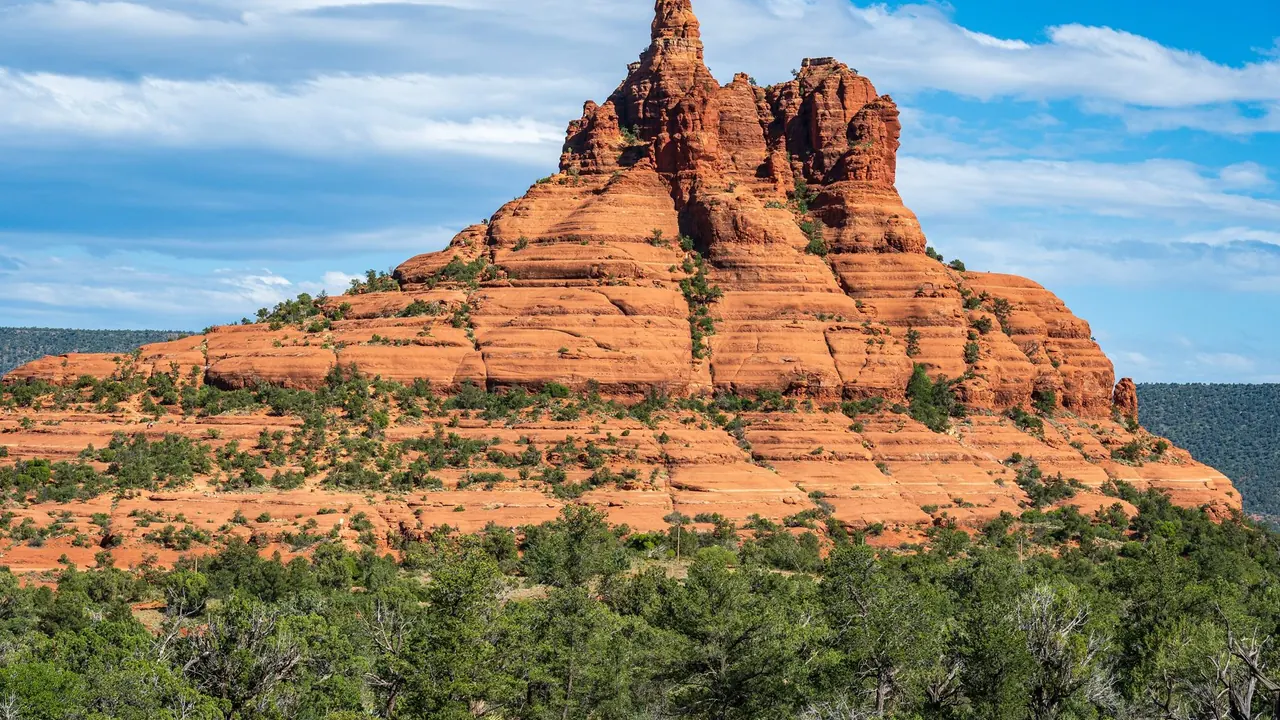
Photos: Jackson Hole by Pavel Špindler, CC BY 3.0, cropped; Sedona by dconvertini, CC BY-SA 2.0, cropped.
Jackson Hole or Sedona?
Our verdict in twelve categories, each scored against the same fixed benchmark cities, and the climate month by month, so you can choose for your trip.
Choose Jackson Hole for
- families
- nightlife
- live music and the arts
Jackson Hole suits travellers who want high mountains with plenty of wildlife. Grand Teton is on the doorstep, Yellowstone is within a drive, moose and bison can be seen from the car, and in winter there is some of the steepest lift-served skiing in North America. It is also the better pick for families, and for anyone who wants a good dinner and a saloon afterwards in a small town that is easy to walk around.
Choose Sedona for
- day trips
- wellness
- prices
Sedona is the choice for a slower trip built around rest. Its resort spas, yoga and meditation, and sunrise walks among the red rock buttes put relaxation at the centre of a stay, and its mild winters make it a good escape when the Tetons are under snow. It also has more to see beyond the trails, with Jerome, the Verde Valley tasting rooms and Sinagua cliff dwellings all a short drive away.
Scoreboard
Twelve categories on one fixed scale from 0 to 100. The shaded stretch is the gap between the two.
Your match
Pick a travel style or drag the sliders, and both match scores follow your weighting.
Too close to call, 1 point apart
Wins on families and nightlife with your weighting.
Wins on day trips and wellness with your weighting.
What matters to you?
Category by category
What the scores mean for a trip.
Beaches & swimming
Neither is a swimming destination, and in both a swim is a cool freshwater break from hiking. Jackson Hole's swimming is in the lakes beneath the Tetons. Sandy-bottomed String Lake warms enough for a proper swim by late summer, but Jenny Lake and the larger lakes stay bracing.
Sedona's swimming is in Oak Creek and is more playful: you can ride the sandstone chute at Slide Rock or swim in the deeper pools at Grasshopper Point and Red Rock Crossing. The spots are small and busy on hot weekends, but the warm weather lasts well beyond Jackson's few weeks.
Food & drink
Jackson Hole eats better. The wealth that passes through the valley pays for more chef-driven dining rooms than a town its size would normally have, and the menu is clearly regional: elk, bison, trout and huckleberries in everything from sauces to ice cream, with a few serious wine lists and a summer farmers' market on the square.
Sedona's dining leans on the view, with resort terraces, Southwestern chilli and corn dishes, and plenty for vegetarians. You soon run out of better kitchens, though the Verde Valley tasting rooms down the road offer something Jackson does not. Neither town has street food or cheap meals.
Culture & sights
Jackson Hole's best cultural stop is the National Museum of Wildlife Art, on a hillside above the elk refuge, with its American wildlife painting and sculpture. There are also the antler arches on the Town Square, a small museum on the trappers and homesteaders, and the Mormon Row barns and log chapel with the Tetons behind them. A single day covers it all.
Sedona has just as few sights, but they reach further back in time. The modernist Chapel of the Holy Cross, built into a butte in 1956, is the landmark. The Sinagua cliff dwellings at Palatki and Honanki and the V Bar V petroglyphs are a short drive into the backcountry. Neither town is worth choosing for culture alone.
Nightlife
Jackson Hole has a real night out, even if a modest one. In winter the après-ski bars at Teton Village get loud when the lifts close. In town, the saloon with saddles for bar stools and a country dance floor is the classic evening, followed by brewpubs and cocktail bars near the square. It still winds down before midnight.
Sedona barely has nightlife at all. You get a glass in a wine bar or resort lounge after dinner, and then a sky dark enough for serious stargazing.
Nature & outdoors
Jackson Hole is alpine country. The Tetons rise straight from the valley floor, Yellowstone is within a drive, and the wildlife matters as much as the trails: moose, bison, bears and thousands of wintering elk. It works all year, with rafting and fly fishing in summer and serious skiing in winter.
Sedona is desert rock, with red sandstone buttes and spires at Cathedral Rock, Bell Rock and Devil's Bridge, and slickrock trails that mountain bikers know well. Oak Creek Canyon climbs into pine forest, and the South Rim of the Grand Canyon is about two hours away. Spring and autumn are the best seasons for walking there, while Jackson's hiking is best in summer.
Day trips
Sedona has far more places to drive to. Jerome, the old copper-mining town on its mountainside, is about forty minutes away, and the Verde Canyon Railroad runs through a canyon with no road. Montezuma Castle and Tuzigoot are within half an hour, with Flagstaff, Walnut Canyon and Wupatki further on.
From Jackson, nearly every outing goes into the parks rather than to another town. Victor and Driggs over Teton Pass make a pleasant drive, but nothing nearby matches Sedona's mix of mining towns and ancient pueblos.
Good for families
Jackson Hole is the better family base. Children can spot wildlife from the car, earn Junior Ranger badges, walk the flat lakeside trails, float down the Snake, ride a winter sleigh, and watch the summer rodeo and the shootout on the square. The ski school takes care of winter.
Sedona has Slide Rock, the gentle lower trails at Bell Rock and jeep tours, but much of the town is aimed at couples and spa guests, and summer heat on exposed trails calls for care. Neither has a zoo, aquarium or theme park, and both mean a lot of driving.
Getting around
Neither works well without a car, but Jackson Hole is a little easier. Its centre is compact, with lodgings, restaurants and shops a few blocks from the Town Square. A bus runs the 20km to Teton Village in ski season, and the airport is a short drive north.
Sedona is spread along two highways that meet at the Y, and only Uptown is walkable. Trailhead parking fills early, traffic backs up at weekends, and most visitors arrive through Phoenix, about two hours' drive south.
Shopping & style
Both towns shop mainly for art, and neither has fashion or department stores. Jackson's boardwalks hold galleries of Western and wildlife art next to handmade cowboy hats, boots and leather goods, and serious ski and mountaineering gear.
Sedona centres on Tlaquepaque, the arts village built around courtyards and fountains, along with Native American jewellery, pottery and rugs. Its crystal and metaphysical shops are a speciality Jackson has nothing like.
Affordability
Both are expensive, but Jackson Hole is harder on a budget. Rates are very high and rooms scarce in summer and ski season, and lift tickets, rental cars and guided trips all cost resort prices. Staying over the pass in Idaho or coming in late spring or autumn helps most.
Sedona is costly too, especially in spring and autumn, but cheaper beds are easy to find in Cottonwood or Flagstaff. In both places the trails themselves cost next to nothing.
Live music & performing arts
Jackson Hole has more live performance, thanks largely to the Grand Teton Music Festival. For several summer weeks it brings players from leading American orchestras to a timber hall in Teton Village, and the town adds an arts centre, chuckwagon shows and country bands. Outside summer it goes quiet.
Sedona has no concert hall or theatre season, only chamber concerts, local theatre, acoustic sets and Native American flute players. Its long-running film festival takes place in late winter, when Jackson has little on.
Wellness & relaxation
Sedona is built for rest in a way Jackson Hole is not. Destination resort spas face the red rock, yoga, meditation, breathwork and massage are easy to find, and sunrise walks to the vortexes are a local ritual, though treatments come at resort prices.
Jackson has something Sedona lacks entirely: natural hot springs. One is in a forested canyon reached by snowmobile or dog sled in winter, and another sits beside the Snake River. Apart from those and the hotel spas, wellness there mostly means easing legs that are sore from skiing.
When should you go?
Pick your month. The climate figures are measured averages, not a forecast.
Jackson Hole in July
Sedona in July
Daytime high, °C
Rainfall in the month, mm
Where the figures come from
Sedona's station stands 153 m above the city centre, so the centre is likely a little warmer than the figures say.
Sedona has no rain gauge within 25 km of the centre, so its rainfall comes from a gridded climate dataset read at the city rather than from a gauge further away.
Temperature and rainfall are climate normals, averaged over the years shown. Jackson Hole: 1991-2020 normals, Jackson Hole / Moose (14.9 km from centre). Sedona: 2009-2025 (rainfall 1991-2020) normals, Sedona / West Sedona (1.3 km from centre).
Jackson Hole has two seasons that matter, summer and winter. Days warm quickly from June to a peak of about 32°C in July, which is also almost dry at 7mm. July and August are the months for high trails, rafting and a late-summer lake swim, and September is still mild and dry enough for long walks. From December to February daytime highs stay around 0°C, which makes for ski weather rather than strolling, while spring and late autumn are cool and in between.
Sedona's calendar runs the other way. Winters are mild enough for hiking, and April, May and October are the best months, warm and mostly dry. June to August reach about 34°C, too hot for walking except at dawn, and the rain comes back in July and August at up to 56mm, although this is when Oak Creek is most tempting. Jackson is at its best when Sedona is at its hottest, and in winter the pattern is reversed.
Which traveller are you?
On a family trip with children, Jackson Hole is the easier choice. The parks and their wildlife keep children busy in summer and winter, and the small, walkable town is simple to manage. Sedona's hotels and pace are aimed more at couples.
For a ski trip, Jackson Hole is the only option. The tram at Teton Village climbs above some of the steepest lift-served terrain in North America, with cross-country and backcountry routes across the valley. Sedona gets no more than the odd dusting of snow.
For a relaxing and wellness trip, Sedona is the clear choice. Spas face the red rock, yoga and meditation are easy to book, and the nights are dark and still. Jackson has good hot springs but little spa culture outside its hotels.
Before you go
| Measure | Jackson Hole | Sedona |
|---|---|---|
| Currency | US Dollar (USD) | US Dollar (USD) |
| Sockets | AB120 V, 60 Hz | AB120 V, 60 Hz |
| Driving side | Right | Right |
| Time zone | UTC-7, UTC-6 in summer | UTC-7 |
| Emergency number | 911 | 911 |
| Elevation | 1,901 m | 1,319 m |
| Main airport | Jackson Hole Airport (JAC)15 km from centre16 non-stop destinations | Phoenix Sky Harbor International Airport (PHX)160 km from centre149 non-stop destinations |
| Public holidays this year | 11 days | 12 days |
By the numbers
| Measure | Jackson Hole | Sedona |
|---|---|---|
| City population | 10,760 | 9,684 |
| People per km² | 1,416 | 195 |
| Museums within 10 km | 1 | 0 |
| UNESCO World Heritage sites within 50 km | 0 | 0 |
Where else could you go?
Every comparison below shares a destination with this one, so you can follow Jackson Hole or Sedona somewhere new.
- Flagstaffvs Sedona
- Scottsdalevs Sedona
- Phoenixvs Sedona
- Tucsonvs Sedona
- Salt Lake Cityvs Jackson Hole
- Park Cityvs Jackson Hole