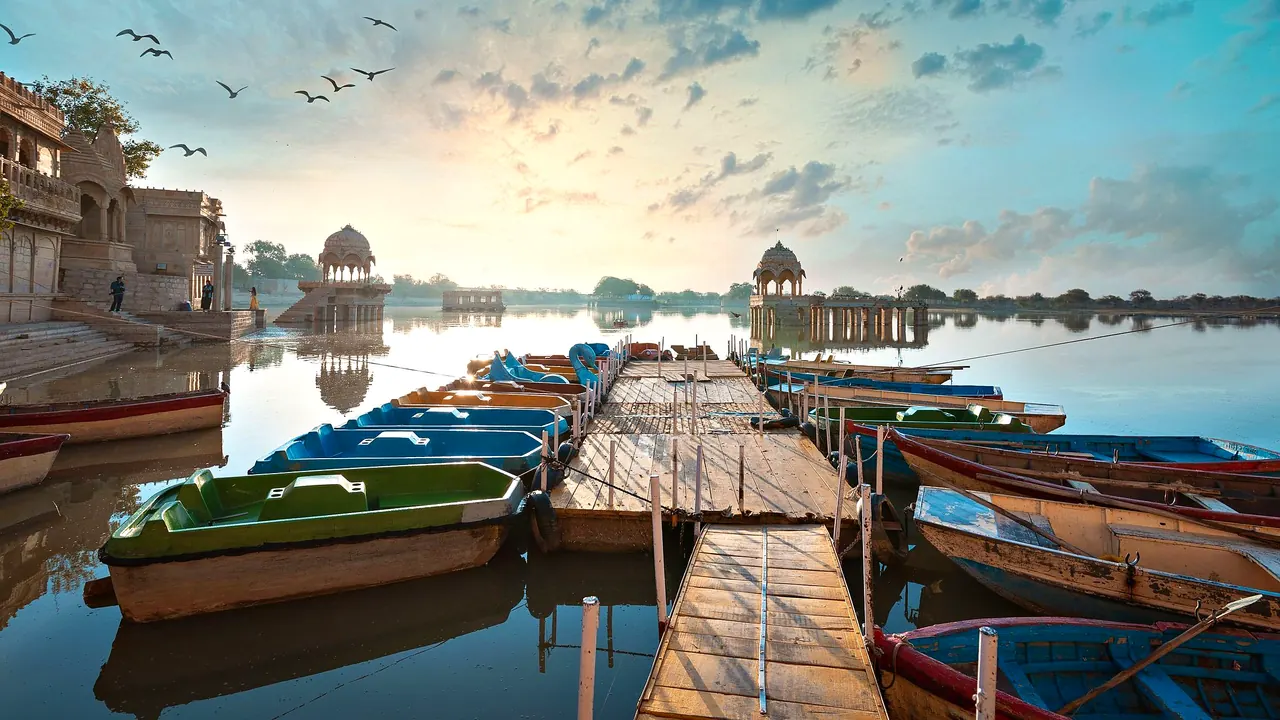
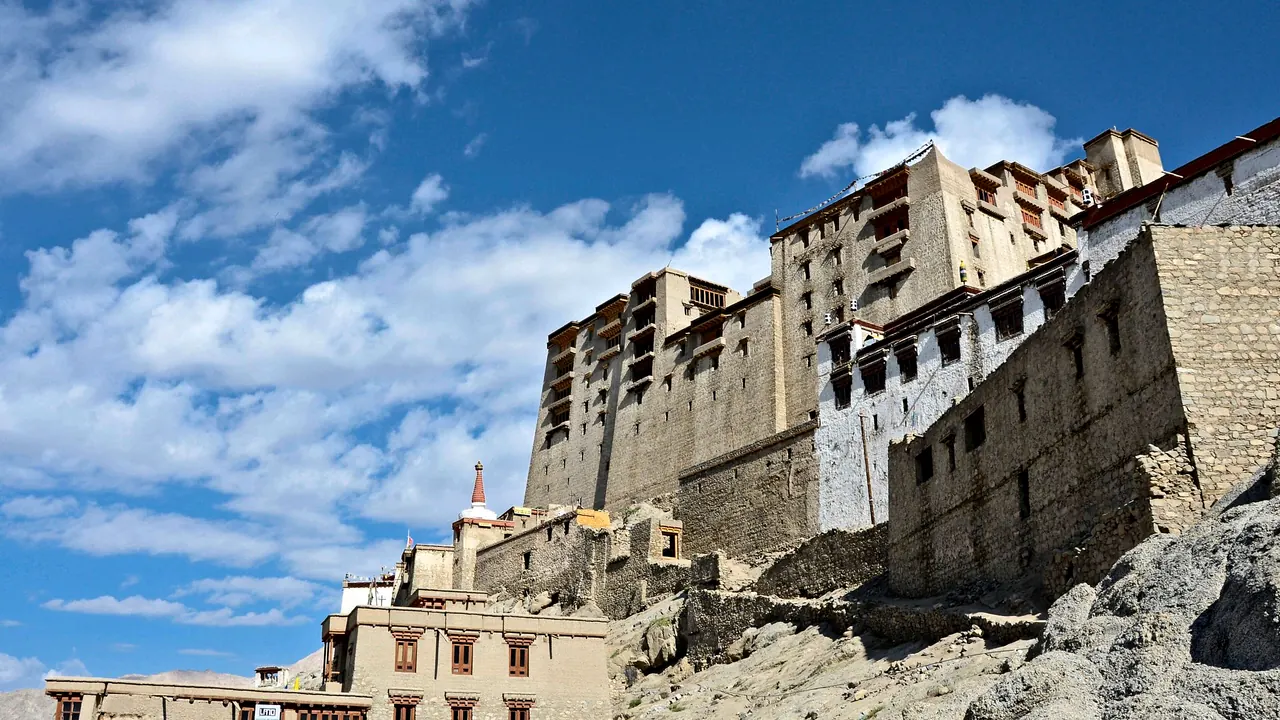
Photos: Jaisalmer by Prakash Yadav, Pexels License; Leh by Rayan Naqash, CC BY-SA 3.0, cropped.
Jaisalmer or Leh?
Our verdict in twelve categories, each scored against the same fixed benchmark cities, and the climate month by month, so you can choose for your trip.
Choose Jaisalmer for
- families
- getting around
- culture and sights
Jaisalmer suits a traveller who wants one concentrated piece of heritage: a golden sandstone fort that people still live in, lace-carved havelis below it, and evenings of desert folk music. It is easier with children and lighter on the wallet, compact enough to cover on foot, and works best as a cool-season stop on a wider Rajasthan route.
Choose Leh for
- nature and the outdoors
- day trips
- wellness
Choose Leh when the landscape is the point. The Indus valley, the high passes, treks through Hemis National Park and rafting in the Zanskar gorges put it far ahead for anyone active, and the ring of painted monasteries from Thiksey to Alchi makes it the better base for outings. It asks more in return: days of acclimatisation, long mountain drives and a summer-only window.
Scoreboard
Twelve categories on one fixed scale from 0 to 100. The shaded stretch is the gap between the two.
Your match
Pick a travel style or drag the sliders, and both match scores follow your weighting.
Too close to call, level with your weighting
Wins on families and getting around with your weighting.
Wins on nature and the outdoors and day trips with your weighting.
What matters to you?
Category by category
What the scores mean for a trip.
Beaches & swimming
Neither has anywhere to swim. Jaisalmer's Gadisar Lake is for boating and sunsets, so a pool at one of the heritage hotels on the edge of town is the only option, and a welcome one in the heat. In Leh the snowmelt rivers and high lakes are far too cold for bathing, and the water is there for rafting and the view.
Food & drink
Both kitchens are narrow, but very different in kind. Jaisalmer cooks for the desert: dal baati churma, ker sangri, gatte ki sabzi and slow mutton curries, best met in a vegetarian thali, with kachori and mirchi bada from the morning stalls.
Leh's food is mountain comfort, Tibetan momos and thukpa alongside Ladakhi skyu and salty butter tea, with apricots as the local pride. Both towns fill their visitor rooftops with pizza and pasta, and in Leh much of that scene shuts outside summer.
Culture & sights
Jaisalmer has the stronger sights in town. Its twelfth-century fort is a UNESCO-listed citadel still home to thousands of people, holding a royal palace and Jain temples carved in extraordinary detail, and below it stand the havelis of Patwon, Salim Singh and Nathmal.
Leh answers with the nine-storey palace modelled on the Potala, the Namgyal Tsemo ridge and a mud-brick old town worth wandering, but its museums are modest and a day or two covers it. Its finest monasteries are outings rather than town sights.
Nightlife
Neither is a place to go out. Jaisalmer's evenings are rooftop dinners facing the floodlit fort or a campfire show at a dune camp, while Leh's end even earlier, as cold nights, altitude and dawn starts for the passes send everyone to bed.
Nature & outdoors
Here Leh is in another league. The Indus valley is ringed by bare, many-coloured mountains with the snowy Stok range above, and from town you can trek the Markha valley, ride down from Khardung La above 5,000m, raft deep gorges or head out to the Nubra dunes and Pangong Tso. Winter adds snow leopard tracking and the frozen-river Chadar trek.
Jaisalmer has one landscape, the Thar. An overnight camel trek under a dark, starry sky is memorable, the Khuri dunes are a calmer alternative to crowded Sam, and birders find bustards and winter migrants in the Desert National Park. Beyond that there are no hills, rivers or real hiking.
Day trips
Leh is by far the better base. Thiksey and Shey are under half an hour away, Hemis about an hour, and a long day west reaches Alchi's thousand-year-old painted temples, among the finest early Buddhist art anywhere. Nearly everything is a monastery or palace, but the quality is exceptional.
Jaisalmer's outings are short and few: the Jain temples at Lodurva and the abandoned villages of Kuldhara and Khaba, which pair well with the dunes. Anything further is a long drive for a modest reward.
Good for families
Jaisalmer is the easier of the two with children, though still best for school-age ones in the cool months. Camels, jeep runs over the dunes and a tent camp with music are made for older children, and the many Indian families visiting make for a warm welcome.
Leh is hard going: altitude sickness after the flight up is a real risk for small children, and most outings are long drives on mountain roads. Robust teenagers who want to trek or raft are the exception.
Getting around
Both centres can be walked, but Jaisalmer's sights sit tighter together, with auto-rickshaws for short hops and hotels arranging cars or jeeps for the dunes and villages. The hassles are motorbikes, cattle and heat in the narrow lanes.
In Leh the slopes are tiring at altitude, and everything beyond town relies on taxi-union cars, hired motorbikes or shared jeeps over long mountain roads, some of them closed in winter.
Shopping & style
Jaisalmer offers more to browse: the fort lanes and old town are crammed with mirror-work textiles, embroidered quilts, camel leather, silver and carved sandstone, though bargaining can be wearing. Leh's Main Bazaar is smaller and leans Tibetan and Kashmiri, with pashmina, thangkas and turquoise, plus useful trekking gear. In both, the same stock repeats from stall to stall.
Affordability
Both are cheap places to stay, but Jaisalmer stretches a small budget further. Guesthouses with fort views, thalis and rickshaws all cost little, and haggling brings down camel treks and camps.
Leh's guesthouses and momos are just as modest, but transport adds up quickly through fixed taxi-union fares, hired cars and permits for the outer valleys, and hotels charge more in the short summer.
Live music & performing arts
Jaisalmer has the richer live tradition. Manganiyar and Langa musicians, with kamaicha fiddles and khartal clappers, play most evenings at camps, on rooftops and in small shows by the fort, alongside Kalbelia dancers and puppets, and the winter Desert Festival adds more.
Leh's performance is sacred and seasonal: masked cham dances in monastery courtyards, above all at the Hemis festival in summer and around Losar. Timed right it is deeply moving, but on most days there is little to attend.
Wellness & relaxation
Jaisalmer offers rest only in pockets. The larger heritage hotels have spas and the old town has simple ayurvedic massage, but touts, traffic and heat make the lanes tiring, so the calmest hours are spent in a haveli courtyard or at a remote camp out in the dunes.
Leh is the better choice for real quiet. It has meditation courses at Buddhist centres near town, consultations with amchi practitioners of traditional Tibetan medicine, and slow mornings on a guesthouse roof, which suit a contemplative stay more than a pampering one. The thin air works against rest at first, though, with dry skin and broken sleep for the first few days.
When should you go?
Pick your month. The climate figures are measured averages, not a forecast.
Jaisalmer in July
Leh in July
Daytime high, °C
Rainfall in the month, mm
Where the figures come from
Jaisalmer has no rain gauge within 25 km of the centre, so its rainfall comes from a gridded climate dataset read at the city rather than from a gauge further away.
Leh has no weather station within reach, so its figures come from a gridded climate model rather than a measured record, and read a broad area rather than the city itself.
Temperature and rainfall are climate normals, averaged over the years shown. Jaisalmer: 1993-2020 (rainfall 1991-2020) normals, Jaisalmer (1.9 km from centre). Leh: 1991-2020 normals, TerraClimate 4 km grid at the town, no weather station within 90 km.
The two run on opposite calendars. Jaisalmer is a winter destination: from November to February daytime highs sit between about 24°C and 32°C, comfortable for the fort lanes and the dunes, though desert nights turn cold. From April the heat becomes punishing and stays so through October, and the only real rain falls in July and August, which are still too hot for sightseeing beyond early mornings and evenings.
Leh is the reverse. Its winter is freezing, with January days below zero and some passes closed, while from June to September highs of about 21°C to 25°C are ideal for trekking and the high roads. The town stays dry all year, as the monsoon barely reaches it. A summer trip points to Leh, a winter one to Jaisalmer.
Which traveller are you?
For a culture and arts trip, Jaisalmer gives more within the town itself: the lived-in fort with its Jain temples, the merchant havelis, and Manganiyar and Langa musicians performing most evenings. Leh's own sights are fewer, its great monasteries lying a drive away.
On an outdoors trip, Leh wins outright. Treks through Hemis National Park, mountain biking down from Khardung La, rafting on the Indus and Zanskar and journeys to Pangong Tso far outstrip Jaisalmer, where the dunes and a camel trek are the whole offer.
On a family trip with children, Jaisalmer is the safer choice. Camel rides, a fort like a giant sandcastle and a night in a tent camp delight school-age children, and the sights are close together. Leh's altitude, reached in a single flight, makes it hard going for young ones.
Before you go
| Measure | Jaisalmer | Leh |
|---|---|---|
| Official language | Hindi, English | Hindi, English |
| Currency | Indian Rupee (INR) | Indian Rupee (INR) |
| Sockets | CM230 V, 50 Hz | CM230 V, 50 Hz |
| Driving side | Left | Left |
| Time zone | UTC+5:30 | UTC+5:30 |
| Emergency number | 108 or 112 | 108 or 112 |
| Elevation | 225 m | 3,500 m |
| Main airport | Jaisalmer Airport (JSA)6 km from centre5 non-stop destinations | Leh Kushok Bakula Rimpochee Airport (IXL)5 km from centre5 non-stop destinations |
By the numbers
| Measure | Jaisalmer | Leh |
|---|---|---|
| City population | 65,471 | 30,870 |
| People per km² | 12,837 | - |
| Museums within 10 km | 2 | 2 |
| UNESCO World Heritage sites within 50 km | 1 | 0 |
Where else could you go?
Every comparison below shares a destination with this one, so you can follow Jaisalmer or Leh somewhere new.