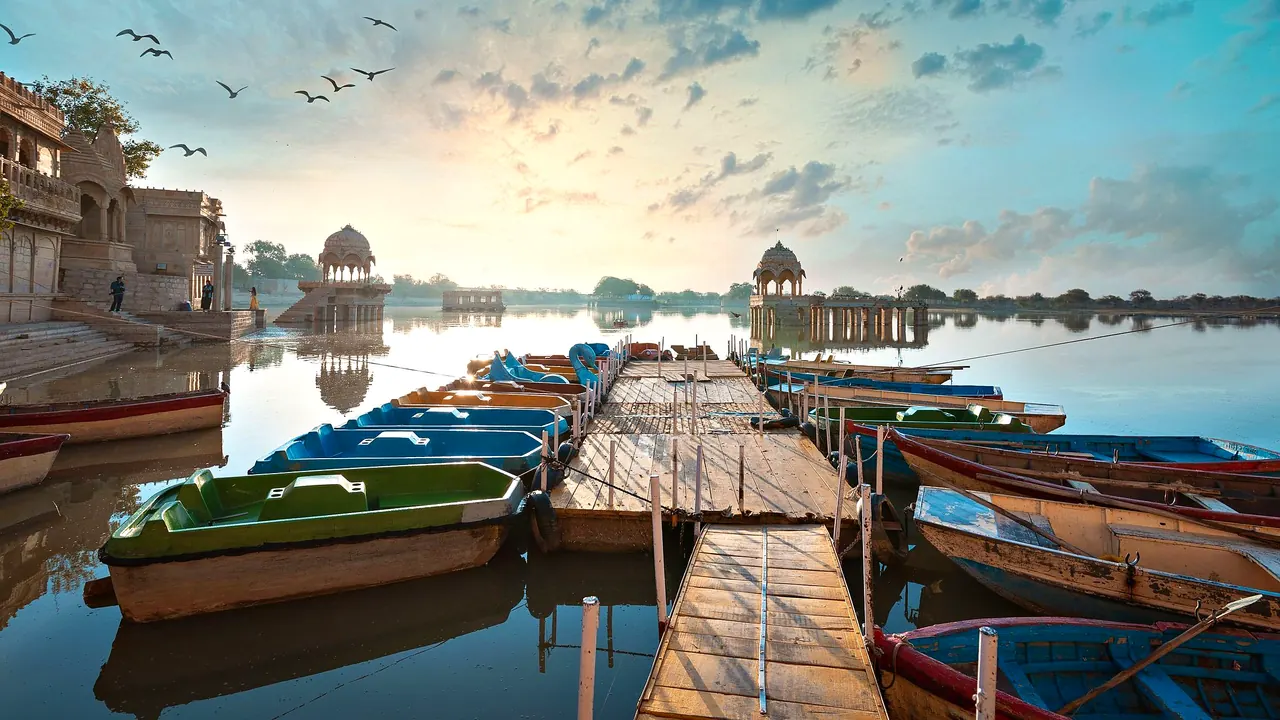
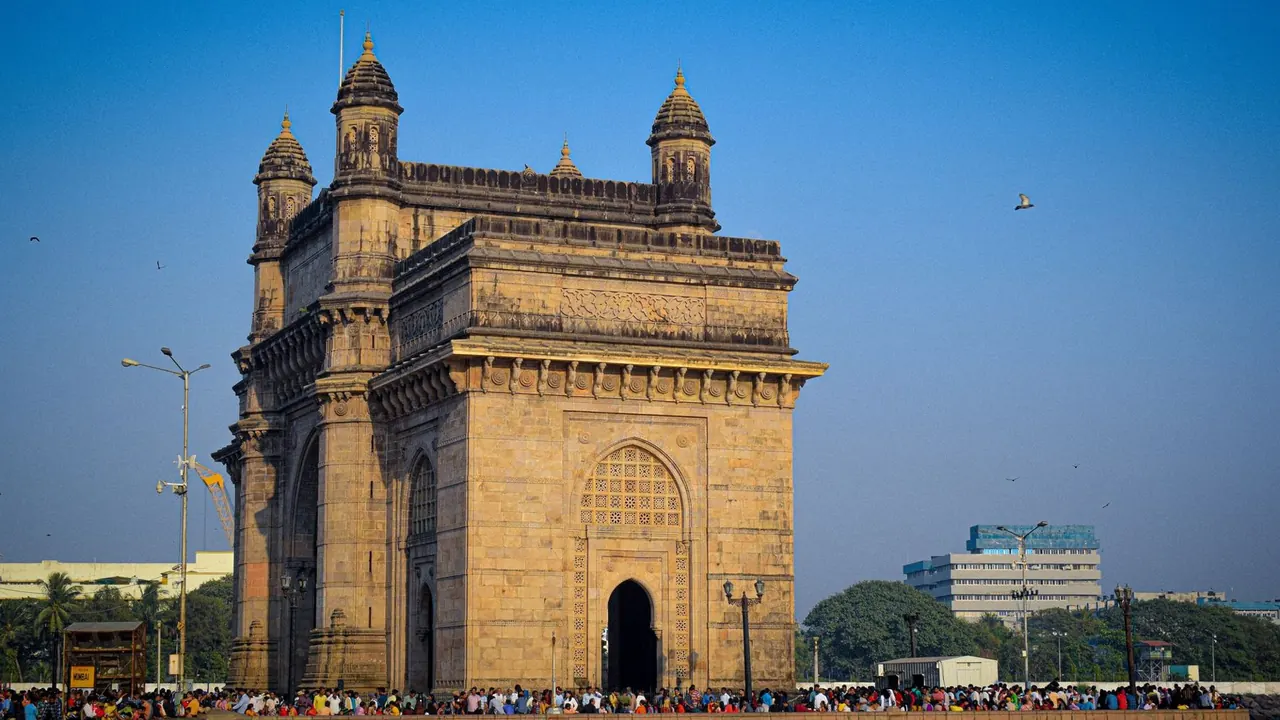
Photos: Jaisalmer by Prakash Yadav, Pexels License; Mumbai by Shubam Bhasin, Pexels License.
Jaisalmer or Mumbai?
Our verdict in twelve categories, each scored against the same fixed benchmark cities, and the climate month by month, so you can choose for your trip.
Choose Jaisalmer for
- prices
- getting around
Jaisalmer suits a traveller who wants one striking place, seen slowly and cheaply. It has a golden sandstone fort that people still live in, merchant havelis carved like lace and a night out in the Thar dunes, all in a small town you can cover in two or three days. It works best as a stop on a longer Rajasthan route between October and March, for people who are happy with quiet evenings and a short menu.
Choose Mumbai for
- food and drink
- nightlife
- day trips
Anyone who wants the range of a big city should pick Mumbai. Its street food, coastal kitchens and modern restaurants go much deeper, there are bars and stages to fill the evenings, and the shopping runs from Victorian market halls to designer boutiques. In return you get slow traffic, a bigger hotel bill and humid heat, and the monsoon months are best avoided.
Scoreboard
Twelve categories on one fixed scale from 0 to 100. The shaded stretch is the gap between the two.
Your match
Pick a travel style or drag the sliders, and both match scores follow your weighting.
Wins on prices and getting around with your weighting.
Wins on food and drink and nightlife with your weighting.
What matters to you?
Category by category
What the scores mean for a trip.
Beaches & swimming
Neither is a beach destination, but Mumbai at least has the sea. Juhu and Girgaum Chowpatty are broad stretches of sand for a sunset walk, kite-flying and snacks, though the water is too murky to swim in, and a ferry across the harbour reaches cleaner water on the Alibaug coast.
Jaisalmer has no open water to swim in at all, and Gadisar Lake is for boats and views. In both cities a hotel pool is the practical answer, and in the Jaisalmer heat it matters even more.
Food & drink
Mumbai is one of India's great places to eat, and the gap here is wide. With vada pav from station carts, bhel puri at Chowpatty, bun maska in the Irani cafés, Malvani crab and pomfret curries, and cooking from across India, you could eat for a week without repeating a meal. Bandra and Lower Parel add a polished tier of restaurants and cocktail bars.
Jaisalmer's food is narrower but its own: desert dishes such as ker sangri and dal baati churma, best tried in a vegetarian thali. Beyond that, the rooftop menus facing the fort lean on pizza and pasta, and drinking is not part of local life.
Culture & sights
The two are close here, but their sights are very different. Jaisalmer offers one compact set: the golden fort with people still living inside its walls, the finely carved Jain temples, the havelis and the cenotaphs at Bada Bagh, all seen on foot in two or three days.
Mumbai's sights belong to the colonial port city, from the Gothic extravagance of its great railway terminus to the Art Deco blocks of Marine Drive facing the Oval Maidan. It adds proper museum collections, the Kala Ghoda galleries and the Haji Ali Dargah. There is more variety, but the sights are scattered and slow to get between.
Nightlife
Mumbai has a real night out: cocktail bars and gastropubs in Bandra and Khar, clubs in the old mill compounds of Lower Parel and a more casual bar strip in Colaba. Most places close around 1am and drinks are heavily taxed.
In Jaisalmer the evening is a rooftop dinner facing the floodlit fort or a campfire show at a dune camp, and the lanes are quiet well before midnight.
Nature & outdoors
Mumbai has more outdoors to choose from. Sanjay Gandhi National Park brings forest, leopards and the Kanheri caves inside the city, flamingos feed on the Sewri mudflats in winter, and the Western Ghats offer monsoon hikes to hill forts and car-free Matheran.
Jaisalmer has a single landscape, but it is memorable: the Thar Desert, best seen on an overnight camel trek under a very dark sky, with the quieter Khuri dunes and the bustards and gazelles of the Desert National Park. Beyond that there is little to do outdoors, and the comfortable season is short.
Day trips
Mumbai has the stronger outings. The boat to the cave temples of Elephanta Island is a real highlight, the Buddhist cave halls at Karla and Bhaja lie out towards Lonavala, and the Alibaug coast adds sea forts. City traffic limits most visitors to one or two trips.
From Jaisalmer the options are short and local: the Jain temples of Lodurva and the abandoned villages of Kuldhara and Khaba, easy to pair with a trip to the dunes. Anything bigger is hours away, so the town works better as a stop than as a base.
Good for families
Neither is easy with children, though both welcome them warmly. Jaisalmer offers adventure for school-age children: a fort like a giant sandcastle, camel rides and a night in a tent camp. That only works in the cool months, and nothing there is built for children.
Mumbai has the more conventional outings, such as the Nehru Science Centre, the Byculla zoo, harbour ferries and ice cream at Chowpatty, set against traffic, broken pavements and humidity. In both cities a car and driver and a hotel pool make life easier.
Getting around
Both are tiring to get around, but for opposite reasons. Jaisalmer is compact, with the fort, the havelis and the lake all within walking distance. The lanes are uneven and hot, though, and the dunes and villages need a hired car or jeep.
Mumbai is long and spread out, with a walkable core around Fort, Kala Ghoda and Colaba. The suburban railway is fast outside rush hour and the metro covers part of the city, but road traffic can turn a short hop into an hour.
Shopping & style
Mumbai offers far more range. Crawford Market, the gold of Zaveri Bazaar and the antiques of Chor Bazaar sit alongside the street stalls of Colaba Causeway and Linking Road, designer and handloom shops in Kala Ghoda and Bandra, and luxury malls.
Jaisalmer is a crafts town, with mirror-work textiles, appliqué quilts, camel leather and carved sandstone filling the lanes of the fort. The stock repeats from shop to shop and sellers push hard, but it is a good place to buy desert handicrafts.
Affordability
Jaisalmer is clearly the cheaper trip, mainly because a simple room with a rooftop view of the fort costs very little. Food, rickshaws and entry to the sights are cheap too, and only the palace hotels and luxury camps charge international rates.
Mumbai is just as cheap for street food, trains and taxis, but rooms are the problem. Decent budget options are scarce, good hotels cost far more than elsewhere in India, and taxed cocktails add up quickly.
Live music & performing arts
Mumbai has a real stage life. The National Centre for the Performing Arts is home to the Symphony Orchestra of India and puts on classical music, dance, jazz and theatre, Prithvi Theatre in Juhu is the heart of the Hindi and English stage, and Marathi plays fill auditoriums in Dadar.
Jaisalmer has no venues, but it has the Manganiyar and Langa musicians of the Thar, heard most evenings at desert camps and rooftop shows, and the Desert Festival each winter. The setting may be staged for visitors, but the music is genuine.
Wellness & relaxation
Neither is a place to unwind, and in both, relaxation means hotel spas and simple Ayurvedic massage. The quiet moments are what differ: in Jaisalmer, an afternoon in a haveli courtyard or a night at a remote camp in the dunes, and in Mumbai, an early walk on Marine Drive or Bandstand, a seat by the Banganga Tank or a yoga class in Bandra.
When should you go?
Pick your month. The climate figures are measured averages, not a forecast.
Jaisalmer in July
Mumbai in July
Daytime high, °C
Rainfall in the month, mm
Where the figures come from
Jaisalmer has no rain gauge within 25 km of the centre, so its rainfall comes from a gridded climate dataset read at the city rather than from a gauge further away.
Temperature and rainfall are climate normals, averaged over the years shown. Jaisalmer: 1993-2020 (rainfall 1991-2020) normals, Jaisalmer (1.9 km from centre). Mumbai: 1991-2020 (rainfall 1961-1990) normals, Bombay / Santacruz (5.4 km from centre).
Jaisalmer has a short, clear season. From November to February the days are warm and dry, around 24°C in January, which is ideal for climbing through the fort and sleeping out in the dunes, although desert nights turn cold. From March the heat rises quickly to about 43°C in May, too hot for walking the lanes after mid-morning. July and August bring the town's only real rain, with sticky heat.
Mumbai is hot all year, rarely far from the low thirties, so the rain makes the difference. The monsoon from June to September is enormous, with 842mm in July, rough seas and very little sunshine. October to May is dry and sunny, and December to February is the most comfortable time for walking. The sea stays warm through the year, but in the city it is not for swimming. The best months of the two cities line up neatly in winter.
Which traveller are you?
On a trip on a tight budget, Jaisalmer goes further. Guesthouses with views of the fort cost little, thalis and street snacks are cheap, and haggling brings down the price of camel treks. In Mumbai the food and trains are cheap, but decent rooms are scarce and expensive.
For a food and nightlife trip, Mumbai is the clear choice. Its station snacks, Irani cafés, Konkani seafood and modern kitchens go far beyond Jaisalmer's short menu. Bandra and Lower Parel also have cocktail bars and clubs, while Jaisalmer goes to bed early.
On a shopping trip, Mumbai gives you much more to search through, from the gold of Zaveri Bazaar and the antiques of Chor Bazaar to the designer boutiques of Kala Ghoda. Jaisalmer suits only those after desert crafts such as mirror-work textiles and camel leather, and you will have to bargain hard there.
Before you go
| Measure | Jaisalmer | Mumbai |
|---|---|---|
| Official language | Hindi, English | Hindi, English |
| Currency | Indian Rupee (INR) | Indian Rupee (INR) |
| Sockets | CM230 V, 50 Hz | CM230 V, 50 Hz |
| Driving side | Left | Left |
| Time zone | UTC+5:30 | UTC+5:30 |
| Emergency number | 108 or 112 | 108 or 112 |
| Elevation | 225 m | 14 m |
| Main airport | Jaisalmer Airport (JSA)6 km from centre5 non-stop destinations | Chhatrapati Shivaji Maharaj International Airport (BOM)2 km from centre122 non-stop destinations |
By the numbers
| Measure | Jaisalmer | Mumbai |
|---|---|---|
| City population | 65,471 | 15,414,288 |
| People per km² | 12,837 | 25,563 |
| Museums within 10 km | 2 | 1 |
| UNESCO World Heritage sites within 50 km | 1 | 4 |
| Swim season, months above 21 °C | - | 12 months |
Where else could you go?
Every comparison below shares a destination with this one, so you can follow Jaisalmer or Mumbai somewhere new.
- Jodhpurvs Jaisalmer
- Udaipurvs Jaisalmer
- Jaipurvs Jaisalmer
- Udaipurvs Mumbai
- Amritsarvs Jaisalmer
- Delhivs Jaisalmer