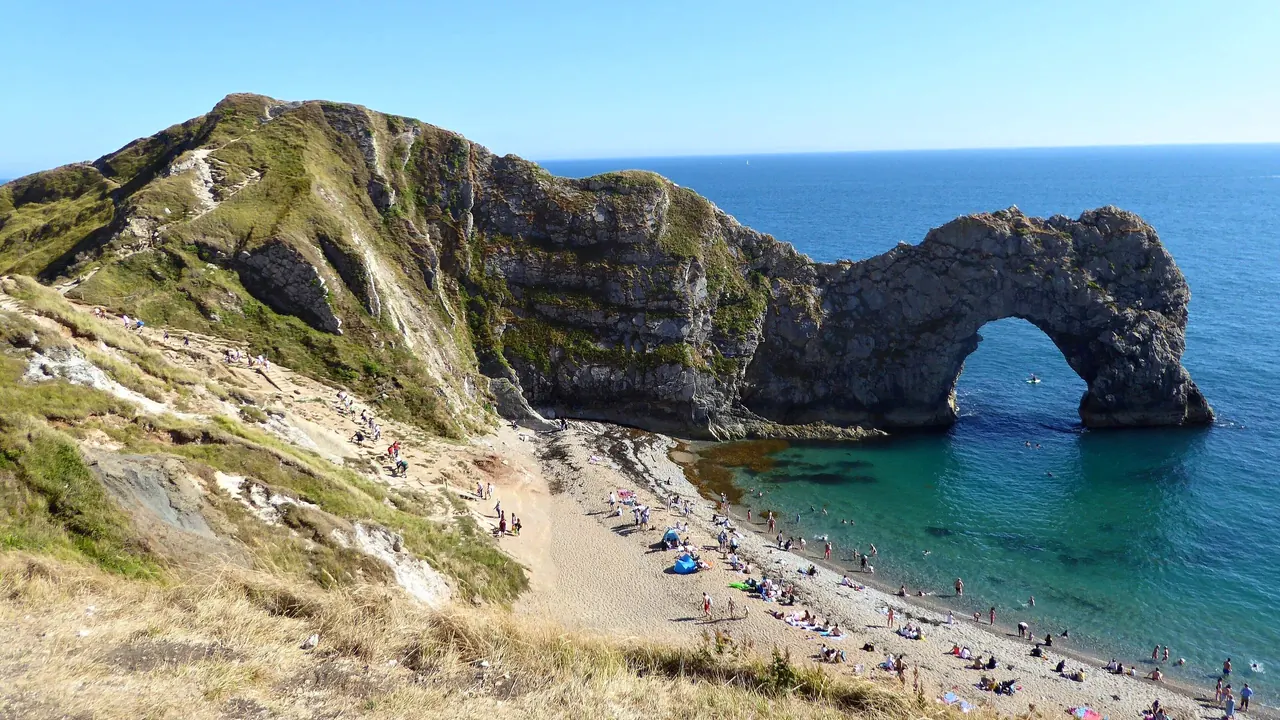
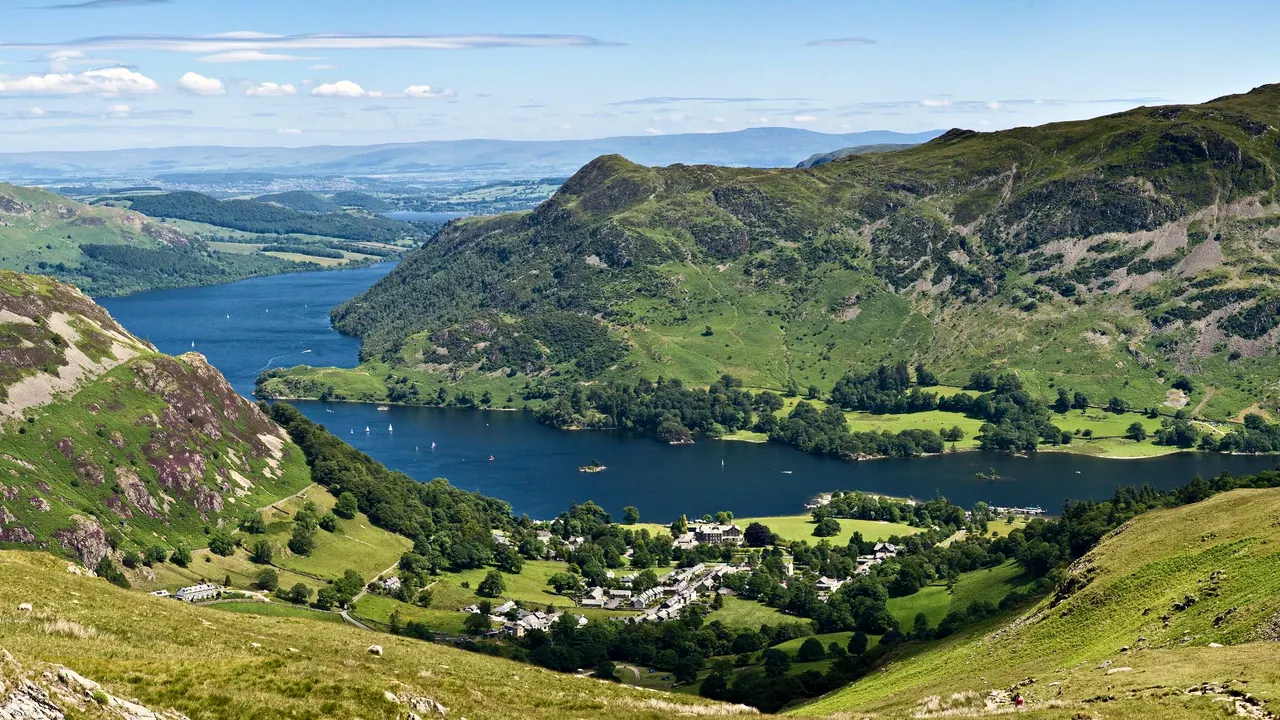
Photos: Jurassic Coast by Ethan Doyle White, CC BY-SA 4.0, cropped; Lake District by Diliff, CC BY-SA 3.0, cropped.
Jurassic Coast or Lake District?
Our verdict in twelve categories, each scored against the same fixed benchmark cities, and the climate month by month, so you can choose for your trip.
Choose Jurassic Coast for
- beaches
- families
- prices
The Jurassic Coast suits a summer seaside trip with a bit of everything: sandy bays at Weymouth and Studland, fossil hunting on the shingle at Charmouth, clifftop walks to Durdle Door and a crab sandwich on the harbour wall. It is warmer, drier and sunnier than the Lakes, and its gentler beaches make it the easier choice for families with young children who want sand and sea every day.
Choose Lake District for
- wellness
- culture and sights
- nature and the outdoors
Walkers and anyone who wants mountains should head north to the Lake District. Here the fells rise straight from long lakes, routes like Helvellyn and Scafell Pike give proper mountain days, and the evenings end with a fire, a good pub supper or a lakeside spa. It is wetter and cooler, and there is no beach life, but it has more for literary pilgrims and more for travellers who simply want to slow down.
Scoreboard
Twelve categories on one fixed scale from 0 to 100. The shaded stretch is the gap between the two.
Your match
Pick a travel style or drag the sliders, and both match scores follow your weighting.
Too close to call, 1 point apart
Wins on beaches and families with your weighting.
Wins on wellness and culture and sights with your weighting.
What matters to you?
Category by category
What the scores mean for a trip.
Beaches & swimming
The Jurassic Coast is a real summer seaside destination, with sandy, gently shelving bays at Weymouth and Studland, red-cliffed beaches at Exmouth and Sidmouth, and steep shingle coves with clear water at Lulworth and Durdle Door.
The Lake District has nothing comparable. Swimming there means a bracing dip in Buttermere or Ullswater from a shingle shore or jetty, and the Cumbrian coast's long beaches are better for a walk than a swim.
Food & drink
Both regions eat simply and well, but the Lakes come out a little ahead thanks to their top end: the country-house and farm-to-table cooking around Cartmel and Windermere draws diners from across Britain, alongside fireside pubs serving Herdwick lamb and Cumberland sausage.
On the Jurassic Coast the strength is the sea: crab, lobster and scallops at harbour shacks in West Bay and Lyme Regis, plus Dorset cheese, cider and English sparkling wine. Bridport is the place to base yourself for eating.
Culture & sights
The Lake District has the richer heritage, and it is literary: Wordsworth's Dove Cottage at Grasmere, Beatrix Potter's Hill Top, Ruskin's Brantwood above Coniston, and the Castlerigg stone circle. These are small sights spread across valleys, but together they give a clear theme to a trip.
On the Jurassic Coast the sights are more scattered and mostly about fossils, from Mary Anning's Lyme Regis to the Charmouth heritage centre. Corfe Castle and Hardy's Dorchester, with Maiden Castle nearby, are the high points.
Nightlife
Neither region is for a night out, and in both the evening means a pub. The difference is small: Weymouth has a seafront bar strip that draws stag and hen groups in summer, while the Lakes' liveliest evenings are walkers talking routes in Ambleside, Keswick or Bowness and an early night before the fells.
Nature & outdoors
Both regions are made by their landscape, but the Lake District goes further. It has England's highest mountains rising from glacial lakes, ridge walks such as Striding Edge, the crags where British rock climbing began, and sailing and paddling on Windermere and Ullswater.
The Jurassic Coast offers a different kind of outdoor trip: 95 miles of cliff walking on the South West Coast Path, famous landforms like Durdle Door and Chesil Beach, fossil hunting after storms, and sailing in Weymouth Bay. The hills are rolling rather than high.
Day trips
The two are broadly level for outings, and both work best by car. From the Jurassic Coast the trips go inland to Exeter, Sherborne and Dorchester, across to Brownsea Island, and, with a longer drive, to Salisbury and Stonehenge.
From the Lakes the pull is north and south of the national park: Carlisle's castle, the central stretches of Hadrian's Wall and the Yorkshire Dales, plus the Ravenglass miniature railway within the region itself.
Good for families
The Jurassic Coast is the stronger family choice: a traditional British seaside with safe, shallow water at Studland, Weymouth's sandy bay and sea-life centre, the tank museum at Bovington and fossil hunting that children remember. Watch small children closely beneath the crumbling cliffs.
The Lake District suits families who like being outdoors, with lake steamers, the Beatrix Potter connection and gentle walks around Tarn Hows. On wet days, though, there is little to do indoors.
Getting around
The Jurassic Coast is long and strung out along winding lanes, so driving from Exmouth at one end to Studland at the other takes a few hours, more when the summer traffic builds and the car parks at Lulworth fill. Buses cover the coast in stages, with changes at Lyme Regis or Axminster, so car-free visitors do best staying in one town and walking the coast path between stops.
The Lake District is the easier of the two without a car. A branch line reaches Windermere, and from there buses and lake steamers link the central villages as far as Keswick, so many walks start from a bus stop. Only the western valleys, over the steep Hardknott and Wrynose passes, really need a car.
Shopping & style
Shopping is no reason to visit either region, though each has its own speciality. On the Jurassic Coast it is Bridport's street market and antiques quarter, plus polished ammonites in Lyme Regis. In the Lakes it is the outdoor-kit shops of Ambleside and Keswick, along with Herdwick wool and slate crafts.
Affordability
Both are pricey in high summer and broadly level overall. On the Jurassic Coast, Weymouth, campsites and caravan parks are the cheaper options, while car parking keeps adding up. The Lakes counter with a long tradition of youth hostels and bunkhouses, and prices ease noticeably in winter and outside school breaks. In both, the walking itself costs nothing.
Live music & performing arts
The Lakes have a little more on stage. Theatre by the Lake in Keswick runs a proper repertory season, and Kendal has an arts centre and its November mountain festival.
On the Jurassic Coast the offer is mostly Weymouth's seafront pavilion shows, small venues in Lyme Regis and Bridport, and summer folk and literary festivals. In both regions, larger productions mean a trip out of the area.
Wellness & relaxation
Neither region has a spa or bathing tradition. On the Jurassic Coast, wellness means a handful of country-house and seafront hotel spas and a few yoga retreats in the Dorset hills. What it offers instead is the steady rhythm of a cottage stay, with cliff walks by day, and Beer, Charmouth and the Purbeck hamlets at their quietest outside August.
The Lake District is the better choice for a restorative stay, because treatments are part of the usual trip there. A weekend of hill walking followed by a soak in a hotel pool is a classic Lakes break, not something you have to hunt for. Both regions have cold-water swimmers. On the Jurassic Coast they swim in the open sea in groups, while in the Lakes the swim is in a still tarn or lake, and locals keep it up all year.
When should you go?
Pick your month. The climate figures are measured averages, not a forecast.
Jurassic Coast in July
Lake District in July
Daytime high, °C
Rainfall in the month, mm
Where the figures come from
Jurassic Coast's temperatures are measured 66 km from the centre, at Bournemouth Airport.
Jurassic Coast has no rain gauge within 25 km of the centre, so its rainfall comes from a gridded climate dataset read at the destination rather than from a gauge further away.
Lake District's temperatures are measured 37 km from the centre, at Walney Island.
Lake District has no rain gauge within 25 km of the centre, so its rainfall comes from a gridded climate dataset read at the destination rather than from a gauge further away.
Lake District's sunshine is measured 90 km from the centre, at Leeming.
Temperature and rainfall are climate normals, averaged over the years shown. Jurassic Coast: 1991-2020 normals, Bournemouth Airport (65.7 km from centre). Lake District: 1991-2020 normals, Walney Island (36.8 km from centre).
On the Dorset coast, June to September is the time to go. Afternoons reach about 22°C in July and August, early summer is the driest stretch of the year, and July brings the most sunshine. The sea stays cold until late in the season and is at its least bracing in August and September, at about 17°C, so September works well for both a swim and a long walk. From October the rain picks up and the days shorten, and the winter months suit fossil hunting after storms rather than the beach.
In the central Lakes the summer is noticeably cooler, with highs of around 18°C. It rains in every month, and summer there is much wetter than on the Dorset coast. The wettest stretch runs from October to January, when monthly totals reach about 200mm. May is often the sunniest month and one of the drier ones, which makes late spring the best time for long fell days, with September a good second choice. In high summer the lakes and the Irish Sea off the Cumbrian coast are similarly cool, warm enough only for a short dip.
Which traveller are you?
For a beach and sun trip, the Jurassic Coast is the clear choice. It has warmer, sunnier summers, the long sands of Studland and Weymouth and the clear water at Lulworth, while the Lakes offer only cold lake dips and empty, chilly shores.
On a relaxing and wellness trip, the Lake District does better. Lakeside hotels around Windermere and Ullswater pair spa pools with views over the water, and quiet valleys and fireside evenings set a slower pace than the busy Dorset resorts in August.
On a family trip with young children, the Jurassic Coast is easier. Shallow, sandy paddling at Studland, donkeys on Weymouth beach and guided fossil walks at Charmouth fill the days, whereas the Lakes suit children who are already keen walkers and cope with rain.
Before you go
| Measure | Jurassic Coast | Lake District |
|---|---|---|
| Official language | English | English |
| Currency | Pound Sterling (GBP) | Pound Sterling (GBP) |
| Sockets | G230 V, 50 Hz | G230 V, 50 Hz |
| Driving side | Left | Left |
| Time zone | UTC, UTC+1 in summer | UTC, UTC+1 in summer |
| Emergency number | 112 or 999 | 112 or 999 |
| Main airport | Exeter International Airport (EXT)25 non-stop destinations | Manchester Airport (MAN)211 non-stop destinations |
| Public holidays this year | 8 days | 8 days |
By the numbers
| Measure | Jurassic Coast | Lake District |
|---|---|---|
| Swim season, months above 21 °C | None | None |
Where else could you go?
Every comparison below shares a destination with this one, so you can follow Jurassic Coast or Lake District somewhere new.
- Devonvs Jurassic Coast
- Yorkshire Dalesvs Lake District
- Isle of Wightvs Jurassic Coast
- Northumberlandvs Lake District
- Cotswoldsvs Jurassic Coast
- Peak Districtvs Lake District