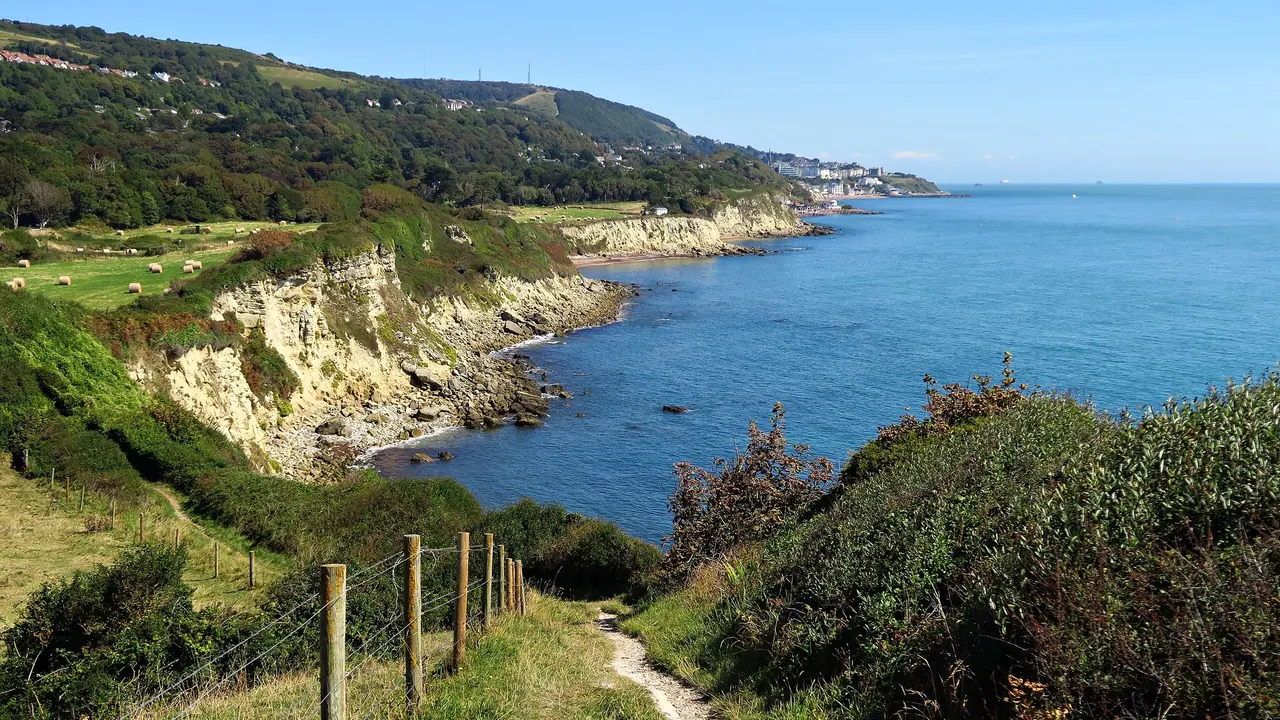
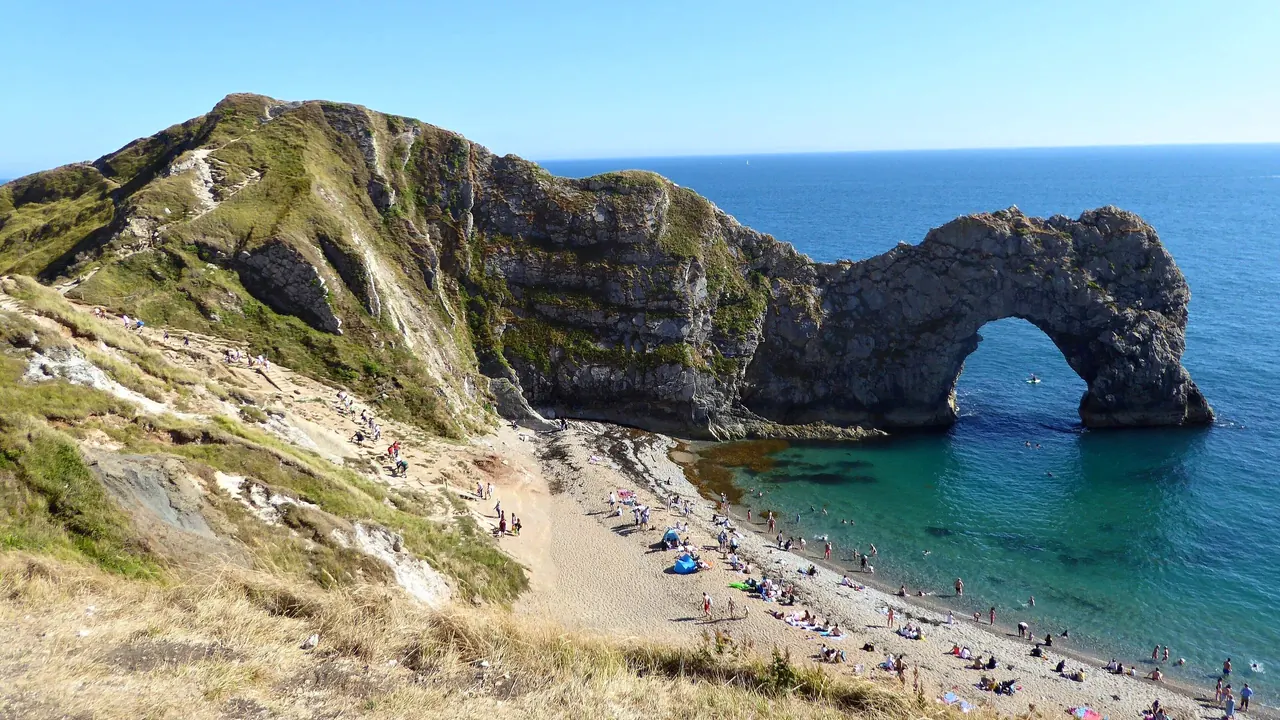
Photos: Isle of Wight by Michael Coppins, CC BY-SA 4.0, cropped; Jurassic Coast by Ethan Doyle White, CC BY-SA 4.0, cropped.
Isle of Wight or Jurassic Coast?
Our verdict in twelve categories, each scored against the same fixed benchmark cities, and the climate month by month, so you can choose for your trip.
Choose Isle of Wight for
- getting around
- live music and the arts
- culture and sights
The Isle of Wight suits travellers who want everything close at hand without needing a car. It is compact. Its buses and the little railway down the east coast link the resorts, and it has the stronger set of sights, led by Osborne House and Carisbrooke Castle. Families who want a week of sandy bays and attractions made for children, with a short foot-ferry crossing at each end, will find it the easier of the two.
Choose Jurassic Coast for
- nature and the outdoors
- food and drink
- shopping
Walkers, and anyone who travels for landscape, should pick the Jurassic Coast. Its cliffs run from the red sandstone of east Devon to Durdle Door and Old Harry Rocks, they are on another level from the island's gentle downs, and fossil hunting goes on all along the shore. The price is effort. The coast is long and a car is close to essential, so it works best from one base such as Lyme Regis or Bridport, where the food is also a little better.
Scoreboard
Twelve categories on one fixed scale from 0 to 100. The shaded stretch is the gap between the two.
Your match
Pick a travel style or drag the sliders, and both match scores follow your weighting.
Too close to call, 1 point apart
Wins on getting around and live music and the arts with your weighting.
Wins on nature and the outdoors and food and drink with your weighting.
What matters to you?
Category by category
What the scores mean for a trip.
Beaches & swimming
Both are proper seaside, and the difference is in the beaches themselves. The island's best sand is one long, sheltered curve around Sandown Bay, with the flats at Ryde and wild Compton Bay for variety.
On the Jurassic Coast, the sand is at the two ends, among the dunes at Studland and in Weymouth's bay. The famous middle stretch around Durdle Door and Lulworth is shingle that drops steeply into clear water. The sea is chilly on both, so most swimming happens in late summer.
Food & drink
The Jurassic Coast eats a little better, mainly because it has a real food town in Bridport, with its street market, and serious seafood kitchens around Lyme Regis. Local cider, Blue Vinny cheese and sparkling wine from the chalk slopes widen the range.
The Isle of Wight works from similar ingredients: crab in the harbour pubs, garlic, tomatoes and its own ales. Outside a few places in Cowes and Ventnor, though, eating out means fish and chips, cream teas in Godshill and pub lunches.
Culture & sights
The island has the stronger sights. Osborne House is a heritage visit of national standing. Carisbrooke Castle, the mosaics at Brading and the Needles Old Battery each make a good half day, and none is far from the others.
The Jurassic Coast's heritage leans on its rocks: Mary Anning's story at Lyme Regis, the ruin of Corfe Castle, and Hardy's Dorchester with Maiden Castle beyond. It is rewarding, but more spread out and thinner on the ground.
Nightlife
Neither is a place to go out, and evenings on both end in the pub. The island's liveliest stretch is regatta week in August, when sailing crews fill the Cowes waterfront. On the Jurassic Coast, Weymouth's seafront bars draw stag and hen weekends, and a proper night out means heading to Bournemouth.
Nature & outdoors
Landscape is the Jurassic Coast's great advantage. Its cliffs run in geological order from Devon's red sandstone to Purbeck's chalk, and Durdle Door, Chesil Beach and Old Harry Rocks are among the best-known stretches of coast in Britain. The coast path is long and properly steep in places, and fossil hunting gives every walk a purpose.
The Isle of Wight has its own set pieces: the Needles seen from Tennyson Down, the wooded Undercliff, red squirrels and sailing on the Solent. Its 110km round-island path is gentler, though, and a few days cover the best of it.
Day trips
Every mainland outing from the Isle of Wight starts with a crossing, while the Jurassic Coast's best days out are drives inland. From Ryde, the foot ferry reaches Portsmouth in well under half an hour, and HMS Victory and the Mary Rose wait at the Historic Dockyard. The Yarmouth boat lands at Lymington, close to the New Forest and Beaulieu. On days when you stay on the island, Yarmouth's harbour, Ventnor's terraces and thatched Godshill are all close by.
From the Dorset and Devon shore, most outings head for cathedral and abbey towns: Exeter at the western end, Sherborne and Shaftesbury from Weymouth, and Salisbury and Stonehenge as a longer outing from the Purbeck end. Rail links inland are poor, so a car does most of the work, although from Purbeck the Swanage steam railway and the boats to Brownsea Island make easier days.
Good for families
On the Isle of Wight, much of the fun was built for children, while on the Jurassic Coast the shore itself does that job. On the island, Blackgang Chine's smugglers and dinosaurs, the woodland play at Robin Hill, the tiger and lemur zoo at Sandown and the chairlift down to Alum Bay are all a short trip from one another.
On the Jurassic Coast, the guided fossil hunts at Charmouth are what children remember most. Studland's shallow water and the donkeys on Weymouth's sands suit the youngest, and the tank museum at Bovington is good for a rainy day. Steep cliff paths and falling rock mean small children need closer watching on some beaches.
Getting around
The Isle of Wight is far easier to get around. It is only about 37km from end to end, buses reach every town, and the railway from Ryde Pier links the east-coast resorts, so a week without a car is realistic. The quick foot ferries land right in Ryde and Cowes.
The Jurassic Coast is a long strip of winding lanes, with hours of driving between its two ends, and the car parks at Lulworth fill early. The buses cover the coast in stages, so without a car you do best staying in one town and walking from there.
Shopping & style
Neither is a shopping destination. The Jurassic Coast is slightly better for browsing, with Bridport's market and antiques quarter and fossils and polished ammonites at Lyme Regis. Shopping on the island is more practical: sailing gear along the High Street in Cowes, local crafts, and bottles of coloured sand from Alum Bay.
Affordability
Both charge full English summer rates for cottages and hotels in July and August, and both are much cheaper outside the school summer break. The extra costs differ. On the island it is the ferry, especially if you bring a car.
On the Jurassic Coast it is fuel and parking, offset by the free beaches, coast path and fossil hunting. Weymouth and the island's caravan parks are the cheapest bases.
Live music & performing arts
The Isle of Wight has more on, mainly thanks to its June festival, a big rock and pop weekend with a famous history. Ventnor's summer fringe and the Victorian theatre in Shanklin add to it. The Jurassic Coast offers less: shows at Weymouth's seafront pavilion, small venues in Bridport and Lyme Regis, and folk and literary festivals in the market towns.
Wellness & relaxation
Neither has spas worth travelling for, and on both the rest comes from the slow pace. The island has Ventnor, built as a Victorian health resort for its mild air, and the gardens of Quarr Abbey. The Jurassic Coast adds a few yoga retreats in the Dorset hills, cold-water swimming groups and quiet villages such as Beer.
When should you go?
Pick your month. The climate figures are measured averages, not a forecast.
Isle of Wight in July
Jurassic Coast in July
Daytime high, °C
Rainfall in the month, mm
Where the figures come from
Isle of Wight's temperatures are measured 39 km from the centre, at Bournemouth Airport.
Isle of Wight has no rain gauge within 25 km of the centre, so its rainfall comes from a gridded climate dataset read at the destination rather than from a gauge further away.
Jurassic Coast's temperatures are measured 66 km from the centre, at Bournemouth Airport.
Jurassic Coast has no rain gauge within 25 km of the centre, so its rainfall comes from a gridded climate dataset read at the destination rather than from a gauge further away.
Temperature and rainfall are climate normals, averaged over the years shown. Isle of Wight: 1991-2020 normals, Bournemouth Airport (38.9 km from centre). Jurassic Coast: 1991-2020 normals, Bournemouth Airport (65.7 km from centre).
Where most visitors stay, the two have almost the same weather. Highs reach 22°C in July and August, and late spring through summer brings the longest sunny days. The sea is warm enough for a real swim only from July to September. It peaks at 18°C off the island in August and runs a degree cooler on the Dorset and Devon shore. May, June and September are the best months for walking: mild, bright and fairly dry.
The difference is in the rain. Both turn wet and windy from October, but the island's autumn is the heavier, with November close to 116mm. The Jurassic Coast is a little damper in high summer instead. Winter highs of around 8°C are fine for a bracing cliff walk or a fossil hunt after a storm, but too cold for the beach.
Which traveller are you?
For an outdoors trip, the Jurassic Coast is the clear choice. The South West Coast Path climbs over Golden Cap and past Lulworth, the cliffs show layer after layer of geology, and Portland adds climbing and coasteering. The island's walks are lovely, but gentler.
On a culture and arts trip, the Isle of Wight has more to fill the days: Queen Victoria's Osborne House, Carisbrooke Castle, the mosaics at Brading and Tennyson's Freshwater. If you time the trip for the June festival, the evenings get better too.
On a family trip with young children, both coasts work, but the Isle of Wight is easier. Sandown Bay has gentle sand, Blackgang Chine and the zoo are close together, and buses go everywhere. In Dorset, the best beaches often mean steep paths and long drives.
Before you go
| Measure | Isle of Wight | Jurassic Coast |
|---|---|---|
| Official language | English | English |
| Currency | Pound Sterling (GBP) | Pound Sterling (GBP) |
| Sockets | G230 V, 50 Hz | G230 V, 50 Hz |
| Driving side | Left | Left |
| Time zone | UTC, UTC+1 in summer | UTC, UTC+1 in summer |
| Emergency number | 112 or 999 | 112 or 999 |
| Main airport | Southampton Airport (SOU)15 non-stop destinations | Exeter International Airport (EXT)25 non-stop destinations |
| Public holidays this year | 8 days | 8 days |
By the numbers
| Measure | Isle of Wight | Jurassic Coast |
|---|---|---|
| Population | 140,459 | - |
| People per km² | 369 | - |
| Swim season, months above 21 °C | None | None |
Where else could you go?
Every comparison below shares a destination with this one, so you can follow Isle of Wight or Jurassic Coast somewhere new.
- Devonvs Jurassic Coast
- Cotswoldsvs Isle of Wight
- Cotswoldsvs Jurassic Coast
- Devonvs Isle of Wight
- Normandyvs Isle of Wight
- Cornwallvs Jurassic Coast