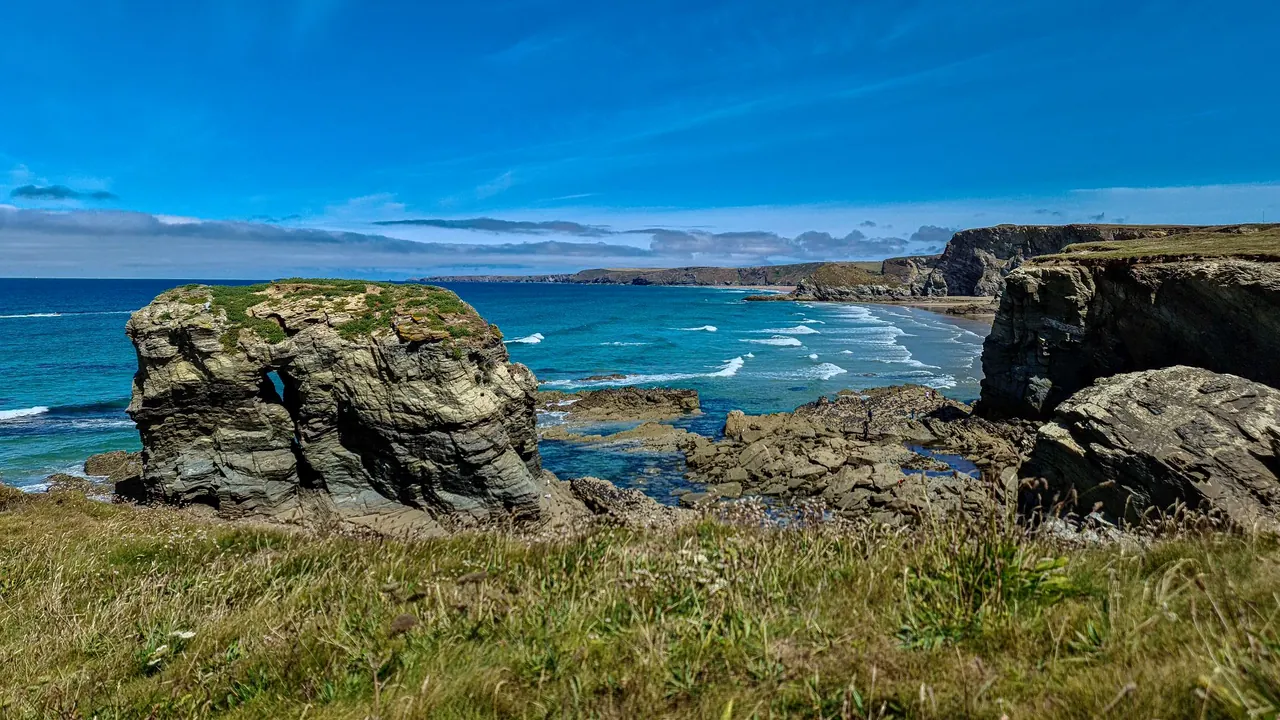
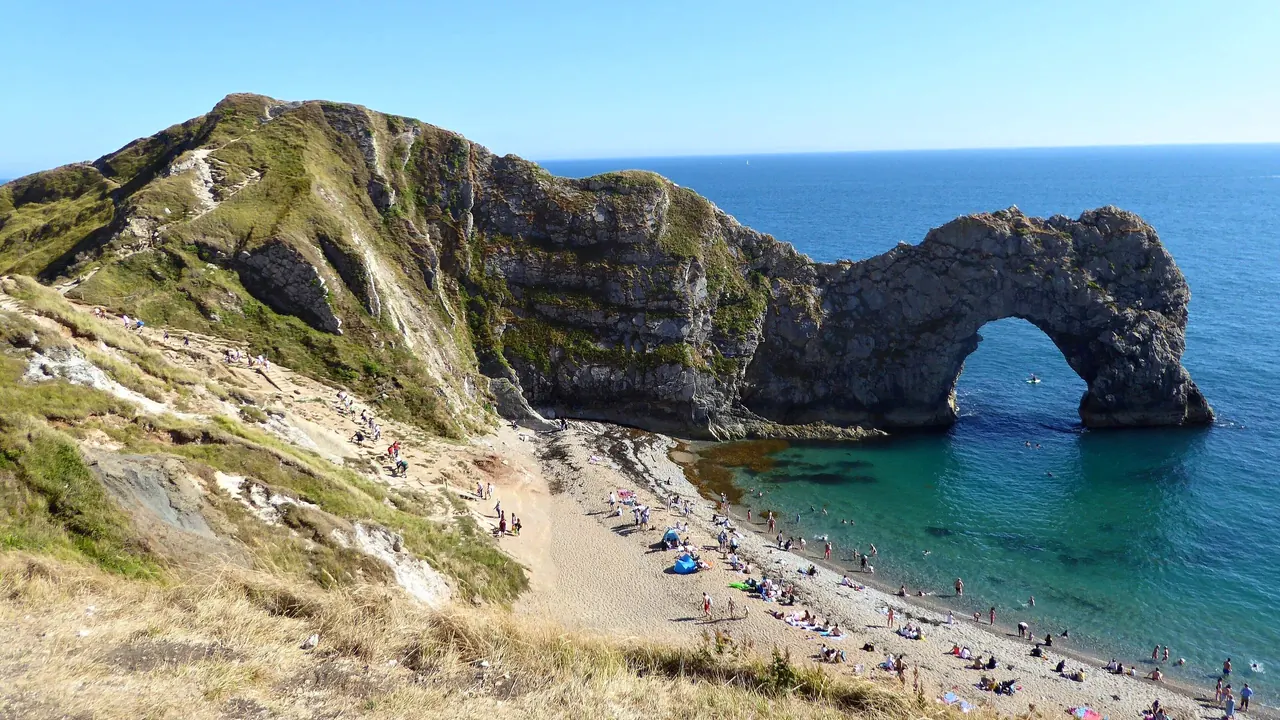
Photos: Cornwall by Howard Senton, Pexels License; Jurassic Coast by Ethan Doyle White, CC BY-SA 4.0, cropped.
Cornwall or Jurassic Coast?
Our verdict in twelve categories, each scored against the same fixed benchmark cities, and the climate month by month, so you can choose for your trip.
Choose Cornwall for
- nightlife
- culture and sights
- beaches
Cornwall is the better choice for a fuller seaside trip, where the beaches, the cooking and the evenings all count. It has the wider range of sand, from north coast surf breaks to the pale coves of the far west, along with seafood towns such as Padstow and Newlyn, the art of St Ives and the Minack's cliff stage. It also has a little more life after dark. The price is long, slow lanes and busy summer resorts.
Choose Jurassic Coast for
- prices
The Jurassic Coast is for travellers who come mainly for the coast itself and are happy to keep things simple. Its cliffs read like a geology textbook from Exmouth to Old Harry Rocks, fossil hunting at Charmouth and Lyme Regis gives the days a purpose, and summers here are a touch warmer and sunnier. In return, the beaches are more shingle than sand, there are fewer good places to eat, and the evenings mostly end at the pub.
Scoreboard
Twelve categories on one fixed scale from 0 to 100. The shaded stretch is the gap between the two.
Your match
Pick a travel style or drag the sliders, and both match scores follow your weighting.
Wins on nightlife and culture and sights with your weighting.
Wins on prices with your weighting.
What matters to you?
Category by category
What the scores mean for a trip.
Beaches & swimming
Cornwall has the better beaches by some way. Its north coast has long surf beaches at Fistral, Watergate Bay and Gwithian, the far west has white sand at Porthcurno and Porthminster, and the Fal and Fowey coves give calmer swimming.
On the Jurassic Coast the good sand is at the two ends, at Studland and Weymouth Bay. The famous middle stretch around Durdle Door, Lulworth and Charmouth is mostly steep shingle, which looks dramatic but makes a poor place for lounging. The water is equally cold on both coasts.
Food & drink
Cornwall eats better. Newlyn's catch supplies proper restaurants in several towns, Padstow has built a name on seafood, and Camel Valley sparkling wine and Cornish cider make a local drinks list worth exploring.
The Jurassic Coast does honest food well: crab sandwiches at West Bay, harbour shacks at Lyme Regis, Blue Vinny cheese and Bridport's market. Beyond Bridport and Lyme Bay, though, there is little besides pub menus.
Culture & sights
Cornwall has more to show you, spread along its whole length. You can walk the causeway at low tide to St Michael's Mount, see the clifftop ruins at Tintagel, the mining engine houses at Botallack and the Eden Project's biomes, and St Ives has a real art scene built on its artists' colony.
The Jurassic Coast's sights are fewer and quieter. They are Corfe Castle, Mary Anning's Lyme Regis, Portland's quarries and Hardy's Dorchester with Maiden Castle nearby. They are pleasant for an afternoon but don't make a trip on their own.
Nightlife
Neither coast is for late nights, but Cornwall at least has options. Newquay fills its bars and clubs with surfers and groups through the summer, and Falmouth's students keep a smaller scene going.
The Jurassic Coast has only Weymouth's seafront strip. Lyme Regis, Swanage and the Purbeck villages are quiet by eleven, so a proper night out means a trip to Bournemouth.
Nature & outdoors
Both are first-rate coastal walking country, joined by the same South West Coast Path, and the difference lies in what you are looking at. Cornwall has granite cliffs around Penwith and the Lizard heathland, and Bodmin Moor gives you open tors inland. It is also Britain's surfing capital, and seals, dolphins and basking sharks turn up offshore.
The Jurassic Coast is a walk through 185 million years of geology, from red Devon sandstone to Purbeck chalk, past Durdle Door, Chesil Beach and Old Harry Rocks. Here the outdoor pursuits are fossil hunting, climbing on Portland's sea cliffs and sailing in Weymouth Bay rather than surfing.
Day trips
Day trips are about as good on either coast but point in different directions. In Cornwall you hop from one harbour town to the next, from St Ives to Mousehole, Port Isaac and Fowey. The one outing that stands apart is the flight or ferry to the Isles of Scilly.
From the Jurassic Coast the better trips head inland, to Exeter's cathedral, abbey-town Sherborne, hilltop Shaftesbury, and Salisbury with Stonehenge from the eastern end. The Poole ferry and Brownsea Island make a good change from inland country towns.
Good for families
Both are classic British family seaside destinations with self-catering cottages to match. Cornwall leans on bodyboarding, rock pooling and lifeguarded sand, with the Eden Project and the Gweek seal sanctuary for wet days.
The Jurassic Coast's highlight for children is fossil hunting at Charmouth, along with the shallow water at Studland, Weymouth's donkeys, the Bovington tank museum and the Swanage steam railway. Crumbling cliffs mean small children need closer watching on some beaches.
Getting around
On both coasts you will want a car, with narrow lanes, summer queues and full car parks. Cornwall's branch lines to St Ives, Falmouth, Newquay and Looe make a car-free stay in one of those towns realistic, though the single-track lanes to the villages are the harder driving.
The Jurassic Coast is long and thin, and crossing Poole Harbour or the Purbeck hills adds an hour. Buses work in stages with changes, so without a car you base yourself in one town and walk the coast path between stops.
Shopping & style
Cornwall is the better place to shop for art and craft. St Ives has a dense run of galleries and potteries, and there are makers' studios in Falmouth and Fowey, independent shops on Penzance's Chapel Street, surf gear in Newquay and a proper high street in Truro.
On the Jurassic Coast the shopping comes down mostly to Bridport, with its street market and vintage quarter, plus polished ammonites in Lyme Regis and seaside rock in Weymouth.
Affordability
Both are pricey in July and August, and the pretty villages book out early on either coast. The savings differ. Cornwall gets noticeably cheaper in spring and autumn, but parking and attraction tickets add up through a stay.
On the Jurassic Coast the coast path, the beaches and the fossil hunting are free. Weymouth and the caravan parks also give a cheaper base than Lyme Regis or Purbeck.
Live music & performing arts
Cornwall has the one stage worth planning a trip around. That is the Minack Theatre, cut into the cliffs above Porthcurno, with the sea behind the actors. Add the Hall for Cornwall in Truro, male voice choirs, Padstow's May Day and the August surf-and-music festival near Newquay.
The Jurassic Coast has Weymouth's pavilion shows, small arts venues in Lyme Regis and Bridport, and pub folk nights. For anything larger you drive to Poole or Exeter.
Wellness & relaxation
Wood-fired saunas on the sand and spa hotels above the surf give Cornwall a real wellness side. At Watergate Bay, Carbis Bay and St Mawes you can follow a treatment with a cold sea swim, which many locals keep up all winter.
On the Jurassic Coast you get rest rather than treatments. Apart from a few hotel spas and some yoga retreats in the Dorset hills, the calm comes from a cottage in Beer, Charmouth or a Purbeck hamlet outside August, with walking by day and the pub by night.
When should you go?
Pick your month. The climate figures are measured averages, not a forecast.
Cornwall in July
Jurassic Coast in July
Daytime high, °C
Rainfall in the month, mm
Where the figures come from
Cornwall has no rain gauge within 25 km of the centre, so its rainfall comes from a gridded climate dataset read at the destination rather than from a gauge further away.
Cornwall's sunshine is measured 28 km from the centre, at Camborne.
Jurassic Coast's temperatures are measured 66 km from the centre, at Bournemouth Airport.
Jurassic Coast has no rain gauge within 25 km of the centre, so its rainfall comes from a gridded climate dataset read at the destination rather than from a gauge further away.
Temperature and rainfall are climate normals, averaged over the years shown. Cornwall: 1991-2020 normals, Saint Mawgan (5.7 km from centre). Jurassic Coast: 1991-2020 normals, Bournemouth Airport (65.7 km from centre).
Both coasts are at their best from June to September, when there is enough warmth for beach days and the Atlantic and Channel both reach about 17°C by August, still cool enough that most swims are short. The Jurassic Coast is the warmer and brighter of the two in high summer, with afternoons around 22°C in July and August against about 19°C in Cornwall. It also gets more sunshine and a little less rain. May and June are good months on both coasts, sunny and fairly dry before the summer rain picks up.
Autumn turns wet sooner and harder in Cornwall, where October to January each bring over 100mm and November peaks around 120mm, so winter visits there are for storm-watching and empty cliff paths rather than the beach. Dorset and east Devon are also damp and mild in winter. September is the gentle sweet spot on both coasts, with the sea still at its warmest and the roads quieter.
Which traveller are you?
On a culture and arts trip, pick Cornwall. Its tin-mining past, Arthurian legend and twentieth-century art colony give you several threads to follow over a week. The Jurassic Coast's heritage is mostly fossils and fills an afternoon rather than a trip.
For a food and nightlife trip, Cornwall wins on both counts. You can eat the day's catch in a different harbour town each evening, and a surf resort or a university town is there for a later night. The Jurassic Coast suits quiet evenings and early mornings.
Fossil hunters should head for the Jurassic Coast, which has no rival in Britain. Winter storms keep exposing ammonites in its crumbling cliffs, and the guided walks teach beginners how to spot them. Cornwall's hard granite shore makes a fine view but gives you nothing to collect.
Before you go
| Measure | Cornwall | Jurassic Coast |
|---|---|---|
| Official language | English | English |
| Currency | Pound Sterling (GBP) | Pound Sterling (GBP) |
| Sockets | G230 V, 50 Hz | G230 V, 50 Hz |
| Driving side | Left | Left |
| Time zone | UTC, UTC+1 in summer | UTC, UTC+1 in summer |
| Emergency number | 112 or 999 | 112 or 999 |
| Main airport | Cornwall Airport Newquay (NQY)15 non-stop destinations | Exeter International Airport (EXT)25 non-stop destinations |
| Public holidays this year | 8 days | 8 days |
By the numbers
| Measure | Cornwall | Jurassic Coast |
|---|---|---|
| Population | 575,525 | - |
| People per km² | 162 | - |
| Swim season, months above 21 °C | None | None |
Where else could you go?
Every comparison below shares a destination with this one, so you can follow Cornwall or Jurassic Coast somewhere new.
- Devonvs Jurassic Coast
- Isle of Wightvs Jurassic Coast
- Isles of Scillyvs Cornwall
- Devonvs Cornwall
- Cotswoldsvs Jurassic Coast
- Pembrokeshirevs Cornwall