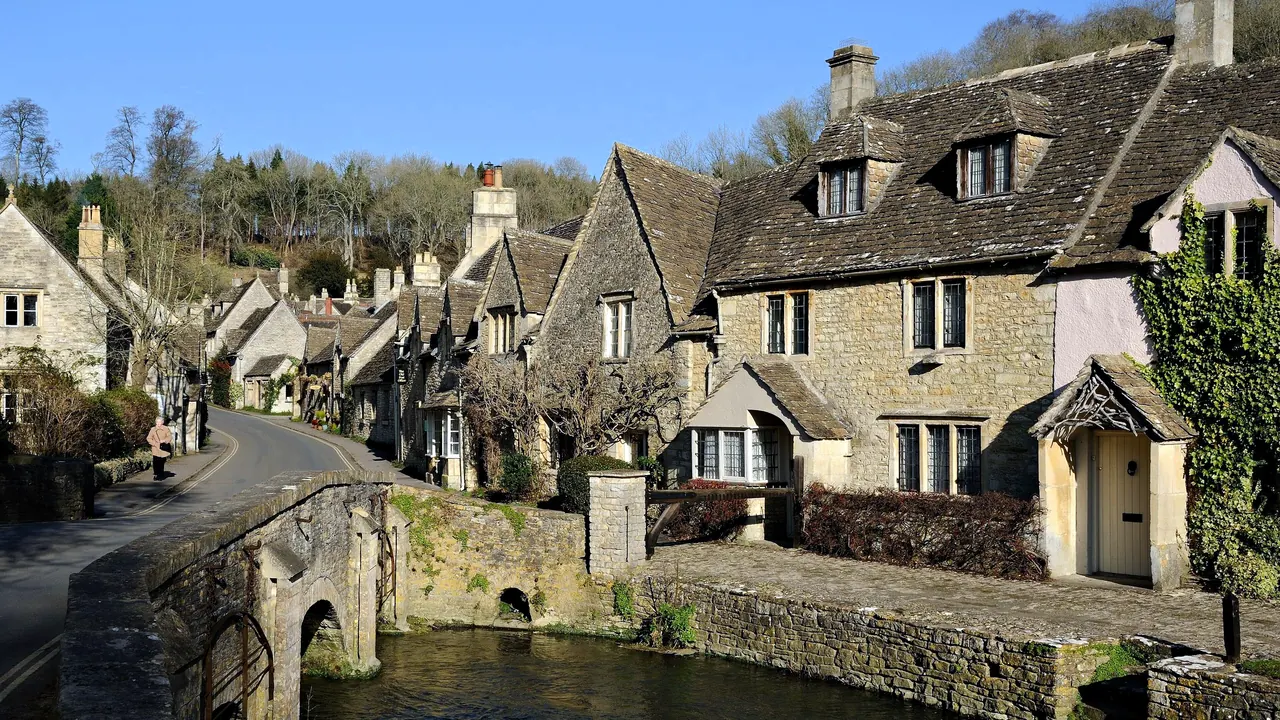
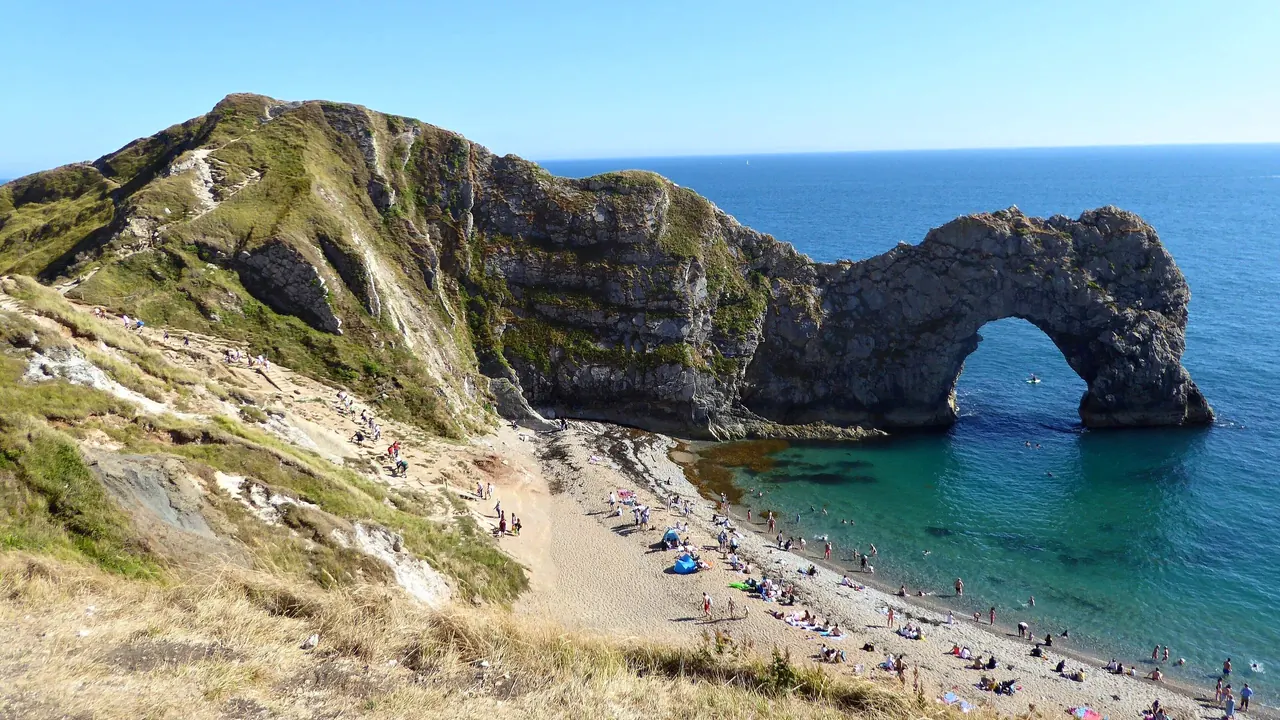
Photos: Cotswolds by Saffron Blaze, CC BY-SA 3.0, cropped; Jurassic Coast by Ethan Doyle White, CC BY-SA 4.0, cropped.
Cotswolds or Jurassic Coast?
Our verdict in twelve categories, each scored against the same fixed benchmark cities, and the climate month by month, so you can choose for your trip.
Choose Cotswolds for
- culture and sights
- wellness
- day trips
The Cotswolds suit a slower inland stay built around honey-stone villages, wool churches and great houses such as Blenheim, with Oxford, Bath and Stratford-upon-Avon all close enough for a day out. They reward couples and travellers who want a good pub dinner, a country-house spa and the odd evening at the theatre, and who will pay for comfort and drive the lanes between places.
Choose Jurassic Coast for
- beaches
- nature and the outdoors
- prices
If the sea and the cliffs are what you're after, pick the Jurassic Coast instead. Families on a summer seaside vacation, walkers on the South West Coast Path and anyone who wants to hunt fossils at Charmouth will get far more from it, and if you base yourself in Weymouth or at a campsite it costs less. There is less history to see and the evenings are just as quiet, so it suits days spent outdoors.
Scoreboard
Twelve categories on one fixed scale from 0 to 100. The shaded stretch is the gap between the two.
Your match
Pick a travel style or drag the sliders, and both match scores follow your weighting.
Wins on culture and sights and wellness with your weighting.
Wins on beaches and nature and the outdoors with your weighting.
What matters to you?
Category by category
What the scores mean for a trip.
Beaches & swimming
This is the largest gap between the two. The Jurassic Coast is a summer seaside region: Studland has dune-backed sand and shallow water, Weymouth has a wide, gently shelving bay, and Lulworth Cove and Durdle Door have shingle with clear, steep water. The sea is cool, so expect quick dips rather than long swims.
The Cotswolds have no sea worth the name. The Severn Estuary is mudflats and strong tides, and the nearest you'll get to a beach day is the sandy lake shore at the Cotswold Water Park near Cirencester.
Food & drink
The Cotswolds have a slight edge, but the real difference is in kind: country pub cooking inland against seafood on the coast. A good Cotswold meal is lamb or autumn game by an open fire in a stone inn, followed by local cheese. Cheltenham adds fine dining and international cooking, and nothing along the coast matches that range. The weak spot is the busiest villages, where some menus are written for coach parties.
On the Jurassic Coast the best food is simpler and comes straight off the boats. You'll find crab sandwiches on the harbour at West Bay or Lyme Regis, scallops and mackerel, and fish and chips in Weymouth, with Bridport's street market making it the obvious base for food lovers. Both regions do cream teas and local cider. Away from Bridport and Lyme Bay, though, the coast villages offer little beyond the pub menu.
Culture & sights
The Cotswolds have much more to see. The wool trade left whole villages of golden stone, including Chipping Campden, Burford and Bibury, along with parish churches at Northleach and Fairford that rank among England's finest. Blenheim Palace, Sudeley Castle and Chedworth Roman Villa add plenty of half-day outings.
The coast's heritage is scattered and mostly about fossils: Mary Anning's Lyme Regis, the Charmouth heritage centre and Portland's quarries. The ruin of Corfe Castle and Hardy's Dorchester, with Maiden Castle nearby, are its strongest sights.
Nightlife
Both regions go quiet by eleven, and a pint by the fire is the typical evening. The difference is in their one livelier town. Cheltenham has cocktail bars around the Promenade and Montpellier that fill up on race days, while Weymouth has a seafront strip of bars popular with stag and hen groups. For anything more, coast visitors head to Bournemouth.
Nature & outdoors
This is where the coast pulls clearly ahead. Its cliffs show 185 million years of rock, from red Devon sandstone to Purbeck chalk, and landmarks such as Durdle Door, Chesil Beach and Old Harry Rocks are some of Britain's best-known coastal scenery. The South West Coast Path is steep around Golden Cap, and you can add fossil hunting, sea-cliff climbing on Portland and sailing in Weymouth Bay.
The Cotswolds are gentler: rolling wolds, beech woods and river valleys. The views from the western escarpment over the Severn Vale reward a walk on the Cotswold Way, but the region is pleasant rather than dramatic.
Day trips
The Cotswolds are one of England's best bases for days out. Oxford, Bath, Stratford-upon-Avon, Warwick and Gloucester Cathedral are all about an hour or less away, and several of them are easy by train.
From the coast the trips are fewer and more rural: Exeter, Sherborne, Shaftesbury, the chain ferry to Poole and Brownsea Island. Salisbury and Stonehenge make a longer day from the Purbeck end, and you'll nearly always need a car.
Good for families
Both work well with children, and the coast has a slight edge because the seaside is the draw. It offers sandcastles and donkeys at Weymouth, safe paddling at Studland and guided fossil hunts at Charmouth, plus the tank museum and the Swanage steam railway when it rains. Watch small children closely near cliff paths and falling rock.
The Cotswolds offer the Wildlife Park's rhinos and giraffes, Bourton's model village and shallow river, lambing at farm parks and Warwick Castle just to the north, with more driving between them.
Getting around
Both regions really need a car, but the Cotswolds are more compact. Most villages are less than half an hour apart, the London line stops at Moreton-in-Marsh and Kingham, and footpaths link neighbouring villages well enough to plan a walking trip.
The coast is longer than it looks: driving from Exmouth to Studland takes about two and a half hours. Buses follow the coast in stages with changes, so without a car it's best to stay in one town and use the coast path between bus stops.
Shopping & style
The Cotswolds are the better place to browse. Tetbury and Stow-on-the-Wold are full of antique dealers, Burford and Broadway sell homeware and art, and Cheltenham has Regency arcades and boutiques in Montpellier.
On the coast, shopping means Bridport's street market and vintage quarter, polished ammonites in Lyme Regis and Charmouth, and the usual seaside gift shops elsewhere.
Affordability
Neither is cheap, but the coast is easier on the budget. Its main draws, the beaches, the coast path and fossil hunting, are free, and Weymouth, the campsites and caravan parks cost much less than the pretty villages, although parking adds up.
The Cotswolds charge more for almost everything: manor-house hotels, cottage rentals and dinner at the better pubs, as well as full admission at Blenheim, Hidcote and the Wildlife Park. Sharing a group cottage or staying in Cheltenham helps.
Live music & performing arts
Cheltenham's festivals set the Cotswolds apart. There is jazz in late spring, classical music in early summer and literature in autumn, and the Victorian Everyman Theatre puts on touring drama, opera and pantomime. In summer you can hear Wagner in a converted barn at Longborough, and the Royal Shakespeare Company at Stratford is about half an hour from the northern villages.
On the coast, the main stage is Weymouth's seafront pavilion, with touring comedy and summer shows. Beyond that there are small arts venues in Lyme Regis and Bridport, folk nights in pubs and a few small summer festivals. For an orchestra or a larger production you have to go to Poole or Exeter.
Wellness & relaxation
For pampering, the Cotswolds win clearly. Spa breaks are central to local tourism, with country-house hotels running pools and treatment rooms in old barns, and Bath's rooftop pool, fed by Britain's only natural hot springs, is close to the southern wolds.
The coast has a few hotel spas and yoga retreats, but its calm is more basic: a cottage in Beer or a Purbeck hamlet, cold-water swims and long cliff walks.
When should you go?
Pick your month. The climate figures are measured averages, not a forecast.
Cotswolds in July
Jurassic Coast in July
Daytime high, °C
Rainfall in the month, mm
Where the figures come from
Cotswolds has no rain gauge within 25 km of the centre, so its rainfall comes from a gridded climate dataset read at the destination rather than from a gauge further away.
Cotswolds's sunshine is measured 46 km from the centre, at Lyneham.
Jurassic Coast's temperatures are measured 66 km from the centre, at Bournemouth Airport.
Jurassic Coast has no rain gauge within 25 km of the centre, so its rainfall comes from a gridded climate dataset read at the destination rather than from a gauge further away.
Temperature and rainfall are climate normals, averaged over the years shown. Cotswolds: 1961-1990 (sunshine 1991-2020, rainfall 1991-2020) normals, Fairford Royal Air Force Base (22.5 km from centre). Jurassic Coast: 1991-2020 normals, Bournemouth Airport (65.7 km from centre).
Both regions are at their best from May to September, when the days are long and the lanes are dry enough for walking. The Cotswolds peak at about 22°C in July and turn properly cold in winter, with highs near 5°C in January, so a winter visit is about fires in pubs rather than long walks. Rain is spread through the year, but it is wettest from October to December.
On the coast the winters are milder, around 8°C in January, and the summers are slightly sunnier. June is the driest month. The sea is the limit. It only reaches about 17°C in August and September, so the beach season is really late July to early September. Autumn storms bring the wettest months, up to 97mm in October, and they also loosen the cliffs and wash out the fossils that hunters come for.
Which traveller are you?
For a beach and sun trip, the Jurassic Coast is the only real option. Studland and Weymouth have sandy bays and Lulworth has clear water. The Cotswolds have just a lake beach at the Water Park, and the muddy Severn Estuary is not for swimming.
On a culture and arts trip, the Cotswolds give you much more to see. There are wool churches, Blenheim Palace and Chedworth Roman Villa, plus Cheltenham's festivals and the Royal Shakespeare Company nearby. Inland, the coast offers fossil museums and Corfe Castle, and not much else.
On a relaxing and wellness trip, the Cotswolds win easily. Country-house hotels with proper spas, quiet villages and the thermal waters of nearby Bath make it easy to slow down. On the coast, rest means a quiet cottage and a cold sea, with few treatments on offer.
Before you go
| Measure | Cotswolds | Jurassic Coast |
|---|---|---|
| Official language | English | English |
| Currency | Pound Sterling (GBP) | Pound Sterling (GBP) |
| Sockets | G230 V, 50 Hz | G230 V, 50 Hz |
| Driving side | Left | Left |
| Time zone | UTC, UTC+1 in summer | UTC, UTC+1 in summer |
| Emergency number | 112 or 999 | 112 or 999 |
| Main airport | Bristol Airport (BRS)117 non-stop destinations | Exeter International Airport (EXT)25 non-stop destinations |
| Public holidays this year | 8 days | 8 days |
By the numbers
| Measure | Cotswolds | Jurassic Coast |
|---|---|---|
| Swim season, months above 21 °C | - | None |
Where else could you go?
Every comparison below shares a destination with this one, so you can follow Cotswolds or Jurassic Coast somewhere new.
- Devonvs Jurassic Coast
- Isle of Wightvs Jurassic Coast
- Isle of Wightvs Cotswolds
- Peak Districtvs Cotswolds
- Cornwallvs Jurassic Coast
- Snowdoniavs Cotswolds