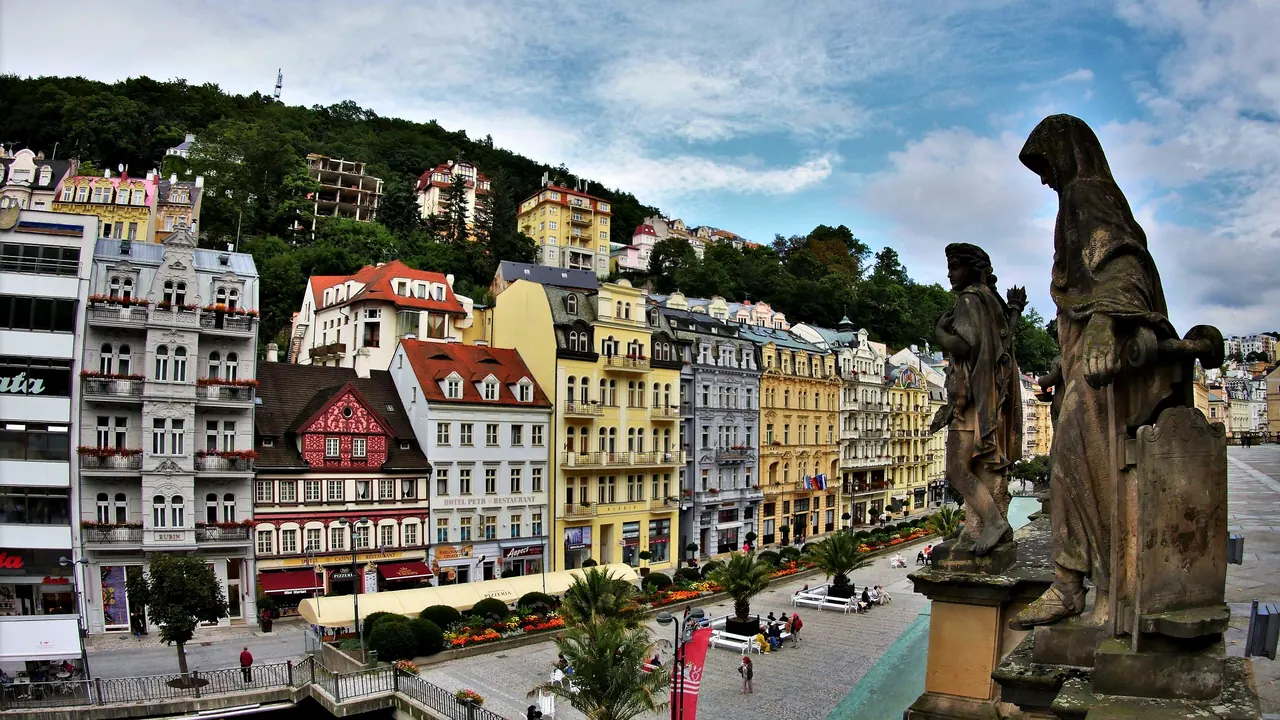
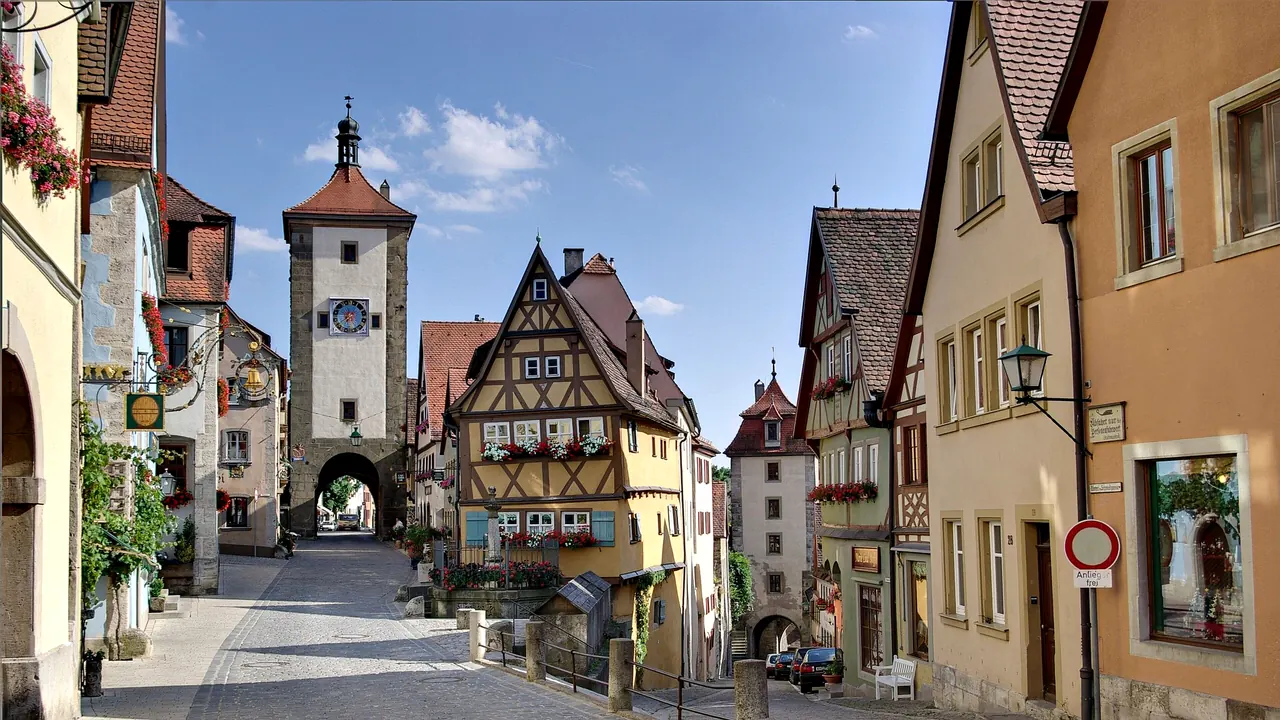
Photos: Karlovy Vary by Rolf Dietrich Brecher from Germany, CC BY-SA 2.0, cropped; Rothenburg ob der Tauber by Berthold Werner, Public domain.
Karlovy Vary or Rothenburg ob der Tauber?
Our verdict in twelve categories, each scored against the same fixed benchmark cities, and the climate month by month, so you can choose for your trip.
Choose Karlovy Vary for
- wellness
- nature and the outdoors
- live music and the arts
Karlovy Vary is for a slow, restorative stay. You sip warm spring water from a spouted cup as you walk the colonnades, book a spa hotel for baths and massages, and climb into beech forest above the valley. It also costs less, keeps an orchestra and an ornate theatre for the evenings, and sells Moser crystal to take home.
Choose Rothenburg ob der Tauber for
- day trips
- culture and sights
- families
Travellers who want the medieval past to be the whole point should pick Rothenburg ob der Tauber. A complete ring of walls, gate towers and gabled lanes surrounds a Riemenschneider altar, and the town makes a good base for driving to other walled towns on the Romantic Road. Children also take to it more easily, with ramparts to walk and a lantern-carrying night watchman to follow.
Scoreboard
Twelve categories on one fixed scale from 0 to 100. The shaded stretch is the gap between the two.
Your match
Pick a travel style or drag the sliders, and both match scores follow your weighting.
Wins on wellness and nature and the outdoors with your weighting.
Wins on day trips and culture and sights with your weighting.
What matters to you?
Category by category
What the scores mean for a trip.
Beaches & swimming
Neither town is a place for swimming, and the choice between them comes down to what lies nearby. From Karlovy Vary you can reach Lake Medard, a flooded mine near Sokolov, in about half an hour, and the town's warm outdoor pools fed by the springs are a pleasure in any season.
Rothenburg offers its own outdoor pool, or a drive of about an hour to the grassy shores of the Franconian lakes such as the Altmühlsee.
Food & drink
Both towns serve hearty, meat-heavy cooking within a narrow range, so the difference lies in what you drink and what you snack on. Karlovy Vary has roast pork, dumplings and svíčková with Pilsner-style beer, warm spa wafers from the colonnade stalls, Becherovka distilled in town, and riverside cafés made for cake.
Rothenburg pours dry Franconian Silvaner from the round Bocksbeutel and Tauber valley wines in its taverns, and sells the sugary Schneeball everywhere. In both towns the better meals are found away from the main promenade or square.
Culture & sights
Rothenburg has the stronger pull for sightseers. It is an almost wholly medieval walled town: you can walk much of the covered wall above the rooftops, see the Plönlein between its two gate towers, and look at Riemenschneider's carved Holy Blood Altar in St Jakob's. The Medieval Crime Museum gives it one museum with real depth.
Karlovy Vary's appeal is later and softer. Belle Époque hotels and bathhouses rise in pastel tiers up the valley, and colonnades of Corinthian columns and carved timber stand alongside the Vřídlo geyser, all part of a UNESCO-listed spa town. Its museums are small and specialised, and each town takes a day or two.
Nightlife
Both towns are asleep by about eleven, but Karlovy Vary has slightly more to do after dinner: cocktail and wine bars, Czech pubs and casinos. During the film festival week in early summer, parties and outdoor bars fill the valley.
Rothenburg's evening is a wine tavern and the night watchman's walking tour. For anything livelier you would have to go to Würzburg or Nuremberg.
Nature & outdoors
Karlovy Vary has much more to offer outdoors. Beech and spruce forest starts right at the edge of town, with graded spa paths up to the Diana tower and the stag-leap rock. Further out are the moors of the Slavkov Forest, skiing around Klínovec in the Ore Mountains, and canoeing on the Ohře.
Rothenburg's countryside is gentle farmland and river meadow. Paths drop from the walls to mills and meadows in the Tauber valley, and the well-known Tauber valley cycle path runs downstream through vineyards, but there are no hills of any size or wild country.
Day trips
Rothenburg has the richer choice of outings, as long as you have a car. Dinkelsbühl and Nördlingen, the latter ringed by walls inside a meteorite crater, continue the medieval theme along the Romantic Road. Würzburg's Residenz and Nuremberg's castle are each about an hour away.
Karlovy Vary's outings are closer and easier without a car. The castle town of Loket is twenty minutes away, Mariánské Lázně and Františkovy Lázně complete the spa trio, and Bečov keeps the reliquary of St Maurus. Prague is possible in a long day by coach.
Good for families
Rothenburg holds children's attention for longer, because the whole walled town feels like a game of knights. Kids can walk the ramparts, climb the tower and follow the night watchman, and older children love the shame masks in the Crime Museum. The centre is also largely free of through traffic.
Karlovy Vary has a few hits: the geyser, the funicular to the small animal enclosure, the thermal pool and the spa wafers. Beyond those, it is built around adults taking cures, and its steep valley sides are tiring with a pushchair.
Getting around
Both are easy on foot and awkward beyond, but in different ways. Karlovy Vary is a long, narrow strip along the Teplá, with buses and a funicular to help on the steep valley sides. Slow regional trains go to Loket and Mariánské Lázně, and coaches run to Prague, so you can manage without a car.
You can cross Rothenburg's compact walled centre in fifteen minutes, on cobbles. Its branch line usually means changing trains at Steinach, though, and the village buses are sparse, so a car matters much more there.
Shopping & style
Karlovy Vary has the better shopping, with genuine local crafts. Moser crystal is sold from its own showroom, alongside Karlovy Vary porcelain, Bohemian garnets, and boutiques for spa guests along Stará louka.
Rothenburg sells mostly Christmas goods all year round, such as glass baubles, nutcrackers and Erzgebirge carvings, plus teddy bears and cuckoo clocks. Its December market on the Marktplatz is the big draw, but fashion and everyday shopping are almost absent.
Affordability
Karlovy Vary is the cheaper stay. The grand hotels and colonnade restaurants charge for the setting, but one street back, Czech pubs and canteens serve food and beer at local prices, and the colonnades, buses and funicular cost little or nothing. Avoid festival week if money matters.
Rothenburg adds a tourist premium to German small-town prices, especially for rooms inside the walls in December and on summer weekends. Staying outside the gates or in a nearby village brings the cost down considerably.
Live music & performing arts
Karlovy Vary offers a real programme of evening performances. Its symphony orchestra descends from the old spa orchestras and plays light classical concerts, some outdoors on the colonnades in summer. The Fellner and Helmer theatre hosts operetta and touring drama, and a Dvořák festival takes place in autumn.
In Rothenburg, performance is tied to history: the costumed Meistertrunk play, summer open-air theatre and organ concerts in St Jakob's. Outside those dates there is little to go and see.
Wellness & relaxation
Here the two towns are furthest apart. Karlovy Vary is built around its springs. You sip from porcelain cups along the colonnades, sanatoria offer doctors' consultations, carbonated baths and peat wraps, and hotels have pools of warm spring water.
Rothenburg's calm comes from its empty lanes at dawn and after the coach parties leave, and from quiet walks in the valley. For thermal bathing you have to drive about an hour to Bad Windsheim or Bad Mergentheim.
When should you go?
Pick your month. The climate figures are measured averages, not a forecast.
Karlovy Vary in July
Rothenburg ob der Tauber in July
Daytime high, °C
Rainfall in the month, mm
Where the figures come from
Karlovy Vary's station stands 156 m above the city centre, so the centre is likely a little warmer than the figures say.
Karlovy Vary has no rain gauge within 25 km of the centre, so its rainfall comes from a gridded climate dataset read at the city rather than from a gauge further away.
Karlovy Vary's sunshine is measured 37 km from the centre, at Cheb.
Rothenburg ob der Tauber's sunshine is measured 27 km from the centre, at Feuchtwangen-heilbronn.
Temperature and rainfall are climate normals, averaged over the years shown. Karlovy Vary: 1999-2020 (sunshine 1981-2010, rainfall 1991-2020) normals, Karlovy Vary (4.6 km from centre). Rothenburg ob der Tauber: 1991-2020 normals, Rothenburg ob der Tauber (0.9 km from centre).
Both towns are at their best from May to September, but their summers differ. Karlovy Vary stays cooler, with highs around 22°C in July and August, and those are also its wettest months, with July bringing about 95mm of rain. That suits forest walks but makes days at the lake less reliable. Rothenburg is a few degrees warmer, around 25°C at the height of summer. Its rain is spread evenly through the year, and it gets noticeably more sunshine from spring to autumn, so long days on the walls and in the Tauber valley are easier to plan.
Winter in both towns is cold and grey, with little daylight. Karlovy Vary sits close to freezing, with January highs near 1°C, and its warm spring-fed pools and spa treatments are what make a winter stay there worthwhile. Rothenburg is a little milder but wetter in December, and that month is its strongest winter draw, when the Christmas market fills the Marktplatz below the gabled houses. In both towns, spring and early autumn are mild enough for comfortable walking.
Which traveller are you?
On a relaxing and wellness trip, Karlovy Vary is the clear choice. Thirteen springs, medical spa hotels with carbonated baths and peat wraps, and a slow rhythm of coffee and promenades are what the town exists for. Rothenburg has only small hotel spas.
For an outdoors trip, Karlovy Vary again comes out ahead. Forest paths climb straight from the colonnades, the Slavkov Forest and the Ore Mountains offer hiking, cycling and winter skiing, and the Ohře makes for easy canoeing. Rothenburg's countryside is gentler and tamer.
On a family trip with children, Rothenburg works better. Kids can walk the covered ramparts, climb the Rathaus tower and join the night watchman's tour, and older ones are fascinated by the Crime Museum. Karlovy Vary's geyser and funicular entertain, but the town is built for adults.
Before you go
| Measure | Karlovy Vary | Rothenburg ob der Tauber |
|---|---|---|
| Official language | Czech | German |
| Currency | Czech Koruna (CZK) | Euro (EUR) |
| Sockets | CE230 V, 50 Hz | CF230 V, 50 Hz |
| Driving side | Right | Right |
| Time zone | UTC+1, UTC+2 in summer | UTC+1, UTC+2 in summer |
| Emergency number | 112 | 112 |
| Elevation | 447 m | 430 m |
| Main airport | Václav Havel Airport Prague (PRG)100 km from centre178 non-stop destinations | Nuremberg Airport (NUE)66 km from centre56 non-stop destinations |
| Public holidays this year | 13 days | 12 days |
By the numbers
| Measure | Karlovy Vary | Rothenburg ob der Tauber |
|---|---|---|
| City population | 49,073 | 11,331 |
| People per km² | 830 | 272 |
| Museums within 10 km | 2 | 6 |
| UNESCO World Heritage sites within 50 km | 3 | 2 |
Where else could you go?
Every comparison below shares a destination with this one, so you can follow Karlovy Vary or Rothenburg ob der Tauber somewhere new.
- Nurembergvs Rothenburg ob der Tauber
- Bambergvs Rothenburg ob der Tauber
- Stuttgartvs Rothenburg ob der Tauber
- Heidelbergvs Rothenburg ob der Tauber
- Dresdenvs Karlovy Vary
- Praguevs Karlovy Vary