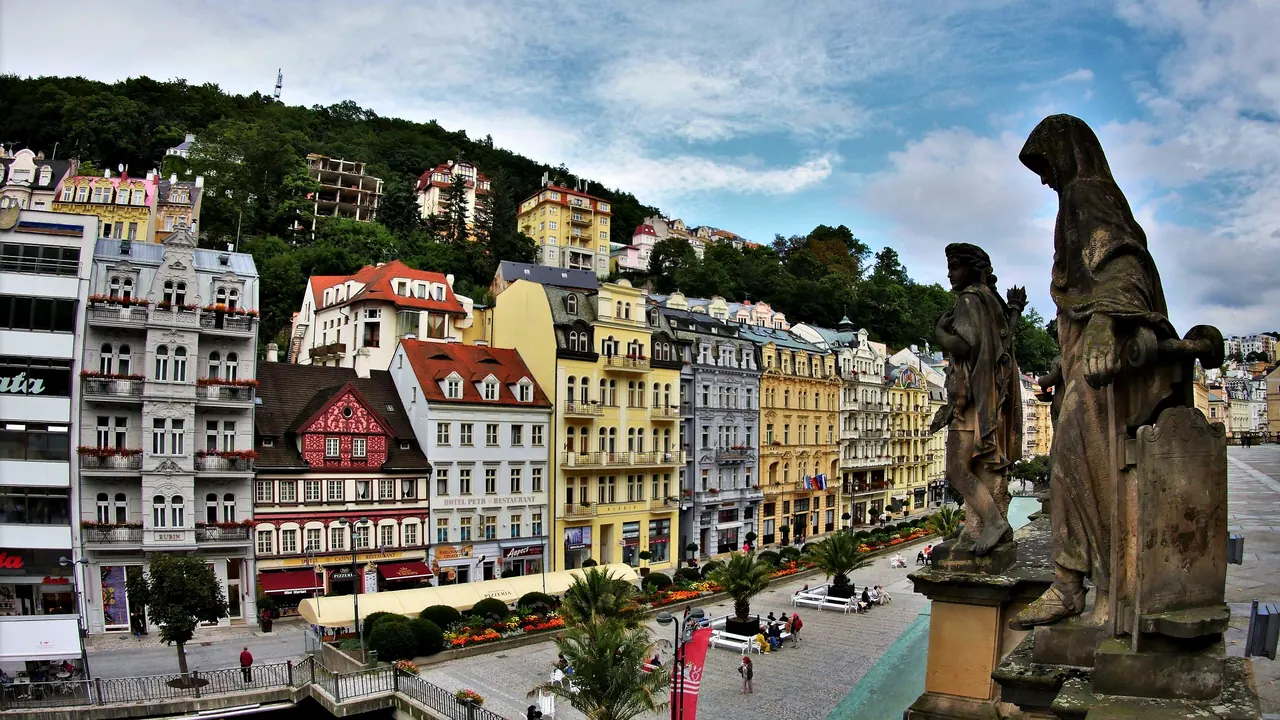
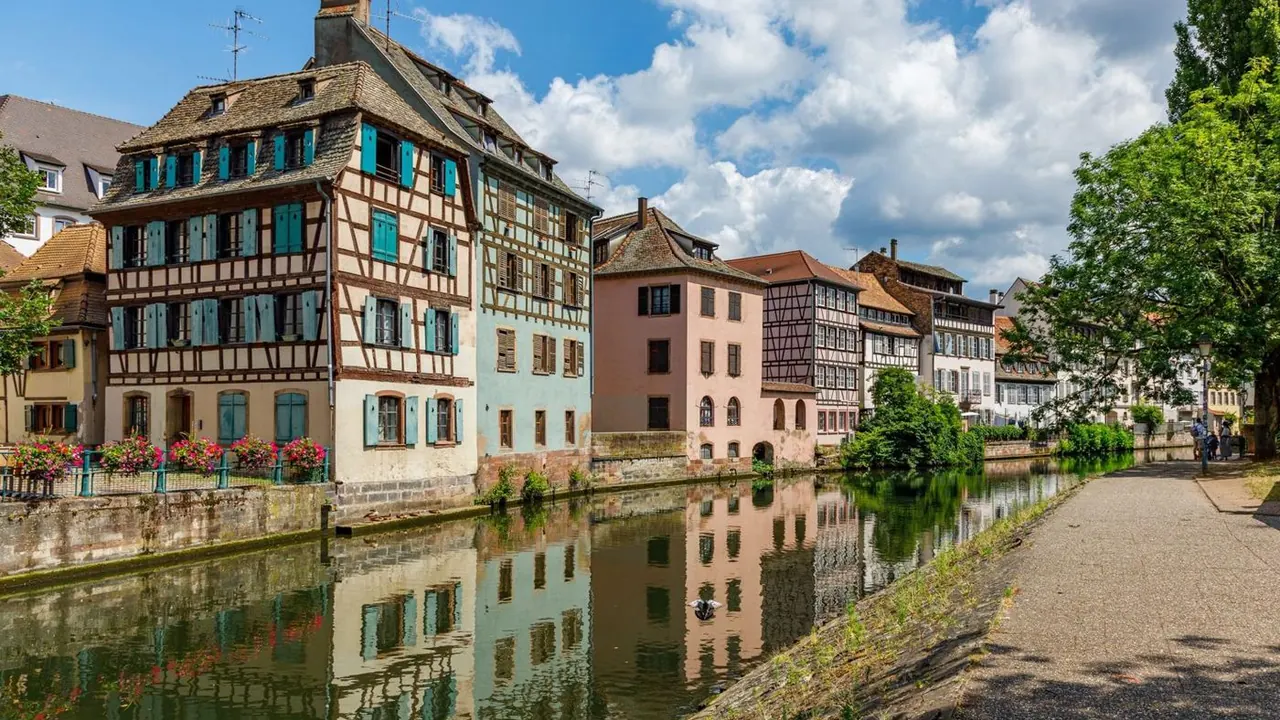
Photos: Karlovy Vary by Rolf Dietrich Brecher from Germany, CC BY-SA 2.0, cropped; Strasbourg by Edoardo Colombo, Pexels License.
Karlovy Vary or Strasbourg?
Our verdict in twelve categories, each scored against the same fixed benchmark cities, and the climate month by month, so you can choose for your trip.
Choose Karlovy Vary for
- wellness
- prices
Karlovy Vary is for a slow, restorative stay built around the springs: a spa hotel booking, the drinking cure along the colonnades and forest paths between coffee and cake. It suits couples and older travellers who want early, quiet evenings and a lighter bill, and who are happy with a day or two of sightseeing.
Choose Strasbourg for
- food and drink
- families
- nightlife
If you want a city that fills several days, choose Strasbourg. Its cathedral, museums and Alsatian kitchen are a clear step up. Trams and flat streets make it easy with children, and Colmar, the wine villages and the German side of the Rhine are all close enough for day trips. Evenings have more going on too, with student bars and a full opera and theatre season.
Scoreboard
Twelve categories on one fixed scale from 0 to 100. The shaded stretch is the gap between the two.
Your match
Pick a travel style or drag the sliders, and both match scores follow your weighting.
Wins on wellness and prices with your weighting.
Wins on food and drink and families with your weighting.
What matters to you?
Category by category
What the scores mean for a trip.
Beaches & swimming
Neither city has a sea, and both answer a hot day with fresh water. Karlovy Vary's best swim is Lake Medard, a flooded mine about half an hour away. Closer in is the warm, spring-fed outdoor pool on the hillside, which works even when the air is cool.
Strasbourg's gravel-pit lakes are easier to reach. The Baggersee is on the tram line, and several lakes have lifeguards in July and August. Its warmer summers make an afternoon on the grassy banks more likely, but neither city is worth choosing for swimming.
Food & drink
Strasbourg eats far better. Alsace mixes French and German cooking, so you get choucroute, baeckeoffe and tarte flambée in wood-panelled winstubs, with Riesling by the pichet from vineyards just to the south. Add foie gras, a serious fine-dining tier and a covered market for Munster and charcuterie.
Karlovy Vary's table is narrower: dumplings, goulash and svíčková with Pilsner-style beer, and cake in the riverside cafés. Its two treats of its own are the warm spa wafers and Becherovka. The food suits a gentle spa routine, but it is not a reason to travel.
Culture & sights
Both towns have UNESCO-listed centres, but Strasbourg has much more to see. You can fill two or three days with the pink sandstone cathedral and its astronomical clock, the timber-framed Grande Ile and Petite France, the imperial Neustadt and the three museums in the Palais Rohan. The European institutions add a modern layer.
In Karlovy Vary the attraction is the whole townscape: pastel Belle Époque hotels rising up the Teplá valley, the colonnades and the Vřídlo geyser. Its museums are small and specialised, covering glass and the local liqueur, and a day or two is enough.
Nightlife
Neither city is for a big night out, but Strasbourg has a student life to lean on. Krutenau and the streets around Place Saint-Étienne fill with bars and beer cellars, and riverside terraces stay busy on summer evenings, though there are few clubs.
Karlovy Vary is largely asleep by eleven, leaving hotel bars, pubs and casinos. Only the film festival week in early summer brings parties and outdoor bars to the valley.
Nature & outdoors
Both cities have green country close by, but of a different kind. In Karlovy Vary the beech and spruce forest starts right above the colonnades. Gentle old spa paths lead to the Diana tower and the lookouts, the moors of the Slavkov Forest lie beyond, and there is skiing at Klínovec in winter.
Strasbourg is flat, so its outdoors begins on a bike, along the Rhine and the canals and through riverside forests with storks and beavers. The hills are further away, with the Vosges and the Black Forest about an hour out. They offer more demanding walking and are easiest to reach by car.
Day trips
Karlovy Vary's outings are smaller and closer to home. The castle town of Loket is twenty minutes away, the sister spas of Mariánské Lázně and Františkovy Lázně are about an hour, and Bečov keeps the St Maurus reliquary in its castle. Plzeň makes a longer day out, and Prague means about two hours each way by coach.
Strasbourg has the wider choice, and it reaches into three countries. Colmar is half an hour south by train, with the Alsace wine route and Haut-Koenigsbourg along the way. Baden-Baden, Freiburg and Heidelberg lie across the Rhine in Germany, and Basel, in Switzerland, is a train ride to the south.
Good for families
Strasbourg is the far easier base for a family. It has a compact, car-free centre and trams, boat trips around the island, playgrounds and rowing boats in the Orangerie, and the Le Vaisseau science centre. Europa-Park is about an hour away.
Karlovy Vary is safe and tidy but built for adults taking cures. The geyser, the funicular to the Diana lookout and the thermal pool fill an afternoon or two. After that, the steep valley sides wear out anyone pushing a pushchair.
Getting around
You can manage both without a car, but Strasbourg is simpler. Its island centre is flat and largely pedestrianised. Trams run to the station, the European quarter and across the Rhine to Kehl, and separated bike lanes often make cycling the quickest option.
Karlovy Vary is a long, narrow strip along the river. It is an easy walk along the promenades but steep wherever hotels and viewpoints climb the valley, where you rely on local buses and the funicular. Rail links out of town are slow.
Shopping & style
Strasbourg has the wider range. Chain stores and a department store sit around Place Kléber, with delicatessens and bookshops in the lanes by the cathedral, and Alsace wine, Soufflenheim pottery and printed linens to take home. In December there is one of Europe's oldest Christmas markets.
Karlovy Vary's shopping is narrower and aimed at well-off spa guests, with jewellers and fur boutiques on the promenades. What it sells that Strasbourg cannot is Moser crystal from the maker's own showroom, local porcelain and Bohemian garnets.
Affordability
Karlovy Vary is the cheaper stay. The grand spa hotels and colonnade restaurants charge for the setting, but a street back the pubs serve Czech food and beer at local prices. Buses, the funicular and the springs themselves cost little.
Strasbourg is priced like a large French regional city. Winstub meals and trams are fair value, but hotel rooms are the main expense and become much dearer during the Christmas market and the weeks when the European Parliament sits. In Karlovy Vary the week to avoid is the film festival.
Live music & performing arts
Strasbourg has a proper arts season. The Opéra national du Rhin, the Philharmonic and the Théâtre National de Strasbourg all perform there, and the Musica festival in autumn and a respected jazz festival add more.
Karlovy Vary offers lighter evenings. The symphony orchestra carries on the old spa-concert tradition, sometimes outdoors on the colonnades in summer, and the ornate Fellner and Helmer theatre takes touring operetta and drama.
Wellness & relaxation
Wellness is the reason Karlovy Vary exists. Thirteen springs feed the colonnades, and guests sip from spouted porcelain cups on a drinking cure that has been prescribed there for centuries. Sanatoria offer carbonated baths, peat wraps and medical consultations, and booking a full spa stay is the best way to have the whole experience.
Strasbourg has the tiled Bains municipaux with its hammam and saunas. For real thermal bathing you cross to Baden-Baden, under an hour away. Otherwise its calm comes from canal walks and long lunches rather than a cure.
When should you go?
Pick your month. The climate figures are measured averages, not a forecast.
Karlovy Vary in July
Strasbourg in July
Daytime high, °C
Rainfall in the month, mm
Where the figures come from
Karlovy Vary's station stands 156 m above the city centre, so the centre is likely a little warmer than the figures say.
Karlovy Vary has no rain gauge within 25 km of the centre, so its rainfall comes from a gridded climate dataset read at the city rather than from a gauge further away.
Karlovy Vary's sunshine is measured 37 km from the centre, at Cheb.
Temperature and rainfall are climate normals, averaged over the years shown. Karlovy Vary: 1999-2020 (sunshine 1981-2010, rainfall 1991-2020) normals, Karlovy Vary (4.6 km from centre). Strasbourg: 1991-2020 normals, Strasbourg (9.1 km from centre).
Karlovy Vary is the cooler of the two all year. Summer highs reach about 22°C in July and August, which is pleasant for forest walks and sitting on the colonnades. July is also the wettest month, at around 95mm, so expect showers. Winter is properly cold and dark, barely above freezing from December to February, and better suited to the warm spring pools than to walking the streets. Late May, June and September are the most comfortable months for exploring the valley.
Strasbourg is several degrees warmer, around 26°C in high summer, which is warm enough for an afternoon at the gravel-pit lakes. From spring through September it also gets noticeably more sunshine. Its rain peaks in May rather than in midsummer. Spring and early autumn are best for walking the old town and cycling the river paths. Winter is chilly but milder than in the Bohemian hills.
Which traveller are you?
For a relaxing and wellness trip, Karlovy Vary is the natural choice. A booked spa stay of a week or longer sets the rhythm: treatments in the morning, a slow round of the springs, cake by the river and early nights. Strasbourg is calm, but it has no cure to follow.
On a family trip with children, Strasbourg works much better. Karlovy Vary keeps children happy for a day or two, and then the days start to drag. Strasbourg can fill a week, mixing short, level city outings with days out in the hills and over the border.
For a food and nightlife trip, Strasbourg wins clearly. Karlovy Vary offers hearty Czech plates, spa wafers and a town in bed by eleven. In Strasbourg, long winstub dinners with Alsace wine lead on to the student bars of Krutenau and the riverside terraces.
Before you go
| Measure | Karlovy Vary | Strasbourg |
|---|---|---|
| Official language | Czech | French |
| Currency | Czech Koruna (CZK) | Euro (EUR) |
| Sockets | CE230 V, 50 Hz | CE230 V, 50 Hz |
| Driving side | Right | Right |
| Time zone | UTC+1, UTC+2 in summer | UTC+1, UTC+2 in summer |
| Emergency number | 112 | 112 |
| Elevation | 447 m | 132 m |
| Main airport | Václav Havel Airport Prague (PRG)100 km from centre178 non-stop destinations | Strasbourg Airport (SXB)10 km from centre43 non-stop destinations |
| Public holidays this year | 13 days | 11 days |
By the numbers
| Measure | Karlovy Vary | Strasbourg |
|---|---|---|
| City population | 49,073 | 293,771 |
| People per km² | 830 | 3,752 |
| Museums within 10 km | 2 | 21 |
| UNESCO World Heritage sites within 50 km | 3 | 3 |
Where else could you go?
Every comparison below shares a destination with this one, so you can follow Karlovy Vary or Strasbourg somewhere new.
- Baden-Badenvs Strasbourg
- Colmarvs Strasbourg
- Freiburgvs Strasbourg
- Stuttgartvs Strasbourg
- Dresdenvs Karlovy Vary
- Praguevs Karlovy Vary