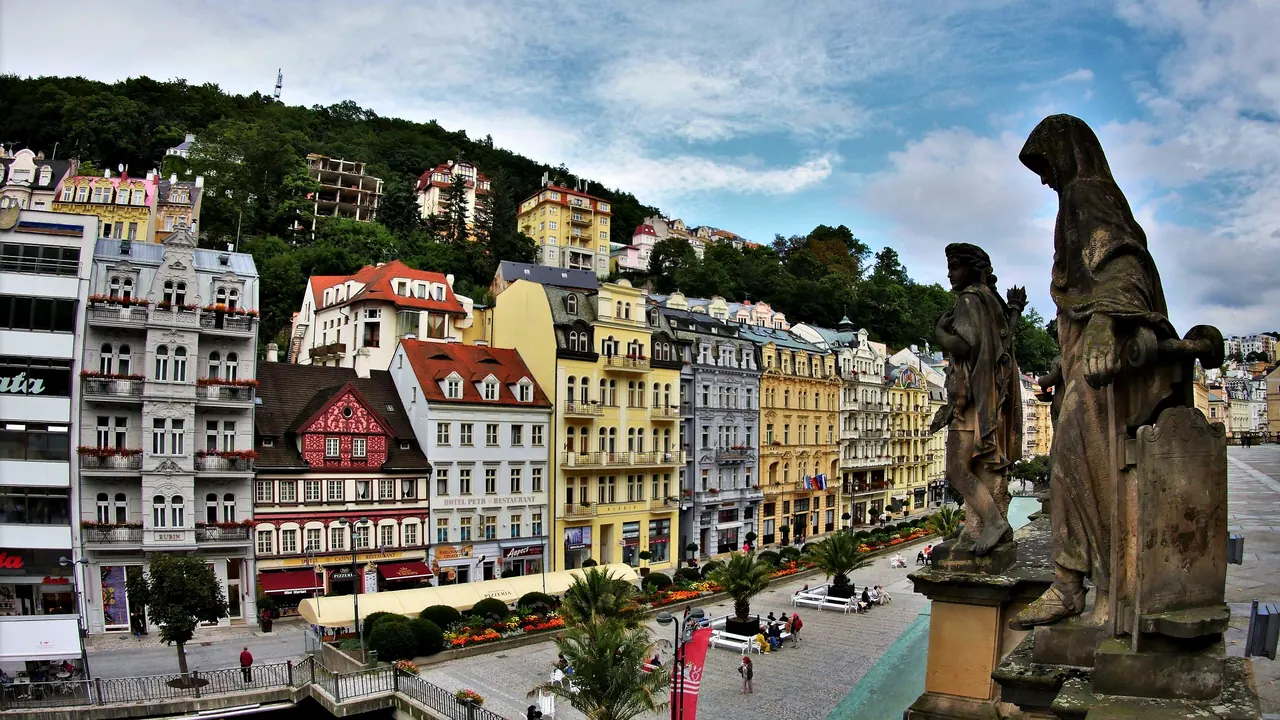
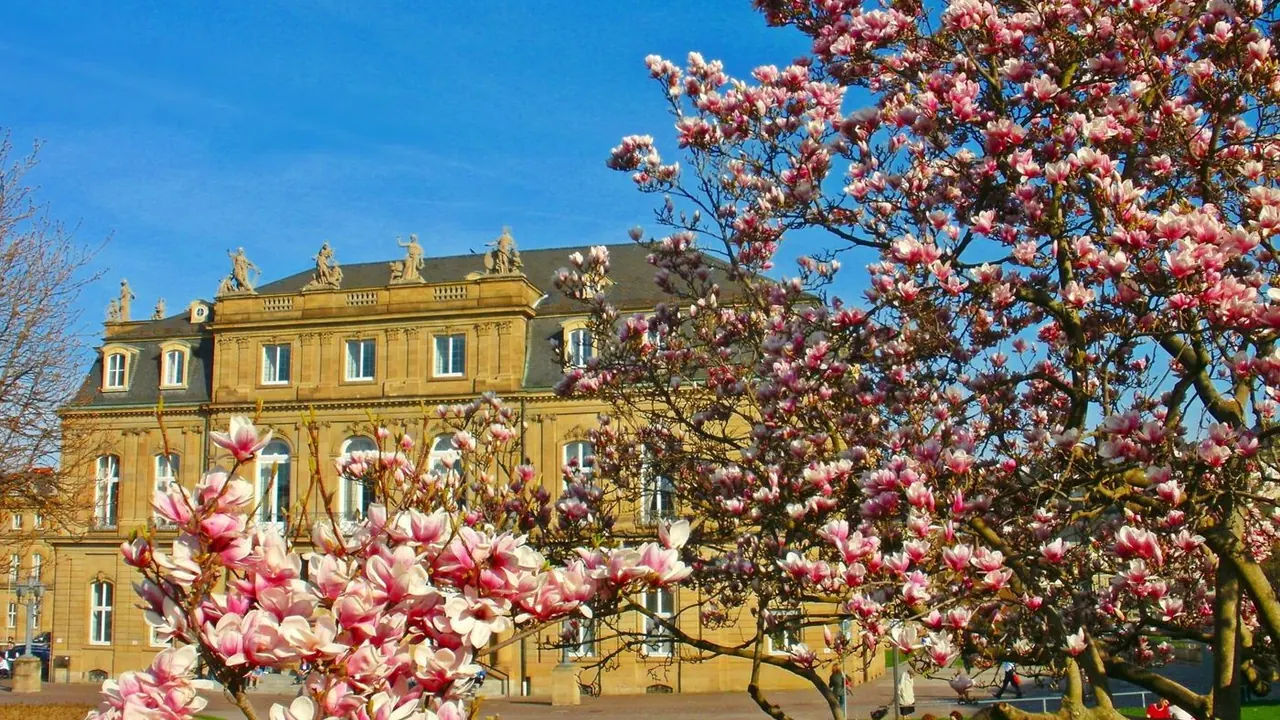
Photos: Karlovy Vary by Rolf Dietrich Brecher from Germany, CC BY-SA 2.0, cropped; Stuttgart by Baden de, CC BY 3.0, cropped.
Karlovy Vary or Stuttgart?
Our verdict in twelve categories, each scored against the same fixed benchmark cities, and the climate month by month, so you can choose for your trip.
Choose Karlovy Vary for
- wellness
- prices
- beaches
Karlovy Vary is the choice for a slow, restorative stay built around the springs. The whole spa quarter is there for drinking cures, warm mineral baths and treatments booked through a spa hotel, and the gentle forest paths above the colonnades keep to the same unhurried pace. It is also the cheaper of the two, as long as you eat one street back from the promenade. Couples and older travellers who want quiet evenings will feel at home here.
Choose Stuttgart for
- live music and the arts
- families
- nightlife
Travellers who want a fuller city, with more to fill both days and evenings, should pick Stuttgart. Its ballet, opera and concert halls are in another league, the car museums and Wilhelma keep adults and children busy, and Swabian taverns pouring local vineyard wine give the food real character. Fast trains to Heidelberg, Tübingen and Ludwigsburg also make it a much stronger base for seeing the region.
Scoreboard
Twelve categories on one fixed scale from 0 to 100. The shaded stretch is the gap between the two.
Your match
Pick a travel style or drag the sliders, and both match scores follow your weighting.
Wins on wellness and prices with your weighting.
Wins on live music and the arts and families with your weighting.
What matters to you?
Category by category
What the scores mean for a trip.
Beaches & swimming
Neither city is a place for swimming, and in summer locals in both use outdoor pools fed by mineral springs. The difference is the natural water nearby. Karlovy Vary has Lake Medard, a flooded mine about half an hour away, and small reservoirs in the hills. Stuttgart's Neckar and Max-Eyth-See are not for bathing, and Lake Constance is more than two hours away.
Food & drink
Both kitchens are hearty, but Stuttgart's has much more range. Swabian dishes such as Maultaschen and Käsespätzle come with Trollinger and Riesling from vineyards inside the city limits. The Art Nouveau Markthalle is a good place to browse regional produce, and there is a serious fine-dining tier on top.
Karlovy Vary keeps to standard Czech cooking: roast pork, dumplings and svíčková with Pilsner-style beer, plus its own warm spa wafers and Becherovka. What it does best is coffee and cake in a riverside café, not a memorable dinner.
Culture & sights
Karlovy Vary's appeal is a single, unified townscape. Pastel Belle Époque hotels are stacked up the sides of the Teplá valley around the colonnades and the Vřídlo geyser, all inside the UNESCO-listed spa quarter. Its museums are small, so the pleasure is in walking the town rather than going indoors.
Stuttgart has the deeper collections: the Mercedes-Benz and Porsche museums, the Staatsgalerie and the modernist houses of the Weissenhof Estate. Wartime bombing left only pockets of the old centre, so the city suits museum-goers and design fans more than people looking for a beautiful old street scene.
Nightlife
Of the two, only Stuttgart offers a real night out. Theodor-Heuss-Strasse fills with bars at weekends, clubs in basements and old industrial buildings play electronic music, and in autumn the beer tents of the Cannstatter Volksfest take over.
Karlovy Vary is asleep by about eleven, and a late evening means hotel bars, Czech pubs or a casino. The one exception is the film festival week in early summer, when parties fill the valley.
Nature & outdoors
In both cities a forest walk starts close to the centre, but the country around them differs. Karlovy Vary's old spa paths are gentle trails to lookouts such as the Diana tower, with the moors of the Slavkov Forest, easy canoeing on the Ohře and winter skiing around Klínovec further out. Stuttgart has vineyard trails above the Neckar, and within about an hour the cliffs and caves of the Swabian Jura and the fir-covered ridges of the northern Black Forest.
Day trips
Both make good bases, but Stuttgart reaches much more, and faster. Ludwigsburg's palace and the half-timbered streets of Esslingen are a short S-Bahn ride away, and Tübingen is under an hour. Fast trains put Heidelberg, and even Strasbourg, within a day.
From Karlovy Vary, the castle town of Loket is the best short outing. Mariánské Lázně, Františkovy Lázně, the reliquary at Bečov and the mining town of Jáchymov make a fine regional circuit. Slow regional trains mean longer journeys, though, and Prague takes a long day by coach.
Good for families
Stuttgart is much the easier city with children. Wilhelma fills a day on its own, Killesberg park has a narrow-gauge railway and animal enclosures, and Ludwigsburg adds a fairy-tale garden for younger children.
Karlovy Vary is safe and pleasant, but it is built around adults taking cures. The geyser, the funicular, spa wafers and an outing to Loket castle keep children happy for a day or two. The steep valley sides are hard work with a pushchair.
Getting around
Karlovy Vary's spa quarter needs little transport, but Stuttgart is plainly the easier city to get around. In Karlovy Vary most of what you want lies along the promenades of the narrow Teplá valley, with local buses and the funicular for the steep climbs to hotels and the Diana lookout. Beyond the town, regional trains are slow, so a car helps with the forests and villages.
Stuttgart has a flat, compact core where Königstrasse, Schlossplatz and the Markthalle are a short walk apart. Where the basin climbs, the Stadtbahn, S-Bahn, buses, a rack railway and a funicular all run on one ticket. They reach the car museums, Wilhelma and the airport without a car, and the long public stairways called Stäffele make shortcuts up the hills on foot.
Shopping & style
Stuttgart is the better city for a shopping trip. It has the long pedestrian Königstrasse, the Breuninger department store for designer fashion, and the outlet village at Metzingen about half an hour away. Karlovy Vary's promenades are smaller and more specialised. Moser crystal, local porcelain and Bohemian garnets are the things worth taking home, alongside spa cups and Becherovka.
Affordability
Karlovy Vary is the cheaper stay. The grand hotels and colonnade restaurants charge for the setting, but pubs one street back serve food and beer at ordinary Czech prices, and the buses and funicular cost little.
Stuttgart is a prosperous business city, and central hotels and smart restaurants push costs up, especially during trade fairs. Weekend rates and traditional taverns bring the bill down, but it stays the more expensive of the two.
Live music & performing arts
On stage, Stuttgart is in a different league. Its ballet is one of the most respected in Europe, the Staatsoper is known for bold productions, and the Liederhalle and the big musical theatres keep stages busy through the season.
In Karlovy Vary, a show is a pleasant evening rather than part of a scene. The town's symphony orchestra plays light classical concerts, sometimes outdoors on the colonnades, and touring productions come to the ornate municipal theatre.
Wellness & relaxation
Karlovy Vary was built for this. Drinking cures from thirteen springs, medical spa stays with carbonated baths and peat wraps, and a slow daily round of walks and coffee make the whole visit restorative. It is best booked as a stay at a spa hotel.
Stuttgart's mineral springs are surprisingly productive, and the Mineralbad Cannstatt and Mineralbad Leuze are fine for an afternoon's soak and sauna. The city around them is businesslike, though, so the baths make a break from sightseeing rather than a retreat.
When should you go?
Pick your month. The climate figures are measured averages, not a forecast.
Karlovy Vary in July
Stuttgart in July
Daytime high, °C
Rainfall in the month, mm
Where the figures come from
Karlovy Vary's station stands 156 m above the city centre, so the centre is likely a little warmer than the figures say.
Karlovy Vary has no rain gauge within 25 km of the centre, so its rainfall comes from a gridded climate dataset read at the city rather than from a gauge further away.
Karlovy Vary's sunshine is measured 37 km from the centre, at Cheb.
Temperature and rainfall are climate normals, averaged over the years shown. Karlovy Vary: 1999-2020 (sunshine 1981-2010, rainfall 1991-2020) normals, Karlovy Vary (4.6 km from centre). Stuttgart: 1991-2020 normals, Stuttgart / Neckartal (2.8 km from centre).
Both cities are inland, so summer means pools and lakes, not a beach. Karlovy Vary is the cooler of the two all year. Summer highs reach about 22°C in July and August, which is pleasant for forest walks and the outdoor thermal pool, but July is also its wettest month at 95mm. Winter in the valley is properly cold, close to freezing by day from December to February, with very little sunshine, so it is a season for warm spa pools rather than long walks. May, June and September are the most comfortable months on the promenades.
Stuttgart runs several degrees warmer. Summer highs are around 26°C and there is noticeably more sunshine from spring to autumn, so outdoor pools and beer gardens are at their best from June to August, though May to July also bring its heaviest rain. Winter is milder than in Karlovy Vary, around 6°C by day, which is fine for museum and theatre days, and September and October are good months for walking the vineyard slopes.
Which traveller are you?
On a relaxing and wellness trip, Karlovy Vary is the clear pick. Thirteen springs, spa hotels offering medical treatments and pools of warm spring water set the pace of the whole town. Stuttgart's mineral baths make a fine afternoon, but they are not a retreat.
For a culture and arts trip, Stuttgart has far more to offer. The Stuttgart Ballet and the Staatsoper, the Staatsgalerie, the car museums and the Weissenhof Estate fill several days. Karlovy Vary's colonnades and small museums take one or two.
On a family trip with children, Stuttgart works much better. Wilhelma's zoo and gardens, Killesberg park with its little railway, the outdoor pools and the rack railway keep children busy. Karlovy Vary is built for adults, and its geyser and funicular amuse them for about a day.
Before you go
| Measure | Karlovy Vary | Stuttgart |
|---|---|---|
| Official language | Czech | German |
| Currency | Czech Koruna (CZK) | Euro (EUR) |
| Sockets | CE230 V, 50 Hz | CF230 V, 50 Hz |
| Driving side | Right | Right |
| Time zone | UTC+1, UTC+2 in summer | UTC+1, UTC+2 in summer |
| Emergency number | 112 | 112 |
| Elevation | 447 m | 245 m |
| Main airport | Václav Havel Airport Prague (PRG)100 km from centre178 non-stop destinations | Stuttgart Airport (STR)10 km from centre124 non-stop destinations |
| Public holidays this year | 13 days | 12 days |
By the numbers
| Measure | Karlovy Vary | Stuttgart |
|---|---|---|
| City population | 49,073 | 609,365 |
| People per km² | 830 | 2,938 |
| Museums within 10 km | 2 | 42 |
| UNESCO World Heritage sites within 50 km | 3 | 3 |
Where else could you go?
Every comparison below shares a destination with this one, so you can follow Karlovy Vary or Stuttgart somewhere new.
- Baden-Badenvs Stuttgart
- Heidelbergvs Stuttgart
- Strasbourgvs Stuttgart
- Dresdenvs Karlovy Vary
- Praguevs Karlovy Vary
- Leipzigvs Karlovy Vary