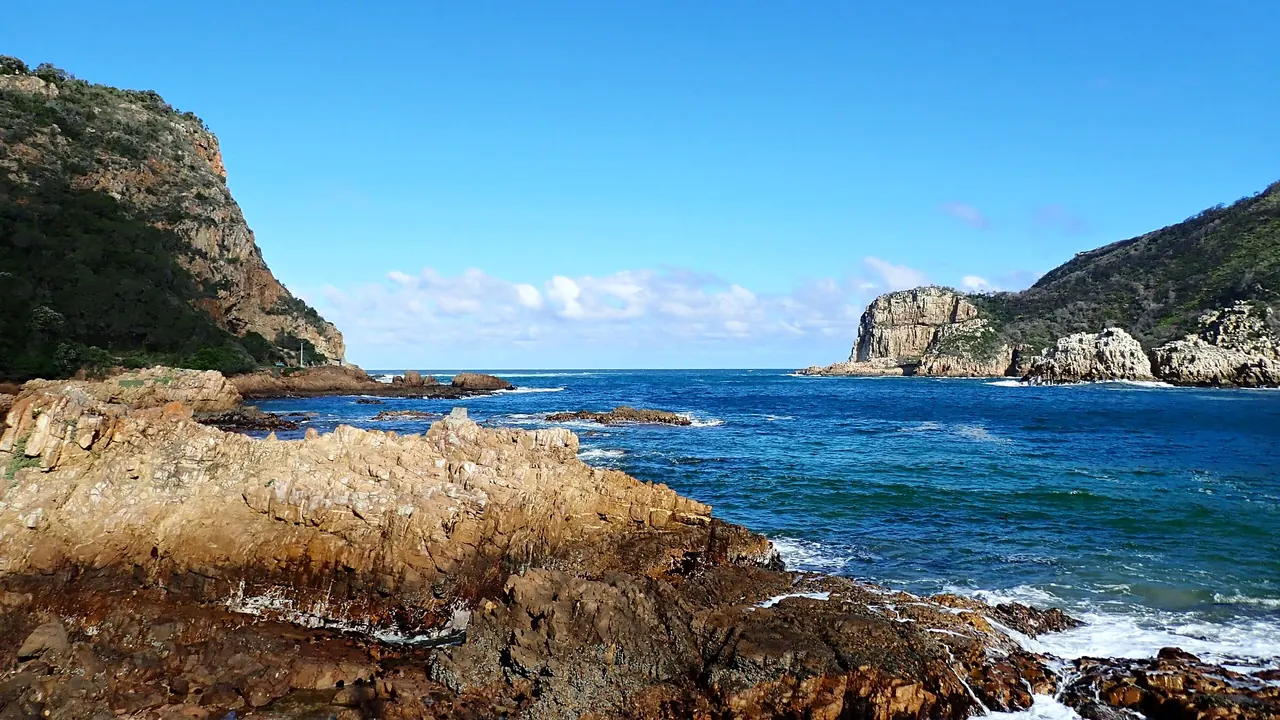
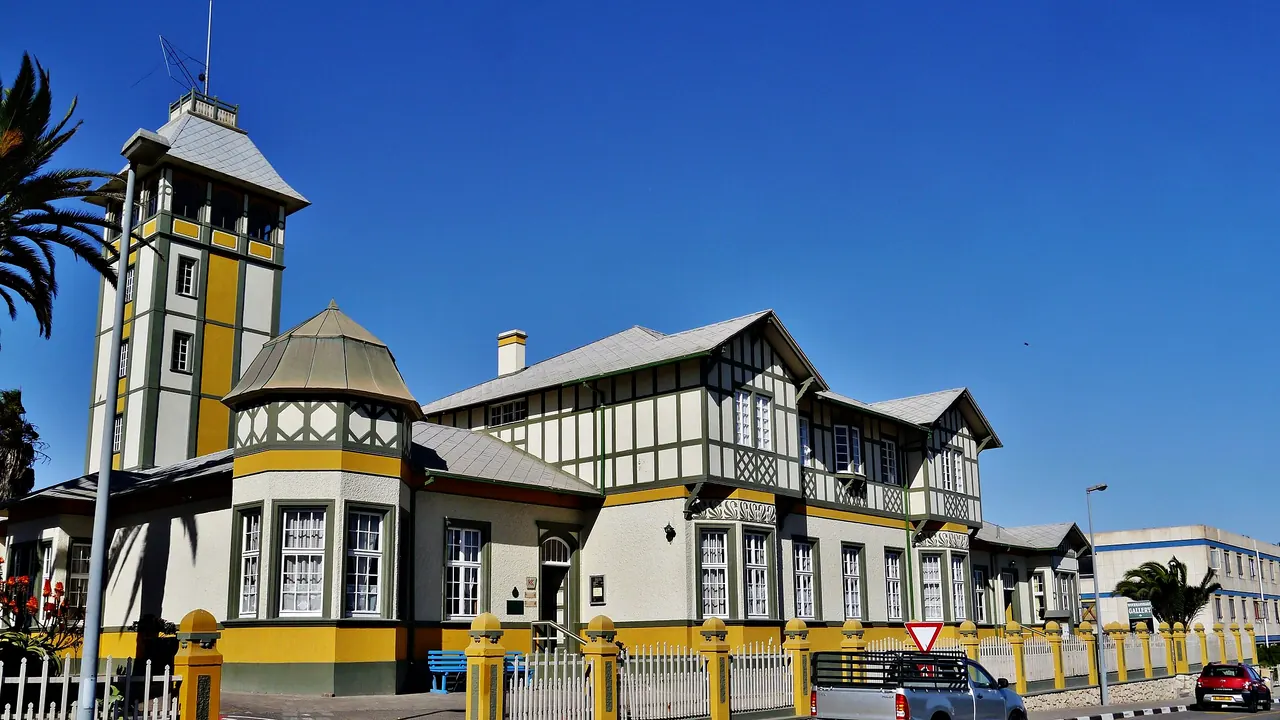
Photos: Knysna by Andrawaag, CC BY-SA 4.0, cropped; Swakopmund by Zairon, CC BY-SA 4.0, cropped.
Knysna or Swakopmund?
Our verdict in twelve categories, each scored against the same fixed benchmark cities, and the climate month by month, so you can choose for your trip.
Choose Knysna for
- beaches
- day trips
- nature and the outdoors
Knysna suits travellers who want green, varied outdoor days and the option of a swim. Forest trails, a calm lagoon for paddling and kayaking, and proper Indian Ocean beaches within a short drive give it the edge for families, walkers and anyone who wants to slow down. A hire car is the price of all that variety, because almost nothing sits within walking distance.
Choose Swakopmund for
- getting around
- culture and sights
- shopping
Swakopmund is the better pick as a stop on a Namibian road trip, when you want a few cool, rainless days, a compact German colonial town you can explore on foot, and desert adventures on the edge of town. Sandboarding, quad biking and seal-watching boat trips are its strengths. Swimming is not, because the Atlantic here stays too cold for beach days.
Scoreboard
Twelve categories on one fixed scale from 0 to 100. The shaded stretch is the gap between the two.
Your match
Pick a travel style or drag the sliders, and both match scores follow your weighting.
Wins on beaches and day trips with your weighting.
Wins on getting around and culture and sights with your weighting.
What matters to you?
Category by category
What the scores mean for a trip.
Beaches & swimming
Knysna has far better beaches, even though the town itself faces a lagoon rather than the sea. The long, wild beaches at Brenton-on-Sea and Buffalo Bay, the forested cove at Noetzie and the sheltered swimming at Plettenberg Bay are all a short drive away, and the shallows off Leisure Isle suit small children. In summer the sea is warm enough for a proper swim, though you should stay near lifeguards because of rip currents.
Swakopmund sits right on the Atlantic, but the Benguela Current keeps the water cold all year, and morning fog and rough surf put most people off swimming. The beach there is for walks, fishing and watching the sunset.
Food & drink
The two are evenly matched, and each has its own farmed oysters, from the Knysna lagoon in one case and the Walvis Bay lagoon in the other. In Knysna the pleasure is a long lunch on a waterfront deck on Thesen Island or by the quays, with line fish, a seafood platter or a braai, and a local beer or a Western Cape wine alongside. The winter Oyster Festival puts the town's speciality at the centre for a few days.
Swakopmund's table has a German accent. Bakeries and coffee houses serve Black Forest cake and apfelstrudel in the afternoon, the beer is brewed to German purity rules, and oryx, kudu and springbok on most menus make it the place to try game. Neither town has much choice of restaurants, so a week covers the best of either.
Culture & sights
Swakopmund has more to see in town. Its half-timbered colonial streets, the Woermann House tower, the old railway station and the iron jetty make a pleasant walking tour, and the town museum and the Mondesa township tours add depth.
Knysna's history is quieter: the small stone church at Belvidere, the gold-rush remains at Millwood in the forest and modest museums about the timber trade. Neither town is a place to visit for its sights alone.
Nightlife
Both towns are quiet well before midnight, and neither has a club scene. In Knysna an evening means sundowners on a lagoon deck and then a long dinner, and the town livens up during the Oyster Festival and the Pink Loerie Mardi Gras. In Swakopmund the evening is a drink by the jetty or a beer in a German-style pub, and weekends are livened by overland travellers passing through.
Nature & outdoors
Knysna has the richer and more varied outdoors. It has yellowwood forest trails at Diepwalle and Harkerville, cliff paths on Featherbed above the Heads, a lagoon for sailing and paddling, and the seal colony on the Robberg Peninsula walk. Tsitsikamma's gorge is within reach, and whales come close inshore in winter and spring.
Swakopmund offers drama of a different kind: the Namib dunes start at the edge of town, with sandboarding, quad biking and scenic flights. There are flamingos and seals at Walvis Bay, and dunes run straight into the sea at Sandwich Harbour. It is thrilling, but it is a grey, treeless landscape with no forest walking.
Day trips
Knysna has more places within easy reach. Plettenberg Bay and Wilderness are half an hour away along the coast, Mossel Bay has its maritime museum, and the drive over the Outeniqua passes to Oudtshoorn leads to the ostrich-boom mansions and the Cango Caves.
From Swakopmund the towns are few. You can reach the port of Walvis Bay, the small resort of Henties Bay and the Portuguese cross at Cape Cross, and the rock art at Spitzkoppe is the main cultural outing. The big Namibian sights, such as Sossusvlei, need a night away.
Good for families
Knysna gives children more to do. There are calm lagoon shallows for paddling, boat trips through the Heads, elephant sanctuaries where you walk alongside the animals, and the primate park and bird aviary near Plettenberg Bay. Children who love forests and animals do best there.
Swakopmund is calm, flat and easy to manage. Its marine aquarium tunnel and the dunes are the highlights, and older children enjoy sandboarding there most. The cold sea and the long gravel-road drives are harder on younger ones.
Getting around
Swakopmund is much easier without a car. The seafront, the jetty, the museum and the restaurants are all within a few minutes' walk of each other, and activity operators usually collect you from where you are staying.
In Knysna only the town centre, the waterfront and Thesen Island are walkable. The beaches, forest trails and neighbouring towns are spread along the N2 highway, so most visitors fly into George and hire a car there.
Shopping & style
Neither is a shopping destination, but they sell different things. Knysna's speciality is furniture and turned wood from local yellowwood and stinkwood, alongside galleries and boutiques on Thesen Island. Swakopmund has craft markets near the lighthouse and shops for Namibian tourmaline and amethyst, karakul rugs, kudu-hide shoes and Herero dolls.
Affordability
The two are similarly good value for meals, beer and guesthouses, and both fill up in December and January. The difference is in what drives the bill. In Knysna the main cost is the car hire, while walks, beaches and forest trails cost little. In Swakopmund the costs are the activities, because dune tours, boat trips and above all scenic flights and skydives are priced for international visitors.
Live music & performing arts
Neither town has a theatre season, an orchestra or an opera. In both, live music mostly means weekend bands in pubs. Knysna's festivals add concerts and street performance at certain times of year, while Swakopmund's small local theatre puts on only the occasional show.
Wellness & relaxation
Knysna is better for a proper rest. It has quiet forest lodges, spas at the larger hotels, yoga and massage retreats in the hills, and an unhurried lagoon-side pace.
Swakopmund offers a few day spas and a calm routine of promenade walks and afternoon coffee. That works well as a pause on a long drive through Namibia, but there is less there to build a wellness stay around.
When should you go?
Pick your month. The climate figures are measured averages, not a forecast.
Knysna in July
Swakopmund in July
Daytime high, °C
Rainfall in the month, mm
Where the figures come from
Knysna's temperatures are measured 62 km from the centre, at George, George Airport.
Knysna's station stands 184 m above the city centre, so the centre is likely a little warmer than the figures say.
Knysna has no rain gauge within 25 km of the centre, so its rainfall comes from a gridded climate dataset read at the city rather than from a gauge further away.
Swakopmund's temperatures are measured 26 km from the centre, at Walvis Bay-Pelican Point.
Swakopmund has no rain gauge within 25 km of the centre, so its rainfall comes from a gridded climate dataset read at the city rather than from a gauge further away.
Temperature and rainfall are climate normals, averaged over the years shown. Knysna: 1991-2020 normals, George, George Airport (61.5 km from centre). Swakopmund: 2005-2025 (rainfall 1991-2020) normals, Walvis Bay-Pelican Point (26.2 km from centre).
Knysna is mild all year and never gets truly hot. Summer highs reach about 25°C from December to February, and that is also when the sea is warmest, at around 21°C, so this is the season for beach days. Winter is cooler but still fine for forest walks, and it brings the whales. Rain is spread across the year rather than coming in one wet season, and spring is the dampest stretch, with about 81mm in November. Sunshine holds up well in every month.
Swakopmund is almost rainless at any time of year, so the weather never stops you walking the streets or heading into the dunes. Oddly, the warmest weather comes in autumn, with highs around 27°C in May, while late winter and spring are the coolest months. The sea never gets above about 18°C, so here it is something to look at rather than swim in. The two places suit opposite seasons: Knysna is best in the southern summer, and Swakopmund is at its most pleasant from March to May.
Which traveller are you?
For a beach and sun trip, Knysna is the clear choice. Brenton-on-Sea, Noetzie and the sheltered bays at Plettenberg Bay are warm enough for swimming in summer. Swakopmund's beaches are washed by a cold current, so most visitors only paddle there.
For a short city break, Swakopmund works better. Its flat, compact centre of German colonial buildings, cafés and seafront can be explored on foot in a weekend. In Knysna the best sights are spread out and you need a car to reach them.
On a relaxing and wellness trip, Knysna offers more. It has forest lodges, yoga retreats, hotel spas and slow mornings on the lagoon. Swakopmund's few day spas and quiet promenade make it a good rest stop, but it is not really a destination for unwinding.
Before you go
| Measure | Knysna | Swakopmund |
|---|---|---|
| Official language | English, Zulu, Xhosa, Afrikaans, Venda, Northern Sotho, Swazi, Tswana, Tsonga, Sesotho, Southern Ndebele, South African Sign Language | English |
| Currency | Rand (ZAR) | Namibia Dollar (NAD) |
| Sockets | CMN230 V, 50 Hz | M220 V, 50 Hz |
| Driving side | Left | Left |
| Time zone | UTC+2 | UTC+2 |
| Emergency number | 112 | 112 |
| Elevation | 9 m | 6 m |
| Main airport | George Airport (GRJ)62 km from centre4 non-stop destinations | Walvis Bay International Airport (WVB)37 km from centre2 non-stop destinations |
| Public holidays this year | 13 days | 13 days |
By the numbers
| Measure | Knysna | Swakopmund |
|---|---|---|
| City population | 51,078 | 75,921 |
| People per km² | 469 | 419 |
| Museums within 10 km | 0 | 1 |
| UNESCO World Heritage sites within 50 km | 0 | 0 |
| Swim season, months above 21 °C | 1 month | None |
Where else could you go?
Every comparison below shares a destination with this one, so you can follow Knysna or Swakopmund somewhere new.
- Windhoekvs Swakopmund
- Hermanusvs Knysna
- Stellenboschvs Knysna
- Cape Townvs Knysna
- Durbanvs Knysna
- Johannesburgvs Knysna