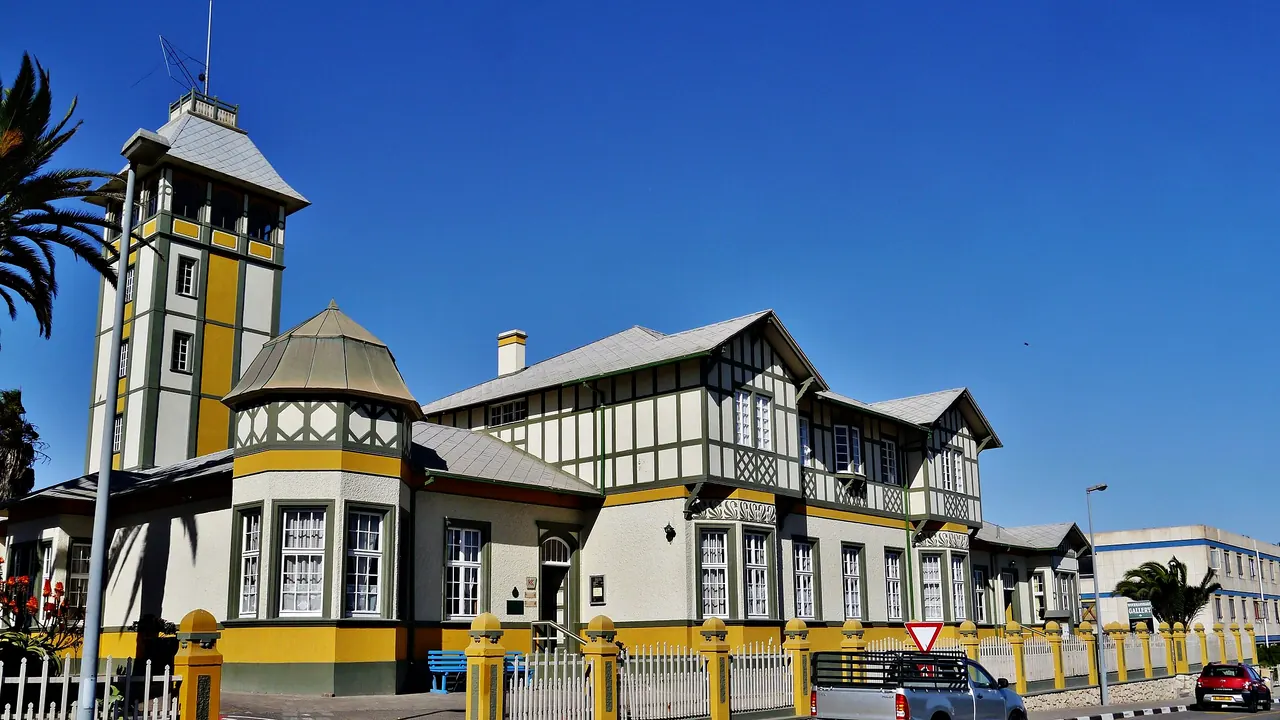
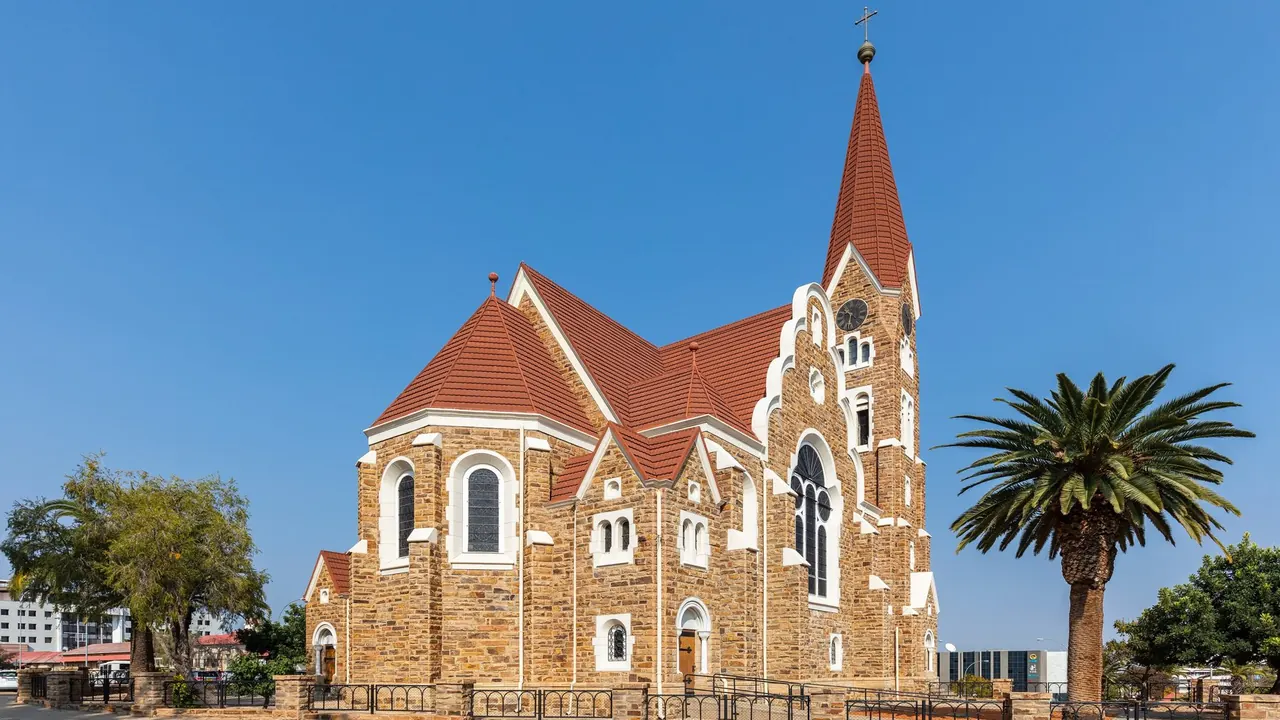
Photos: Swakopmund by Zairon, CC BY-SA 4.0, cropped; Windhoek by Diego Delso, CC BY-SA 4.0, cropped.
Swakopmund or Windhoek?
Our verdict in twelve categories, each scored against the same fixed benchmark cities, and the climate month by month, so you can choose for your trip.
Choose Swakopmund for
- nature and the outdoors
- getting around
- families
Swakopmund is the better pick for travellers who want to do things outdoors. The Namib dunes start at the edge of town, the Walvis Bay lagoon with its seals and flamingos is close by, and the small, flat, orderly centre makes it easy with children. It also suits anyone who wants a few slow days of cool sea air, good fish and afternoon cake in the middle of a long road trip.
Choose Windhoek for
- nightlife
- live music and the arts
Windhoek makes more sense if you want to understand Namibia, not just look at it. The Independence Memorial Museum and the colonial buildings on the ridge tell the country's story more frankly than anything on the coast, and the National Theatre and the clubs and shebeens of Katutura give you a bit more to do after dinner. Game drives at Daan Viljoen are close by, and the city works as the natural place to start or finish a trip to Etosha or Sossusvlei.
Scoreboard
Twelve categories on one fixed scale from 0 to 100. The shaded stretch is the gap between the two.
Your match
Pick a travel style or drag the sliders, and both match scores follow your weighting.
Wins on nature and the outdoors and getting around with your weighting.
Wins on nightlife and live music and the arts with your weighting.
What matters to you?
Category by category
What the scores mean for a trip.
Beaches & swimming
Neither city is a beach destination, but only Swakopmund has a shore at all. Its long sandy beaches and the sheltered stretch by the Mole are good for walks, fishing and sunsets, though the cold Benguela water, morning fog and rough surf mean almost nobody swims.
Windhoek sits on an inland plateau about four hours from the sea. Swimming there means a guest-house pool, which is welcome in the dry summer heat.
Food & drink
The two eat in a similar way, with German bakeries, beer brewed to the purity law, and oryx and kudu on most menus. The difference is what comes with that. Swakopmund has the sea: lagoon oysters from Walvis Bay, kob and kingklip, and a café culture built around cake and coffee.
Windhoek has street food instead. Kapana grilled over open fires in Katutura is its most local meal, and the better sit-down restaurants are out in Klein Windhoek and the suburbs. Neither city has much variety for a long stay.
Culture & sights
Both are an afternoon or a day of sightseeing, but of different kinds. In Swakopmund the town itself is the sight: half-timbered gables, the Woermann House tower and the old station stand against the desert. The local museum and a Mondesa township tour add some depth.
Windhoek has fewer pretty streets and more meaning. The Christuskirche, the Tintenpalast and the Alte Feste stand together on one ridge, and the Independence Memorial Museum deals with colonial rule and the Herero and Nama genocide in a way nothing on the coast does.
Nightlife
Windhoek has more going on after dark, though not a great deal. Beer gardens and lounge bars in Klein Windhoek fill up for long dinners, a few clubs play amapiano and kwaito at weekends, and the Katutura shebeens are where much of the city really goes out, best with a local guide. You will need taxis, since walking between places at night is not advised.
Swakopmund's evening is a sundowner by the jetty and a beer in a German-style pub, and the town is mostly asleep before midnight.
Nature & outdoors
This is where Swakopmund clearly wins. The Namib dunes start where the streets end, so sandboarding, quad biking, skydiving and living desert tours are all on the doorstep. Flamingos, pelicans, seals and dolphins are on the Walvis Bay lagoon a short drive south, and Sandwich Harbour, the Moon Landscape and the Cape Cross seal colony are all within reach.
Windhoek's landscape is gentler: the thornbush and granite koppies of the Khomas Hochland, with hiking among zebra and oryx at Daan Viljoen half an hour away. The dunes and wildlife Namibia is famous for are an overnight trip away.
Day trips
Neither city has much within a day's reach, but Swakopmund has a little more. Walvis Bay's waterfront is half an hour south, Henties Bay and the Portuguese cross at Cape Cross lie up the coast, and the rock paintings at Spitzkoppe make a proper cultural outing about two hours inland.
From Windhoek, the realistic day out is Okahandja, an hour north, for its woodcarvers' market and Herero chiefs' graves, plus a soak at Gross Barmen. Nearly everything else is four hours or more away.
Good for families
Swakopmund is clearly better with children. The National Marine Aquarium's tunnel, the snake park, sandboarding and the seal and dolphin boats give you several days of things to do, and the town is flat, calm and never very hot. Long gravel drives to the outings tire younger children, and the sea is only good for sandcastles.
Windhoek has no zoo, aquarium or theme park. A game drive to see giraffe and zebra is the highlight, and a suburban guest house with a pool does the rest.
Getting around
Swakopmund is simpler to get around. The seafront, jetty, museum and most restaurants are a few flat minutes' walk apart, and activity operators collect you from where you stay, so you only need a car for independent trips into the desert.
Windhoek's walkable part is the centre around Independence Avenue and the church ridge, by day only. The rest of the city spreads over hilly suburbs where the shared taxis take some confidence, so most visitors book taxis or drive themselves.
Shopping & style
The two sell much the same Namibian crafts: Herero dolls, baskets, woodcarvings, karakul wool, gemstones and game-leather shoes. What differs is the setting. Swakopmund has open-air stalls near the lighthouse, specialist gemstone shops and a few German bookshops and delicatessens.
Windhoek gathers its crafts under one roof at the Namibia Craft Centre in the old brewery and along the Post Street Mall. Its suburban malls are useful for stocking up before a long drive.
Affordability
Day-to-day costs are similar, with fairly priced guest houses, meals and beer in both, and in both the hire car is a big part of the bill. In Swakopmund the money goes on activities, since dune tours, boat trips and especially scenic flights and skydives are priced for overseas visitors, and rooms are hard to find in December and January.
In Windhoek the city stay is good value, with cheap kapana and local cafés. The cost comes from the taxis and the safaris and lodges you go on to.
Live music & performing arts
Windhoek has a real if modest stage. The National Theatre of Namibia puts on local drama, dance and choirs, the College of the Arts holds student concerts, and you can sometimes catch shambo or Namibian kwaito in a bar, though it pays to check what is on.
Swakopmund offers little beyond an occasional show at its small theatre and weekend bands in the pubs.
Wellness & relaxation
Swakopmund's calm comes from the sea. After the heat of the interior, the cool Atlantic air and the slow walks along the promenade are a rest in themselves, and the quiet streets set an unhurried pace. Treatments are limited to a few day spas and rooms in guesthouses, so it suits a pause in a road trip rather than a wellness stay.
Windhoek has the warm water instead. The thermal pools at Gross Barmen are about an hour north, and some game farms just outside the city have lodge spas. Like the coast, it has no bathing tradition of its own, but its garden guest houses in low-rise suburbs and clear, cool winter nights make it an easy place to rest for a day.
When should you go?
Pick your month. The climate figures are measured averages, not a forecast.
Swakopmund in July
Windhoek in July
Daytime high, °C
Rainfall in the month, mm
Where the figures come from
Swakopmund's temperatures are measured 26 km from the centre, at Walvis Bay-Pelican Point.
Swakopmund has no rain gauge within 25 km of the centre, so its rainfall comes from a gridded climate dataset read at the city rather than from a gauge further away.
Temperature and rainfall are climate normals, averaged over the years shown. Swakopmund: 2005-2025 (rainfall 1991-2020) normals, Walvis Bay-Pelican Point (26.2 km from centre). Windhoek: 1991-2020 (sunshine 1971-2000) normals, Windhoek (1.7 km from centre).
Swakopmund barely has seasons. It is dry all year, with daytime highs in the low to mid twenties every month, so you can walk the streets or head into the dunes at any time. The Atlantic is the catch: it peaks at about 18°C from January to March and is colder the rest of the year, so it is for paddling, not swimming. Late winter and early spring are the coolest stretch on the coast.
Windhoek swings much more. From October to February the city is hot, reaching around 33°C in December, and the rains come from January to March, with February the wettest month at about 96mm. May to September is the easy season: dry, very sunny, and around 22°C at midday in June and July. That makes it the best time for sightseeing and walking in the hills. If you can only travel in high summer, the coast's mild weather is a welcome break from the heat inland.
Which traveller are you?
For an outdoors trip, choose Swakopmund. You can sandboard, quad bike or fly over the dunes straight from town, paddle among seals on the lagoon, or take a 4x4 to Sandwich Harbour. Windhoek's hiking and game parks are pleasant but much quieter.
On a family trip with children, Swakopmund is the easier base. It has a walk-through aquarium, a snake park, dunes to slide down and boat trips to see dolphins, all in a calm town with mild weather. Windhoek has almost nothing built for children apart from game drives nearby.
For a culture and arts trip, Windhoek gives you more. The Independence Memorial Museum covers the genocide and the liberation struggle, the parliament and fort sit together on one ridge, and the National Theatre has performances. Swakopmund's colonial streets take an afternoon, and in the evenings there is almost nothing to attend.
Before you go
| Measure | Swakopmund | Windhoek |
|---|---|---|
| Official language | English | English |
| Currency | Namibia Dollar (NAD) | Namibia Dollar (NAD) |
| Sockets | M220 V, 50 Hz | M220 V, 50 Hz |
| Driving side | Left | Left |
| Time zone | UTC+2 | UTC+2 |
| Emergency number | 112 | 112 |
| Elevation | 6 m | 1,650 m |
| Main airport | Walvis Bay International Airport (WVB)37 km from centre2 non-stop destinations | Hosea Kutako International Airport (WDH)41 km from centre15 non-stop destinations |
| Public holidays this year | 13 days | 13 days |
By the numbers
| Measure | Swakopmund | Windhoek |
|---|---|---|
| City population | 75,921 | 486,169 |
| People per km² | 419 | 95 |
| Museums within 10 km | 1 | 5 |
| UNESCO World Heritage sites within 50 km | 0 | 0 |
| Swim season, months above 21 °C | None | - |
Where else could you go?
Every comparison below shares a destination with this one, so you can follow Swakopmund or Windhoek somewhere new.
- Livingstonevs Windhoek
- Johannesburgvs Windhoek
- Cape Townvs Windhoek
- Stellenboschvs Windhoek
- Victoria Fallsvs Swakopmund
- Livingstonevs Swakopmund