
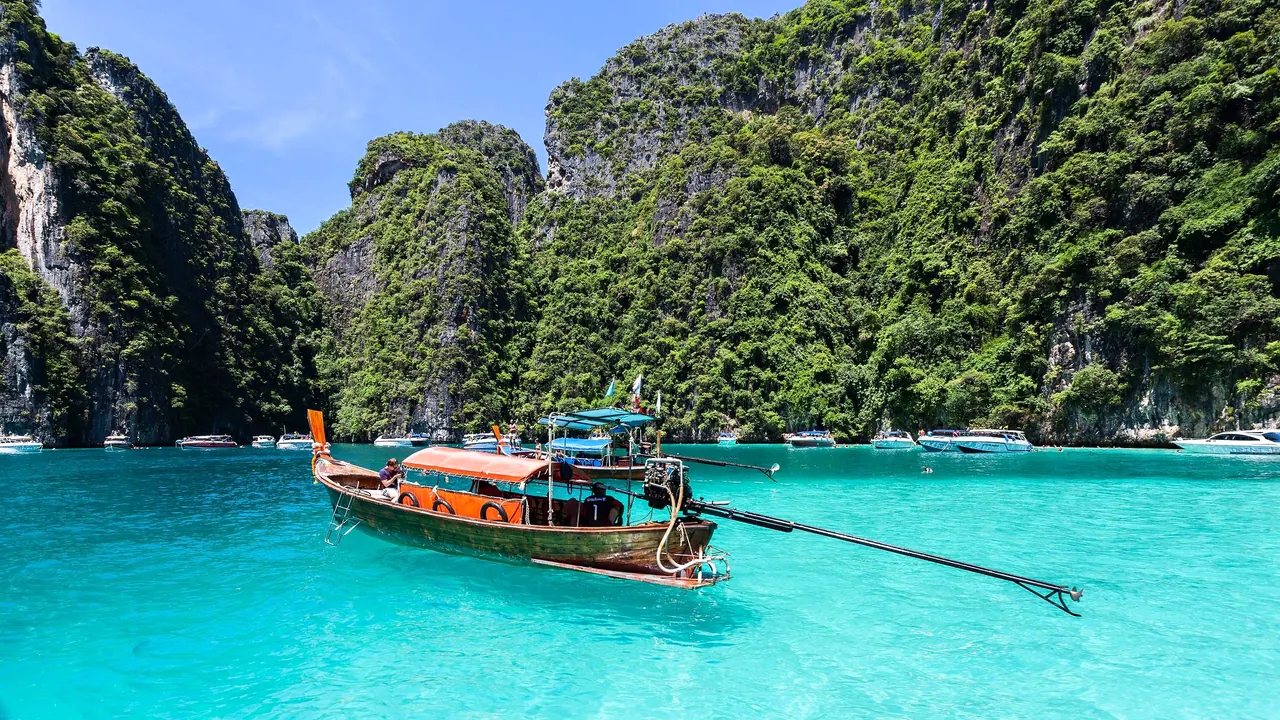
Photos: Koh Kood by Stéphane Bidouze, CC BY-SA 4.0, cropped; Koh Phi Phi by Diego Delso, CC BY-SA 3.0, cropped.
Koh Kood or Koh Phi Phi?
Our verdict in twelve categories, each scored against the same fixed benchmark cities, and the climate month by month, so you can choose for your trip.
Choose Koh Kood for
- prices
- culture and sights
- wellness
Koh Kood is for travellers who want a beach week with very little else going on. You get pale, palm-backed bays along the west coast with only a few resorts behind each one, a forested interior with waterfall pools, and evenings that end after dinner. Day to day it costs a little less. The price is a long journey in and an island where you mostly stay on your own bay.
Choose Koh Phi Phi for
- nightlife
- nature and the outdoors
- getting around
Koh Phi Phi gives you a more dramatic and more sociable island. Limestone cliffs, Pileh Lagoon, coral walls and reef sharks are all a short boat ride away, and there are beach parties on Loh Dalum every night of the dry season. It also fits easily into a longer Andaman route, with ferries on to Lanta, Railay and Phuket. Light sleepers can still stay up at Laem Tong.
Scoreboard
Twelve categories on one fixed scale from 0 to 100. The shaded stretch is the gap between the two.
Your match
Pick a travel style or drag the sliders, and both match scores follow your weighting.
Wins on prices and culture and sights with your weighting.
Wins on nightlife and nature and the outdoors with your weighting.
What matters to you?
Category by category
What the scores mean for a trip.
Beaches & swimming
These are two outstanding beach islands, but the beaches feel very different. Koh Kood's west coast is a run of soft, pale bays such as Klong Chao, Ao Tapao and Ao Prao. Each has jungle and only a few resorts behind it, so even in high season there is room to spread out and nothing to do but swim and kayak. Some bays empty at low tide and a few have sandflies, so choose a beach with deeper water.
Koh Phi Phi has the more spectacular setting: turquoise water under limestone cliffs, plus boat trips to Bamboo Island and the coves of Phi Phi Leh. It is also much busier. Loh Dalum fills with day-trippers and goes very shallow at low tide, so the better swimming is at Long Beach or Laem Tong.
Food & drink
Neither island is worth the trip for its food, and both do simple Thai cooking well enough. Koh Kood's best meals are in the stilt fishing villages of Ao Salad and Ao Yai, where grilled crab and squid come straight off the boats. Because the bays are far apart, most evenings end at your own resort's restaurant.
Phi Phi has more choice packed into one place. Tonsai's lanes serve curries, pizza and burgers, roti carts work the streets, and seafood is grilled on the beach at night. The cooking is often toned down for a backpacker crowd, though.
Culture & sights
Neither island has sights to speak of. On Koh Kood you can at least see something of traditional island life: the wooden stilt houses and piers of Ao Yai and Ao Salad, along with a few small temples. Phi Phi's village is a modern cluster of guesthouses, and beyond a small tsunami memorial and a look at Viking Cave from a passing boat, there is nothing to set out for.
Nightlife
This is where the two islands differ most. Koh Kood has no clubs, no bar strip and no beach parties. A drink at your resort bar is as late as most nights go.
Phi Phi goes out every night. Loh Dalum's bars put out mats and low tables, stage fire-dancing shows, play dance music and serve drinks in buckets until the early hours, and the village has reggae bars and amateur Muay Thai. It is young, loud and fairly uniform, but it is a real night out.
Nature & outdoors
Phi Phi's scenery is in a different league. Sheer limestone walls rise from the sea, and from the viewpoint above the village you look down on two bays joined by a narrow isthmus. Longtails and kayaks slip into Pileh Lagoon. Underwater there are soft-coral walls at Bida Nok and Bida Nai and blacktip sharks at Shark Point, although heavy boat traffic has worn the reefs.
Koh Kood is greener and wilder in feel, with most of the island still under forest. Its outdoor life is gentle: short jungle walks to Klong Chao and Huang Nam Kheo waterfalls, giant old trees inland, kayaking up a mangrove river, and snorkelling trips to the marine park to the north.
Day trips
Koh Kood has one real outing, while Phi Phi sits on ferry routes to several other places. From Koh Kood, that outing is neighbouring Koh Mak, a flat, quiet island of coconut plantations, reached by boat in the dry season and usually combined with snorkelling stops at tiny islets. Trat and the mainland are too far for a day there and back, so most visitors stay on their bay.
Phi Phi is the better base, although every outing starts with a ferry. Koh Lanta's stilt-house old town is about an hour away and the cliff-backed peninsula of Railay about an hour and a half. You can also reach Phuket Town's Sino-Portuguese shophouses, but at two hours each way it makes a long day.
Good for families
Both islands work for a quiet beach week with children if you choose your base carefully, and neither has attractions built for them. On Koh Kood, the calm bays, kayaks and waterfall pools are easy wins. The drawbacks are the long road-and-boat journey from Bangkok and the need to cross to Trat for any serious medical care.
On Phi Phi, the resorts at Laem Tong have shallow water and pools, and the lack of cars helps. Stay away from the village, though, which is noisy late into the night and has steep, unlit paths to the outer beaches. The ferry can also be rough outside the dry season.
Getting around
Phi Phi is the easier island to reach and to use. Ferries from Phuket, Krabi or Ao Nang take under two hours, and Tonsai village and Loh Dalum are a few minutes apart on foot along car-free lanes. To reach the other beaches you take a longtail or walk steep hill paths.
Koh Kood takes more effort. You travel by road or air to Trat and then take a boat. On the island there is no public transport, so most people hire a scooter for the one hilly road with its steep, sandy turns down to the bays, or rely on resort pick-ups.
Shopping & style
On Koh Kood, shopping means a few minimarts and small grocery stores on the main road for sun cream and snacks, plus the beachwear in resort boutiques. Phi Phi's village lanes give you a little more to browse: sarongs, souvenir T-shirts, snorkel and dive gear, and a handful of tailor and jewellery stalls.
You won't find markets or local crafts on either island, so pack what you need and save any real shopping for the mainland.
Affordability
Koh Kood is somewhat kinder on the budget. Most stays are in mid-range bungalow resorts, and simple fan bungalows, scooter hire and local Thai restaurants keep costs down. Isolated bays do push many meals to resort prices, though, and boat transfers add up.
Phi Phi is expensive by Thai standards. Everything comes in by boat and space is tight, and you pay for drinks, boat tours, longtail rides and an entry fee to the island. Budget travellers still manage in the village dormitories.
Live music & performing arts
On Koh Kood, the most you can expect after dark is an occasional acoustic guitar evening at a resort bar. Phi Phi's entertainment is louder and part of the party, with fire dancers on the beach and cover acts in the village bars. On both islands it comes with a night out, and nobody would plan a trip around it.
Wellness & relaxation
Both islands offer Thai massage and resort spas rather than any real wellness tradition. Where they differ is in how quiet they are. On Koh Kood the calm covers the whole island: no traffic, no nightlife and many resorts on a bay of their own, with massage pavilions near most beaches and yoga at some of the upmarket places.
On Phi Phi, rest depends on where you stay. Laem Tong and the isolated eastern bays have slow days and spas among the trees, while around Tonsai the music carries late and the lanes are crowded.
When should you go?
Pick your month. The climate figures are measured averages, not a forecast.
Koh Kood in July
Koh Phi Phi in July
Daytime high, °C
Rainfall in the month, mm
Where the figures come from
Koh Kood's temperatures are measured 39 km from the centre, at Khlong Yai.
Koh Kood has no rain gauge within 25 km of the centre, so its rainfall comes from a gridded climate dataset read at the destination rather than from a gauge further away.
Koh Phi Phi's temperatures are measured 65 km from the centre, at Phuket Airport.
Koh Phi Phi has no rain gauge within 25 km of the centre, so its rainfall comes from a gridded climate dataset read at the destination rather than from a gauge further away.
Temperature and rainfall are climate normals, averaged over the years shown. Koh Kood: 1971-2000 (rainfall 1991-2020) normals, Khlong Yai (38.5 km from centre). Koh Phi Phi: 1991-2020 (sunshine 1961-1990) normals, Phuket Airport (65.2 km from centre).
Both islands are hot all year, with daytime highs between 30°C and 34°C, and the sea is warm enough to swim in every month. What decides the timing is the rain. Koh Kood has a short, very dry season from November to February, and December is almost rainless. From May the monsoon hits the west coast hard. August brings 777mm of rain, and many places close until the autumn.
Koh Phi Phi's wet season is gentler but lasts longer. Rain builds from May, peaks in October at 316mm and is still heavy in November, when Koh Kood has already dried out. January to March are Phi Phi's best months, with the most sunshine and the calmest sea for boat trips. In March and April the two islands are much alike: at their hottest, with some showers. From June to October neither is at its best, but Phi Phi stays far more usable.
Which traveller are you?
For a food and nightlife trip, Koh Phi Phi is the clear choice. Loh Dalum's bars put on fire shows and loud dance music until the early hours, and Tonsai's lanes have far more places to eat than Koh Kood's scattered resorts.
On an outdoors trip, Koh Phi Phi again comes out ahead. You can kayak under sheer limestone into Pileh Lagoon, dive the coral walls at Bida Nok, swim with reef sharks and climb the bolted cliffs. Koh Kood's waterfalls and mangrove paddles are gentler and smaller in scale.
On a relaxing and wellness trip, Koh Kood is the safer pick. It is quiet across the whole island, with no traffic and no party noise, and most beaches have massage pavilions. On Phi Phi, rest depends on avoiding the village.
Before you go
| Measure | Koh Kood | Koh Phi Phi |
|---|---|---|
| Official language | Thai | Thai |
| Currency | Baht (THB) | Baht (THB) |
| Sockets | ABCF220 V, 50 Hz | ABCF220 V, 50 Hz |
| Driving side | Left | Left |
| Time zone | UTC+7 | UTC+7 |
| Emergency number | Police 191, ambulance 1669, fire 199 | Police 191, ambulance 1669, fire 199 |
| Main airport | Trat Airport (TDX)1 non-stop destination | Krabi International Airport (KBV)14 non-stop destinations |
By the numbers
| Measure | Koh Kood | Koh Phi Phi |
|---|---|---|
| Population | 2,000 | - |
| People per km² | 18 | - |
| Swim season, months above 21 °C | 12 months | 12 months |
Where else could you go?
Every comparison below shares a destination with this one, so you can follow Koh Kood or Koh Phi Phi somewhere new.
- Koh Lantavs Koh Phi Phi
- Phuketvs Koh Phi Phi
- Koh Changvs Koh Kood
- Koh Rongvs Koh Kood
- Koh Lipevs Koh Phi Phi
- Koh Sametvs Koh Kood