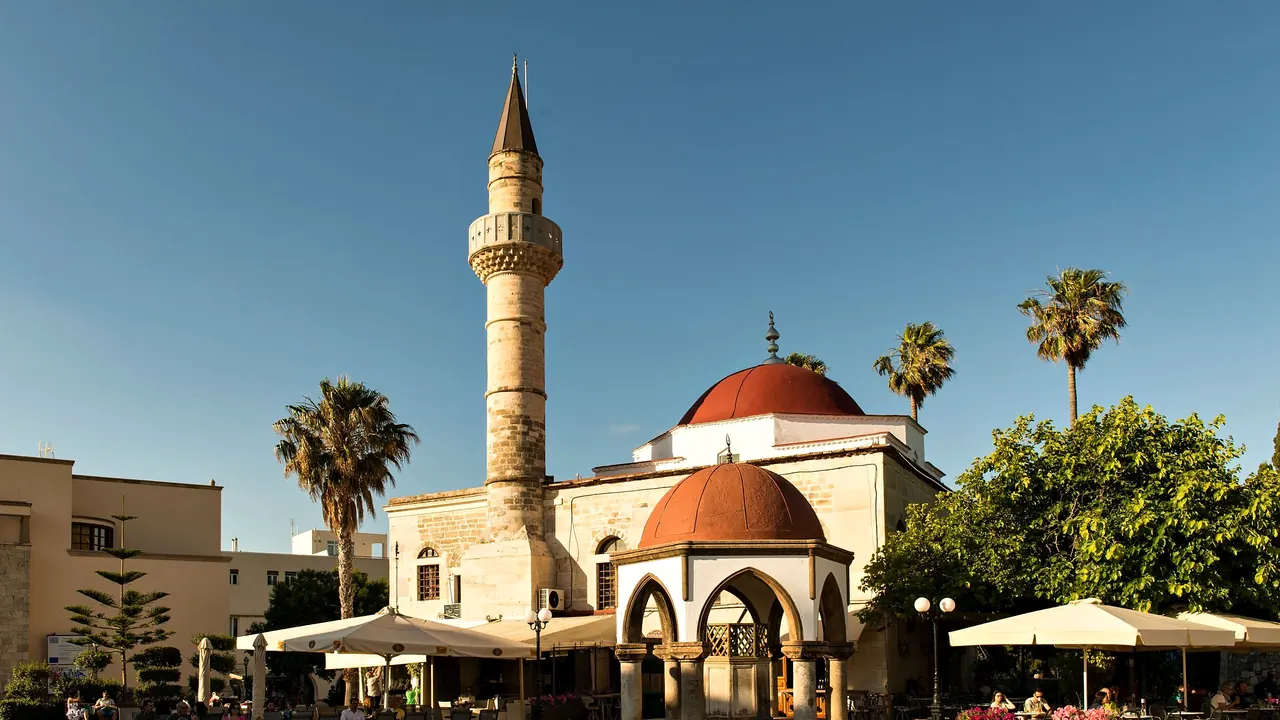
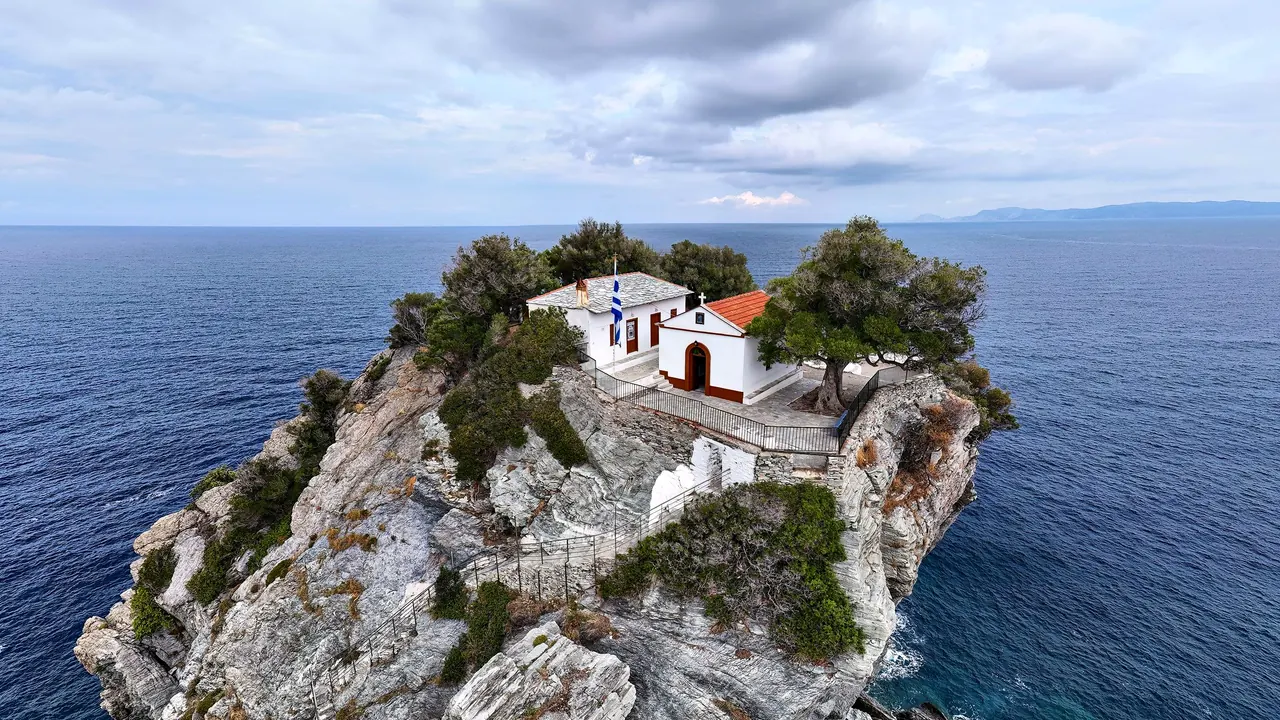
Photos: Kos by Wolfgang Weiser, Pexels License; Skopelos by Giles Laurent, CC BY-SA 4.0, cropped.
Kos or Skopelos?
Our verdict in twelve categories, each scored against the same fixed benchmark cities, and the climate month by month, so you can choose for your trip.
Choose Kos for
- nightlife
- getting around
- day trips
Kos is the easier and broader island. It has its own airport, flat land and long sandy strands on the north coast that suit small children, and resorts built around pools. For evenings there are the bars of Kos Town and the late clubs of Kardamena, and for days off the beach there are Roman ruins, the Asklepieion and boats to Bodrum, Nisyros and Kalymnos. Choose it if you want plenty within easy reach and don't mind sharing it with the package crowd.
Choose Skopelos for
- nature and the outdoors
Skopelos is for a slower, greener trip. Pine forest runs down to clear pebble coves, and the evenings end with a long dinner and a drink on the harbour. It suits couples and walkers better than party-goers, with mule tracks up to the monasteries above Skopelos Town and boat trips into the marine park. It takes more effort: you arrive by ferry, and the smaller bays are easiest to reach with a car or scooter.
Scoreboard
Twelve categories on one fixed scale from 0 to 100. The shaded stretch is the gap between the two.
Your match
Pick a travel style or drag the sliders, and both match scores follow your weighting.
Wins on nightlife and getting around with your weighting.
Wins on nature and the outdoors with your weighting.
What matters to you?
Category by category
What the scores mean for a trip.
Beaches & swimming
The two are equally strong for beaches, but the beaches themselves are quite different. Kos is mostly sand: long, open strands from Tigaki to Mastichari with room to spread out, the more sheltered south coast around Kardamena, and the best-looking bays, Paradise Beach and Agios Stefanos, out on the Kefalos peninsula.
Skopelos gives you a different small cove every day. Most are fine pebble or sand and pebble, with pines growing down to the shore and water clear far out, from Stafylos near town to Panormos, Limnonari and Kastani in the west. On both islands the summer meltemi roughens the north coast, so the south side is the place to swim on windy days.
Food & drink
The food is about equal and very similar: grilled octopus, meze and village tavernas on both islands. On Kos, look for pitaroudia chickpea fritters and wine-matured krasotyri in Zia, Pyli or the Mastichari harbour, and avoid the multilingual menus of the big resorts. Skopelos has its fried, coiled cheese pie, dishes made with its plums and the almond sweets from the town's bakeries. Its kitchens are less geared to package tourists, but many close once summer is over.
Culture & sights
Kos has more history to see. Kos Town is built around its antiquities, with the Agora, the Odeon, Roman mosaics and the Casa Romana among the streets, the Knights' castle at the harbour, and the terraced Asklepieion on the hill above. Together they fill two or three good days.
On Skopelos the main sight is the town itself: whitewashed, slate-roofed houses climbing to a Venetian castle, with monasteries on Mount Palouki and the Mamma Mia chapel of Agios Ioannis on its rock. It is attractive rather than important, and a day or two covers it.
Nightlife
This is the biggest gap between the two. From June to September Kos has a real resort scene. Bars fill the lanes of Kos Town's old quarter until the small hours, there are beach clubs at Lambi, and Kardamena runs late clubs for a young crowd.
Skopelos has nothing like it. A night out there is a long dinner followed by a drink on the harbour or in a small bar playing Greek music, and there are no clubs at all. That suits couples, but not anyone hoping to dance until dawn.
Nature & outdoors
Skopelos is the greener island. Aleppo and black pine cover most of it, and old mule tracks link chapels, orchards and empty bays. Offshore, the Northern Sporades marine park has monk seals and dolphins, and the indented coast is good for kayaking.
Kos is drier and flatter. Its hill walks are in the Dikeos range, up to the sunset point on Mount Christos, and flamingos gather on the Alikes salt lake in the cooler months. Where Kos does better is the wind: the steady meltemi makes Marmari and Tigaki good for windsurfing and kitesurfing.
Day trips
Kos has more varied day trips. You can take a short ferry to Bodrum on the Turkish coast (bring your passport), take a boat to Nisyros to look into its volcanic crater, or cross from Mastichari to the sponge-diving harbour of Kalymnos.
From Skopelos the choice comes down to its neighbours: Skiathos with its busier port town, and quiet Alonissos with its hilltop old village, often combined with swimming stops in the marine park. The mainland is hours away, so day trips stop at the Sporades.
Good for families
Kos is better set up for children. Flights land on the island, the coast is flat enough for family bike rides, the north-coast sand shelves gently, and there is a large water park near Marmari as well as resorts with pools and kids' clubs. Kardamena is the one place to avoid if you want quiet nights.
Skopelos is good for a quiet beach week, with sheltered, shallow bays such as Limnonari and Agnontas and tavernas just behind them. But it has no attractions built for children, the stepped lanes of the town are hard with a pushchair, and getting there takes a flight and a ferry.
Getting around
Kos is far easier to get around. It has an airport, buses run along the main road to the larger resorts, and Kos Town is flat and has cycle lanes to the nearby beaches. A hire car for a day or two covers the hill villages and the south-west.
Skopelos takes more planning. You reach it by boat, usually via Skiathos, and a single road runs from the town to Glossa. Summer buses go to the well-known beaches, but the coves and monasteries mean driving on narrow, winding and sometimes unpaved roads.
Shopping & style
Neither island is a shopping destination, though Kos has slightly more. Besides the souvenir lanes of the old quarter, there are a few good shops for olive oil and ceramics, and the Italian-era market hall on Eleftherias Square for spices and local produce. Skopelos has one evening's browsing in the lanes behind the harbour: ceramics, linen, prunes, herbal teas and almond sweets.
Affordability
Both cost about what you would expect for a mid-priced Greek island, but the savings come in different ways. Kos is built for package travel, so there are plenty of mid-range rooms in Kardamena, Tigaki and Marmari, and the buses and bike hire are cheap. On Skopelos the family-run studios and taverna meals are reasonably priced, but the ferry, a hire car and boat trips add up, and rooms are hard to find in high summer. June and September are cheaper on both.
Live music & performing arts
Neither island has much to offer, and what there is happens only in summer. On Kos, the Hippokrateia festival puts on concerts and theatre in the Asklepieion, the Odeon and the castle. On Skopelos you will find rebetiko and island songs in tavernas around the harbour, and dancing at the village saints'-day festivals in August.
Wellness & relaxation
Kos has more to offer here. At Therma on the south-east coast, a hot sulphur spring runs onto a pebble beach, where bathers build stone pools to mix it with the sea, and the large beach resorts have spas.
Skopelos has no springs and only a few hotel spas. What it offers is the pace: late breakfasts, shaded tavernas and very little traffic. Kos can be that slow too, around Kefalos or in Zia and Pyli.
When should you go?
Pick your month. The climate figures are measured averages, not a forecast.
Kos in July
Skopelos in July
Daytime high, °C
Rainfall in the month, mm
Where the figures come from
Kos has no rain gauge within 25 km of the centre, so its rainfall comes from a gridded climate dataset read at the destination rather than from a gauge further away.
Skopelos's temperatures are measured 68 km from the centre, at Skyros Airport.
Skopelos has no rain gauge within 25 km of the centre, so its rainfall comes from a gridded climate dataset read at the destination rather than from a gauge further away.
Temperature and rainfall are climate normals, averaged over the years shown. Kos: 1993-2020 (rainfall 1991-2020) normals, Kos Airport (23.2 km from centre). Skopelos: 1998-2025, 11 years observed (rainfall 1991-2020) normals, Skyros Airport (67.7 km from centre).
The two islands follow the same summer pattern. June to early October is warm enough for the sea on both, and July and August are almost dry. Kos gets hotter, reaching about 31°C at midday in high summer, which makes long walks round the ruins of Kos Town hard work in the afternoon. Skopelos peaks nearer 29°C and stays a little gentler. Its pine-shaded hills are best for walking in spring and from late September into October.
Winter is where they differ most. Kos turns very wet from November to February, with around 170mm in January, while Skopelos has steadier but much lighter rain and stays under 80mm in every month. Off-season, Kos's sea is warmer for longer. Skopelos's sea is very cold until late May and then warms quickly by June.
Which traveller are you?
On a family trip with young children, Kos is the better choice. You can fly straight in, the north-coast sand shelves gently, there is a water park near Marmari, and resorts have kids' clubs. Skopelos means a ferry, plus stepped lanes that are hard work with a pushchair.
For an outdoors trip, choose Skopelos. Pine forest covers it up to Mount Delfi, waymarked mule tracks link monasteries and bays, and boats head into a marine park with monk seals and dolphins. Kos's main outdoor draw is the meltemi for windsurfing.
On a food and nightlife trip, Kos is the clear pick. The tavernas are similar on both islands, but Kos Town's old quarter stays loud into the small hours and Kardamena has proper late clubs. On Skopelos the night ends with a harbour drink and some Greek music.
Before you go
| Measure | Kos | Skopelos |
|---|---|---|
| Official language | Greek | Greek |
| Currency | Euro (EUR) | Euro (EUR) |
| Sockets | CF230 V, 50 Hz | CF230 V, 50 Hz |
| Driving side | Right | Right |
| Time zone | UTC+2, UTC+3 in summer | UTC+2, UTC+3 in summer |
| Emergency number | 112 | 112 |
| Main airport | Kos International Airport "Ippokratis" (KGS)75 non-stop destinations | Skiathos Island National Airport (JSI)37 non-stop destinations |
| Public holidays this year | 15 days | 15 days |
By the numbers
| Measure | Kos | Skopelos |
|---|---|---|
| Population | 33,387 | - |
| People per km² | 115 | - |
| Swim season, months above 21 °C | 5 months | 5 months |
Where else could you go?
Every comparison below shares a destination with this one, so you can follow Kos or Skopelos somewhere new.