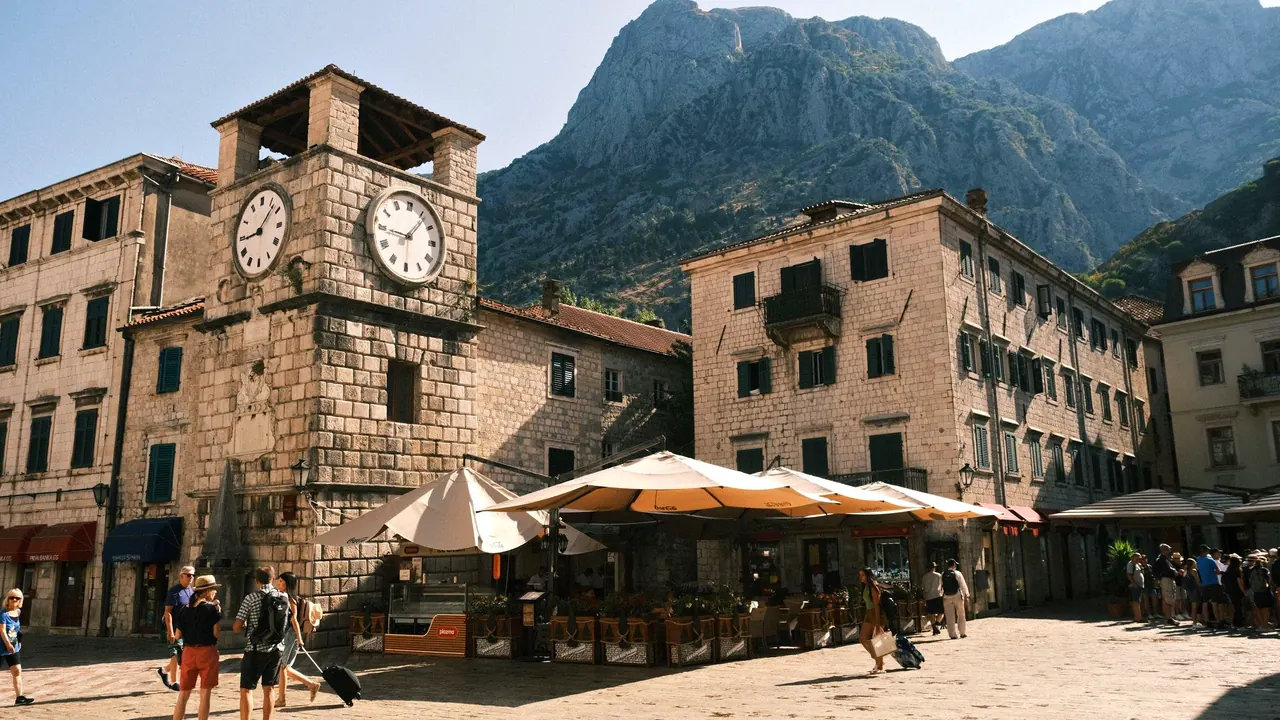
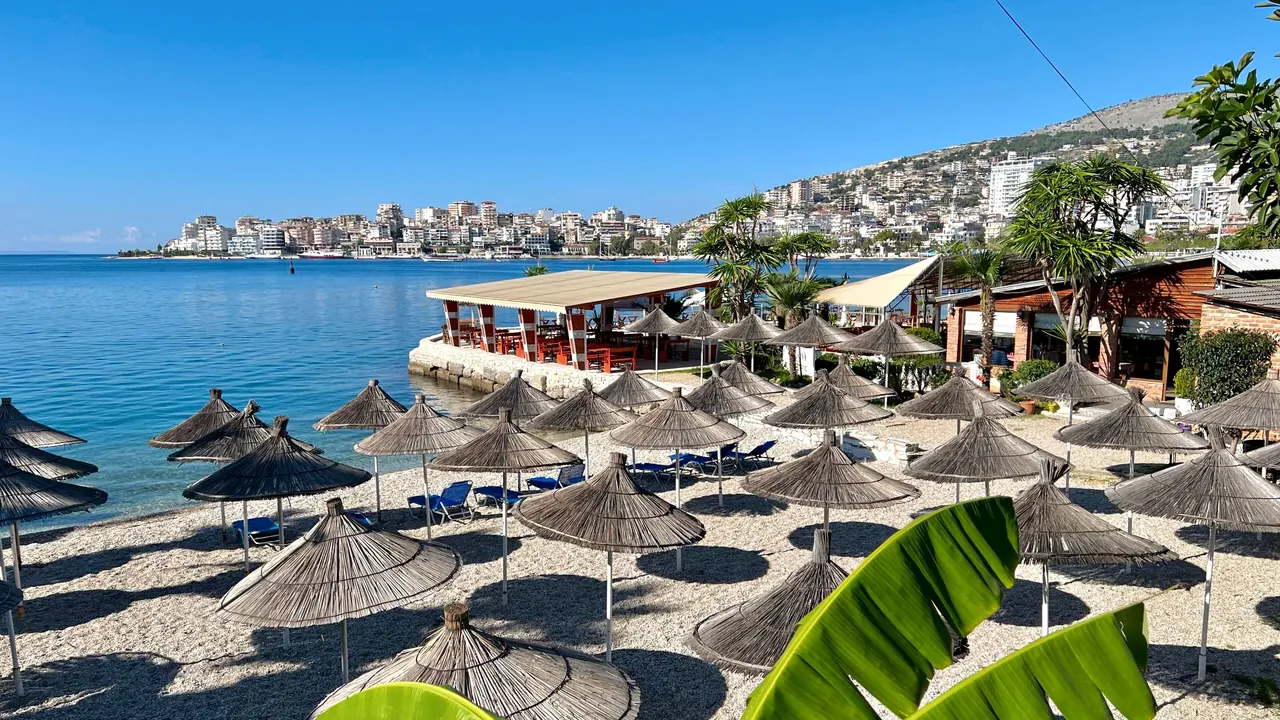
Photos: Kotor by Muhammed Fatih Beki, Pexels License; Saranda by Sharon Hahn Darlin, CC BY 2.0, cropped.
Kotor or Saranda?
Our verdict in twelve categories, each scored against the same fixed benchmark cities, and the climate month by month, so you can choose for your trip.
Choose Kotor for
- culture and sights
- nature and the outdoors
- live music and the arts
Kotor suits travellers who care more about scenery and history than sand. The UNESCO-listed walled town under its cliff, the fortress walls zigzagging above and a fjord-like bay hemmed in by mountains make it a place for walking, climbing and boat trips to Perast. The beach is a drive away at Budva, not at the door.
Choose Saranda for
- beaches
- prices
- nightlife
For a sea-first vacation on a tighter budget, Saranda is the better pick. The clear water and islets at Ksamil are twenty minutes away, rooms and meals cost less, and the summer promenade is livelier after dark. The town itself has little to see, but Butrint, Gjirokaster and Corfu make up for it as day trips.
Scoreboard
Twelve categories on one fixed scale from 0 to 100. The shaded stretch is the gap between the two.
Your match
Pick a travel style or drag the sliders, and both match scores follow your weighting.
Too close to call, 2 points apart
Wins on culture and sights and nature and the outdoors with your weighting.
Wins on beaches and prices with your weighting.
What matters to you?
Category by category
What the scores mean for a trip.
Beaches & swimming
Kotor has no beach of its own. Swimming means concrete platforms and narrow pebble strips along the shore towards Dobrota and Muo. The water is calm but enclosed and less clear than the open sea, so a proper beach day means the half-hour trip to Jaz or Sveti Stefan.
In Saranda the sea is the point of the stay. The town's pebble beaches are fine for a quick dip, Ksamil's coves and islets twenty minutes south have strikingly clear Ionian water, and Lukova and Borsh along the Riviera are quieter. Expect sunbeds packed close together at the nearest spots in August.
Food & drink
Both kitchens rest on the same coastal staples of grilled fish, octopus and farmed mussels, and neither offers much fine dining or international cooking. The difference is in what comes with the seafood. Kotor adds Venetian touches, black cuttlefish risotto and Njegusi ham with mountain cheese, washed down with dark Vranac. Its better konobas sit along the shore at Dobrota, Prcanj and Perast.
Saranda leans towards southern Albanian home cooking: byrek in the morning, stuffed peppers, grilled meats and plenty of olive oil, with raki rather than any serious wine culture. Its best meals come from the family taverns in the back streets, not the promenade.
Culture & sights
Kotor is in another league here. The whole walled town is the sight: a UNESCO-listed triangle of marble lanes with St Tryphon's, the Romanesque cathedral consecrated in 1166, small churches, the palazzi of seafaring families and the Maritime Museum. Above it all, the walls climb to St John's fortress.
Saranda is a modern resort town. Its own history amounts to the mosaic floors of the old synagogue, fragments of city wall and the view from Lekuresi Castle. Its real heritage lies outside town, which is why its day trips matter so much.
Nightlife
Saranda has more going on after dark, at least in July and August. On summer evenings the promenade turns from a family stroll into loud cocktail bars running past midnight, and beach clubs at Ksamil keep the DJs going later still. The crowd is young and largely Albanian and Kosovar.
Kotor's evenings are quieter. You get a drink on an old town square beneath the floodlit walls, a few late bars and a small club scene, and anyone wanting a big night heads to Budva's seafront. Outside summer, both towns go quiet early.
Nature & outdoors
Kotor has the more striking setting. The bay twists inland between limestone walls rising more than 1,000m almost from the water. The Ladder of Kotor and the fortress path climb straight from the town gates, and above the 25 hairpins Lovcen National Park adds beech woods and karst meadows.
Saranda's landscape is gentler. It has a horseshoe bay facing Corfu, the lagoon and reed beds of Butrint for birdwatching, and the Blue Eye spring inland. The Riviera offers sea kayaking and boat trips to caves, but the trails are largely unmarked. In both places summer heat makes spring and autumn the time for hiking.
Day trips
Both have excellent excursions within easy reach, but they are of different kinds. From Kotor the trips follow the bay: baroque Perast and Our Lady of the Rocks, Herceg Novi, Budva and Sveti Stefan. Inland, the road over Lovcen leads to the old royal capital at Cetinje, and Dubrovnik and Ostrog make longer days.
Saranda's list is shorter but richer in ancient history. At Butrint, Greek, Roman and Venetian remains overlap in a lagoon woodland. Gjirokaster has Ottoman tower houses below its castle, and the ferry takes you to Corfu's old town in under an hour.
Good for families
Neither town is built for children, but both welcome them warmly. Kotor's old town is car-free, safe and small, the street cats are a hit and a boat to Perast's island church is an easy outing. On the other hand, the fortress climb is hard going in summer and swimming in the bay is from jetties.
Saranda's advantage is the water: the sheltered coves at Ksamil suit young swimmers, and the evening promenade with ice cream and rides is a family ritual. Against that, the streets are steep, pavements are patchy and summer traffic is chaotic, so a pool hotel in June or September works best.
Getting around
Both are easy on foot in the centre and awkward beyond it. Kotor's old town is flat, car-free and crossed in minutes. Buses go to Budva, Tivat and Cetinje and water taxis reach some of the bay villages, but the single road around the bay jams in summer.
Saranda's promenade links the beaches, restaurants and port, though hotels on the slopes mean steep climbs, and buses and minibuses run without printed timetables. In both towns, a hire car or driver is the way to see the best of the area.
Shopping & style
Kotor has a little more worth browsing. Among the cat souvenirs, its lanes sell silver filigree, lace and coral jewellery, and a few galleries show local painters. Saranda's promenade mostly sells beachwear and everyday goods.
The best buys in both are edible: Vranac and Njegusi ham from Kotor's green market, and olive oil, mountain honey and raki from Saranda's stalls. For brands, people go from Kotor to the marina at Tivat. For crafts, Saranda's shoppers do better at the bazaar in Gjirokaster.
Affordability
Your money goes further in Saranda. Grilled fish, byrek, local buses and taxis cost little, and apartments and family hotels off the seafront are good value for most of the year. In high summer, though, Ksamil's sunbeds and seafront rooms cost noticeably more.
Kotor is moderately priced rather than cheap. It is cheaper than the better-known resorts up the coast, but hotels and restaurants inside the walls charge resort rates in July and August. Staying in Dobrota or Muo and eating away from the main squares closes the gap. In both towns, May, June and September give you the same sea for noticeably less.
Live music & performing arts
Neither town has a year-round stage, but Kotor has more to see. Its summer festival brings classical recitals, choirs and children's theatre into the squares and churches, and the cathedral sometimes holds concerts. The carnival and Boka Night fill the bay with masked parades and decorated boats.
Saranda has little beyond the odd seafront concert, an occasional performance in Butrint's ancient theatre and live Albanian music in some restaurants. For traditional polyphonic singing, the area around Gjirokaster is where to look.
Wellness & relaxation
In Kotor, calm depends on where you stay. If you base yourself along the shore outside the walls, you get quiet mornings on the water and long lunches in the bay villages, and you can see the old town early or late, away from the midday crowds.
In Saranda, it depends on when you go. July and August are loud with music and traffic into the night, while May, June and late September slow down to quiet terraces and evening walks by the bay. Neither has a bathing tradition, so spa time in either means a hotel or resort spa.
When should you go?
Pick your month. The climate figures are measured averages, not a forecast.
Kotor in July
Saranda in July
Daytime high, °C
Rainfall in the month, mm
Where the figures come from
Kotor has no rain gauge within 25 km of the centre, so its rainfall comes from a gridded climate dataset read at the destination rather than from a gauge further away.
Kotor's sunshine is measured 42 km from the centre, at Podgorica-Grad.
Saranda's temperatures are measured 30 km from the centre, at Kerkyra Airport.
Saranda has no rain gauge within 25 km of the centre, so its rainfall comes from a gridded climate dataset read at the destination rather than from a gauge further away.
Temperature and rainfall are climate normals, averaged over the years shown. Kotor: 1991-2020 normals, Tivat (4.2 km from centre). Saranda: 1991-2020 normals, Kerkyra Airport (29.8 km from centre).
Kotor and Saranda follow much the same calendar. From June to August both are hot and dry, with highs around 32°C in August. That suits the beach, but it is too hot at midday for the fortress steps above Kotor or the hills behind Saranda. The sea is warm enough to swim in both from June into October. In high summer Saranda is the sunnier and drier of the two, while Kotor still gets the odd shower.
Spring and autumn are better for walking and sightseeing. Highs are around 20°C in April and 24°C in May, and October is still pleasantly warm, though by then the rain has come back. Kotor is the damper of the two in April. The wet season starts in September and is heaviest in November and December, when Saranda gets more than 200mm a month. Winter is mild in both, and Saranda is slightly warmer but also wetter.
Which traveller are you?
On a beach and sun trip, Saranda is the clear choice. Ksamil's pale coves and islets are close by, the Riviera bays to the north give you more space, and summers are sunnier and drier. Kotor's inner bay offers only jetties and pebble strips.
For a culture and arts trip, Kotor wins comfortably. Its walled old town, St Tryphon's Cathedral and the Maritime Museum put history on the doorstep, and summer recitals fill its churches. Saranda has few sights of its own, so culture there means a day out at Butrint.
On an outdoors trip, Kotor is the stronger base for serious walkers: steep, sustained climbs begin on foot from town. Go in spring or autumn and start early. Saranda suits a gentler mix of lagoon walks, kayaking and boat trips, and its mountain hikes need careful navigation.
Before you go
| Measure | Kotor | Saranda |
|---|---|---|
| Official language | Montenegrin | Albanian |
| Currency | Euro (EUR) | Lek (ALL) |
| Sockets | CF230 V, 50 Hz | CF220 V, 50 Hz |
| Driving side | Right | Right |
| Time zone | UTC+1, UTC+2 in summer | UTC+1, UTC+2 in summer |
| Emergency number | 112 | 112 |
| Elevation | 10 m | 0 m |
| Main airport | Tivat Airport (TIV)5 km from centre41 non-stop destinations | Corfu Ioannis Kapodistrias International Airport (CFU)32 km from centre88 non-stop destinations |
| Public holidays this year | - | 14 days |
By the numbers
| Measure | Kotor | Saranda |
|---|---|---|
| Population | 562 | 22,613 |
| People per km² | - | 383 |
| Museums within 10 km | 3 | 0 |
| UNESCO World Heritage sites within 50 km | 3 | 3 |
| Swim season, months above 21 °C | 5 months | 5 months |
Where else could you go?
Every comparison below shares a destination with this one, so you can follow Kotor or Saranda somewhere new.