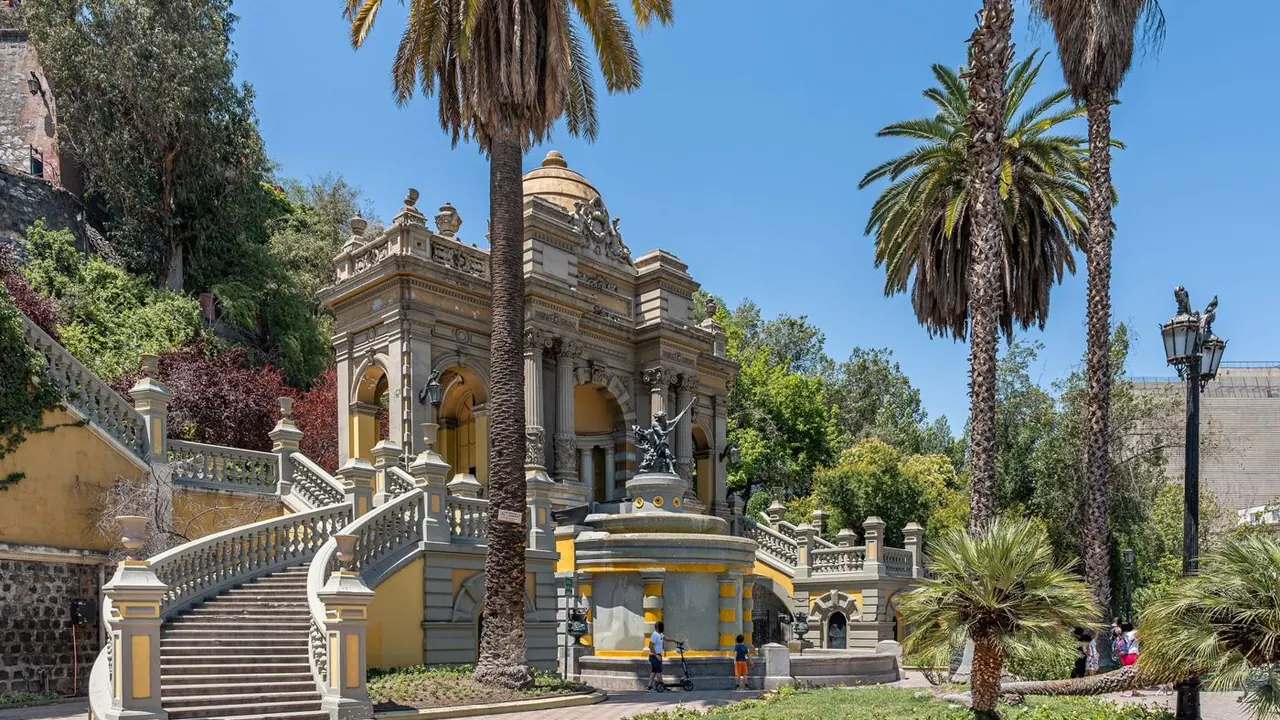
Photos: Santiago by Rjcastillo, CC BY-SA 4.0, cropped.
La Paz or Santiago?
Our verdict in twelve categories, each scored against the same fixed benchmark cities, and the climate month by month, so you can choose for your trip.
Choose La Paz for
- prices
La Paz suits travellers who want somewhere that feels like nowhere else and who don't mind roughing it a little. You get a city poured into a canyon under snow peaks, cholitas and ritual stalls in the everyday streets, cable cars over the rooftops and climbs and bike descents in the mountains just outside. It is also far cheaper. The price is altitude: everyone needs a slow start, nights end early and it is no place for small children.
Choose Santiago for
- families
- day trips
- wellness
Santiago is the easier and more rounded choice. It works better for families, for anyone who wants late dinners with good wine and a proper night out, and for travellers who like to take day trips to Valparaíso or the vineyards. The metro makes it simple to get around, the Andes are close enough for hiking or a ski day, and you can arrive and get going on the first afternoon without worrying about thin air.
Scoreboard
Twelve categories on one fixed scale from 0 to 100. The shaded stretch is the gap between the two.
Your match
Pick a travel style or drag the sliders, and both match scores follow your weighting.
Wins on prices with your weighting.
Wins on families and day trips with your weighting.
What matters to you?
Category by category
What the scores mean for a trip.
Beaches & swimming
Neither city is for a beach trip, but Santiago at least has a coast within reach. Viña del Mar and the central coast are a day out by bus, although the Humboldt Current keeps the water cold enough that many people only paddle.
La Paz has no coast at all. Lake Titicaca is for boat trips rather than swimming, so in either city swimming mostly means a pool, and in La Paz it means a heated one.
Food & drink
Santiago eats better. Its seafood, such as conger eel soup, sea urchins and machas clams at the Mercado Central and around La Vega, is the high point, and Chilean wine is on every table. Lastarria, Barrio Italia and Bellavista add a modern restaurant scene with more depth than La Paz offers.
La Paz is at its best in the morning. Salteñas, purple-corn api and the potato and grain stalls of Mercado Rodríguez make an excellent street breakfast, but the range is narrow, the cooking is heavy and the altitude can take away your appetite for the first days.
Culture & sights
The two are well matched, but the culture is of a different kind. In La Paz it lives on the street: the Witches' Market, cholitas in bowler hats, the cholet mansions of El Alto and the carved mestizo baroque front of San Francisco. Seeing the whole city from the cable cars is a sight in itself.
Santiago's strength is its museums and modern history. The Precolombino collection is the finest single museum in either city, and La Moneda and the Museum of Memory tell the story of 1973 and the dictatorship. Earthquakes have left little colonial fabric, though, and two or three days covers the essentials.
Nightlife
Santiago is the place to go out. Dinner is late, bars fill after eleven and clubs run until early morning at weekends, with Bellavista the loudest district and Lastarria and Barrio Italia better for wine and cocktails.
La Paz is quieter by design. You'll find small bars in Sopocachi and traveller bars around Sagárnaga, but the cold nights and the way alcohol hits harder at altitude send most visitors to bed early.
Nature & outdoors
Both cities sit right under the Andes, but they use the mountains differently. La Paz is about high altitude. Huayna Potosí is one of the most accessible six-thousand-metre peaks in the world, the Death Road descends from snow to cloud forest in a day, and the Valle de la Luna is a short ride from the centre. Every one of these starts above 3,500m.
Santiago's mountains are easier to use without acclimatising. You can hike Cerro San Cristóbal inside the city, go rafting and walk to the El Morado glacier in the Cajón del Maipo, and ski at Valle Nevado or La Parva on a winter day trip. Against that, you have urban sprawl to cross on the way out and winter smog that can hide the peaks.
Day trips
Santiago gives you far more choice for a day out. Valparaíso's hills and funiculars, with Viña del Mar beside it, make an easy full day, and the Maipo and Casablanca wine valleys are close. Pomaire fills a spare half-day.
La Paz has one essential trip, the pre-Inca ruins of Tiwanaku. Most of its other destinations, such as Copacabana, Isla del Sol, Coroico and Sorata, are far enough away that they need an overnight stay rather than a day.
Good for families
For children, the gap is wide. Santiago welcomes them in restaurants late into the evening and has plenty to fill the days: the Parque Metropolitano with its funicular, zoo and pools, the Mirador science museum, the Parque O'Higgins amusement park and the playgrounds of Parque Bicentenario.
La Paz is hard work with little ones. Arriving at about 4,000m is a real health risk for young children, and the steep streets and heavy traffic don't help. Teenagers who cope with the altitude will enjoy the markets and the landscapes, but with younger children Santiago is the safer choice.
Getting around
Santiago is much simpler to get around. A clean, easy-to-follow metro runs Line 1 along the main axis from the Centro to Las Condes, and the neighbourhoods visitors use are pleasant to walk between. Ride-hailing covers the rest.
La Paz has something more memorable but less complete. Mi Teleférico's cable cars glide over the city to El Alto and the southern suburbs, but beyond them you are left with shouted-destination minibuses and taxis. Walking up the steep hills at altitude leaves you out of breath quickly.
Shopping & style
Santiago has the wider range. It has big malls in the eastern districts, luxury labels along Alonso de Córdova and independent design and vintage shops in Barrio Italia, plus lapis lazuli, copper and Mapuche silver at the Pueblito Los Dominicos craft village.
La Paz is the better place for Andean textiles. The lanes around Sagárnaga are full of alpaca knitwear, weavings and instruments, and the 16 de Julio fair in El Alto sprawls for street after street. Quality varies, and there is nothing in the way of fashion or luxury.
Affordability
La Paz is far cheaper. Meals, transport and comfortable central hotels cost little, and the main expenses are guided climbs and the Death Road ride, where it pays to choose a reputable operator.
Santiago costs about as much as a mid-range southern European city. Market food, set lunches and local wine are good value, but hotels in Providencia and Las Condes, skiing and mountain tours make the overall bill clearly higher.
Live music & performing arts
Santiago offers more for an evening out. The 19th-century Teatro Municipal has opera, ballet and a philharmonic, the GAM and the university theatres stage contemporary work, and January's Santiago a Mil festival brings international companies. Most of the theatre is in Spanish, though.
La Paz is better for folk performance. Peñas present panpipes, charangos and the diablada, and the yearly Gran Poder festival fills the streets with dancers, but formal classical and theatre programmes are modest.
Wellness & relaxation
Neither city is restful in itself, but Santiago has more ways to escape. Termas de Colina's terraced pools are on the city's northern edge, and the Cajón del Maipo has simple hot springs, while Parque Forestal and Cerro San Cristóbal give you shade within the city.
La Paz adds altitude to the noise and fumes, so sleep can be poor for the first nights. The nearest thermal pools, at Urmiri, are about two hours away, and coca tea with an early night is the usual way people recover.
When should you go?
Pick your month. The climate figures are measured averages, not a forecast.
La Paz in July
Santiago in July
Daytime high, °C
Rainfall in the month, mm
Where the figures come from
La Paz has no weather station within reach, so its figures come from a gridded climate model rather than a measured record, and read a broad area rather than the city itself.
Temperature and rainfall are climate normals, averaged over the years shown. La Paz: 2001-2020 normals, NASA POWER reanalysis grid, no weather station within 90 km. Santiago: 1991-2020 normals, Santiago Q. Normal (3.1 km from centre).
The two cities have almost opposite years. La Paz stays cool all year, with daytime highs of about 14°C in every month, so warmth hardly matters when you choose dates. Rain does. The wet season runs from December to March, peaking at around 136mm in January, while May to September is very dry, with the clearest mountain skies. That dry stretch is the best time for walking the city and for trekking or climbing nearby.
Santiago has a real summer. January reaches about 28°C, with almost no rain and long sunny days, which is pleasant by the hotel pool but hot for a full afternoon on foot. Its rain comes in winter, peaking at around 87mm in June, when days are cool and grey, and that is also the season for skiing. Spring and autumn, roughly October to November and March to April, are the comfortable months for walking the city.
Which traveller are you?
On a trip on a tight budget, La Paz goes much further. Market set lunches, salteñas, cable-car rides and taxis cost very little, and comfortable hotels in Sopocachi cost far less than their equivalents in Providencia or Las Condes.
On a family trip with children, Santiago is the clear choice. It has a funicular and a zoo on Cerro San Cristóbal, a hands-on science museum, summer pools and a child-friendly restaurant culture. In La Paz, the altitude is a real health risk for young children.
For a food and nightlife trip, Santiago wins. It has seafood counters at the Mercado Central, wine from the nearby valleys and late nights in Bellavista and Lastarria. La Paz has excellent street breakfasts, but its evenings are cold, quiet and short.
Before you go
| Measure | La Paz | Santiago |
|---|---|---|
| Official language | Spanish, Aymara, Quechua, Guarani | Spanish |
| Currency | Boliviano (BOB) | Chilean Peso (CLP) |
| Sockets | AC50 Hz | CL220 V, 50 Hz |
| Driving side | Right | Right |
| Time zone | UTC-4 | UTC-4, UTC-3 in summer |
| Emergency number | 911 | Police 133/134, ambulance 131, fire 132 |
| Elevation | 3,640 m | 575 m |
| Main airport | El Alto International Airport (LPB)6 km from centre12 non-stop destinations | Comodoro Arturo Merino Benítez International Airport (SCL)14 km from centre67 non-stop destinations |
| Public holidays this year | 12 days | 16 days |
By the numbers
| Measure | La Paz | Santiago |
|---|---|---|
| City population | 755,732 | 6,257,516 |
| People per km² | 1,601 | 7,468 |
| Museums within 10 km | 21 | 54 |
| UNESCO World Heritage sites within 50 km | 1 | 0 |
Where else could you go?
Every comparison below shares a destination with this one, so you can follow La Paz or Santiago somewhere new.