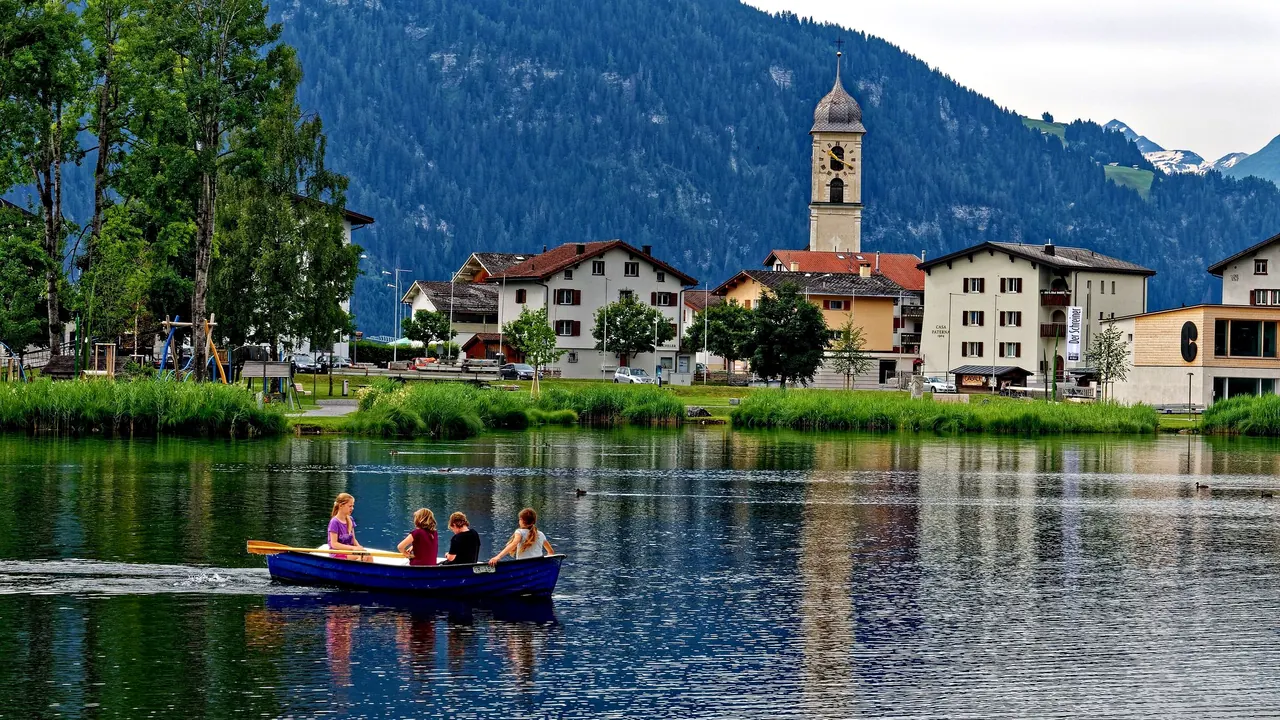
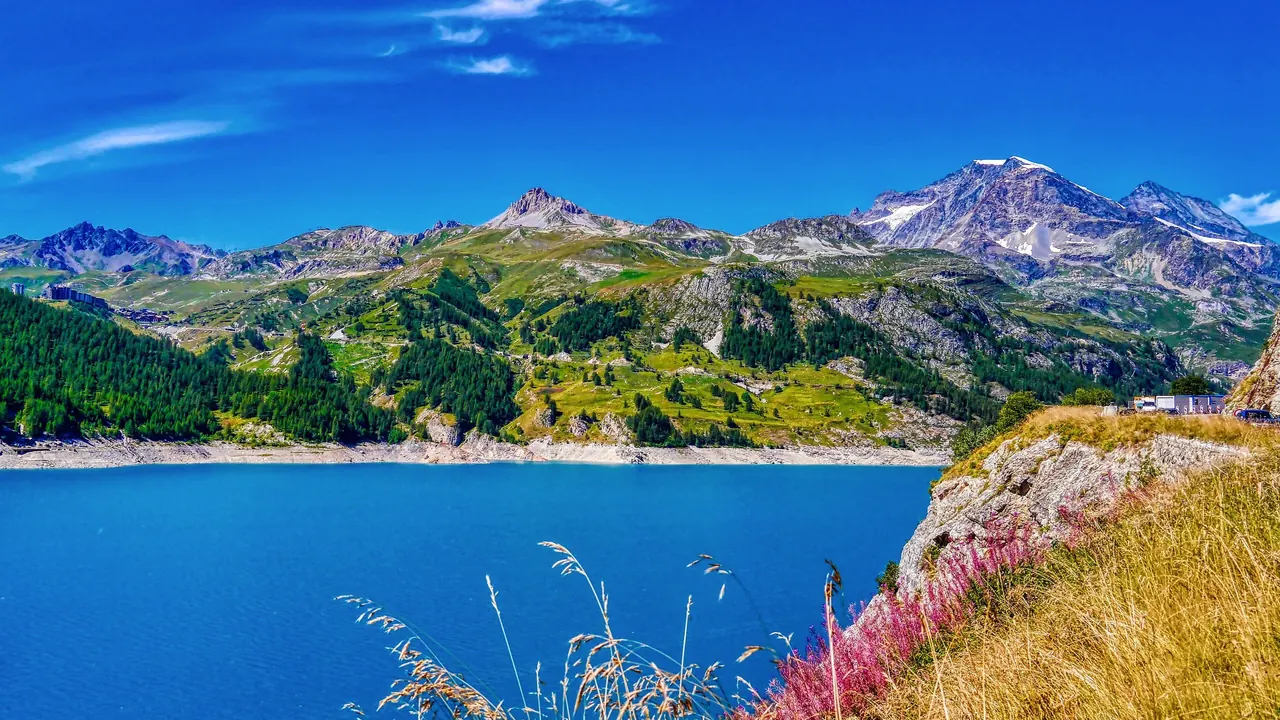
Photos: Laax by Holger Uwe Schmitt, CC BY-SA 4.0, cropped; Tignes by Zairon, CC BY-SA 4.0, cropped.
Laax or Tignes?
Our verdict in twelve categories, each scored against the same fixed benchmark cities, and the climate month by month, so you can choose for your trip.
Choose Laax for
- beaches
- day trips
- families
Laax suits travellers who want the mountains with a little more around them. Summer brings warm forest lakes for swimming. Chur and the Rhaetian Railway are close enough for days off the slopes, and free buses link the villages. It is the better pick for families and for anyone mixing hiking, rafting in the Rhine Gorge and the odd excursion, as long as they accept Swiss costs.
Choose Tignes for
- nightlife
- prices
- food and drink
Tignes is for people who want altitude above all else. It is high and snow-sure, its season is long and its slopes link with Val d'Isère. In winter its après-ski is louder and goes on later. It is slightly easier on the budget, especially for groups in self-catering apartments, but there is little to do once you leave the snow, and getting out of the valley takes effort.
Scoreboard
Twelve categories on one fixed scale from 0 to 100. The shaded stretch is the gap between the two.
Your match
Pick a travel style or drag the sliders, and both match scores follow your weighting.
Too close to call, 2 points apart
Wins on beaches and day trips with your weighting.
Wins on nightlife and prices with your weighting.
What matters to you?
Category by category
What the scores mean for a trip.
Beaches & swimming
Laax is the better place for a summer swim. The Caumasee and Crestasee lie in the forest towards Flims, turquoise and spring-fed, with lawns and wooden platforms, and the small Laaxersee is right by the village. On a warm July day the water reaches the low twenties.
Tignes offers a single supervised bathing area on its lake at 2,100m, where the snowmelt rarely gets above 16°C. Most visitors end up in the indoor lagoon pool instead.
Food & drink
Neither is a food destination, and the two differ mainly in which regional kitchen they serve. Laax cooks from Graubünden, with capuns, pizzoccheri and air-cured beef in the slope-side huts. Tignes is Savoie cheese country, with fondue, raclette and tartiflette made with Beaufort and Reblochon.
Tignes has the slight edge because its cheese is good enough to buy in the delicatessens and take home. In both resorts menus repeat and many kitchens shut between seasons.
Culture & sights
Both are places for mountains, not sightseeing, but what little each has is quite different. Laax keeps an old village with Romansh houses, a baroque church and a language still spoken in the valley, and Falera's hilltop church stands beside prehistoric standing stones.
Tignes was built at altitude in the 1960s and 1970s, and its blocks have none of that age. Its heritage is the story of the old village drowned by the Chevril dam, recalled in the giant mural on the dam wall.
Nightlife
Tignes has the bigger winter night out. Après-ski moves from the mountain terraces into the bars of Val Claret and Tignes Le Lac, and the small clubs stay open well past midnight, with British, Scandinavian and French crowds dancing in ski boots.
Laax is livelier than most Swiss resorts thanks to its freestyle crowd, but its scene is a handful of venues around the Murschetg lift base that come alive mainly at weekends and during events. Both go quiet in summer.
Nature & outdoors
Both are first-rate mountain bases, but the setting differs. Laax is lower and greener. Its ski area climbs to the Vorab glacier and is known for its freestyle parks, and in summer there are the Flimserstein cliffs, the Martinsloch and rafting through the white cliffs of the Ruinaulta gorge.
Tignes is higher and wilder. Above it the Grande Motte glacier rises to nearly 3,500m, the slopes link with Val d'Isère for big off-piste skiing, and the Vanoise National Park, with its ibex and marmots, starts right beside the resort.
Day trips
Laax is far better placed for days away from the slopes. Chur's old town is about half an hour by bus, and from there the Rhaetian Railway runs the UNESCO-listed Albula line to St Moritz. Vals, Zillis and Vaduz are within a day's reach.
Tignes sits at the end of a long valley road. Val d'Isère is close, but Conflans and Beaufort need a car, and Aosta is only practical in summer, when the pass is open.
Good for families
Laax gives families more to work with, especially in summer, when the lakes, adventure trails and forest walks round the Caumasee fill the days. The quiet villages and free buses also make it easy without a car.
Tignes is strong for a ski week, with ski-in, ski-out apartments and beginner slopes beside the villages. Its indoor aquatic centre is a wet-weather fallback that Laax lacks, but the altitude and cold are harder on small children.
Getting around
Laax is simpler to reach. It is a train to Chur and then about half an hour on the regional bus, and a free shuttle links Laax, Flims, Falera and the lifts. Its parts are spread out, so walking between them is not always practical.
Tignes is easier once you are there, with compact villages and skiing from door to door. Getting in and out is the hard part: a winding road climbs about forty minutes from the station at Bourg-Saint-Maurice.
Shopping & style
In both resorts the shops sell ski and outdoor gear and little else. Laax adds a few streetwear boutiques for its snowboard crowd, while the best things to take home from Tignes are Beaufort, cured sausages and mountain honey from the delicatessens.
Affordability
Both are expensive, but Laax is the harder on the wallet. Swiss prices apply to everything from lift passes to a simple mountain lunch, and there is no cheap way to spend a winter week there.
Tignes leaves more room to save. Self-catering apartments make up much of the resort, weeks early and late in the season cost noticeably less, and summer stays are cheaper again.
Live music & performing arts
Neither has a stage of its own. Music in both comes from DJs and bands around ski and freestyle events. Laax at least has Chur within easy reach for a play or a concert, while Tignes has nothing of the kind anywhere near it.
Wellness & relaxation
The two are close here, and the difference is in mood. Laax is the calmer place to slow down, with quiet villages and hotel saunas, and the celebrated stone baths at Vals are about an hour away.
Tignes runs on early lifts and late bars, and its spa is the hammam and massage area of the lakeside aquatic centre. Brides-les-Bains is down the valley for anyone who wants thermal waters.
When should you go?
Pick your month. The climate figures are measured averages, not a forecast.
Laax in July
Tignes in July
Daytime high, °C
Rainfall in the month, mm
Where the figures come from
Laax has no weather station within reach, so its figures come from a gridded climate model rather than a measured record, and read a broad area rather than one spot.
Tignes has no weather station within reach, so its figures come from a gridded climate model rather than a measured record, and read a broad area rather than one spot.
Temperature and rainfall are climate normals, averaged over the years shown. Laax: 1991-2020 normals, TerraClimate 4 km grid at the town, no weather station within 90 km. Tignes: 2001-2020 normals, NASA POWER reanalysis grid, no weather station within 90 km.
Laax is the milder of the two. Summer highs reach about 21°C in July and August, warm enough for a swim in its lakes, but these are also the wettest months, with around 174mm in August. Winter is cold and drier, with daytime highs only a few degrees above freezing from December to February. Spring and autumn bring cool, comfortable walking weather, though the rain only really eases from October.
Tignes sits much higher and stays colder all year. From December to March daytime highs stay at or below freezing, falling to about -4°C in January, which keeps the snow reliable. Even July peaks at around 18°C, so summer means fresh hiking weather rather than warmth. Rain and snow are spread more evenly than in Laax and are much lighter in summer. May is the wettest month and November is also damp, while February is the driest. September is the settled month for the trails, with mild days and little rain.
Which traveller are you?
On a family trip with young children, Laax is the easier choice. Its gentle slopes at Falera, forest lakes, playgrounds and free buses keep children busy in both seasons, and the lower altitude spares the smallest children the tiredness that Tignes can bring.
For a food and nightlife trip, Tignes gives more back. The bars of Val Claret and Le Lac run loud and late through the ski season, and long fondue and raclette dinners made with Beaufort and Reblochon round off each day well.
On a trip on a tight budget, Tignes is the less painful of two expensive resorts. Its many self-catering apartments, cheaper weeks early and late in the season and lower summer lodging stretch money further than Laax, where Swiss prices bite at every meal.
Before you go
| Measure | Laax | Tignes |
|---|---|---|
| Official language | French, German, Italian, Romansh | French |
| Currency | Swiss Franc (CHF) | Euro (EUR) |
| Sockets | CJ230 V, 50 Hz | CE230 V, 50 Hz |
| Driving side | Right | Right |
| Time zone | UTC+1, UTC+2 in summer | UTC+1, UTC+2 in summer |
| Emergency number | 112 | 112 |
| Elevation | 1,016 m | 1,440 m |
| Main airport | Zürich Airport (ZRH)90 km from centre226 non-stop destinations | Geneva International Airport (GVA)105 km from centre150 non-stop destinations |
| Public holidays this year | 9 days | 11 days |
By the numbers
| Measure | Laax | Tignes |
|---|---|---|
| Population | 2,104 | 1,919 |
| People per km² | 66 | 24 |
| Museums within 10 km | 3 | 0 |
| UNESCO World Heritage sites within 50 km | 1 | 0 |
Where else could you go?
Every comparison below shares a destination with this one, so you can follow Laax or Tignes somewhere new.
- Val d'Isèrevs Tignes
- Les Arcsvs Tignes
- La Rosièrevs Tignes
- La Plagnevs Tignes
- Val Cenisvs Tignes
- Courchevelvs Tignes