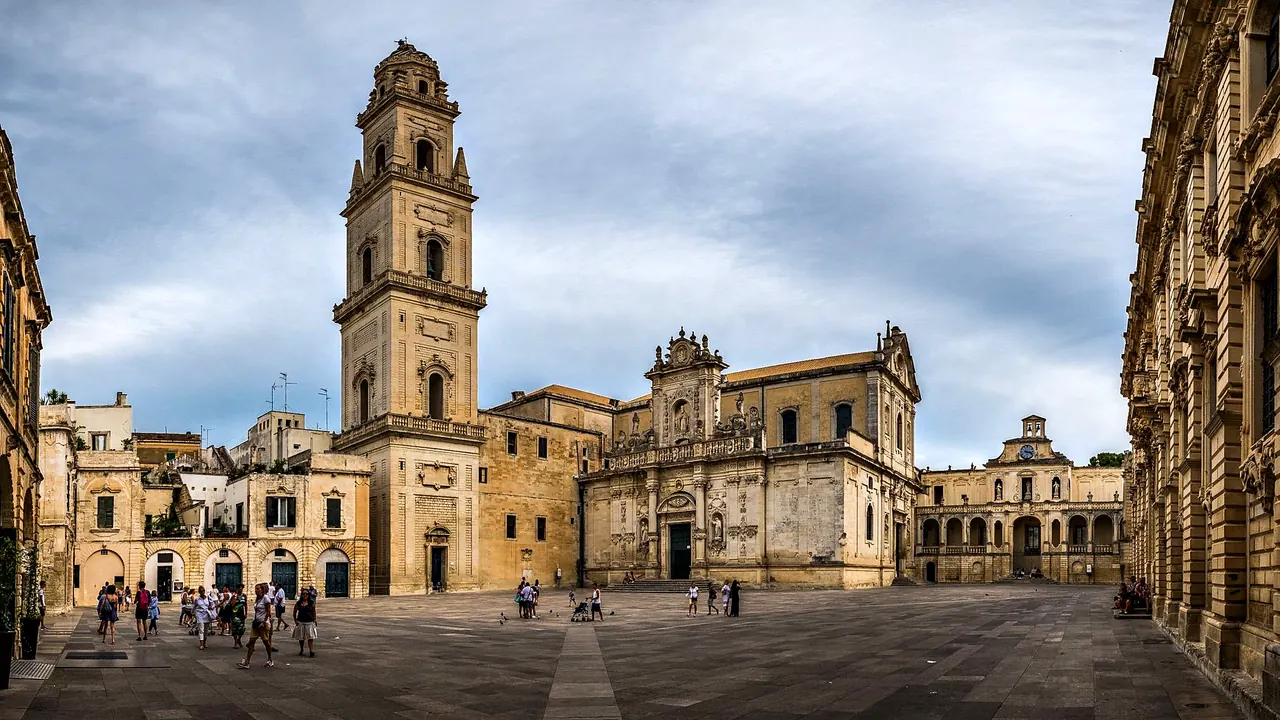
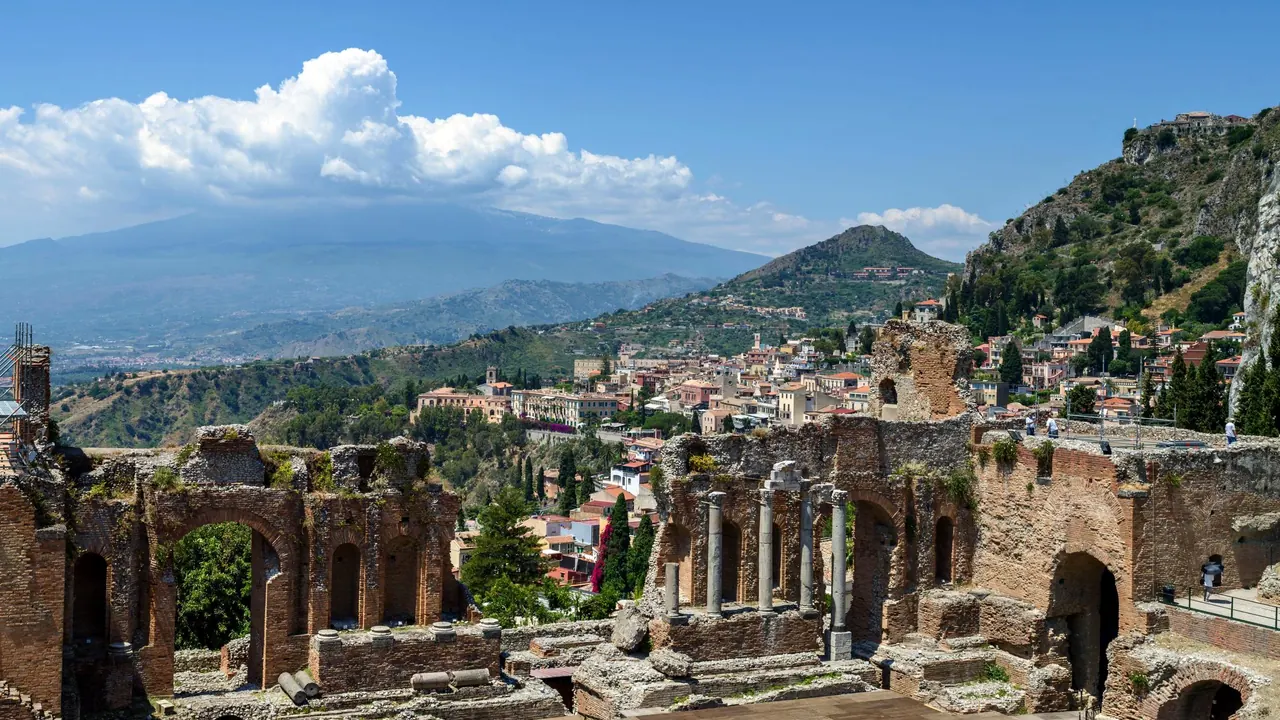
Photos: Lecce by Giuseppe Milo, CC BY 3.0, cropped; Taormina by Reinhard Bruckner, Pexels License.
Lecce or Taormina?
Our verdict in twelve categories, each scored against the same fixed benchmark cities, and the climate month by month, so you can choose for your trip.
Choose Lecce for
- prices
- culture and sights
- nightlife
Lecce suits travellers who want a real city to live in for a week: Baroque streets to wander, cheap and distinctive Apulian food, a student crowd in the wine bars and a long list of Salento towns and beaches within reach by car. It is also the easier and cheaper choice for families and for anyone watching the budget, with sandy, shallow beaches and fairly priced rooms outside August.
Choose Taormina for
- nature and the outdoors
- getting around
- day trips
Taormina is the pick for scenery and the outdoors. From a clifftop town with Etna in view you can walk lava fields, snorkel the marine reserve at Isola Bella and spend days in Syracuse or Catania. It costs far more and offers less to see within the town itself, so it rewards couples who want a beautiful, slow base more than those after sights or nightlife.
Scoreboard
Twelve categories on one fixed scale from 0 to 100. The shaded stretch is the gap between the two.
Your match
Pick a travel style or drag the sliders, and both match scores follow your weighting.
Wins on prices and culture and sights with your weighting.
Wins on nature and the outdoors and getting around with your weighting.
What matters to you?
Category by category
What the scores mean for a trip.
Beaches & swimming
Both make fine summer bases for the sea, but the beaches differ in kind. Lecce is inland, so every beach day means a drive or a seasonal bus, and the reward is sand: the pale coves of Torre dell'Orso on the Adriatic and the long, shallow, very clear shallows of Porto Cesareo and Punta Prosciutto on the Ionian.
Taormina has the sea right below it, reached by cable car or steep paths, but its bays at Mazzarò and Isola Bella are narrow pebble strips with glassy water for snorkelling. For sand you go down to Giardini Naxos or Letojanni.
Food & drink
Lecce has the edge, mainly because its peasant cooking is so particular and so cheap to eat well: pasticciotto and iced almond-milk espresso for breakfast, ciceri e tria and fava purée with chicory at dinner, Negroamaro and Primitivo in the glass. Its weakness is range, with little beyond Apulian food.
Taormina has a finer top tier, refined Sicilian cooking with sea views and some of Italy's most interesting wines from Etna's slopes, plus the granita and brioche ritual. But the main street leans on tourist menus at resort prices, and good everyday eating takes a walk into the side streets or a trip down to Giardini Naxos.
Culture & sights
Lecce offers far more to see. Its entire old town is a Baroque townscape in honey-coloured stone, from the carved facade of Santa Croce to the enclosed Piazza del Duomo, with a Roman amphitheatre half-exposed in the main square and Messapian layers beneath the streets.
Taormina has one sight of world class, the Greek theatre framing Etna and the coast, and an attractive medieval Corso with Arab, Norman and Catalan touches. Beyond that the list is short and there are no major museums, so it suits a day of slow walking rather than a week of sightseeing.
Nightlife
Neither is a nightlife destination, but Lecce is the livelier of the two. Its student population keeps the old-town wine and cocktail bars busy late on weekends for much of the year, and in summer the coast around Gallipoli adds open-air discos.
Taormina's evenings are slower and older: aperitivo in Piazza IX Aprile, piano bars on terraces over the sea and a few beach lounges in summer. Outside the season it goes quiet soon after dinner.
Nature & outdoors
Taormina is much the better choice for the outdoors. Etna gives it craters, lava flows, guided trips towards the summit, vineyards and chestnut woods and even winter skiing, and the basalt gorges of Alcantara are close by. Paths climb to Castelmola and Monte Tauro, and the marine reserve at Isola Bella is good for diving and kayaking.
Around Lecce the land is flat olive country, best for easy cycling. Its outdoors is the coast: the cliffs and sea caves between Roca Vecchia and Otranto, the wetlands of Le Cesine and Alimini and the pine woods of Porto Selvaggio.
Day trips
The Salento and Sicily's east coast both give a week of good outings, though the Sicilian list carries more weight. From Lecce you reach walled Otranto and the great floor mosaic in its cathedral, Gallipoli on its island, the frescoes of Galatina and, further north, white Ostuni and the trulli of Alberobello. Most of these are far easier with a hire car.
Taormina has Syracuse within reach, and Ortigia with the Greek theatre and quarries of Neapolis makes one of the finest days out in Sicily. Lava-stone Catania and the Baroque towns of the Val di Noto add more big names. Closer in, Etna's wine villages and hill towns such as Savoca and Castelmola fill the quieter days.
Good for families
Lecce is the easier place with children. Its old town is flat and mostly free of traffic, the evening piazzas are full of families, and the shallow sandy beaches at Porto Cesareo suit toddlers well.
Taormina welcomes children but makes them work for it, with steps and steep lanes everywhere, pebbly beaches and hotels geared to couples. It suits school-age children who will enjoy Etna and snorkelling, and families with small children often stay down in Giardini Naxos instead.
Getting around
Taormina is the simpler base without a car. The cable car runs to the beaches, local buses reach Castelmola and Giardini Naxos, and the coastal railway and coaches connect it to Catania, the airport, Messina and Syracuse. The catch is the slope: stairways and steep lanes are part of every walk.
Lecce's centre is flat and pleasant on foot, and fast trains run north to Brindisi and Bari, but the rest of the Salento depends on slow local trains and summer-only beach buses, so most visitors end up hiring a car.
Shopping & style
Lecce's best buys come from its workshops, while Taormina's come from one polished street. In Lecce that means cartapesta, the papier-mâché saints and nativity figures made in the old town, along with small limestone carvings and ceramics from nearby Grottaglie. Beyond those there are a few fashion shops and plenty of olive oil and taralli.
Taormina's Corso Umberto has more gloss, with jewellers, coral and cameo dealers, lace, resort wear and painted moor's-head vases, and Bronte pistachio cream and Etna wines to carry home. Much of it is aimed at visitors, and for serious fashion shopping you go down to Catania.
Affordability
Lecce is far kinder to the wallet. Pastries, trattorias and local wine cost little and old-palazzo bed and breakfasts are fairly priced except in August, when the Salento fills up and a hire car adds to the bill.
Taormina is expensive by any Sicilian measure, with grand hotels setting the tone and resort prices on the main street. Staying in Giardini Naxos or Letojanni and coming up in the evening, or visiting in spring or autumn, brings the cost down.
Live music & performing arts
Both are thin outside summer and both come alive in it, in quite different ways. Lecce's distinctive sound is pizzica, the tambourine dance heard at village festivals through the summer and peaking at the huge Notte della Taranta in Melpignano, with a modest year-round season at the Politeama Greco and Teatro Paisiello.
Taormina's draw is the setting: concerts, opera, ballet and international acts staged in the Greek theatre with Etna behind, plus its long-running film festival. Serious winter opera means going to Catania.
Wellness & relaxation
Neither has a bathing culture of its own, so relaxation comes from the southern pace in both. From Lecce, the sulphur springs of Santa Cesarea Terme in cliffside grottoes are under an hour away, and converted masserie in the countryside offer quiet spa retreats.
Taormina's wellness lives in its hotels, with spas and terrace pools above the sea using volcanic mud and citrus. Its calm is seasonal, gentle in May and late September but crowded in August.
When should you go?
Pick your month. The climate figures are measured averages, not a forecast.
Lecce in July
Taormina in July
Daytime high, °C
Rainfall in the month, mm
Where the figures come from
Lecce's temperatures are measured 38 km from the centre, at Brindisi.
Lecce has no rain gauge within 25 km of the centre, so its rainfall comes from a gridded climate dataset read at the city rather than from a gauge further away.
Taormina's temperatures are measured 45 km from the centre, at Messina.
Taormina has no rain gauge within 25 km of the centre, so its rainfall comes from a gridded climate dataset read at the city rather than from a gauge further away.
Temperature and rainfall are climate normals, averaged over the years shown. Lecce: 1991-2020 (sunshine 1981-2010) normals, Brindisi (38 km from centre). Taormina: 1991-2020 normals, Messina (45.1 km from centre).
Both cities have a long swimming season from June into October, with the sea at its warmest around 26°C in August. July and August are hot and very dry in both, around 30°C, which makes midday sightseeing hard and pushes the day towards the beach. For walking Lecce's old town or hiking on Etna, May and late September are the sweet spots, warm, sunny and still mostly dry.
The differences come in the shoulder seasons. Taormina stays a degree or two milder through winter and its sea holds its warmth longer, still about 20°C in November, while Lecce's water has cooled noticeably by then. Both turn wet from October, with Taormina's heaviest rain arriving in October and Lecce's peaking in November at about 102mm, so neither is at its best in late autumn or winter.
Which traveller are you?
On a trip on a tight budget, Lecce is the clear choice. Pastries, osterie and local wine cost little, and rooms in old palazzi are fairly priced most of the year, whereas Taormina is the costliest base in eastern Sicily.
For a culture and arts trip, Lecce wins. Its whole old town is a Baroque showpiece of carved limestone churches, Roman remains and underground layers, while Taormina's Greek theatre is unforgettable but the rest of the town is seen in a day.
On an outdoors trip, Taormina is far stronger. Etna's craters, lava flows and winter slopes are about an hour away, the Alcantara gorges are closer, and there are coastal hill paths and diving at Isola Bella, against Lecce's flat plain of olive groves.
Before you go
| Measure | Lecce | Taormina |
|---|---|---|
| Official language | Italian | Italian |
| Currency | Euro (EUR) | Euro (EUR) |
| Sockets | CFL230 V, 50 Hz | CFL230 V, 50 Hz |
| Driving side | Right | Right |
| Time zone | UTC+1, UTC+2 in summer | UTC+1, UTC+2 in summer |
| Emergency number | 112 | 112 |
| Elevation | 49 m | 204 m |
| Main airport | Brindisi Airport (BDS)39 km from centre49 non-stop destinations | Catania-Fontanarossa Airport (CTA)47 km from centre96 non-stop destinations |
| Public holidays this year | 13 days | 13 days |
By the numbers
| Measure | Lecce | Taormina |
|---|---|---|
| City population | 94,783 | 10,471 |
| People per km² | 393 | 799 |
| Museums within 10 km | 11 | 5 |
| UNESCO World Heritage sites within 50 km | 0 | 2 |
| Swim season, months above 21 °C | 4 months | 5 months |
Where else could you go?
Every comparison below shares a destination with this one, so you can follow Lecce or Taormina somewhere new.
- Cataniavs Taormina
- Syracuse, Sicilyvs Taormina
- Materavs Lecce
- Barivs Lecce
- Palermovs Taormina
- Tiranavs Lecce