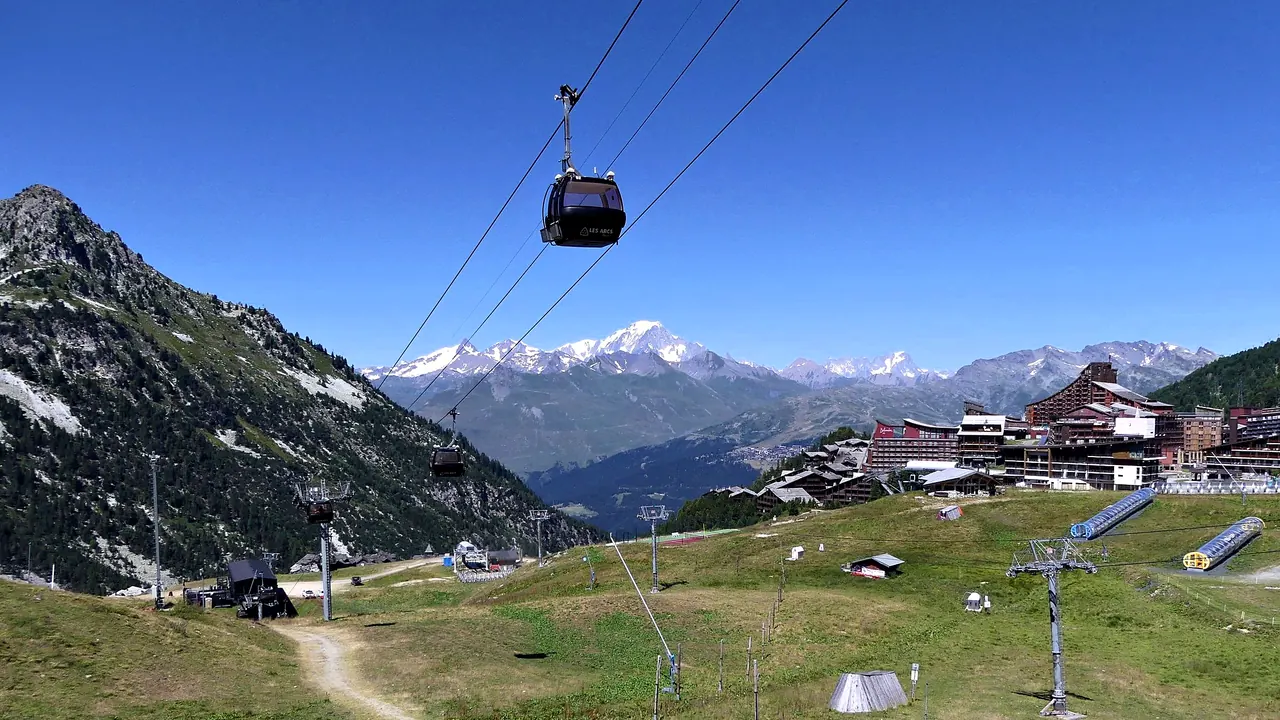
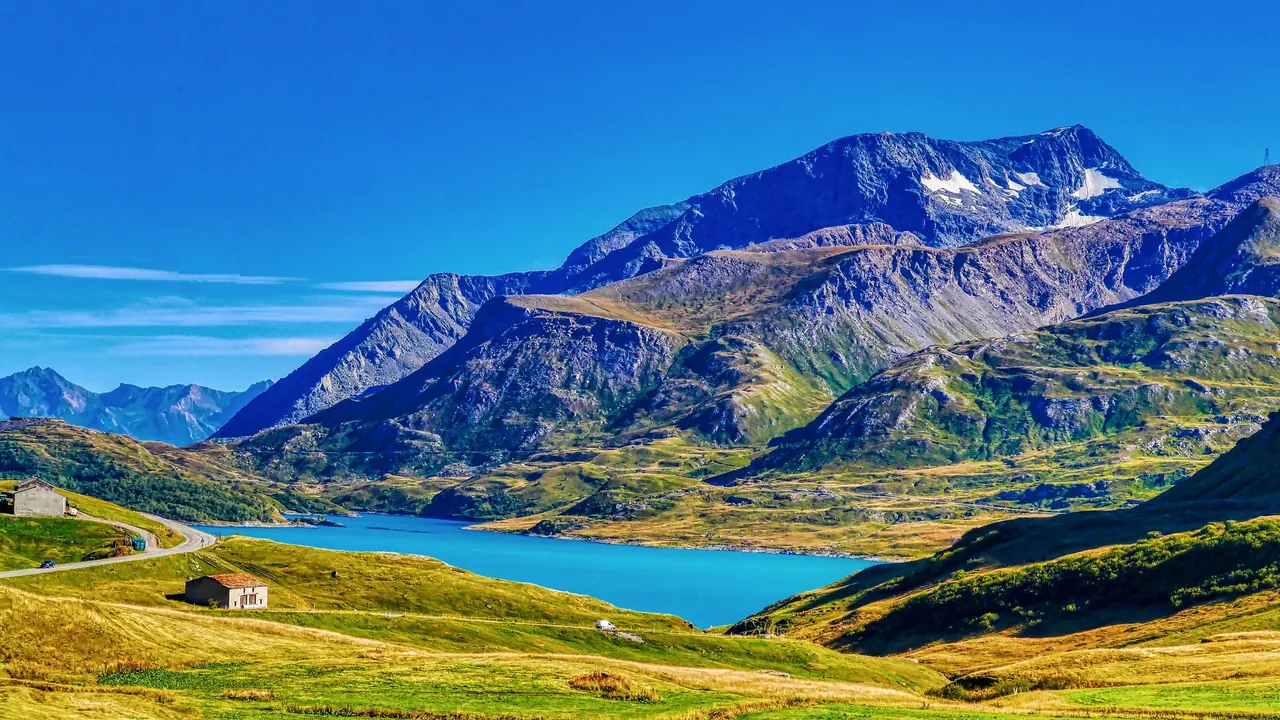
Photos: Les Arcs by Florian Pépellin, CC BY-SA 4.0, cropped; Val Cenis by Zairon, CC BY-SA 4.0, cropped.
Les Arcs or Val Cenis?
Our verdict in twelve categories, each scored against the same fixed benchmark cities, and the climate month by month, so you can choose for your trip.
Choose Les Arcs for
- getting around
- live music and the arts
- nightlife
Les Arcs is the better pick for a full-scale ski week. Its slopes join La Plagne's in one of the biggest linked areas in the Alps, the car-free villages have apartments that open straight onto the snow, and there are more restaurants and more après-ski. You can also come by train and take the funicular up from Bourg-Saint-Maurice, which saves a mountain drive in winter. The trade-off is cost: this is the more expensive of the two, especially in the busiest weeks.
Choose Val Cenis for
- prices
- day trips
- culture and sights
Val Cenis suits travellers who would rather pay less and have quieter evenings. It is a string of old stone villages beside the Vanoise National Park. Its gentle slopes and very long easy run are good for nervous skiers, and in summer its lower valley is milder for hiking and cycling. On fine summer days you can drive over the pass into Italy. You will want a car, and you should expect to be in bed early.
Scoreboard
Twelve categories on one fixed scale from 0 to 100. The shaded stretch is the gap between the two.
Your match
Pick a travel style or drag the sliders, and both match scores follow your weighting.
Wins on getting around and live music and the arts with your weighting.
Wins on prices and day trips with your weighting.
What matters to you?
Category by category
What the scores mean for a trip.
Beaches & swimming
Neither resort has a beach, and both are hours from the sea. To swim in a natural lake from Les Arcs, you need to drive about two hours to Annecy or the Lac du Bourget. Val Cenis has the lake on the Mont Cenis pass close by, but it is a cold reservoir at nearly 2,000m, better for walking round than swimming. In both places a heated pool is the realistic way to swim.
Food & drink
Les Arcs gives you more choice at mealtimes. There are long lunches on sunny terraces in old farm buildings turned into mountain huts, a few kitchens cooking refined alpine dishes, and Beaufort cheese from the surrounding valleys on almost every menu.
Val Cenis serves the same Savoyard staples in fewer places, and many of them close between seasons. It has no fine dining. Its own treat is Bleu de Termignon, a rare blue cheese made on the summer alpine farms, which is worth buying direct from local cheese shops and farms.
Culture & sights
There is little sightseeing in either resort, but the two offer very different kinds. Les Arcs is itself the attraction: modernist resort architecture from the late 1960s, shaped by Charlotte Perriand, which mostly appeals to design enthusiasts.
Val Cenis has older heritage. Its villages keep stone houses with lauze roofs and baroque churches. The highlights are the sixteenth-century frescoes in the chapel of Saint-Sébastien at Lanslevillard and the carved altarpiece at Termignon.
Nightlife
Les Arcs has the livelier evenings. Terrace bars at the foot of the slopes fill as the lifts close, and Arc 1800 and Arc 2000 have DJs and table-dancing, with a late bar or two and a small club in Arc 1800. In Val Cenis, après-ski means a few bars in Lanslebourg and Lanslevillard, and most nights end after dinner.
Nature & outdoors
Both are serious mountain destinations, but they are different kinds of place. Les Arcs is the bigger ski resort. A double-decker cable car links it to La Plagne, it has long runs from the Aiguille Rouge at over 3,200m, and the off-piste is good. In summer it adds a bike park, rafting on the Isère and paragliding.
Val Cenis is a gentler, wilder valley. Its ski area tops out at about 2,800m, with a very long easy run that beginners love. In summer you can hike hut to hut in France's oldest national park, the Vanoise, and ride the Iseran and Mont Cenis road climbs, which are classics of Alpine cycling.
Day trips
Both resorts look to Italy in summer, when the passes are open, and both lose options in winter. From Les Arcs the Little St Bernard Pass leads to Aosta and Courmayeur, and Annecy and Chambéry are about two hours away by road.
Val Cenis has the slightly better range. Susa's Roman arch is under an hour away, the Sacra di San Michele is a little further, and Turin is reachable through the Fréjus tunnel. On the French side, Bessans' painted chapels and the Esseillon forts are close by.
Good for families
Les Arcs was planned for ski weeks with children, and it shows. The villages are mostly car-free, the apartments open onto the snow, and there are kindergartens and themed fun slopes. Skating, sledging and pools fill the afternoons.
Val Cenis works for families who want quiet more than facilities. Its villages are small, safe and uncrowded, and the long easy run gives children confidence. There is less to do off the slopes, and with toddlers the mountain roads take some planning.
Getting around
Les Arcs is much easier without a car. Long-distance trains stop at Bourg-Saint-Maurice, a funicular takes a few minutes to climb to Arc 1600, and free shuttles link the villages, though these are far apart and slow down in snow.
The nearest station to Val Cenis is at Modane, about half an hour down the valley. Buses run only in season, and outside winter almost everyone drives.
Shopping & style
Neither resort is a place to shop. Les Arcs has a little more, with outdoor clothing shops and a few gift shops, and Bourg-Saint-Maurice below for Beaufort, charcuterie and génépi. In Val Cenis it comes down to ski hire, small grocers, and local cheese and honey.
Affordability
Val Cenis costs clearly less. Its lift passes and lodging are cheaper than those of the big high-altitude resorts, and hiking in the national park is free.
A winter week in Les Arcs costs more: the pass for a large linked area, ski school and meals on the slopes all add up, and prices peak in the French school vacation weeks. In both resorts, self-catering and coming in summer bring the cost down.
Live music & performing arts
Les Arcs has one real draw. A classical music festival, held since the 1970s, brings chamber concerts and a music academy to its halls and chapels for a few weeks each July. Val Cenis has nothing to match it, only village festivals, the odd church concert in summer and resort entertainment in the ski season.
Wellness & relaxation
Both resorts are about rest after a day outdoors rather than spa culture. Les Arcs has more facilities: many residences have a pool, sauna or hammam, and the old thermal spas of Brides-les-Bains are about an hour down the valley.
Val Cenis has a few hotel spas, but it is quieter overall, with little traffic and early nights, even in winter.
When should you go?
Pick your month. The climate figures are measured averages, not a forecast.
Les Arcs in July
Val Cenis in July
Daytime high, °C
Rainfall in the month, mm
Where the figures come from
Les Arcs's temperatures are measured 43 km from the centre, at Grand St. Bernard / Grand Saint Bernard.
Les Arcs's station stands 199 m above the city centre, so the centre is likely a little warmer than the figures say.
Les Arcs has no rain gauge within 25 km of the centre, so its rainfall comes from a gridded climate dataset read at the destination rather than from a gauge further away.
Val Cenis has no weather station within reach, so its figures come from a gridded climate model rather than a measured record, and read a broad area rather than one spot.
Temperature and rainfall are climate normals, averaged over the years shown. Les Arcs: 1991-2020 normals, Grand St. Bernard / Grand Saint Bernard (43.4 km from centre). Val Cenis: 2001-2020 normals, NASA POWER reanalysis grid, no weather station within 90 km.
Both resorts are at their best in midwinter for snow. Daytime highs sit around -4°C in January in both places, and either one is cold enough for reliable skiing through the heart of the season. The difference shows in spring and summer. Les Arcs is high and cold, and even in July the high is only about 12°C. It is also much wetter, with heavy falls in late autumn that peak at around 193mm in November. On the plus side, it gets its most sunshine in June to August, so those are the clearest months for walking and biking.
Val Cenis warms sooner and more fully. April is already above freezing, and July reaches about 18°C, which makes June to September comfortable for hiking. It also gets roughly half the rain of Les Arcs in most months, with the wettest spell in May. May, October and November are quiet in-between months in both resorts.
Which traveller are you?
On a family trip with young children, Les Arcs is the easier choice. The resort was designed around family ski weeks, so the hard parts, getting kit to the snow and keeping children busy once their legs give out, are already taken care of. Val Cenis asks more planning of parents.
For a trip on a tight budget, Val Cenis is the sensible choice. You give up the giant linked ski area, but few beginners or intermediates would cover it in a week anyway, and a summer stay needs little more than walking boots.
For a food and nightlife trip, choose Les Arcs. Because it is the bigger resort, there is more choice at lunch and late at night, and its après-ski has a real party side. Val Cenis is made for early nights, so evenings there end soon after dinner.
Before you go
| Measure | Les Arcs | Val Cenis |
|---|---|---|
| Official language | French | French |
| Currency | Euro (EUR) | Euro (EUR) |
| Sockets | CE230 V, 50 Hz | CE230 V, 50 Hz |
| Driving side | Right | Right |
| Time zone | UTC+1, UTC+2 in summer | UTC+1, UTC+2 in summer |
| Emergency number | 112 | 112 |
| Elevation | 2,273 m | 1,752 m |
| Main airport | Geneva International Airport (GVA)92 km from centre150 non-stop destinations | Turin Airport (TRN)59 km from centre65 non-stop destinations |
| Public holidays this year | 11 days | 11 days |
By the numbers
| Measure | Les Arcs | Val Cenis |
|---|---|---|
| Museums within 10 km | 0 | 0 |
| UNESCO World Heritage sites within 50 km | 0 | 1 |
Where else could you go?
Every comparison below shares a destination with this one, so you can follow Les Arcs or Val Cenis somewhere new.
- La Rosièrevs Les Arcs
- La Plagnevs Les Arcs
- Tignesvs Les Arcs
- Val d'Isèrevs Les Arcs
- Val d'Isèrevs Val Cenis
- Tignesvs Val Cenis