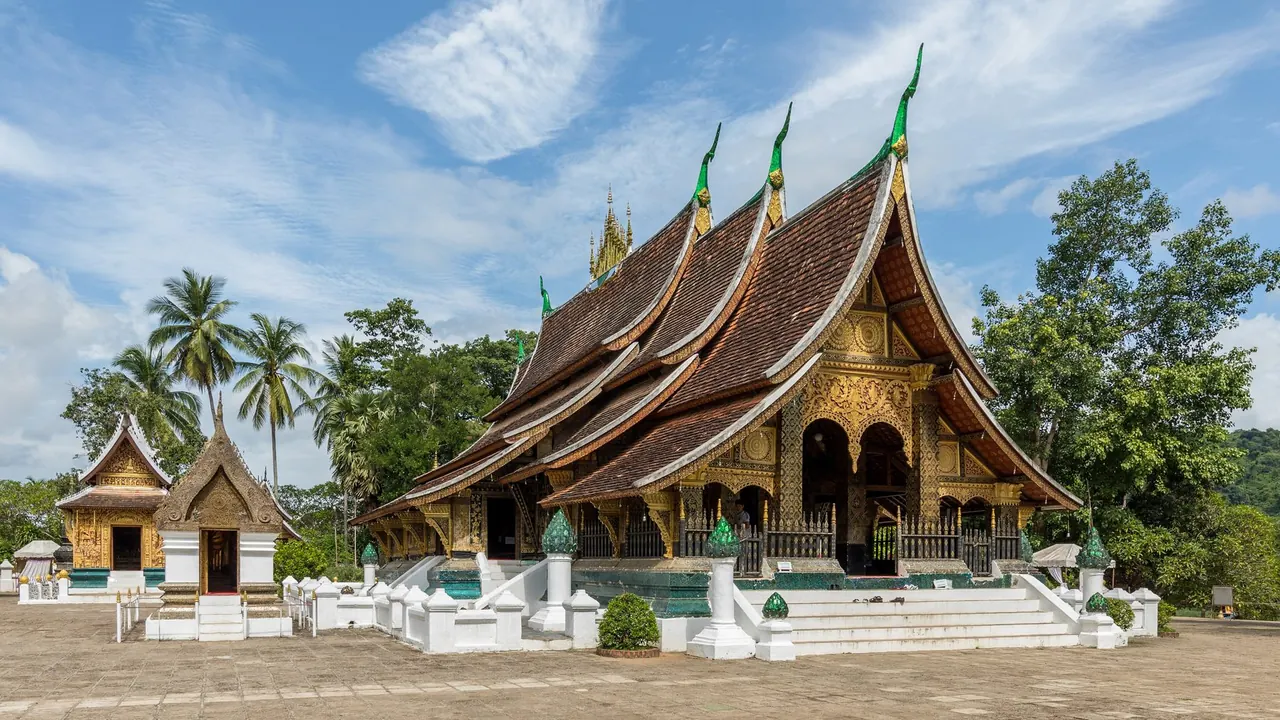
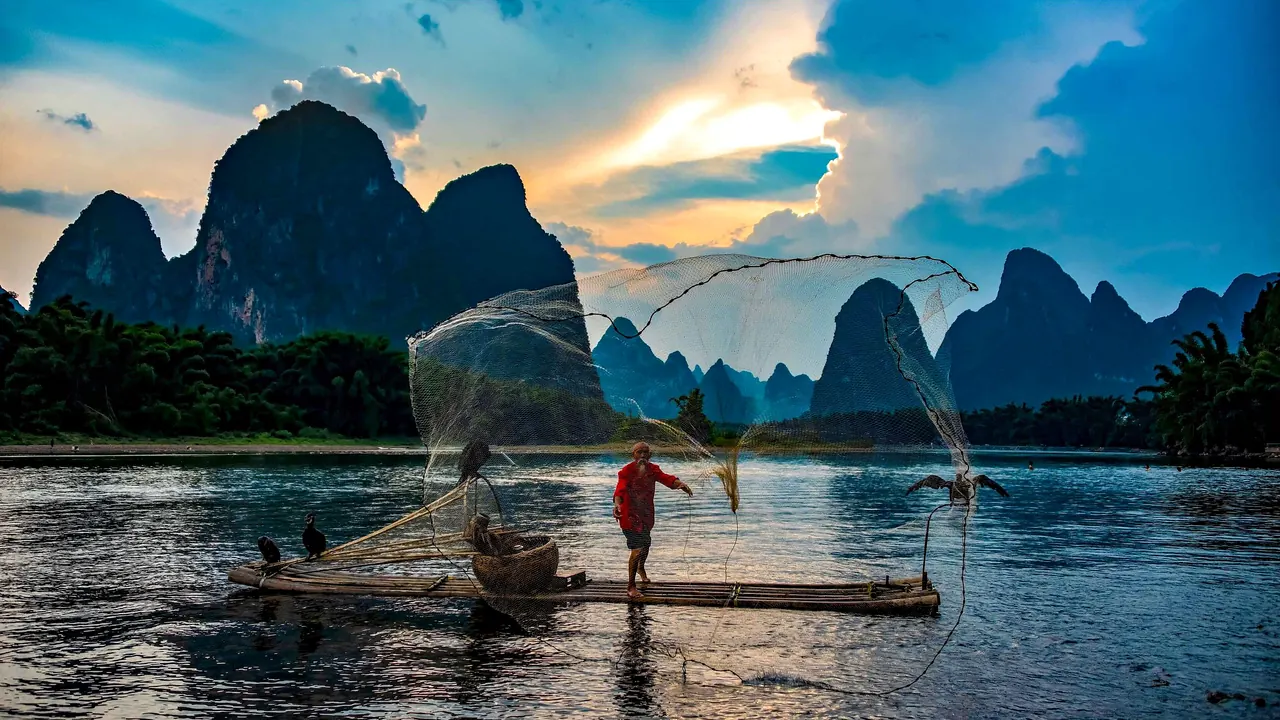
Photos: Luang Prabang by Basile Morin, CC BY-SA 4.0, cropped; Yangshuo by Rod Waddington from Kergunyah, Australia, CC BY-SA 2.0, cropped.
Luang Prabang or Yangshuo?
Our verdict in twelve categories, each scored against the same fixed benchmark cities, and the climate month by month, so you can choose for your trip.
Choose Luang Prabang for
- culture and sights
- getting around
- shopping
Luang Prabang is for the traveller who wants a whole town to be the attraction. Monasteries, colonial shophouses and the dawn alms round sit together on one flat peninsula you can cover on foot or by bicycle, the pace is slow and the evenings end early. It suits a calm, culture-led stay with good Lao food, massages and sunsets over the Mekong, and it asks little effort to get around.
Choose Yangshuo for
- nightlife
- nature and the outdoors
- day trips
Pick Yangshuo if the landscape matters more than the town. The karst peaks begin at the edge of the streets, and the days fill with rafting the Yulong, walking the Li, cycling between villages and some of Asia's best rock climbing. There is little heritage to see, but there is a loud night out on West Street for anyone who wants one, and active families will find more to do here.
Scoreboard
Twelve categories on one fixed scale from 0 to 100. The shaded stretch is the gap between the two.
Your match
Pick a travel style or drag the sliders, and both match scores follow your weighting.
Too close to call, 2 points apart
Wins on culture and sights and getting around with your weighting.
Wins on nightlife and nature and the outdoors with your weighting.
What matters to you?
Category by category
What the scores mean for a trip.
Beaches & swimming
Neither place has a beach, and you swim in both in very different ways. In Luang Prabang the rivers are too fast and muddy to swim in, so a dip means a half-day trip to the turquoise forest pools below Kuang Si or Tad Sae.
In Yangshuo the river itself is the swimming spot. In the hot months people wade in from the gravel banks and weirs of the Yulong at the end of a raft or bike ride. It is more casual, but the setting is less striking.
Food & drink
Luang Prabang has the more rewarding table, though not by a wide margin. It has its own dishes, such as peppery or lam, smoky jeow bong and crisp river-weed kaipen, along with a morning market and a French legacy of baguettes, bakeries and strong highland coffee.
Yangshuo's food comes down to a few regional favourites: beer fish, stuffed snails and vegetables, and rice noodles for breakfast. You eat better in the side streets and villages than on West Street, and there is no coffee culture to match the Lao one. In both places the menus start to repeat within a few days.
Culture & sights
There is a big gap here. Luang Prabang is a heritage town in its own right. More than thirty monasteries stand on its peninsula, led by Wat Xieng Thong and its glass-mosaic Tree of Life, and the town is still a working religious centre where monks collect alms at dawn.
Yangshuo offers a stone Ming bridge, an ancient banyan tree and some old brick villages along the Yulong, but its centre has been rebuilt and it has no museums of note. Anyone who comes for heritage will find more in the old towns nearby than in Yangshuo itself.
Nightlife
Yangshuo is the place for a night out. After dark, West Street fills with loud bars, dancers on stage and crowds of domestic tourists, and it stays busy well past midnight. Quieter backpacker bars sit just off the main strip.
Luang Prabang has a few garden bars and riverside terraces, but the town curfew closes them around midnight, and after that the streets go dark and quiet. It suits a drink at sunset, not a late night.
Nature & outdoors
Both places are surrounded by fine country, but Yangshuo's scenery is the more famous and more dramatic. Its limestone peaks rise straight out of the rice fields at the edge of town. The walk along the Li between Yangdi and Xingping and the views from Moon Hill and Laozhai Hill are classics, and the rock climbing draws people from around the world.
Luang Prabang's setting is gentler: green hills, the Mekong sliding past limestone cliffs, the tiered falls at Kuang Si and treks to Hmong and Khmu villages. It is lovely, but you go for a mix of town and nature rather than for the landscape alone.
Day trips
Yangshuo has the longer list of outings. The old quarters of Xingping, Fuli and Daxu are all close by, Huangyao has well-preserved Ming and Qing streets, and Guilin is about an hour away.
From Luang Prabang the classic trip is the boat ride to the Buddha-filled Pak Ou caves, along with the weaving villages nearby. The train puts Vang Vieng and Vientiane within reach, but beyond them the area is mostly countryside rather than other towns to explore.
Good for families
Yangshuo has more for active children. There are gentle bamboo rafts, show caves with mud pools and easy village rides on tandems, and Chinese families travel here in such numbers that children are welcome everywhere. Busy roads and the noise of West Street at night are the drawbacks.
Luang Prabang's big hit is Kuang Si, with its rescued bears and swimming pools, plus the long-tail boat rides. After that, most of the sights are temples, and with limited medical care the town is better for older children than toddlers.
Getting around
Luang Prabang is much easier to get around. Nearly everything in the old town is a short, flat walk or bike ride away, and the traffic is light. You only need a tuk-tuk or boat for the waterfalls and caves.
In Yangshuo the centre is small, but the things you came for are out in the countryside. That means hiring a bicycle, a scooter or a driver, dealing with coach traffic and signs mostly in Chinese, and making a separate drive to the high-speed rail station.
Shopping & style
Luang Prabang is better for shopping, mainly because of its textiles. The nightly market on the main street sells silk, Hmong embroidery and paper lanterns. In the weaving studios in town and in the nearby villages you can watch natural dyeing and buy cloth of real quality.
Yangshuo's stalls are mostly mass-produced souvenirs. The worthwhile buys are the hand-painted fans from the workshops in Fuli, local tea and osmanthus treats.
Affordability
Both are cheap places to stay, but costs creep up in different ways. In Luang Prabang, a guesthouse, market food and a bicycle cost little, and the bill only climbs if you choose a restored colonial hotel, wine by the river or a private driver.
In Yangshuo, daily living is just as cheap, but the river cruises, rafts, cave entries and the big night show all charge tourist prices. Room rates also jump sharply during Golden Week and the Spring Festival.
Live music & performing arts
Neither place has much to offer, but Yangshuo has the bigger evening out: the outdoor Li River show staged by Zhang Yimou, with hundreds of performers lit on the water against the floodlit peaks. Beyond that, there are staged dance shows for tour groups and cover bands.
Luang Prabang's main performance is smaller and more traditional: the masked Phralak Phralam, the Lao Ramayana, danced at the theatre in the Royal Palace grounds. A few folk evenings and the temple drums at dusk make up the rest.
Wellness & relaxation
Luang Prabang is restful wherever you stay. There is no high-rise and little traffic, and the days run from the dawn alms round to sunset over the Mekong. Gentle Lao massage, lemongrass-scented herbal steam rooms and riverside yoga in boutique hotels fit naturally into that pace.
Yangshuo can be just as peaceful, but only out in the Yulong valley or the villages towards Xingping, where tai chi classes and a cave mud pool add to quiet terraces. Stay in the town centre and the noise carries late into the night.
When should you go?
Pick your month. The climate figures are measured averages, not a forecast.
Luang Prabang in July
Yangshuo in July
Daytime high, °C
Rainfall in the month, mm
Where the figures come from
Yangshuo's temperatures are measured 64 km from the centre, at Guilin.
Yangshuo has no rain gauge within 25 km of the centre, so its rainfall comes from a gridded climate dataset read at the city rather than from a gauge further away.
Temperature and rainfall are climate normals, averaged over the years shown. Luang Prabang: 1991-2020 normals, Luang-Prabang (0.8 km from centre). Yangshuo: 1991-2020 normals, Guilin (64.4 km from centre).
Luang Prabang is at its best from November to January, when the rain almost stops, skies are clear and highs of 28 to 30°C are warm but easy for walking the old town. February stays dry but heats up quickly, and from March to May it is hot, reaching 36°C in April, while haze from field burning often dulls the hills. The monsoon runs from May to September and is heaviest in August, with fewer sunny hours. In return, the countryside is at its greenest and the waterfalls are full.
Yangshuo has a real winter. January highs are around 12°C, damp and grey, just when Luang Prabang is at its most pleasant. April brings mild days and misty green fields. May and June are the wettest months, with 326mm in June, and July and August are hot and humid. October and November are dry and comfortable for cycling and climbing. That late-autumn window is the one time of year when both places are good to visit.
Which traveller are you?
For a culture and arts trip, Luang Prabang is the clear choice. The entire old town is a World Heritage Site of working monasteries and colonial houses. Yangshuo's centre has been largely rebuilt, and the scenery is the reason people go there.
On an outdoors trip, Yangshuo wins. Karst peaks, rice fields and two rivers start right outside your guesthouse, and you can raft, cycle, kayak, go caving or climb hundreds of bolted limestone routes. Luang Prabang's waterfalls and village treks are lovely but tamer.
For a relaxing and wellness trip, Luang Prabang suits better. The whole town is quiet, with little traffic, gentle Lao massage, herbal steam saunas and early nights. In Yangshuo, rest means staying out in the villages and keeping well away from noisy West Street.
Before you go
| Measure | Luang Prabang | Yangshuo |
|---|---|---|
| Official language | Lao | Putonghua |
| Currency | Lao Kip (LAK) | Yuan Renminbi (CNY) |
| Sockets | ABCEF230 V, 50 Hz | ACI220 V, 50 Hz |
| Driving side | Right | Right |
| Time zone | UTC+7 | UTC+8 |
| Emergency number | Police 191, ambulance 195, fire 190 | Police 110, ambulance 120, fire 119 |
| Elevation | 305 m | 118 m |
| Main airport | Luang Phabang International Airport (LPQ)4 km from centre7 non-stop destinations | Guilin Liangjiang International Airport (KWL)67 km from centre43 non-stop destinations |
| Public holidays this year | - | 6 days |
By the numbers
| Measure | Luang Prabang | Yangshuo |
|---|---|---|
| City population | 53,792 | 273,124 |
| People per km² | - | 190 |
| Museums within 10 km | 0 | 0 |
| UNESCO World Heritage sites within 50 km | 1 | 1 |
Where else could you go?
Every comparison below shares a destination with this one, so you can follow Luang Prabang or Yangshuo somewhere new.
- Guilinvs Yangshuo
- Vientianevs Luang Prabang
- Chiang Raivs Luang Prabang
- Sapavs Luang Prabang
- Guangzhouvs Yangshuo
- Chiang Maivs Luang Prabang