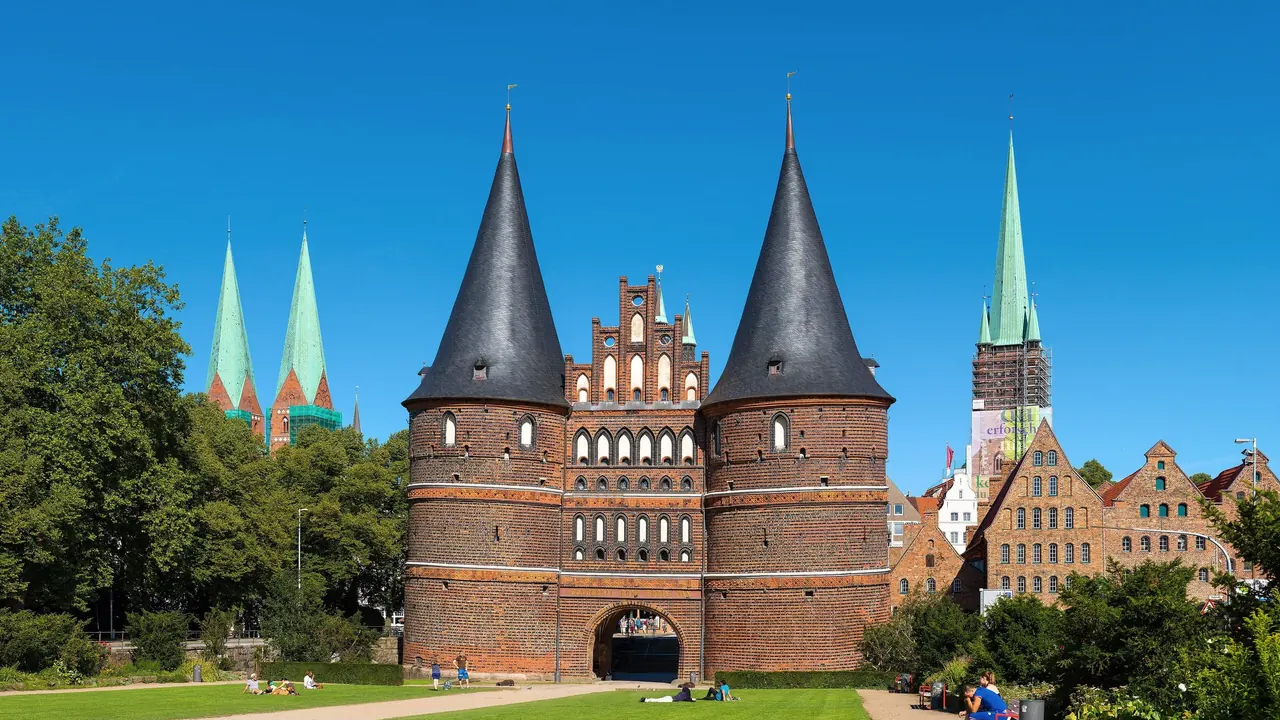
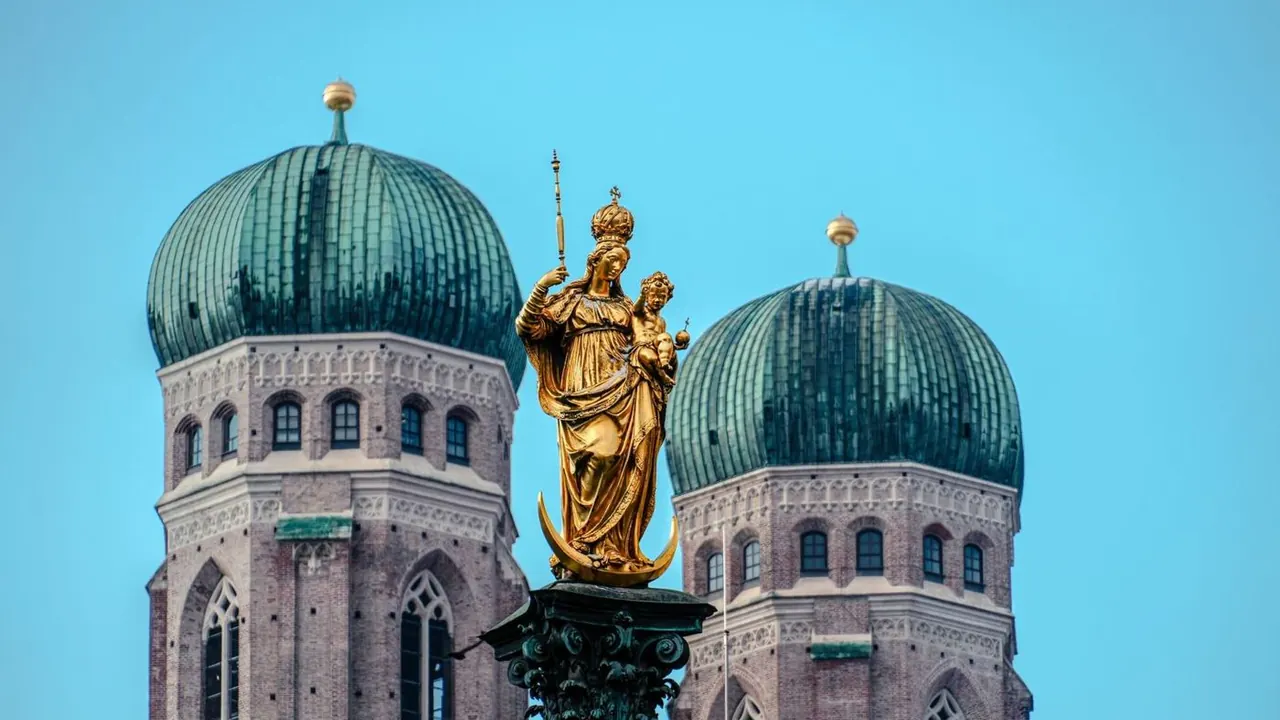
Photos: Lubeck by Christian Wolf (www.c-w-design.de), CC BY-SA 3.0 DE, cropped; Munich by 0xd1ma, Pexels License.
Lubeck or Munich?
Our verdict in twelve categories, each scored against the same fixed benchmark cities, and the climate month by month, so you can choose for your trip.
Choose Lubeck for
- prices
- beaches
Lübeck suits a slower, smaller trip: two days in an intact Hanseatic old town of brick churches, gabled merchants' houses and courtyards, then a few summer afternoons on the sand at Travemünde. It is also the cheaper of the two to stay in. It works best for travellers who want quiet evenings, a town they can cover on foot, and the Baltic close at hand, and who are happy to go to Hamburg for anything bigger.
Choose Munich for
- live music and the arts
- nature and the outdoors
- shopping
Munich is the stronger choice for almost everything else. It has world-class opera and painting, beer gardens, a proper night out, the Alps an hour away and a long list of day trips from Salzburg to Neuschwanstein. Pick it for a fuller city trip with more to fill each day, and expect to pay noticeably more for your room.
Scoreboard
Twelve categories on one fixed scale from 0 to 100. The shaded stretch is the gap between the two.
Your match
Pick a travel style or drag the sliders, and both match scores follow your weighting.
Wins on prices and beaches with your weighting.
Wins on live music and the arts and nature and the outdoors with your weighting.
What matters to you?
Category by category
What the scores mean for a trip.
Beaches & swimming
Lübeck has the real seaside. Travemünde, part of the city, has a long sandy beach with hooded wicker chairs, and the Bay of Lübeck resorts are within half an hour, all on a calm, shallow Baltic with no tides. The drawback is the cool water and a short season.
Munich has no coast. Its swimming happens on the Isar's gravel banks at the Flaucher and at Starnberger See and the Ammersee, which are under an hour away by S-Bahn. The lakes are slightly warmer at their peak, but a lawn and a jetty are not a beach. Neither city is worth booking for the water.
Food & drink
In Lübeck, eating centres on a few specialities: marzipan from the old confectioners near the town hall, smoked and pickled herring, harbour fish sandwiches, and Rotspon wine aged in the city's cellars. You can eat under ship models at the old captains' guild house, but beyond that the choice is provincial.
Munich offers more to eat and more ways to eat it. There are vast brewery beer halls, chestnut-shaded beer gardens where you may bring your own picnic, white sausage and pretzels in the morning, and the Viktualienmarkt for snacks. It also has a tier of starred restaurants that Lübeck does not match.
Culture & sights
Lübeck's strength is the town itself. Almost the whole island old town is UNESCO-listed, with the Holstentor, the Marienkirche as the model for northern brick Gothic, and stepped gables and passageways that largely survived intact. The European Hansemuseum and the Buddenbrookhaus round it out, and two days covers it well.
Munich goes deeper, through its collections. The Kunstareal's Pinakotheks, the Glyptothek and the Lenbachhaus, the Residenz, Nymphenburg and the Deutsches Museum could fill a week. Its old town is handsome but was largely rebuilt after the war.
Nightlife
Lübeck goes quiet early. There are pubs and wine bars around the Obertrave and the cathedral, and Travemünde's promenade gets livelier on summer nights, but most of the town is asleep by midnight. For a big night out, locals take the train to Hamburg.
Munich gives you far more choice after dark. Evenings often start in a beer hall, the Glockenbachviertel and Gärtnerplatz have a dense run of cocktail and gay bars, and a few serious techno clubs stay open until morning at weekends. During Oktoberfest the whole city becomes one long party.
Nature & outdoors
Around Lübeck the countryside is gentle: canoeing on the Wakenitz through reeds, the clay cliff walk at the Brodtener Steilufer, the lakes of Holstein Switzerland, and easy cycling along the coast and the old border strip. It is pleasant, but there are no hills to speak of.
Munich has the mountains. The Alps rise on the southern skyline, and trains reach the Wetterstein, the Zugspitze and Tegernsee for summer hiking and winter skiing. In town, the English Garden and the surfers on the Eisbach standing wave bring the outdoors right into the centre.
Day trips
From Lübeck, Hamburg is the obvious day out at 45 minutes by train. Wismar and Schwerin's island castle are about an hour away, and Ratzeburg, Mölln and Eutin are closer still. After those, the choice thins out quickly.
Munich's list is longer and takes in more countries. Augsburg, Nuremberg and Regensburg are all within easy reach by train, Salzburg and Innsbruck lie across the Austrian border, and Neuschwanstein and Herrenchiemsee are classic castle trips. You could fill a fortnight without repeating yourself.
Good for families
Lübeck works well for families mainly in summer. Travemünde's shallow, calm water suits toddlers, the bay resorts have playgrounds and an aquarium, and Hansa-Park is half an hour up the shore. Out of season there is much less aimed at children.
Munich keeps children busy all year. There is the Hellabrunn zoo along the Isar, the hands-on galleries of the Deutsches Museum, the transport museum and the Sea Life aquarium, and beer gardens with their own playgrounds. Legoland is within driving range for a bigger day out.
Getting around
Lübeck's strength is its size. The old town is a walkable island about 2km long, with the station just across the river from the Holstentor, and a regional train reaches the beach at Travemünde in about twenty minutes. Buses fill the gaps, though the lakes and small coastal villages are easier to reach with a car.
Munich's transport reaches much further. One integrated network of U-Bahn, S-Bahn, trams and buses links the museums, Nymphenburg, the Olympic Park, the airport and the lakes, and regional trains cover most day trips, so most visitors can manage without a car. The flat riverside routes suit cycling, and the main irritation is delays on the central S-Bahn line.
Shopping & style
Lübeck's shopping is modest: chain stores along Breite Strasse and Königstrasse, small galleries and craft shops tucked around Hüxstrasse and Fleischhauerstrasse, and boxes of marzipan to take home. For fashion, people head to Hamburg.
Munich has much more on offer. Luxury houses line Maximilianstrasse and the Theatinerstrasse arcades, department stores fill the pedestrian axis, and Glockenbach and Schwabing have independent boutiques. It also has a souvenir all its own in Tracht: dirndls and lederhosen from specialist tailors.
Affordability
Lübeck is the easier city on the wallet. It has a good spread of moderately priced hotels and guesthouses, reasonable taverns and fish kiosks, and cheap trains to the coast. The exception is a beach stay at Travemünde in July and August, which costs more and books up early.
Munich is Germany's most expensive city, and you feel it most in the price of a room, especially during Oktoberfest and the big trade fairs. Beer-hall food, a picnic in a beer garden, the free parks and lakes, and the token Sunday museum fees soften the bill a little.
Live music & performing arts
Lübeck's musical life is modest but has real character. There is opera and drama at the Art Nouveau Theater Lübeck, organ concerts at the Marienkirche, where Buxtehude once played, and the Schleswig-Holstein Music Festival in summer. Live rock and jazz are thin on the ground.
Munich ranks among Europe's music capitals. The Bavarian State Opera plays at the National Theatre, three orchestras of real standing perform in halls such as the Herkulessaal, and the gilded Cuvilliés Theatre stages chamber opera. There is a respected jazz scene as well, and big touring acts play at the Olympic Park.
Wellness & relaxation
Lübeck's idea of relaxing is seaside air: Travemünde has been a spa resort since the early nineteenth century, there are wellness hotels along the bay and an indoor seawater pool complex at Scharbeutz. The old town's quiet courtyards and riverside benches do the rest.
Munich has a real bathing culture. The Art Nouveau Müller'sches Volksbad has a Roman-style steam bath, the city's public saunas are textile-free in the German manner, and Erding's huge thermal complex is about forty minutes away. The old spa towns of Bad Tölz and Bad Reichenhall lie towards the Alps.
When should you go?
Pick your month. The climate figures are measured averages, not a forecast.
Lubeck in July
Munich in July
Daytime high, °C
Rainfall in the month, mm
Temperature and rainfall are climate normals, averaged over the years shown. Lubeck: 1991-2020 normals, Luebeck-Blankensee (6 km from centre). Munich: 1991-2020 normals, München (1.9 km from centre).
Both cities are at their best from late May to mid-September and are similarly mild, with summer highs around 24°C in Lübeck and 25°C in Munich. Only Lübeck has the sea, and the Baltic stays cool even at its warmest, about 19°C in August, so a beach day really means July or August. Lübeck's summer rain is moderate and well below Munich's, and the long days are bright, with May the sunniest month. Spring and early autumn suit walking the old town, while from November to February the days are short, grey and cold.
Munich's summer is wetter. Thundery rain peaks at about 121mm in June, against roughly 70mm in Lübeck's wettest months, so lake and mountain days need some flexibility. In return, Munich gets clearly more winter sun than the gloomy north, which makes a cold, clear December or January city break there more pleasant than one in Lübeck. Late September and October are drier and mild in both cities, good weather for walking.
Which traveller are you?
For a culture and arts trip, Munich is the clear pick. The Alte Pinakothek, the Residenz and the Deutsches Museum, plus a leading opera house and three major orchestras, will fill many more days than Lübeck's beautiful but compact Hanseatic old town.
On an outdoors trip, choose Munich. Trains reach alpine hiking around Garmisch, the Zugspitze and Tegernsee in about an hour, and there is skiing in winter. Lübeck offers flat cycling routes, canoeing on the Wakenitz and cliff walks, but nothing on that scale.
On a trip with a tight budget, Lübeck goes further. Mid-range rooms, fish kiosks and tavern meals keep costs moderate, and the old town is free to walk. Munich is Germany's most expensive city, especially for hotels, although its beer-garden picnics help a little.
Before you go
| Measure | Lubeck | Munich |
|---|---|---|
| Official language | German | German |
| Currency | Euro (EUR) | Euro (EUR) |
| Sockets | CF230 V, 50 Hz | CF230 V, 50 Hz |
| Driving side | Right | Right |
| Time zone | UTC+1, UTC+2 in summer | UTC+1, UTC+2 in summer |
| Emergency number | 112 | 112 |
| Elevation | 13 m | 519 m |
| Main airport | Hamburg Helmut Schmidt Airport (HAM)53 km from centre120 non-stop destinations | Munich Airport (MUC)29 km from centre210 non-stop destinations |
| Public holidays this year | 10 days | 12 days |
By the numbers
| Measure | Lubeck | Munich |
|---|---|---|
| City population | 217,061 | 1,505,036 |
| People per km² | 1,013 | 4,844 |
| Museums within 10 km | 23 | 75 |
| UNESCO World Heritage sites within 50 km | 1 | 1 |
| Swim season, months above 21 °C | None | - |
Where else could you go?
Every comparison below shares a destination with this one, so you can follow Lubeck or Munich somewhere new.
- Hamburgvs Lubeck
- Innsbruckvs Munich
- Salzburgvs Munich
- Nurembergvs Munich
- Hallstattvs Munich
- Cortina d'Ampezzovs Munich