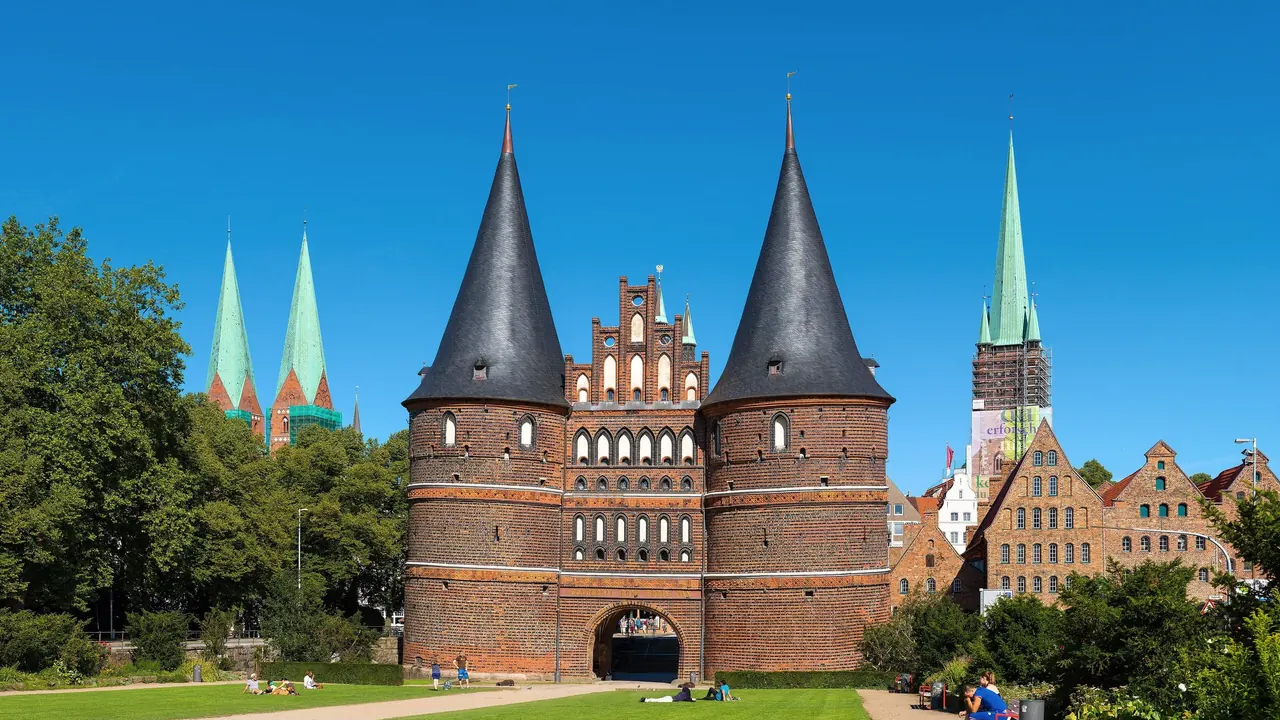
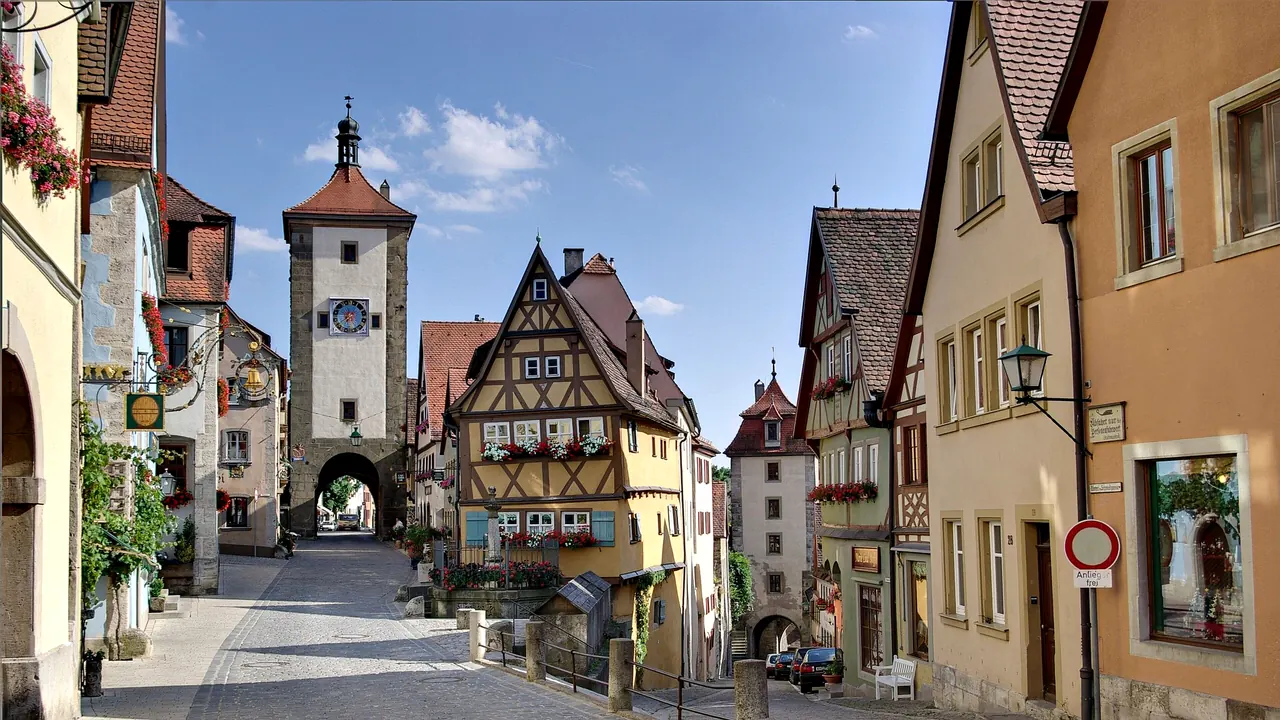
Photos: Lubeck by Christian Wolf (www.c-w-design.de), CC BY-SA 3.0 DE, cropped; Rothenburg ob der Tauber by Berthold Werner, Public domain.
Lubeck or Rothenburg ob der Tauber?
Our verdict in twelve categories, each scored against the same fixed benchmark cities, and the climate month by month, so you can choose for your trip.
Choose Lubeck for
- beaches
- live music and the arts
- nightlife
Lübeck is the better pick for a rounded stay of several days. It has a UNESCO-listed Hanseatic old town to wander, real evenings of opera, concerts and organ music, and a stretch of Baltic coast twenty minutes away by train. Families, summer visitors who want a few beach afternoons, and anyone travelling without a car will find more to fill the days, and Hamburg is close by when they want a big city.
Choose Rothenburg ob der Tauber for
- day trips
Rothenburg ob der Tauber is a narrower kind of trip: one medieval walled town, almost untouched inside its walls, that most people see well in a day or two. It suits travellers on a driving tour of the Romantic Road, where Dinkelsbühl, Nördlingen, Würzburg and Nuremberg are all within easy reach. Come for the storybook lanes, the ramparts and the Christmas atmosphere, and expect quiet nights and little else to do.
Scoreboard
Twelve categories on one fixed scale from 0 to 100. The shaded stretch is the gap between the two.
Your match
Pick a travel style or drag the sliders, and both match scores follow your weighting.
Wins on beaches and live music and the arts with your weighting.
Wins on day trips with your weighting.
What matters to you?
Category by category
What the scores mean for a trip.
Beaches & swimming
Lübeck has a real seaside within its own city limits. Travemünde's long sandy beach with its hooded wicker chairs, and the bay resorts beyond it, give you calm, shallow, tideless water that is gentle for paddling. The Baltic stays cool, though, so swimming is something for a few summer afternoons rather than a reason to book.
Rothenburg sits on a hilltop deep in Franconia, far from any coast. Summer swimming there means the town's outdoor pool or a drive of about an hour to grassy bathing areas on artificial lakes such as the Altmühlsee.
Food & drink
Lübeck eats better, mostly because it has two traditions to draw on. One is marzipan, which comes as cakes and moulded figures in old cafés by the town hall. The other is the sea: herring, plaice, harbour fish sandwiches and Rotspon wine, with the captains' guild house as a historic place to sit down.
Rothenburg's table is hearty Franconian food such as Schäufele, bratwurst and dumplings, washed down with Silvaner or local beer. Around the Marktplatz, many kitchens cook for coach parties, so the better meals are in family guesthouses and wine taverns away from the square. The famous Schneeball pastry looks better than it tastes.
Culture & sights
Both towns are among the best-preserved historic centres in Germany, but they offer different things. Lübeck has more depth. Its island old town is a Hanseatic port city of brick Gothic churches, the Holstentor and gabled merchants' houses, and it has museums with real substance, such as the European Hansemuseum, the Buddenbrookhaus and the St. Annen collection.
Rothenburg is about the townscape rather than its institutions. You walk the covered ramparts, look at the Plönlein and climb the Rathaus tower, with Riemenschneider's Holy Blood Altar and the Medieval Crime Museum as the main visits inside. It is more complete as a picture, but you finish sooner.
Nightlife
Neither town is a place for a night out, but Lübeck at least has some evening life. There are wine bars and pubs in the old town, student bars along the Obertrave and a livelier promenade at Travemünde in summer, with Hamburg forty-five minutes away for clubs. Rothenburg goes silent once the day visitors leave, and the night watchman's walking tour is the main evening outing.
Nature & outdoors
Lübeck has more variety on its doorstep. You can canoe on the Wakenitz river towards the Lauenburg lakes, walk the clay cliffs of the Brodtener Steilufer and cycle long flat routes along the coast. Sailing and windsurfing on the bay add a summer option, and the Holstein Switzerland lakes are within an hour.
Rothenburg's outdoors begins right at the walls, where paths lead down into the Tauber valley with its mills and meadows. The valley cycle path is a classic family route through vineyards. It is lovely in blossom season and in autumn, but it is a smaller, gentler range of things to do, with no water to play on.
Day trips
Rothenburg has the stronger set of excursions, provided you have a car. The Romantic Road is full of towns that rival it: Dinkelsbühl, crater-ringed Nördlingen and Schwäbisch Hall. Würzburg's Residenz and Nuremberg's castle are each about an hour away, so a base here can fill a week of touring.
Lübeck's single big draw is Hamburg, an easy train ride away, with Wismar and Schwerin's island castle about an hour off. Ratzeburg and Eutin are smaller outings. After those the choice thins out, but most of it can be reached without driving.
Good for families
Lübeck works better with children, mainly because of the coast. Travemünde's shallow, calm beach suits toddlers, the bay resorts have playgrounds and an aquarium, and Hansa-Park amusement park is about half an hour up the shore. In summer, that adds up to a proper seaside-and-city stay.
Rothenburg gives children a day or two of storybook magic: the ramparts, the tower climb, the lantern-lit night watchman and, for older ones, the crime museum's torture devices. Beyond that, there is little made for them, and the cobbles and steep valley paths are hard work with a pushchair.
Getting around
On foot the two are much alike, with compact, mostly car-free historic centres and plenty of cobbles. The difference shows as soon as you leave. Lübeck's main station sits next to the Holstentor, and regional trains reach Travemünde and Hamburg directly, so you can manage without a car.
Rothenburg sits at the end of a short branch line, where most journeys need a change at Steinach, and village buses are sparse. You also have the steep climb back up from the Tauber valley. A car is close to essential for seeing the region.
Shopping & style
Lübeck has ordinary shopping on Breite Strasse and Königstrasse, with a department store and bookshops. Smaller galleries and craft shops are tucked into the courtyard passages around Hüxstrasse, and marzipan is the obvious thing to take home.
Rothenburg's shops are almost all aimed at visitors and mostly sell Christmas: glass baubles, nutcrackers, Erzgebirge carvings, cuckoo clocks and pewter. That is charming for a specific gift, but there is little else to buy.
Affordability
Lübeck is the cheaper of the two. Its old town and station area have a good spread of mid-range rooms, fish kiosks and taverns are reasonably priced, and the train to the coast costs little. The one expensive time is a beach stay in Travemünde in July and August.
Rothenburg adds a tourist premium to normal small-town prices, both for rooms inside the walls and for meals around the Marktplatz, and prices peak in December and on summer weekends. Staying in a village outside the walls brings the cost down noticeably.
Live music & performing arts
Lübeck has a proper season. Theater Lübeck stages opera and drama in its Art Nouveau house, the Philharmonic plays by the river, and the Marienkirche carries on the organ tradition of Buxtehude. In summer, the Schleswig-Holstein Music Festival brings well-known performers to town.
Rothenburg's performances are mostly about its own history. The highlight is the costumed Meistertrunk play, alongside summer open-air theatre and church concerts at St Jakob's. On most evenings, there is nothing to see.
Wellness & relaxation
Both towns are restful, and neither is a spa destination in itself. Lübeck's version of relaxation is the seaside. Travemünde has been a spa resort since the early nineteenth century, and the bay has wellness hotels and a seawater pool at Scharbeutz. Rothenburg's calm comes from the empty lanes at dawn and dusk, with real thermal bathing an hour's drive away at Bad Windsheim's salt-water pool or in Bad Mergentheim.
When should you go?
Pick your month. The climate figures are measured averages, not a forecast.
Lubeck in July
Rothenburg ob der Tauber in July
Daytime high, °C
Rainfall in the month, mm
Where the figures come from
Rothenburg ob der Tauber's sunshine is measured 27 km from the centre, at Feuchtwangen-heilbronn.
Temperature and rainfall are climate normals, averaged over the years shown. Lubeck: 1991-2020 normals, Luebeck-Blankensee (6 km from centre). Rothenburg ob der Tauber: 1991-2020 normals, Rothenburg ob der Tauber (0.9 km from centre).
The two towns follow almost the same calendar. Both are cold and grey from November to February, with daytime highs of only a few degrees and short, dim days, so winter visits are about atmosphere rather than comfort. Spring arrives at the same pace in both. May is especially bright on the Baltic, while Rothenburg's orchards are at their best in blossom time. The rain is fairly even all year, with a little more in summer.
Summer is where they part. Rothenburg is slightly warmer and sunnier, with highs around 25°C and long bright days in July, which is good for walking the walls and the valley. Lübeck peaks at about 24°C, and its sea only reaches 18°C to 19°C in July and August, so beach afternoons belong to high summer and nothing else. For walking the streets in comfort, May to September works in both, and September is a mild, quieter choice.
Which traveller are you?
On a beach and sun trip, Lübeck is the only real option. Travemünde's sandy beach and the resorts along the bay are a short train ride away. Landlocked Rothenburg offers only a town pool, or artificial lakes an hour's drive away.
For a culture and arts trip, Lübeck goes deeper. It has a UNESCO-listed island old town, the Hansemuseum and the Buddenbrookhaus, and in the evenings there is opera, the Philharmonic and organ music in the Marienkirche. Rothenburg's walled town is a superb picture, but there is little to see after dark.
For a Christmas market trip in December, Rothenburg has something distinctive. Its market fills the Marktplatz inside intact medieval walls, and shops selling glass baubles, nutcrackers and carvings trade all year, so the whole town feels made for the season.
Before you go
| Measure | Lubeck | Rothenburg ob der Tauber |
|---|---|---|
| Official language | German | German |
| Currency | Euro (EUR) | Euro (EUR) |
| Sockets | CF230 V, 50 Hz | CF230 V, 50 Hz |
| Driving side | Right | Right |
| Time zone | UTC+1, UTC+2 in summer | UTC+1, UTC+2 in summer |
| Emergency number | 112 | 112 |
| Elevation | 13 m | 430 m |
| Main airport | Hamburg Helmut Schmidt Airport (HAM)53 km from centre120 non-stop destinations | Nuremberg Airport (NUE)66 km from centre56 non-stop destinations |
| Public holidays this year | 10 days | 12 days |
By the numbers
| Measure | Lubeck | Rothenburg ob der Tauber |
|---|---|---|
| City population | 217,061 | 11,331 |
| People per km² | 1,013 | 272 |
| Museums within 10 km | 23 | 6 |
| UNESCO World Heritage sites within 50 km | 1 | 2 |
| Swim season, months above 21 °C | None | - |
Where else could you go?
Every comparison below shares a destination with this one, so you can follow Lubeck or Rothenburg ob der Tauber somewhere new.
- Hamburgvs Lubeck
- Nurembergvs Rothenburg ob der Tauber
- Bambergvs Rothenburg ob der Tauber
- Stuttgartvs Rothenburg ob der Tauber
- Heidelbergvs Rothenburg ob der Tauber
- Frankfurtvs Rothenburg ob der Tauber