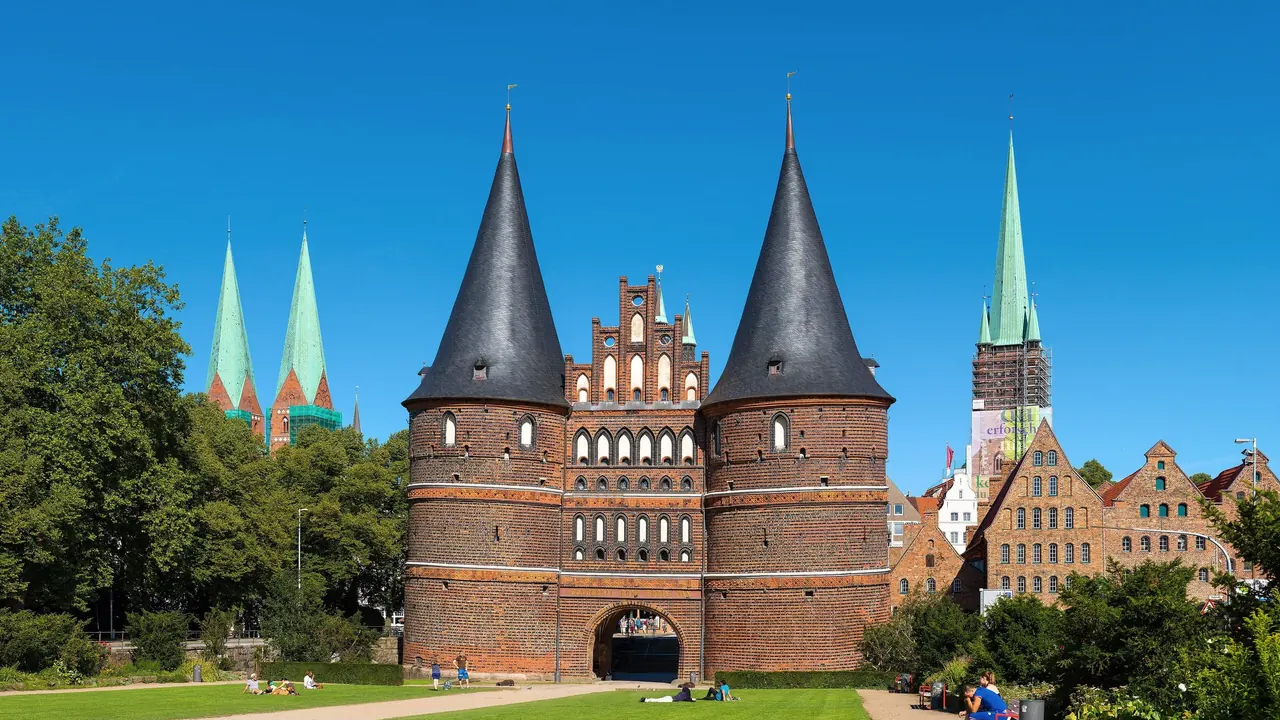
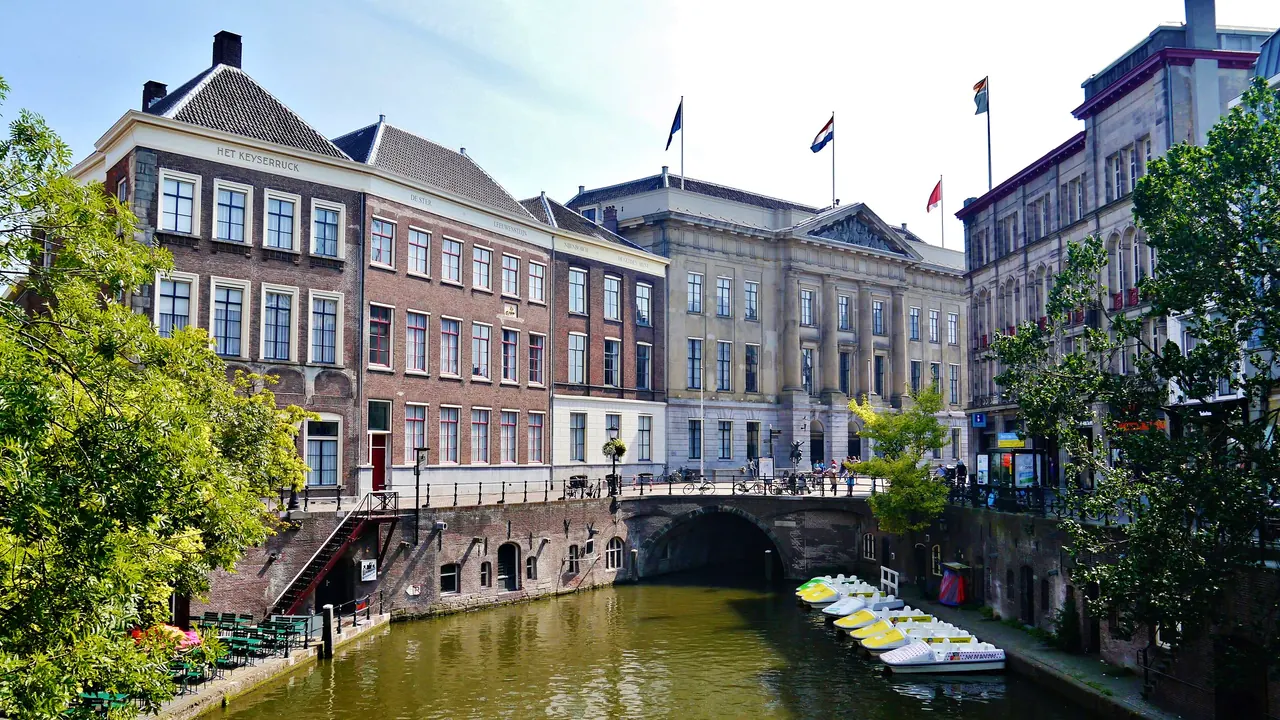
Photos: Lubeck by Christian Wolf (www.c-w-design.de), CC BY-SA 3.0 DE, cropped; Utrecht by Zairon, CC BY-SA 4.0, cropped.
Lubeck or Utrecht?
Our verdict in twelve categories, each scored against the same fixed benchmark cities, and the climate month by month, so you can choose for your trip.
Choose Lubeck for
- beaches
- prices
- culture and sights
Lübeck suits a traveller who wants one historic town to take in slowly, with the Baltic close by. Its UNESCO-listed island of brick Gothic churches and Hanseatic gables is the richer old town of the two. Rooms cost less, and in summer a twenty-minute train to Travemünde turns a city stay into a seaside one. Expect quiet evenings.
Choose Utrecht for
- day trips
- nightlife
- shopping
Pick Utrecht if the trip is about moving around and staying out late. It sits at the hub of the Dutch railways, so Amsterdam, Delft, Gouda and Rotterdam all fit into a week without changing hotels. Its students fill the canal wharves with drinkers and TivoliVredenburg with concert crowds. The trade-off is a higher bill for your bed and no beach worth the name.
Scoreboard
Twelve categories on one fixed scale from 0 to 100. The shaded stretch is the gap between the two.
Your match
Pick a travel style or drag the sliders, and both match scores follow your weighting.
Wins on beaches and prices with your weighting.
Wins on day trips and nightlife with your weighting.
What matters to you?
Category by category
What the scores mean for a trip.
Beaches & swimming
Lübeck has a real seaside inside its city limits. Travemünde's long sandy beach with its hooded wicker chairs, and the resorts of Timmendorfer Strand and Scharbeutz along the bay, offer calm Baltic water with no tides, good for paddling. Outside high summer the water is too cool for a proper swim.
Utrecht has nothing like it. The North Sea beaches at Zandvoort and Scheveningen are an hour or more away by train, so a beach day becomes a full excursion. Closer to home, people swim in recreation lakes such as the Maarsseveense Plassen.
Food & drink
Neither city is worth the trip for food alone, but the pleasures differ. Lübeck's are rooted in the place: marzipan from old confectioners near the town hall, smoked herring and fish sandwiches from harbour kiosks, Rotspon wine, and dinner under hanging ship models in the Schiffergesellschaft.
Utrecht has less food of its own but more variety, with Indonesian and Surinamese kitchens, student lunch cafés and bistros around Lombok. Its best asset is the setting: eating at the water's edge on the Oudegracht wharves.
Culture & sights
Lübeck's old town is the more complete monument. Almost the whole island is UNESCO-listed. The Holstentor, the Marienkirche and the merchants' houses with stepped gables make up the finest Hanseatic townscape on the Baltic, and the Hansemuseum and the Buddenbrookhaus add depth.
Utrecht has one striking set piece, the Dom Tower, which stands alone across a square from the rest of the cathedral since a storm brought down the nave in 1674. It also has the two-level Oudegracht wharves. Its real strength is modern design: the Rietveld Schröder House and the De Stijl collection at the Centraal Museum.
Nightlife
Utrecht is much the livelier of the two. Students fill the bars and terraces around the Neude and the Janskerkhof on weeknights as well as weekends. On summer evenings the main event is drinking at the canal edge, and Amsterdam is a short ride away for a bigger night.
Lübeck winds down early. The wine bars on the Obertrave and Travemünde's promenade in summer are fine for a drink, but there are very few clubs, and people go to Hamburg for a real night out.
Nature & outdoors
The countryside around both cities is equally gentle: flat and green, with no hills to speak of, and best seen by bike. The difference is the water. Lübeck has the Baltic shore, a cliff walk along the Brodtener Steilufer and canoeing on the Wakenitz towards the lakes. Utrecht has polders, windmills along the Vecht, and wooded heath in the Utrechtse Heuvelrug for walking and mountain biking.
Day trips
Utrecht is much the stronger base. It sits at the hub of the Dutch rail network, with Amsterdam under half an hour away and Rotterdam, The Hague, Delft, Leiden and Gouda all easy to reach. A week here can cover most of the country from one hotel.
Lübeck has one excellent day out in Hamburg, about 45 minutes by train. Wismar and Schwerin, with its castle on a lake island, are each about an hour away. After Ratzeburg and Eutin, though, the choice runs thin.
Good for families
Utrecht has more for children all year round. The Railway Museum in its old station, the Miffy museum for toddlers and the Speelklok's music boxes can fill a wet day, and Dutch habit welcomes children everywhere. The one thing to watch is the constant flow of bikes.
Lübeck is a family choice for summer. Travemünde's shallow beach, the promenades along the bay and Hansa-Park make a good seaside week, but outside the warm months there is much less aimed at children.
Getting around
Both centres are compact and easy to walk, but Utrecht is simpler to get around. Utrecht Centraal is on the edge of the old town, trams and buses use the same tap-in card as the trains, and a bike covers everything else.
Lübeck's island old town is about 2km long, and the station is just across the river. Regional trains run out to Travemünde and buses fill the gaps, but there is nothing like Utrecht's joined-up system or bike culture.
Shopping & style
Utrecht has much more to browse. Independent fashion, design and book shops line the Twijnstraat, the Zadelstraat and the Oudegracht wharves. Hoog Catharijne covers the chain stores, and the Vredenburg market, the flower market and the textile market add to the mix.
Lübeck's Breite Strasse and Königstrasse are mostly German chain stores, with a few independent shops and galleries in the courtyard passages. Marzipan is the souvenir to take home, and anyone serious about fashion goes to Hamburg.
Affordability
Lübeck is cheaper, mainly because of what you pay for a room. Hotels in the old town and near the station are moderately priced, and tavern meals and fish-kiosk lunches are reasonable. The one place it gets expensive is the seaside in July and August.
Utrecht's centre has few hotels, so rooms cost the same as in big Western European cities, and more at weekends. Walking, a rental bike and student snack bars keep daily costs low, but the total bill is still higher.
Live music & performing arts
Utrecht has the fuller programme. TivoliVredenburg puts classical, pop, jazz and experimental music under one roof, and the Festival Oude Muziek is one of Europe's leading early-music festivals. There is no opera house, though, and theatre is mostly in Dutch.
Lübeck has the opera Utrecht lacks, staged at the Art Nouveau Theater Lübeck, and a long organ tradition: Buxtehude was organist at the Marienkirche. Outside classical music, though, there is little live music.
Wellness & relaxation
Neither is a spa destination, and the difference is in kind. Lübeck relies on the seaside: Travemünde has been a spa resort since the early nineteenth century, and the bay has wellness hotels and the seawater pool complex at Scharbeutz. Utrecht relies on the large Dutch sauna complexes in its green belt, a short ride out, and on quiet spots such as the Pandhof cloister garden beside the Dom.
When should you go?
Pick your month. The climate figures are measured averages, not a forecast.
Lubeck in July
Utrecht in July
Daytime high, °C
Rainfall in the month, mm
Temperature and rainfall are climate normals, averaged over the years shown. Lubeck: 1991-2020 normals, Luebeck-Blankensee (6 km from centre). Utrecht: 1991-2020 normals, De Bilt (4.3 km from centre).
Both cities share the same mild northern pattern. Summer highs reach only about 24°C in Lübeck and a degree less in Utrecht, so June to September is the main season in both, and walking the streets is comfortable for most of the year apart from a damp, dark winter. Only in July and August does the Baltic off Travemünde warm to around 18°C or 19°C, which is cool but fine for a swim on a calm, sunny day. The North Sea off the Dutch coast reaches much the same and stays a little warmer into September.
Where they differ is rain and light. From May to August Lübeck gets more sunshine, and its rainfall stays moderate all year. Utrecht turns wetter from midsummer, with about 85mm in July and similar totals in most months through to December. Its winters, though, are a little milder and brighter than Lübeck's, where January highs sit around 4°C. In Lübeck, May and June are the best months to go. In Utrecht, April is clearly the driest month, with March and May not far behind.
Which traveller are you?
On a beach and sun trip, Lübeck is the clear choice. Travemünde's sandy beach with its wicker chairs and the resorts along the bay are a short train ride away, with calm, shallow water. From Utrecht the sea is an hour's travel, and its lakes are only for hot days.
For a food and nightlife trip, Utrecht wins on the evenings. Meals are equally pleasant in both cities: marzipan and herring in one, canal-cellar terraces in the other. But Utrecht's students keep the Neude and the Oudegracht busy all week, while Lübeck is mostly asleep by midnight.
On a trip on a tight budget, your money goes further in Lübeck. Its old-town rooms are moderately priced, tavern and fish-kiosk meals are reasonable, and the island centre costs nothing to walk. In Utrecht the scarce central hotels make the bed the expensive part, however cheap the student cafés.
Before you go
| Measure | Lubeck | Utrecht |
|---|---|---|
| Official language | German | Dutch |
| Currency | Euro (EUR) | Euro (EUR) |
| Sockets | CF230 V, 50 Hz | CF230 V, 50 Hz |
| Driving side | Right | Right |
| Time zone | UTC+1, UTC+2 in summer | UTC+1, UTC+2 in summer |
| Emergency number | 112 | 112 |
| Elevation | 13 m | 5 m |
| Main airport | Hamburg Helmut Schmidt Airport (HAM)53 km from centre120 non-stop destinations | Amsterdam Airport Schiphol (AMS)34 km from centre287 non-stop destinations |
| Public holidays this year | 10 days | 11 days |
By the numbers
| Measure | Lubeck | Utrecht |
|---|---|---|
| City population | 217,061 | 359,370 |
| People per km² | 1,013 | 3,619 |
| Museums within 10 km | 23 | 28 |
| UNESCO World Heritage sites within 50 km | 1 | 5 |
| Swim season, months above 21 °C | None | None |
Where else could you go?
Every comparison below shares a destination with this one, so you can follow Lubeck or Utrecht somewhere new.
- Amsterdamvs Utrecht
- Haarlemvs Utrecht
- Rotterdamvs Utrecht
- The Haguevs Utrecht
- Hamburgvs Lubeck
- Antwerpvs Utrecht