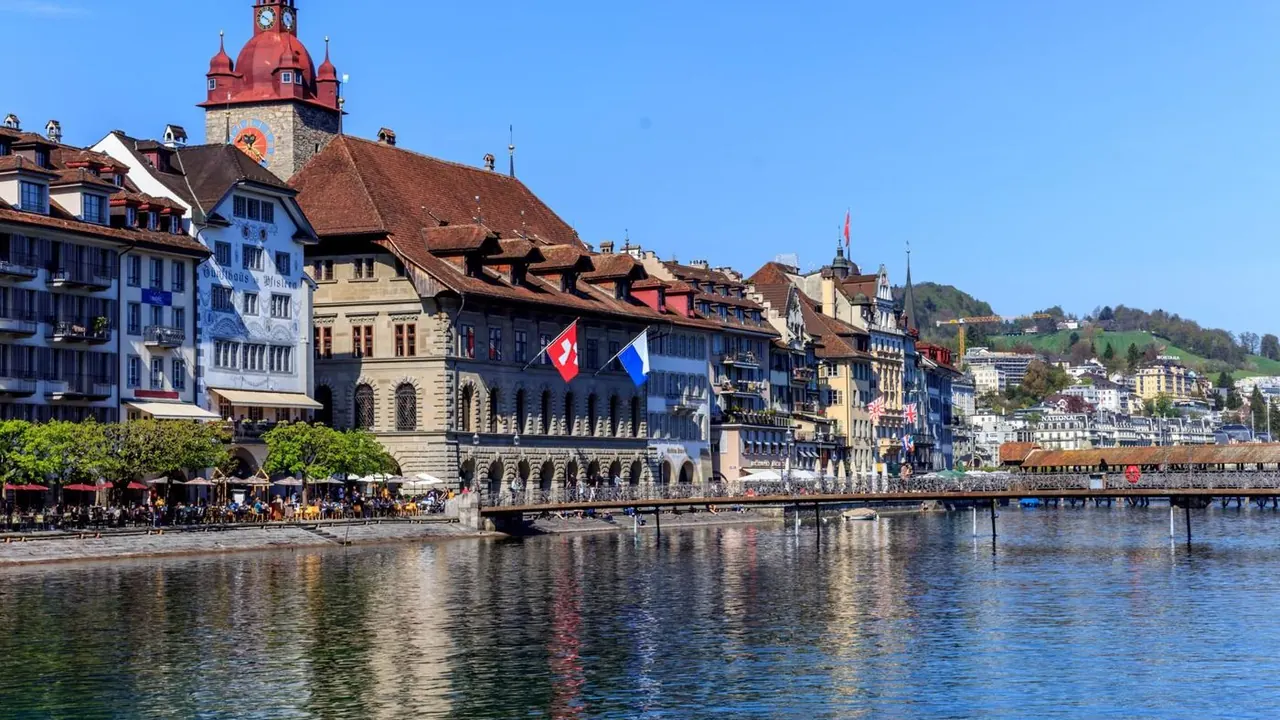
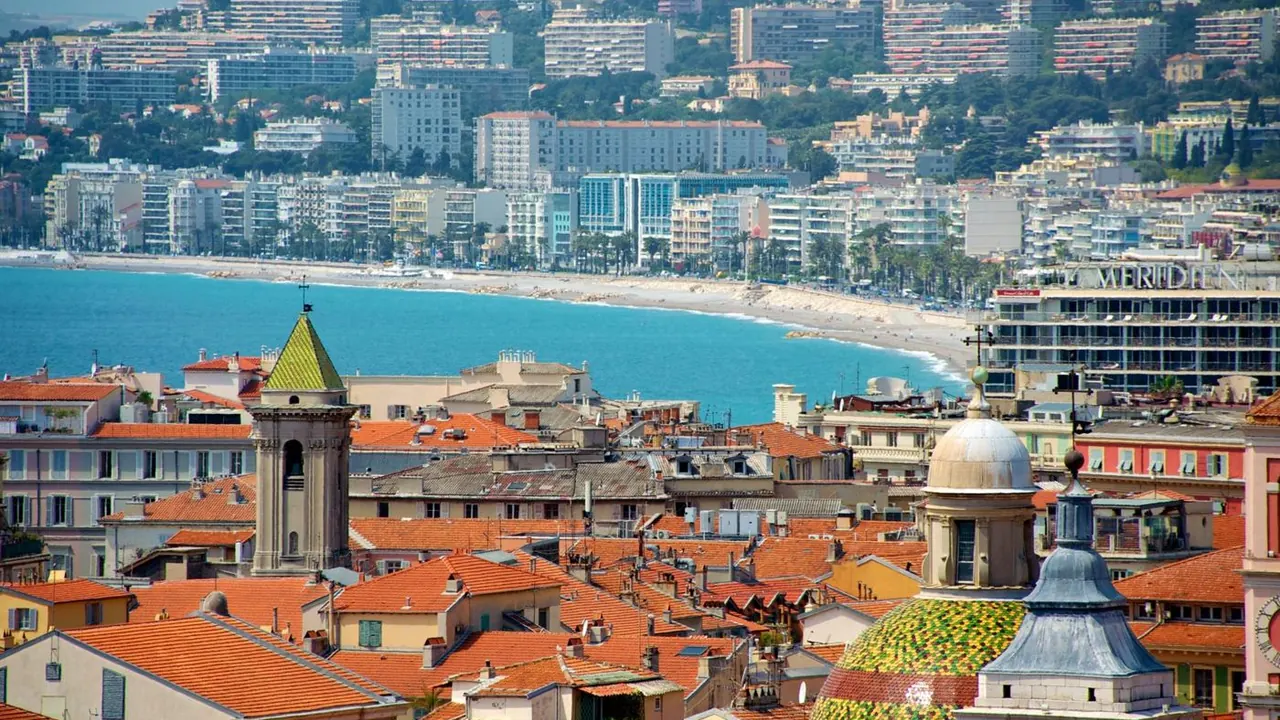
Photos: Lucerne by ILOVESwitzerland, Pexels License; Nice by Daniel Stockman, CC BY-SA 2.0, cropped.
Lucerne or Nice?
Our verdict in twelve categories, each scored against the same fixed benchmark cities, and the climate month by month, so you can choose for your trip.
Choose Lucerne for
- live music and the arts
- nature and the outdoors
- getting around
Lucerne suits travellers who want the mountains to be the trip. Pilatus, Rigi and the lake steamers start almost at the station door, the centre is small and easy, and the concert hall on the lakefront draws serious music lovers. Choose it for a calm, scenic stay with early evenings, and come with a generous budget, because nothing here is cheap.
Choose Nice for
- beaches
- food and drink
- prices
If the sea is part of the plan, Nice is the better choice. It has a long swimming season, a cooking tradition of its own, livelier evenings in the old town and a string of coastal towns from Monaco to Antibes that you can reach by train. It is not a cheap city, but it is a good deal easier on the wallet than Switzerland.
Scoreboard
Twelve categories on one fixed scale from 0 to 100. The shaded stretch is the gap between the two.
Your match
Pick a travel style or drag the sliders, and both match scores follow your weighting.
Wins on live music and the arts and nature and the outdoors with your weighting.
Wins on beaches and food and drink with your weighting.
What matters to you?
Category by category
What the scores mean for a trip.
Beaches & swimming
Lucerne has lake bathing rather than a beach. People swim from the Lido, the old wooden baths and the lawns at Ufschötti, in clean water with a mountain backdrop, but only in high summer and never from sand.
Nice has a 7km pebble shore below the Promenade des Anglais, with clear water warm enough to swim in for five months of the year. Loungers from the beach clubs soften the stones, and sandier, calmer water is a short ride away at Villefranche, Beaulieu and Juan-les-Pins.
Food & drink
Lucerne's tables are hearty and dependable: Chügelipastete, fondue, rösti and perch from the lake, served in guild houses and on terraces along the Reuss. Quality is good, but the range is narrow and many places near the Chapel Bridge cater to tour groups.
Nice gives you more to eat your way through. Socca from wood ovens, pissaladière, stuffed vegetables and pan bagnat form a genuine local cuisine with Ligurian roots, and the morning market on the Cours Saleya and the small Bellet vineyards add to it. The family places in Vieux Nice and around the port are where to eat.
Culture & sights
The two are close, but they differ in scale and character. Lucerne packs its fame into a small medieval core, with the Chapel Bridge and Water Tower, the towers of the Musegg Wall and the carved Lion Monument, plus Picasso and Klee at the Rosengart. A day or two covers it.
Nice has a little more to fill your days. Its Savoyard old town and Belle Époque villas tell two different stories, and its art is the stronger draw: Matisse among the Roman ruins of Cimiez, Chagall's biblical cycle and the Yves Klein rooms at MAMAC.
Nightlife
Neither is a clubbing city, but Nice keeps going later. Lucerne's evenings are a drink by the river or a cocktail in the Neustadt, and the lakefront is usually empty by midnight, apart from the nights of Fasnacht.
In Nice, the lanes of Vieux Nice fill with students, locals and visitors moving between wine bars and pubs, and in summer the beach clubs and the promenade stay busy into the night. For a glossier night out, people head along the coast to Monaco or Cannes.
Nature & outdoors
Lucerne is the stronger choice for scenery and the outdoors. Real mountains rise straight from the lake: you can take the steep cogwheel railway up Pilatus, walk the ridges on Rigi, or go up to the year-round snow on Titlis. Paddle steamers link it all, so a boat, a train and a hike fit into one day.
Nice's appeal is the meeting of mountains and sea. You get coastal paths around Cap Ferrat, cycling on the corniches, and diving and kayaking in the bay. The high country of the Mercantour and the ski slopes are a longer drive inland, rather than a view from your hotel window.
Day trips
Lucerne's central position puts Bern, Basel and Zurich each under an hour away by train. The lake itself makes an outing, with boats to Weggis, Vitznau and the Rütli meadow of the William Tell story.
Nice has the richer choice of short outings, and the towns are closer together and more varied. Monaco is about twenty minutes away, and Èze, Menton, Antibes, the perfume houses of Grasse and Saint-Paul-de-Vence are all within easy reach without a car. You can even pop over to Sanremo in Italy by train.
Good for families
Lucerne is a little easier with children. The Swiss Museum of Transport fills a whole day, the centre is flat and very safe, and the steamers and cogwheel trains are a treat in themselves. The catch is that rain or low cloud can leave you short of ideas.
Nice offers the water jets and playgrounds of the Promenade du Paillon, Parc Phoenix, and the sea, which is a big draw for most children. Against that, the pebbles are hard on small feet, high summer is hot and crowded, and the steps in the old town are awkward with a pushchair.
Getting around
Lucerne is remarkably easy. The station, the boat piers and the Old Town sit side by side on the lakefront, and one integrated ticket system carries you onto the steamers, the mountain railways and the cable cars.
Nice is also simple without a car. Its centre is a flat half-hour walk across, a tram runs from the airport, and regional trains serve the coast. Summer trains can be packed, though, and the mountains inland are really only reachable by car.
Shopping & style
Lucerne's shopping is mostly about watches. The big houses on Schwanenplatz sit beside shops selling army knives, chocolate and cuckoo clocks, with few fashion labels to go with them.
Nice has more variety. There are high-street chains and Galeries Lafayette on Avenue Jean Médecin, luxury houses around rue Paradis, olive oil, soaps and Provençal fabrics in Vieux Nice, and a flea and antiques market on the Cours Saleya every Monday.
Affordability
Neither city is a bargain, but Lucerne is in a different league of expense. Hotels, simple meals and especially the mountain railways that give the stay its point all cost a lot, and lake picnics only soften the bill.
Nice gives you more ways to save. Trams and coastal trains make day trips cheap, many city museums cost little to enter, and socca and market lunches keep food costs down. Spring and late autumn bring hotel prices down noticeably.
Live music & performing arts
For classical music, Lucerne is clearly the destination. The Lucerne Festival brings leading orchestras to Jean Nouvel's lakefront hall, which is famous for its acoustics and keeps a year-round programme of its own. At Fasnacht, Guggenmusik brass bands fill the streets.
Nice offers a solid regional calendar. The red-and-gold Opéra stages opera and ballet, and two big events stand out: the long-running jazz festival in July and the Carnival parades in February. Most other evenings, live music means small bars.
Wellness & relaxation
Lucerne is a little calmer. Neither city has thermal baths, but Lucerne has one soak worth the journey: Mario Botta's mineral bath high on the Rigi, an hour away by steamer and cogwheel train, where you lie in warm water with the Alps in front of you. The town winds down early, so evenings are unhurried, and an afternoon on a lake boat or a summer dip from the wooden baths asks nothing of you. The peace only breaks in the Old Town around midday, when the tour groups pour in.
In Nice, spa time is limited to hotel treatment rooms and the seawater therapy centres further along the coast, and nothing there compares with a pool on a mountainside. The city relaxes you through the shape of the day instead: a morning swim, a slow lunch, a walk along the bay at dusk. That works well in the mild months on either side of summer. In July and August, though, the heat and the crowded shore make Nice far less soothing than Lucerne's lakeside.
When should you go?
Pick your month. The climate figures are measured averages, not a forecast.
Lucerne in July
Nice in July
Daytime high, °C
Rainfall in the month, mm
Where the figures come from
Lucerne has no rain gauge within 25 km of the centre, so its rainfall comes from a gridded climate dataset read at the city rather than from a gauge further away.
Lucerne's sunshine is measured 42 km from the centre, at Zurich Town / Ville..
Temperature and rainfall are climate normals, averaged over the years shown. Lucerne: 2005-2025 (sunshine 1991-2020, rainfall 1991-2020) normals, Emmen (4.2 km from centre). Nice: 1991-2020 normals, Nice (8 km from centre).
Lucerne is at its best from June to September, when days reach about 24°C and the lake is pleasant for a swim. Midsummer is also its wettest stretch, at around 139mm a month, so expect showers and some days when cloud hides the peaks. From November to February it is cold and grey, with little sunshine. That is fine for skiing and sledging nearby, but not for slow sightseeing in the lanes.
Nice has a longer and sunnier season. July and August reach about 28°C with almost no rain, and the sea warms to 25°C. That is ideal for the beach, though it can be too hot for walking at midday. May, June and September are better for combining swimming with sightseeing. The rain arrives in autumn, peaking at around 138mm in November. Winter stays mild enough for walks along the promenade, while Lucerne is in the cold.
Which traveller are you?
For a beach and sun trip, Nice wins clearly. It has a long pebble shore right below the city, sandy coves within easy reach at Villefranche and Juan-les-Pins, and warm sea from June into October. Lucerne can only offer short summer swims in the lake.
On a food and nightlife trip, Nice is the stronger pick. You can eat socca, pissaladière and market produce from the Cours Saleya, then have drinks in the crowded lanes of Vieux Nice. Lucerne serves solid Swiss classics and goes quiet well before midnight.
For an outdoors trip, Lucerne comes out ahead. Pilatus, Rigi, the Stanserhorn and the glacier on Titlis are all reached by train, boat or cable car, so you can combine hikes and lake crossings in a single day without a car.
Before you go
| Measure | Lucerne | Nice |
|---|---|---|
| Official language | French, German, Italian, Romansh | French |
| Currency | Swiss Franc (CHF) | Euro (EUR) |
| Sockets | CJ230 V, 50 Hz | CE230 V, 50 Hz |
| Driving side | Right | Right |
| Time zone | UTC+1, UTC+2 in summer | UTC+1, UTC+2 in summer |
| Emergency number | 112 | 112 |
| Elevation | 436 m | 0 m |
| Main airport | Zürich Airport (ZRH)49 km from centre226 non-stop destinations | Nice-Côte d'Azur Airport (NCE)6 km from centre130 non-stop destinations |
| Public holidays this year | 12 days | 11 days |
By the numbers
| Measure | Lucerne | Nice |
|---|---|---|
| City population | 86,234 | 357,737 |
| People per km² | 2,963 | 4,975 |
| Museums within 10 km | 14 | 17 |
| UNESCO World Heritage sites within 50 km | 1 | 2 |
| Swim season, months above 21 °C | - | 4 months |
Where else could you go?
Every comparison below shares a destination with this one, so you can follow Lucerne or Nice somewhere new.