Malaysia
Malacca
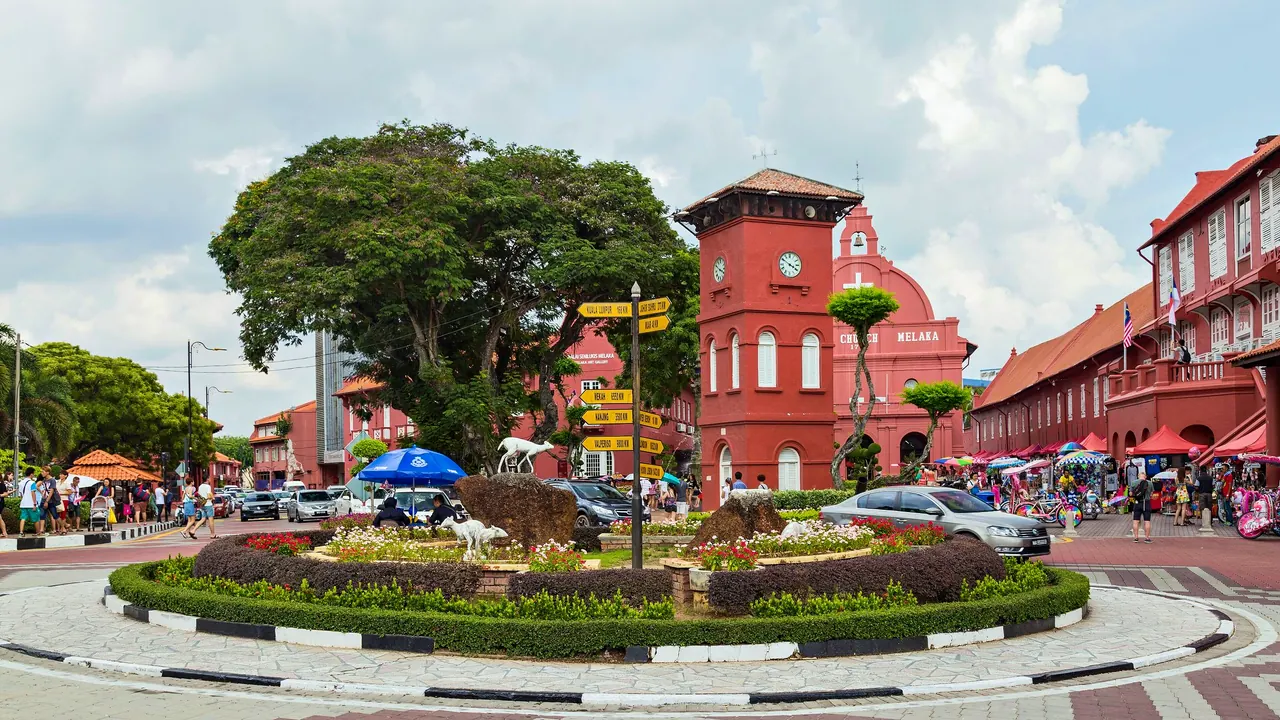
Dutch Square with the red clock tower and Christ Church
- Affordable cities80
- Food & drink66
- Culture & sights66
Photo: Marcin Konsek, CC BY-SA 4.0, cropped
Match
42
Every category weighted equally
- Beach & sun41
- Culture & arts46
- Food & nightlife43
- Family trip45
- Outdoors41
- Relax & unwind41
- Shopping & style44
- On a budget46
Malacca in twelve categories
Our verdict on each, scored 0 to 100 against the same fixed benchmark cities, so a score means the same thing on every page.
Beaches & swimming. Scores 20 out of 100.
Food & drink. Scores 66 out of 100.
Culture & sights. Scores 66 out of 100.
Nightlife. Scores 22 out of 100.
Nature & outdoors. Scores 27 out of 100.
Day trips. Scores 36 out of 100.
Good for families. Scores 48 out of 100.
Getting around. Scores 48 out of 100.
Shopping & style. Scores 38 out of 100.
Affordability. Scores 80 out of 100.
Live music & performing arts. Scores 22 out of 100.
Wellness & relaxation. Scores 30 out of 100.
Malacca category by category
Beaches & swimming
20Malacca sits on the sea, but it is not a beach town. The city front along the Strait of Malacca is mostly reclaimed land and mudflat, and the water, though around 29°C all year, is brown, busy with shipping and often visited by jellyfish. Klebang, just north of the centre, is where locals go for a sunset walk and a coconut shake rather than a swim.
For actual sand, Tanjung Bidara is about 30km up the coast, quiet and lined with casuarina trees, and the longer stretches of Port Dickson are around an hour and a half away. Neither has clear water. Travellers who want a swim usually rely on a hotel pool.
Food & drink
66Eating is one of the main reasons people come. Malacca is the heartland of Peranakan, or Nyonya, cooking, a blend of Chinese and Malay traditions that gives ayam pongteh, rich laksa, sour assam fish and pineapple tarts. On top of that come the town's own specialities: chicken rice moulded into balls, satay celup cooked by dipping skewers into a shared pot of peanut sauce, and cendol made with dark palm sugar from the region. Kristang dishes from the Portuguese Settlement, such as devil's curry and grilled seafood, add another layer.
The food happens in old shophouse kopitiams around Jonker Street and Heeren Street, in hawker centres and at the weekend Jonker Walk night market. Breakfast is a serious matter, with dim sum and roti canai. What the city lacks is breadth beyond its own cuisine and a real fine-dining tier.
Culture & sights
66The historic centre, listed by UNESCO together with George Town, holds five centuries of trading-port history in a few walkable streets. The red Dutch square around the Stadthuys and Christ Church is the landmark everyone photographs. Behind it, St Paul's Hill climbs to the roofless ruin of a Portuguese church, and the Porta de Santiago gate is what survives of the A Famosa fortress.
Across the river, the shophouse lanes of Heeren Street and Jonker Street show the Peranakan city best, with the Baba Nyonya Heritage Museum in a merchant's townhouse. Harmony Street packs the Cheng Hoon Teng temple, Kampung Kling mosque and a Hindu temple into a few hundred metres. A replica Malacca Sultanate palace and many small museums fill out a visit. It is rich in atmosphere rather than in major collections.
Nightlife
22Evenings in Malacca are about walking and eating rather than going out. On weekend nights Jonker Street fills with the night market and a few bars play loud music along it, and the riverside near the old warehouses has some quiet places for a beer with the lit-up water in view. Trishaws covered in flashing lights and cartoon characters provide most of the noise.
On weeknights the centre goes quiet early. There is no club scene to speak of, and those who want a real night out head to the capital.
Nature & outdoors
27The land around Malacca is flat, hot and largely given over to towns and plantations. Within the city the best outdoor time is a walk or boat ride along the Malacca River, and the mangrove and coastal paths near the Straits make an easy morning. Pulau Besar, a small island a short boat ride offshore, has shrines and walking paths.
The one real hike is Gunung Ledang, also called Mount Ophir, about an hour and a half away across the Johor border, a steep climb through rainforest to a summit with views over the plain. Heat and humidity make early starts necessary for anything active.
Day trips
36Malacca works better as a destination than as a base. Kuala Lumpur is about two hours by bus or car, close enough for a long day of towers, mosques and markets but better given a stay of its own, and the planned capital of Putrajaya, with its domed government buildings and lake, lies on the way.
Nearer at hand, the royal town of Muar, about an hour south, has colonial buildings along its river and a food tradition of its own. Seremban and the Minangkabau-style architecture of Negeri Sembilan, with its curved buffalo-horn roofs, make a quieter outing. Singapore is too far for a comfortable return trip.
Good for families
48Malacca is relaxed with children, and Malaysian culture welcomes them in restaurants and temples alike. The decorated trishaws are an easy hit, the river cruise is short and shady, and the revolving observation tower near the waterfront gives a view over the old town. On the outskirts, Zoo Melaka is one of the country's larger zoos, and there are water parks and resort attractions in the Ayer Keroh area.
The drawbacks are heat and humidity all year, heavy weekend crowds in the heritage core, and pavements that come and go. Planning the day around a hotel pool in the afternoon works well.
Getting around
48The heritage centre is small enough to cover on foot: Dutch Square, St Paul's Hill, Jonker Street and Harmony Street are all within a short walk of each other, and the riverside path ties them together. Hiring a bicycle works well in the cooler early morning.
Beyond the core it is harder. There is no metro or tram, city buses are slow and irregular, and pavements disappear quickly. Visitors use ride-hailing apps for the zoo, Klebang or the Portuguese Settlement. Midday heat shortens walks, and weekend traffic into the old town can crawl. Long-distance buses to Kuala Lumpur and Singapore leave from the main terminal at Melaka Sentral.
Shopping & style
38Shopping centres on Jonker Street and the lanes around it, where antique dealers sell old porcelain, clocks and furniture alongside shops of Peranakan crafts: hand-beaded slippers, embroidered kebaya blouses and painted tiles. The weekend night market adds food stalls and a great deal of cheap souvenirs.
The modern malls near the waterfront cover everyday needs and little more. There is no design scene or luxury street, so the purchases worth making are small and local.
Affordability
80Malacca is cheap by almost any standard. Hawker meals and kopitiam breakfasts cost very little, guesthouses in restored shophouses are good value, and ride-hailing fares stay low over the short distances involved. Most museums and temples charge little or nothing.
The exceptions are weekends and Malaysian school vacations, when visitors from the capital and Singapore fill the boutique hotels in the old town, and alcohol, which is heavily taxed. Coming midweek makes a clear difference.
Live music & performing arts
22Malacca's one regular, bookable piece of theatre is a large staged spectacle about the city's history, played in a purpose-built theatre on the reclaimed waterfront north of the centre. The audience sits on a rotating platform that turns between sets, and the show moves through the sultanate, the Portuguese, Dutch and British periods and the arrival of Chinese and Indian traders in about seventy minutes of dance, music and projection. It is made for visitors and it is well produced, so it is worth an evening if the city's past interests you.
Around it is local tradition rather than a performance scene. Dondang sayang, the sung exchange of Malay verses shared by Baba and Malay communities, turns up at cultural events. The Kristang community of the Portuguese Settlement dances branyo at its own celebrations, above all the Festa San Pedro, and the Chinese calendar brings lion dances and sometimes street opera to the shophouse lanes. There is no concert hall, opera or jazz scene, and buskers on Jonker Street at weekends are the rest of the live music.
Wellness & relaxation
30Malacca has no bathing tradition, but it is an easy place to slow down. Foot reflexology and massage shops are common in the old town and inexpensive, and resorts on the outskirts have spas and large pools. On weekday mornings the shophouse lanes are quiet, and a long kopitiam breakfast followed by a stroll along the river sets a gentle pace.
Weekends are another matter, with crowds, traffic and the noise of the night market, so anyone coming to unwind should stay midweek.
When should you go?
Pick a month to see what it is like. The climate figures are measured averages, not a forecast.
Malacca in July
Daytime high, °C
Rainfall in the month, mm
The whole year
Shaded against this city’s own year: the deepest cell is its best month for that figure and the palest its weakest.
Temperature and rainfall are climate normals, averaged over the years shown. Malacca: 1991-2020 (sunshine 1981-2010) normals, Malacca (8.7 km from centre).
Before you go
| Measure | Malacca |
|---|---|
| Official language | Malay |
| Currency | Malaysian Ringgit (MYR) |
| Sockets | G240 V, 50 Hz |
| Driving side | Left |
| Time zone | UTC+8 |
| Emergency number | 999 |
| Elevation | 14 m |
| Main airport | Kuala Lumpur International Airport (KUL)86 km from centre146 non-stop destinations |
By the numbers
| Measure | Malacca |
|---|---|
| City population | 455,300 |
| Museums within 10 km | 22 |
| UNESCO World Heritage sites within 50 km | 1 |
| Swim season, months above 21 °C | 12 months |
Compare Malacca with
Every comparison with a written verdict behind it.