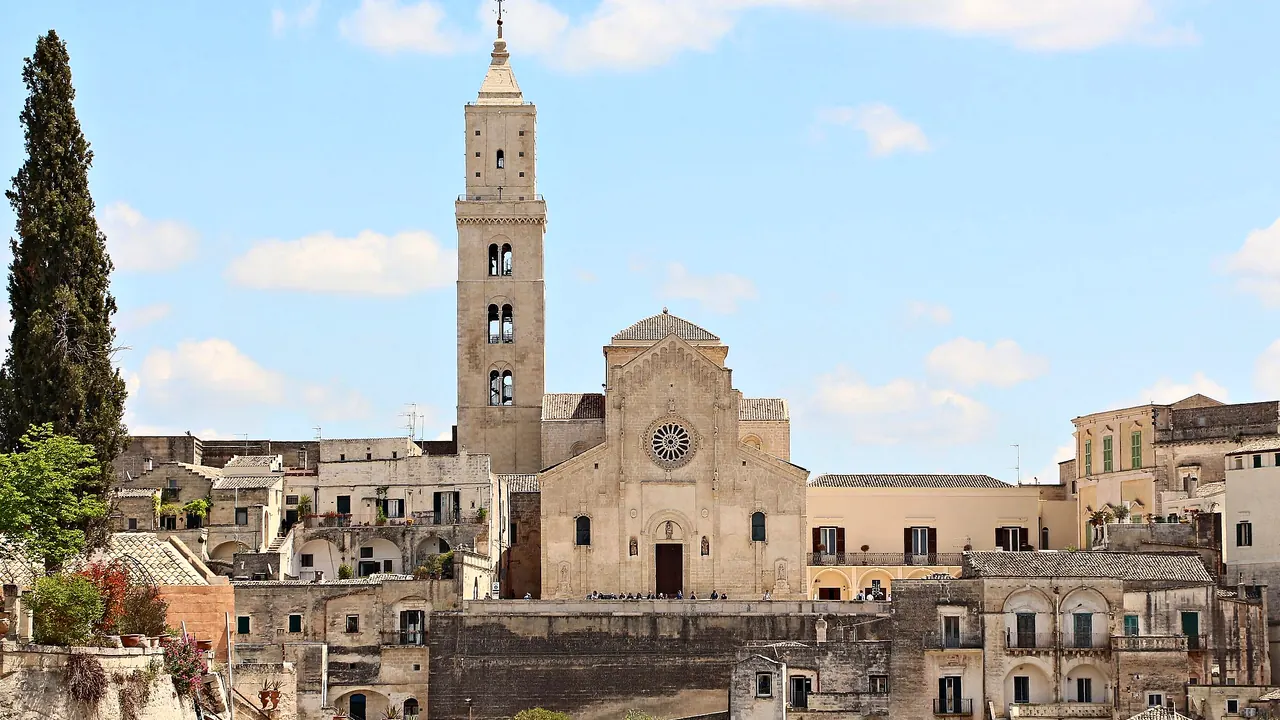
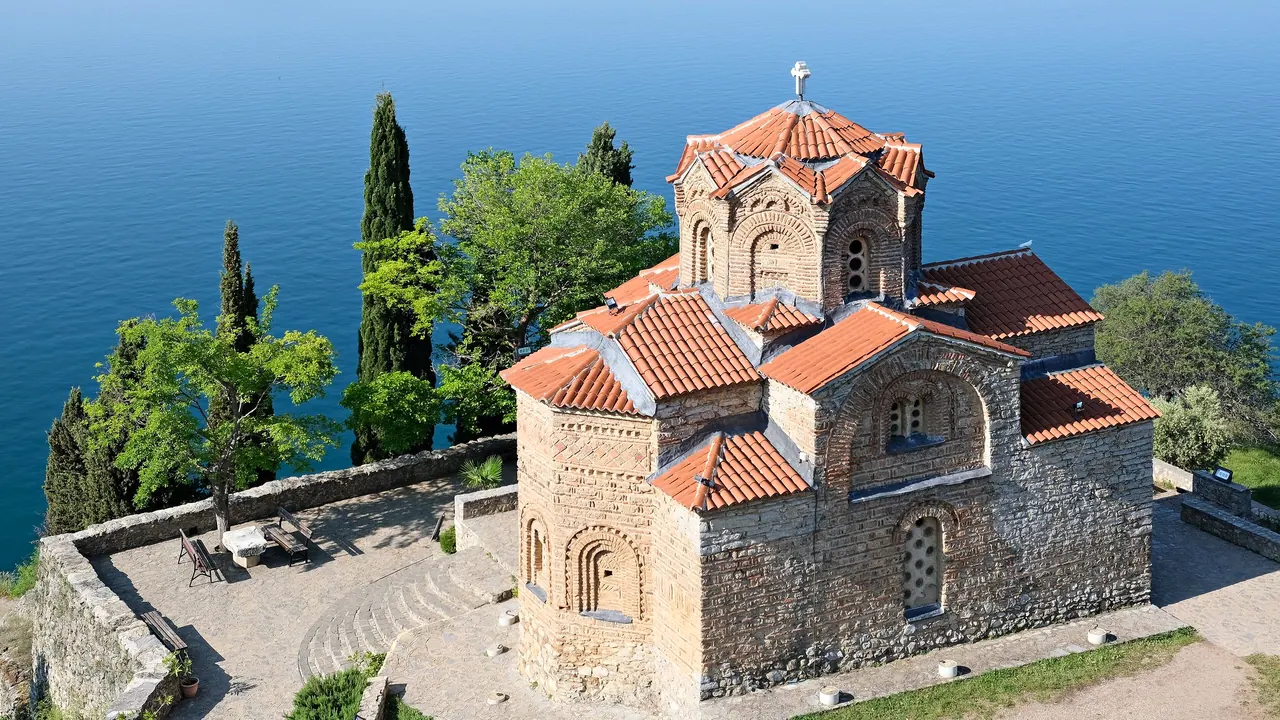
Photos: Matera by Bernard Gagnon, CC BY 4.0, cropped; Ohrid by kallerna, CC BY-SA 4.0, cropped.
Matera or Ohrid?
Our verdict in twelve categories, each scored against the same fixed benchmark cities, and the climate month by month, so you can choose for your trip.
Choose Matera for
- day trips
- food and drink
- culture and sights
Choose Matera for the Sassi and for what lies around them. It is a cave town on the edge of a gorge, with the more rewarding table of the two, and the trulli and white towns of Puglia are within an hour's drive. It suits travellers with a hire car who want a striking base for touring, and couples happy to end the day over a glass of Aglianico above the lit ravine rather than out late.
Choose Ohrid for
- prices
- beaches
- families
Ohrid is the easier, cheaper and more relaxed choice. It is a lake town where frescoed churches stand above clear water you can swim in all summer. Families, travellers watching their spending and anyone who wants mountains, kayaks and a lakeside evening stroll will get more from it. The trade-offs are a short swimming season and plainer food.
Scoreboard
Twelve categories on one fixed scale from 0 to 100. The shaded stretch is the gap between the two.
Your match
Pick a travel style or drag the sliders, and both match scores follow your weighting.
Wins on day trips and food and drink with your weighting.
Wins on prices and beaches with your weighting.
What matters to you?
Category by category
What the scores mean for a trip.
Beaches & swimming
Ohrid has its swimming on the doorstep. The water is clear, calm and fresh, and you can walk to it from the old town at Kaneo and Potpeš, with longer stretches further south at Lagadin and Gradište. What you lie on is concrete platforms, jetties and short pebble strips rather than sand.
Matera has the better sand but none of the convenience. The wide, pine-backed Ionian beaches at Metaponto and Policoro are about 45 minutes away by car and shallow enough for small children. Getting there takes a whole day out rather than an afternoon dip, and without a car most visitors never swim.
Food & drink
Matera has the deeper kitchen. Its peasant cooking is built on the horn-shaped durum loaf, hand-made cavatelli, crapiata and crackling peperoni cruschi, with Aglianico del Vulture to drink, and the trattorias of the upper town around Via Ridola cook it well.
Ohrid's food is honest but narrow, and the same menu repeats along the waterfront: tavče gravče, grilled meats, šopska salad and lake fish such as belvica, with burek from the bakeries in the morning. Neither town offers much beyond its own regional cooking.
Culture & sights
These are two compact sets of sights, equally rewarding but different in character. Matera is about how people lived: cave houses that were lived in until the 1950s, rock churches with faded frescoes, the Palombaro Lungo cistern under the main piazza, and Carlo Levi's panorama in Palazzo Lanfranchi.
Ohrid is about faith and learning. Its highlights are the medieval frescoes of St Sophia, St John at Kaneo on its rock above the lake, Plaošnik with its links to the Cyrillic tradition, and Samuel's Fortress crowning the hill. Each fills a day or two on foot. Matera is at its best at dusk, while Ohrid's sights are spread along the hill above the water.
Nightlife
In July and August Ohrid has the livelier evenings. Café-bars fill the promenade and the streets around the old bazaar, and beach clubs on the southern shore play music into the small hours.
Matera offers the passeggiata on Via del Corso, a long dinner and a few cave wine bars. That makes a lovely evening for a couple but never a night out. Out of season, both towns go quiet soon after dinner.
Nature & outdoors
Ohrid has the bigger landscape. The deep, clear lake is ringed by mountains, and Galičica rises above 2,000m, with views over both Ohrid and Prespa, paragliding from the ridge and kayaks to hire below.
Matera's nature is drier and closer at hand. You can walk straight down from Sasso Caveoso into the Gravina gorge and up onto the Murgia plateau, past abandoned rock churches and Neolithic sites, and the Lucanian Dolomites are within reach by car. Both are best walked in spring and autumn.
Day trips
Matera has more good outings, and they are more varied. Because it sits where Basilicata meets Puglia, a week of trips need not repeat itself. One day you could see the trulli of Alberobello, the next the sea cliffs at Polignano a Mare, then the ghost town of Craco, or Castelmezzano and Pietrapertosa clinging to their sandstone peaks. A Greek temple at Metaponto and Frederick II's octagonal castle add more variety, and most of these are a short or moderate drive away.
Ohrid's list is shorter and centres on the lake and its monasteries. St Naum at the southern tip is the classic, and in summer you can reach it by boat. The floor mosaics of Heraclea Lynkestis outside Bitola are the strongest outing further afield, and Korçë across the Albanian border adds a different country. The roads are slow, though, so each day out takes longer. From either town you will want a car or a driver.
Good for families
Ohrid is easier with children, mainly because the lake is right there. Summer days fill themselves with calm water, boat rides, ice cream on the promenade and the pile village at the Bay of Bones, and a lakeside apartment makes the obvious base.
Older children enjoy Matera's caves, cistern and gorge. But the Sassi's steep steps defeat a pushchair, summer afternoons there are hot with little shade, and the nearest beach is a drive away.
Getting around
Both centres are explored on foot, and both old towns are steep enough to tire the legs. Beyond the centre, Ohrid is simpler. Taxis are plentiful for short hops, and summer boats and local buses run along the shore, even if they are not frequent.
Matera is off the national rail network. A slow narrow-gauge line runs to Bari and buses are sparse, so the beaches, the parks and the towns of Puglia really call for a hire car.
Shopping & style
Neither town is a shopping destination, but Ohrid has one distinctive thing to buy. The Ohrid pearl is made by a few families using a lustre from fish scales and is best bought from a long-established workshop in the bazaar streets, alongside filigree silver and carved wood. Matera offers the cuccù whistle and miniature tufa carvings, and its best buys are things to eat and drink: dried peppers, local pasta and Aglianico.
Affordability
In Matera most of the money goes on your bed. The cave hotels and boutique stays of the Sassi are the town's signature and are priced as one, and they cost most in high summer. A room up in the newer town asks far less, and the ravine is still only a few minutes away on foot. Meals are kind to the budget by Italian standards, and the gorge and the Murgia trails cost nothing at all.
Ohrid is cheaper on every count, so your room does not take up most of the budget the way it does in Matera. Eating out, getting about and seeing the churches add up to very little, and the lake costs nothing to swim in. The one time it gets expensive is a lakefront room on a July or August weekend, so May, June and September give you the most for your money.
Live music & performing arts
Ohrid has the more substantial programme, thanks to its summer festival, held since the early 1960s, which brings opera, concerts and theatre to St Sophia and the ancient theatre. Matera has conservatory concerts, a summer jazz festival and the Festa della Bruna, when the papier-mâché float is torn apart, but little else. Outside summer, neither has much to attend.
Wellness & relaxation
Neither town has a bathing tradition, so relaxing means hotel spas and a slow pace. Matera's unusual touch is spas in candlelit cave rooms with pools cut into the rock. Its calm is in the quiet early mornings in the Sassi, before the tour groups arrive.
In Ohrid the calm comes from the lake: coffee by the still water and quiet evenings on the promenade. Matera is most restful from autumn to spring. Ohrid is easiest in May, June and September and loses its quiet in August.
When should you go?
Pick your month. The climate figures are measured averages, not a forecast.
Matera in July
Ohrid in July
Daytime high, °C
Rainfall in the month, mm
Where the figures come from
Matera has no rain gauge within 25 km of the centre, so its rainfall comes from a gridded climate dataset read at the city rather than from a gauge further away.
Ohrid has no rain gauge within 25 km of the centre, so its rainfall comes from a gridded climate dataset read at the city rather than from a gauge further away.
Temperature and rainfall are climate normals, averaged over the years shown. Matera: 2005-2025, 10 years observed (rainfall 1991-2020) normals, Matera / Martella (4.8 km from centre). Ohrid: 1999-2017 (rainfall 1991-2020) normals, Ohrid (0.2 km from centre).
Matera has the hotter summer. July reaches about 32°C, which makes climbing the Sassi at midday hard work, while the Ionian sea down the road is warm enough to swim from June to September and peaks near 26°C in August. May, late September and October are the best months for walking the town and the Murgia. The rain builds from October to a wet November, and winters are cool rather than cold.
Ohrid is cooler all year. Summer highs of about 29°C are comfortable for walking, and July and August are the months to swim in the lake. Spring comes later and winter is properly cold, with January highs of around 6°C and the heaviest rain, about 94mm a month, in November and December. June and September suit both towns well.
Which traveller are you?
On a tight budget, Ohrid is the clear pick. Rooms, meals with local wine, taxis and church entry all cost little, and lake swimming is free. Much of Matera's charm is in its cave hotels, which are priced as the town's speciality.
On a family trip with young children, Ohrid works better. Calm, clean lake water is a short walk away for whole summer days, with boat rides and the Bay of Bones as extras. In Matera, steep stone steps and beaches you have to drive to make it hard going.
For a short city break, Matera makes the more memorable two or three days. The Sassi and rock churches are like nowhere else, the lights coming on over the gorge round off each evening, and the upper town's cooking beats Ohrid's repetitive waterfront menus.
Before you go
| Measure | Matera | Ohrid |
|---|---|---|
| Official language | Italian | Albanian, Macedonian |
| Currency | Euro (EUR) | Denar (MKD) |
| Sockets | CFL230 V, 50 Hz | CF230 V, 50 Hz |
| Driving side | Right | Right |
| Time zone | UTC+1, UTC+2 in summer | UTC+1, UTC+2 in summer |
| Emergency number | 112 | 112 |
| Elevation | 401 m | 695 m |
| Main airport | Bari Karol Wojtyła International Airport (BRI)54 km from centre104 non-stop destinations | Ohrid St. Paul the Apostle Airport (OHD)9 km from centre14 non-stop destinations |
| Public holidays this year | 13 days | 12 days |
By the numbers
| Measure | Matera | Ohrid |
|---|---|---|
| City population | 59,685 | 38,818 |
| People per km² | 152 | 100 |
| Museums within 10 km | 8 | 11 |
| UNESCO World Heritage sites within 50 km | 1 | 2 |
| Swim season, months above 21 °C | 5 months | - |
Where else could you go?
Every comparison below shares a destination with this one, so you can follow Matera or Ohrid somewhere new.