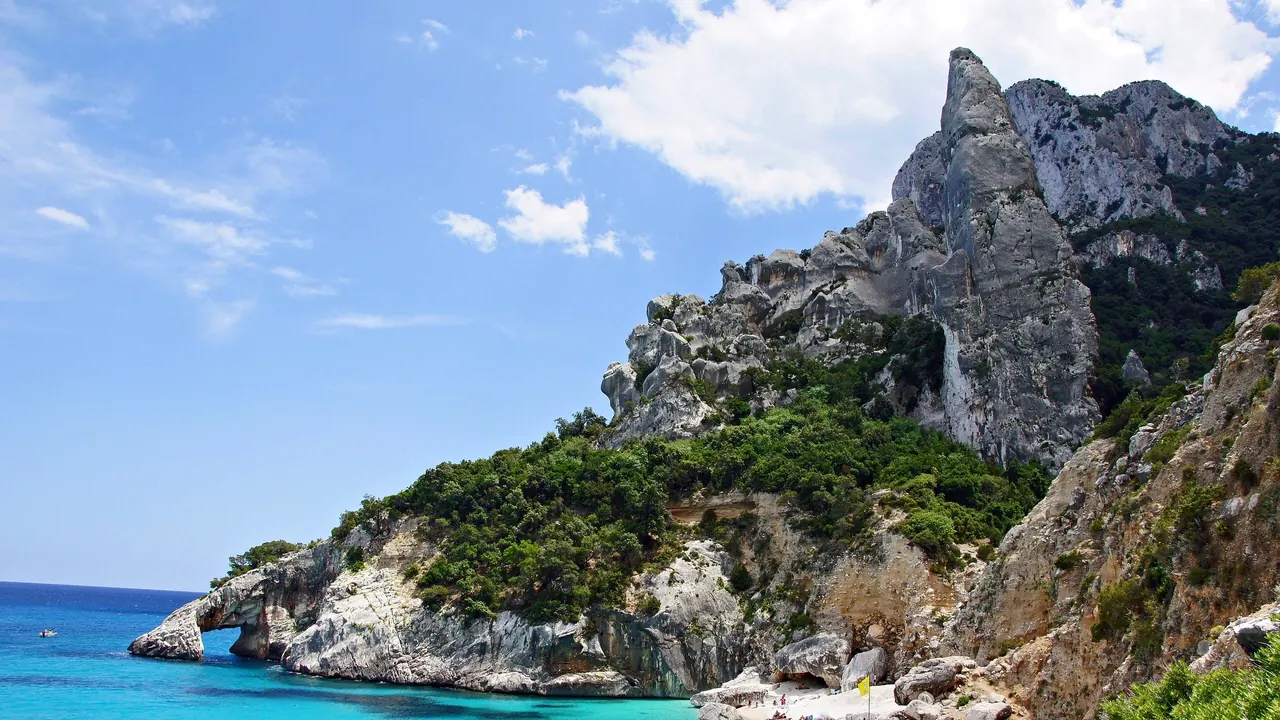
Photos: Sardinia by Yesuitus2001, CC BY-SA 2.5, cropped.
Menorca or Sardinia?
Our verdict in twelve categories, each scored against the same fixed benchmark cities, and the climate month by month, so you can choose for your trip.
Choose Menorca for
- getting around
Menorca suits travellers who want a beach trip without the logistics. The island is small enough to cross in well under an hour, so you can base yourself in one place and still swim at the white southern coves, walk a stretch of the coastal path and spend an evening on the harbour at Mahón or Ciutadella. Its pace is quiet and its sights are compact. That makes it a good fit for young families and for anyone who wants a calm week rather than a full itinerary.
Choose Sardinia for
- day trips
- nightlife
- nature and the outdoors
Sardinia is the bigger trip in every sense. It has more of almost everything: shepherd cooking at farm tables, the wild limestone coast of the Gulf of Orosei, thousands of nuraghi, Cagliari as a real capital and a club scene on the Costa Smeralda in high summer. The price of all that is distance. The roads are slow and the highlights are spread out, so it rewards a longer stay, two bases and a willingness to drive.
Scoreboard
Twelve categories on one fixed scale from 0 to 100. The shaded stretch is the gap between the two.
Your match
Pick a travel style or drag the sliders, and both match scores follow your weighting.
Wins on getting around with your weighting.
Wins on day trips and nightlife with your weighting.
What matters to you?
Category by category
What the scores mean for a trip.
Beaches & swimming
These are two of the best beach islands in the Mediterranean, and neither has the edge. On Menorca the classic picture is the white-sand cove between pine-topped limestone cliffs on the south coast, Macarella or Turqueta, with the redder, rougher bays of the north as a change of scene. Getting to those southern coves in summer means early starts, car-park rules or a walk.
Sardinia has more coastline and more kinds of beach: granite coves in the Gallura and the Maddalena archipelago, white pebble bays under the Orosei cliffs that you reach by boat, and the very shallow sand at La Pelosa and Chia. Because the island is so large, there is nearly always a sheltered side when the mistral blows, and Cagliari has its own long town beach at Poetto.
Food & drink
Sardinia eats better and more widely. Its cooking comes from the inland hills: suckling pig, pane carasau, culurgiones, pecorino and seadas, often served as long set menus at agriturismi, with island wines on the table and Cagliari's San Benedetto market for range.
Menorca has a few signature tastes, such as lobster caldereta in Fornells, Mahón cheese and a glass of pomada on the quay. Beyond these the choice soon narrows, and many kitchens close once the summer ends.
Culture & sights
Both islands are built on Bronze Age stone, which neither mainland Spain nor mainland Italy has to match, and Sardinia goes a little deeper. Menorca's talayotic sites, the Naveta des Tudons and the taula sanctuaries, are close together, and with Ciutadella's cathedral and Mahón's Georgian streets they make a satisfying two or three days.
Sardinia adds a proper museum in Cagliari, home to the Mont'e Prama giants, as well as the great nuraghe of Su Nuraxi, the Phoenician and Roman ruins of Nora and Tharros, and Catalan Alghero. It is a richer picture, but you have to drive to put it together.
Nightlife
If you want to go out, Sardinia gives you more to choose from. In high summer, the Costa Smeralda around Porto Cervo has dressy beach clubs and late nightclubs, Alghero's ramparts fill for aperitivo, and Cagliari keeps a modest scene of wine bars going all year.
Menorca's evenings are mostly drinks along the harbour fronts, plus a single cave club in the cliffs near Cala en Porter. Its best nights are its town festes, above all Sant Joan in Ciutadella.
Nature & outdoors
Menorca's outdoors are gentle: a biosphere reserve of dry-stone walls, wild olive and low hills, with the pine-backed Barranc d'Algendar in the south. It is best seen from the Camí de Cavalls, which circles the whole coast for about 185km in easy stages. The lagoon at S'Albufera des Grau is good for birdwatching, and Fornells Bay is good for sailing.
Sardinia has real wild country, on a far larger scale. The limestone Supramonte drops to the sea along the Gulf of Orosei, the Gorropu gorge cuts deep into it, and the Gennargentu massif behind carries forests of cork and holm oak, with mouflon roaming them. Further west, wild horses graze the Giara plateau in the Marmilla. Out at sea, the Maddalena marine park and the kitesurfing at Porto Pollo add a different kind of outdoors.
Day trips
From Menorca, a day out mostly means the other town or a whitewashed village such as Binibeca. The one trip off the island, the ferry to Alcúdia on Mallorca, makes a long day.
Sardinia offers far more, as long as you choose your base. From the north you can cross to Corsica's Bonifacio in about an hour or tour the Gallura wine country. From Cagliari, Carloforte and the old mining country are within reach, and on the east side there are the masked-carnival villages of the Barbagia.
Good for families
Both islands suit a family beach vacation equally well, and on both the days revolve around the sea. On Menorca, sheltered bays such as Cala Galdana and Son Bou sit right next to low-rise family resorts, and every drive is short.
Sardinia has the same kind of gentle water at Chia, Costa Rei and La Pelosa, and more resort villages with pools and children's clubs. The trade-off is longer drives and fiercer midday heat in high summer.
Getting around
Menorca is far easier to get around. One main road joins Mahón and Ciutadella, almost every drive takes well under an hour, and summer buses reach the main resorts. Your only real problem is the last stretch to the popular coves.
In Sardinia a hire car is essentially required. The winding coastal and mountain roads take much longer than the map suggests, and many coves can only be reached by boat. Flying into whichever of its three airports is nearest your base saves hours.
Shopping & style
Neither island is a place for fashion streets, but Sardinia's crafts cover more ground. You can buy Alghero coral, filigree gold, woven rugs and Pattada shepherd's knives, and in summer Porto Cervo has a piazzetta of luxury boutiques.
Menorca's best buys are avarques sandals and leather from Ciutadella and Alaior, along with cheese and gin. It also has the covered market in a cloister in Mahón.
Affordability
Menorca is costly across the whole island in July and August, from harbour-front restaurants to rental villas and hire cars. To spend less, most visitors rent an apartment, eat in the inland towns or come in June or September.
On Sardinia the steepest prices are mostly on the Costa Smeralda. Around Cagliari, Alghero, Ogliastra and the inland villages, rooms and meals are moderate for Italy, and agriturismo set menus give a lot for what they cost. Choosing your base well therefore saves more here, though ferries and car hire still climb in August.
Live music & performing arts
Menorca's stage is small and mostly a summer one. Mahón's Teatre Principal, built in 1829, is among the oldest opera houses in Spain, and it is joined by organ recitals at Santa Maria and Ciutadella's classical music festival.
Sardinia goes further. Cagliari's Teatro Lirico runs an opera and concert season, but the island's most distinctive music is its own: the deep four-voice canto a tenore of the Barbagia shepherds and the ancient triple pipes called launeddas. In summer there is the Time in Jazz festival in Berchidda, and Cagliari's Sant'Efisio procession is a spectacle of costume and music.
Wellness & relaxation
Sardinia has a little more to offer here. At Fordongianus, warm springs run beside Roman baths, and Sardara has thermal hotels. The big southern resorts add thalassotherapy, while the agriturismi of Ogliastra offer real slowness.
Menorca has no thermal water. Its calm comes from converted farmhouses, low-rise resorts and quiet harbour evenings, with spas mostly in the larger hotels.
When should you go?
Pick your month. The climate figures are measured averages, not a forecast.
Menorca in July
Sardinia in July
Daytime high, °C
Rainfall in the month, mm
Where the figures come from
Sardinia has no rain gauge within 25 km of the centre, so its rainfall comes from a gridded climate dataset read at the destination rather than from a gauge further away.
Temperature and rainfall are climate normals, averaged over the years shown. Menorca: 1991-2020 normals, Menorca / Mahon (3.7 km from centre). Sardinia: 1991-2020 normals, Olbia / Costa Smeralda (3.1 km from centre).
Both islands follow the same Mediterranean rhythm. The sea is warm enough to swim from June, peaks at about 25°C in August and stays pleasant into early October. Spring and autumn are the times to walk and sightsee. The difference is the heat. Menorca's summer is softened by the sea, with highs around 29°C in July and a lot of sunshine, while Sardinia reaches about 32°C in July and August, hot enough to make inland driving and midday sightseeing hard work.
The autumn rain also comes at different times. On Menorca it arrives in September and is heaviest in November, at about 101mm, so late September there can be unsettled. Sardinia stays drier through September and turns wet in October, with its wettest weather around Christmas. For a warm, quiet visit with the sea still swimmable, June suits both islands, and September favours Sardinia slightly.
Which traveller are you?
For an outdoors trip, Sardinia is the clear choice. The Supramonte, the Gorropu gorge, the Selvaggio Blu trek, climbing at Cala Gonone and sailing among the Maddalena islets are on a scale that Menorca's gentle coastal path and wetland cannot match.
On a food and nightlife trip, Sardinia again comes out ahead. Agriturismo feasts, Cannonau and Vermentino, Cagliari's Marina wine bars and the summer clubs of the Costa Smeralda give far more range than Menorca's harbour bars and lobster stew in Fornells.
On a family trip with young children, Menorca makes things easier. Both islands have shallow, sandy beaches, but on Menorca no drive is long, the low-rise resorts sit right next to sheltered bays like Cala Galdana, and the summer heat is gentler.
Before you go
| Measure | Menorca | Sardinia |
|---|---|---|
| Official language | Spanish | Italian |
| Currency | Euro (EUR) | Euro (EUR) |
| Sockets | CF230 V, 50 Hz | CFL230 V, 50 Hz |
| Driving side | Right | Right |
| Time zone | UTC+1, UTC+2 in summer | UTC+1, UTC+2 in summer |
| Emergency number | 112 | 112 |
| Main airport | Menorca Airport (MAH)72 non-stop destinations | Olbia Costa Smeralda Airport (OLB)79 non-stop destinations |
| Public holidays this year | 13 days | 13 days |
By the numbers
| Measure | Menorca | Sardinia |
|---|---|---|
| Population | 100,323 | 1,628,384 |
| People per km² | 145 | - |
| Swim season, months above 21 °C | 5 months | 3 months |
Where else could you go?
Every comparison below shares a destination with this one, so you can follow Menorca or Sardinia somewhere new.
- Corsicavs Sardinia
- Mallorcavs Menorca
- Ibizavs Menorca
- Cinque Terrevs Sardinia
- Caprivs Sardinia
- Amalfi Coastvs Sardinia