Mexico
Guanajuato
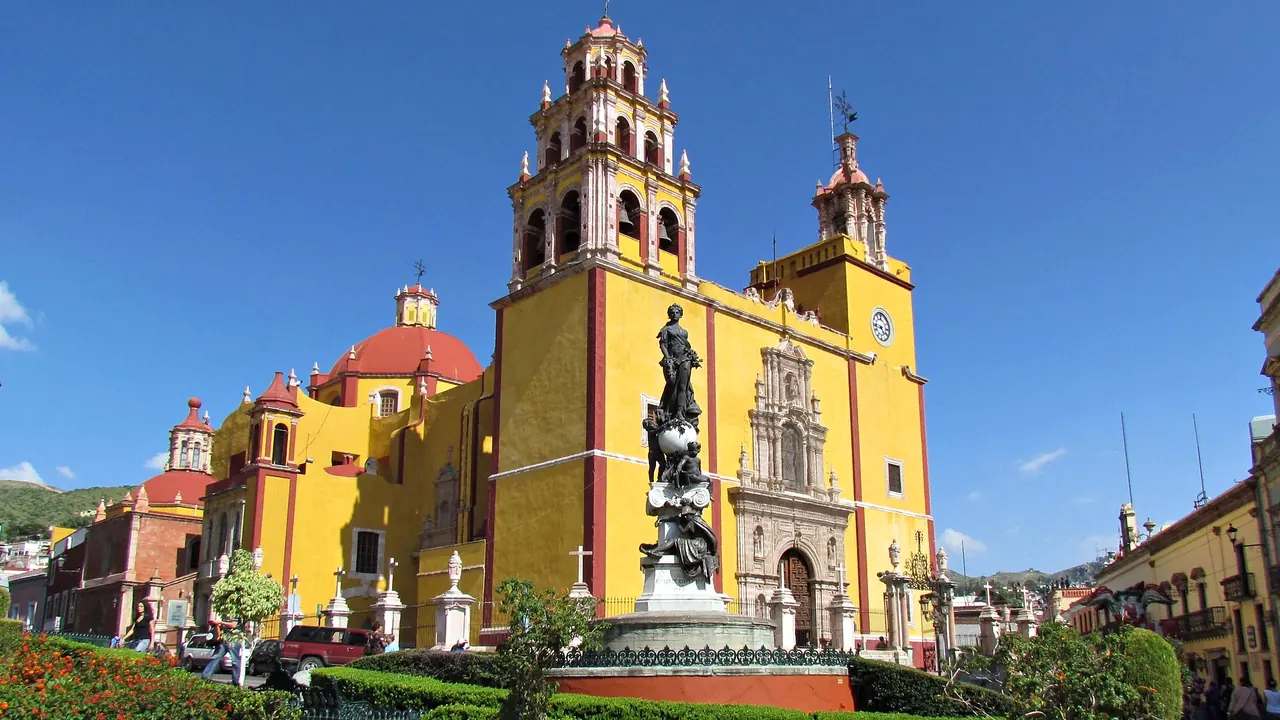
The basilica above the Plaza de la Paz
- Affordable cities80
- Day trips72
- Culture & sights68
Photo: Sandra Dominic Saldaña Garcia, CC BY-SA 3.0, cropped
Match
48
Every category weighted equally
- Beach & sun42
- Culture & arts56
- Food & nightlife50
- Family trip48
- Outdoors50
- Relax & unwind44
- Shopping & style48
- On a budget52
Guanajuato in twelve categories
Our verdict on each, scored 0 to 100 against the same fixed benchmark cities, so a score means the same thing on every page.
Beaches & swimming. Scores 4 out of 100.
Food & drink. Scores 45 out of 100.
Culture & sights. Scores 68 out of 100.
Nightlife. Scores 42 out of 100.
Nature & outdoors. Scores 45 out of 100.
Day trips. Scores 72 out of 100.
Good for families. Scores 35 out of 100.
Getting around. Scores 65 out of 100.
Shopping & style. Scores 32 out of 100.
Affordability. Scores 80 out of 100.
Live music & performing arts. Scores 55 out of 100.
Wellness & relaxation. Scores 33 out of 100.
Guanajuato category by category
Beaches & swimming
4Guanajuato sits in the mountains of central Mexico, a long day's drive from either coast, so there is no sea or lake swimming to plan around. Swimming here means a hotel pool or one of the warm-water balnearios out in the surrounding countryside.
Food & drink
45Eating in Guanajuato is local, unpretentious and cheap. The dish to look for is enchiladas mineras, red-chilli tortillas topped with potato, carrot and crumbly cheese, a miners' meal from the city's silver-mining past. Mercado Hidalgo, the iron market hall near the centre, has food counters upstairs and stalls of sweets below, including cajeta and the regional candied fruit. Street vendors sell gorditas, tacos and fresh fruit cups around the plazas.
Around the Jardín de la Unión the terrace restaurants trade more on view than cooking, and the better meals tend to be in small family places a few alleys away. There is a handful of more ambitious modern kitchens, but the range is narrow and a visitor looking for a serious food city will find the choice thins after a few days.
Culture & sights
68The town itself is the main attraction: a ravine packed with houses painted ochre, pink and blue, colonial churches and plazas linked by steep alleys, all part of a UNESCO World Heritage listing together with its old silver mines. The Basilica of Our Lady of Guanajuato, the baroque Templo de la Valenciana above the town, the neoclassical Teatro Juárez and the main university building with its grand stairway set the tone.
The Alhóndiga de Granaditas, a granary stormed in the opening battle of the War of Independence in 1810, holds the regional museum and Mexican murals. Diego Rivera's birthplace is a museum, the Museo Iconográfico del Quijote is unexpectedly rich, and the Museum of the Mummies is the city's famous macabre curiosity. Narrow lanes such as the Callejón del Beso carry their own legends. It is a compact set, comfortably seen in two or three days.
Nightlife
42A big university keeps Guanajuato livelier after dark than its size suggests. Evenings start around the Jardín de la Unión and Plaza San Fernando, where terraces fill up, and continue in small bars, mezcal spots and a few dance clubs tucked into the alleys and old stone buildings nearby. Thursday to Saturday is the time to go out; weeknights are quieter. It is a friendly, student-flavoured scene rather than a deep one, with few proper clubs and little reason to come for the nightlife alone.
Nature & outdoors
45The city fills a narrow ravine in dry, rocky hills, and the best outdoor experience is climbing out of it: to the Pípila monument for the view over the rooftops, or up the rock outcrops of La Bufa above town on a half-day hike. The Presa de la Olla, an eighteenth-century colonial reservoir with a small park, is a gentle walk from the centre.
Further out, the Sierra de Santa Rosa has oak forest, trails and mountain-biking routes, and the Cerro del Cubilete, crowned by the Cristo Rey statue, gives wide views over the Bajío plain. The landscape is semi-arid and turns green mainly in the summer rainy season. It suits walkers who like a hill and a view, not those after high mountains or water sports.
Day trips
72Guanajuato is the natural base for the Bajío's colonial towns. San Miguel de Allende, a UNESCO-listed town of cobbled streets, galleries and the pink-spired parish church, is about an hour and a half away by bus or car and is the essential outing. Dolores Hidalgo, where the independence movement began in 1810, is about an hour away and known for its painted Talavera pottery workshops and odd ice-cream flavours.
León, around forty minutes away, is a large working city famous for leather and footwear. Querétaro, another UNESCO historic centre with a long aqueduct, is about two hours away, and the half-abandoned mining town of Mineral de Pozos makes a quieter, atmospheric trip. Wineries around Dolores Hidalgo and San Miguel add a small wine-country day.
Good for families
35Children are warmly welcomed, and older ones tend to enjoy the funicular to the Pípila, the tunnels running under the town and the evening callejoneadas with costumed students singing through the alleys. The Museum of the Mummies is a favourite with some teenagers and too much for many younger children.
Beyond that there is little made for families: no zoo, aquarium or theme park of note, and the town is built on steep hills and long stairways that are hard going with a pushchair. Weekend and festival crowds pack the narrow lanes. It works best for families with older children who are happy to walk.
Getting around
65Nearly everything a visitor wants is within a short walk of the Jardín de la Unión, and a car is more burden than help: traffic runs largely through a network of underground tunnels and old riverbeds beneath the town, and parking is scarce. The catch is the terrain. Lanes climb steeply and many are stairways, so walking is slow and tiring at an altitude of about 2000m.
Local buses and cheap taxis run through the tunnels to the outlying sights such as the Valenciana church and the mummy museum, and a funicular lifts visitors to the Pípila viewpoint. Intercity buses to San Miguel de Allende and León leave from a terminal outside the centre.
Shopping & style
32Shopping here is about crafts and sweets rather than fashion. Mercado Hidalgo sells leather goods, local candies, cajeta and souvenirs under its iron roof, and shops around the centre offer majolica-style ceramics, silver jewellery, wooden toys and Cervantes-themed keepsakes. There is no luxury or design shopping to speak of; for leather and shoes in quantity, people head to León.
Affordability
80Guanajuato is an inexpensive place to stay. Market meals, street food and simple restaurants cost little, buses and taxis are cheap, and museum entries are modest. The main exceptions are the boutique hotels in restored colonial houses around the centre and the restaurants on the main plazas, which charge noticeably more. Rooms are also scarce and expensive during the Cervantino festival in October, so book early or come at another time.
Live music & performing arts
55Guanajuato's calendar is dominated by the Festival Internacional Cervantino each October, one of the largest arts festivals in the Spanish-speaking world, when theatre, dance, orchestras and street performance from many countries fill the Teatro Juárez, the plazas and the university courtyards. The festival grew from students staging short Cervantes plays in the small squares, and those entremeses are still part of the town's identity.
All year, the estudiantinas, groups of students dressed as Spanish minstrels, lead callejoneadas through the alleys most evenings, singing and telling local legends. The ornate Teatro Juárez and the university hold concerts and plays outside festival time, but that regular programme is modest, so timing matters for anyone coming mainly for performance.
Wellness & relaxation
33There is no bathing tradition within the town itself, and wellness mostly means a hotel spa or a massage in one of the converted colonial mansions. The state does have hot springs: thermal balnearios such as Comanjilla, near León, are within about an hour and make a relaxed half day. The pace in Guanajuato can be gentle on a weekday morning on a bench in the Jardín de la Unión, but weekend crowds, students and street music late into the night mean it is not a quiet retreat.
When should you go?
Pick a month to see what it is like. The climate figures are measured averages, not a forecast.
Guanajuato in July
Daytime high, °C
Rainfall in the month, mm
The whole year
Shaded against this city’s own year: the deepest cell is its best month for that figure and the palest its weakest.
Temperature and rainfall are climate normals, averaged over the years shown. Guanajuato: 1991-2020 normals, Guanajuato, Gto. (0.7 km from centre).
Before you go
| Measure | Guanajuato |
|---|---|
| Official language | Spanish, Nahuatl, Yucatec Maya |
| Currency | Mexican Peso (MXN) |
| Sockets | AB127 V, 60 Hz |
| Driving side | Right |
| Time zone | UTC-6 |
| Emergency number | 911 |
| Elevation | 2,045 m |
| Main airport | Guanajuato International Airport (BJX)23 km from centre22 non-stop destinations |
| Public holidays this year | 9 days |
By the numbers
| Measure | Guanajuato |
|---|---|
| City population | 70,068 |
| Museums within 10 km | 8 |
| UNESCO World Heritage sites within 50 km | 3 |
Compare Guanajuato with
Every comparison with a written verdict behind it.
- Acapulco
- Guadalajara
- Huatulco
- Los Cabos
- Mazatlan
- Merida
- Mexico City
- Nuevo Vallarta
- Oaxaca
- Puebla
- Puerto Escondido
- Puerto Vallarta
- San Miguel de Allende
- Sayulita
- Zihuatanejo